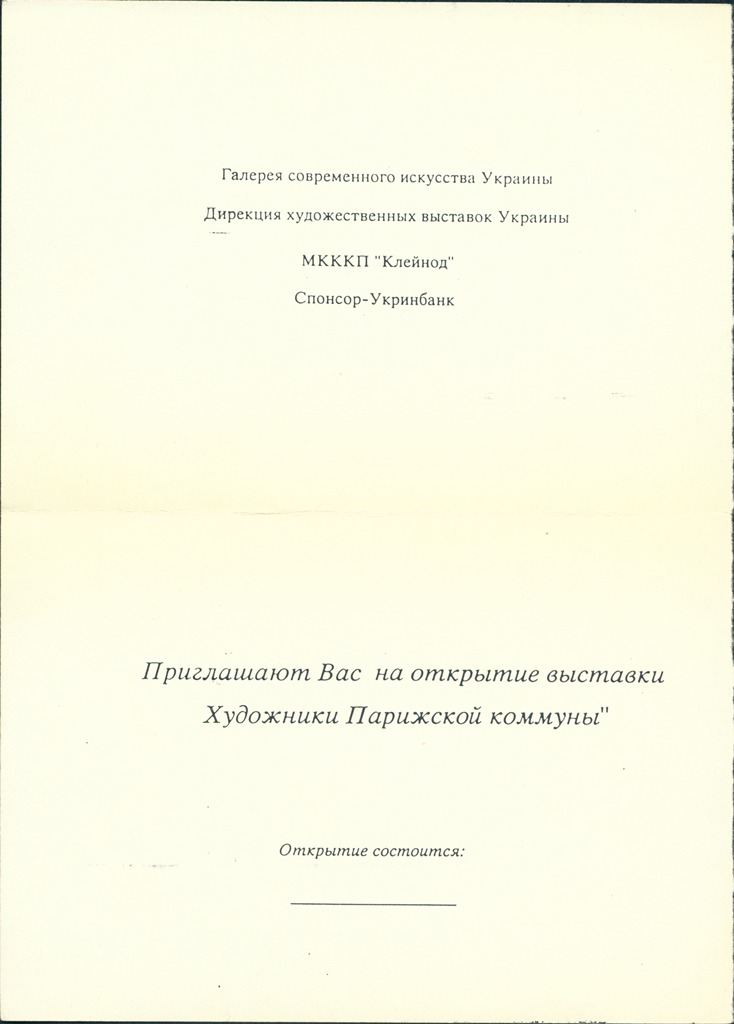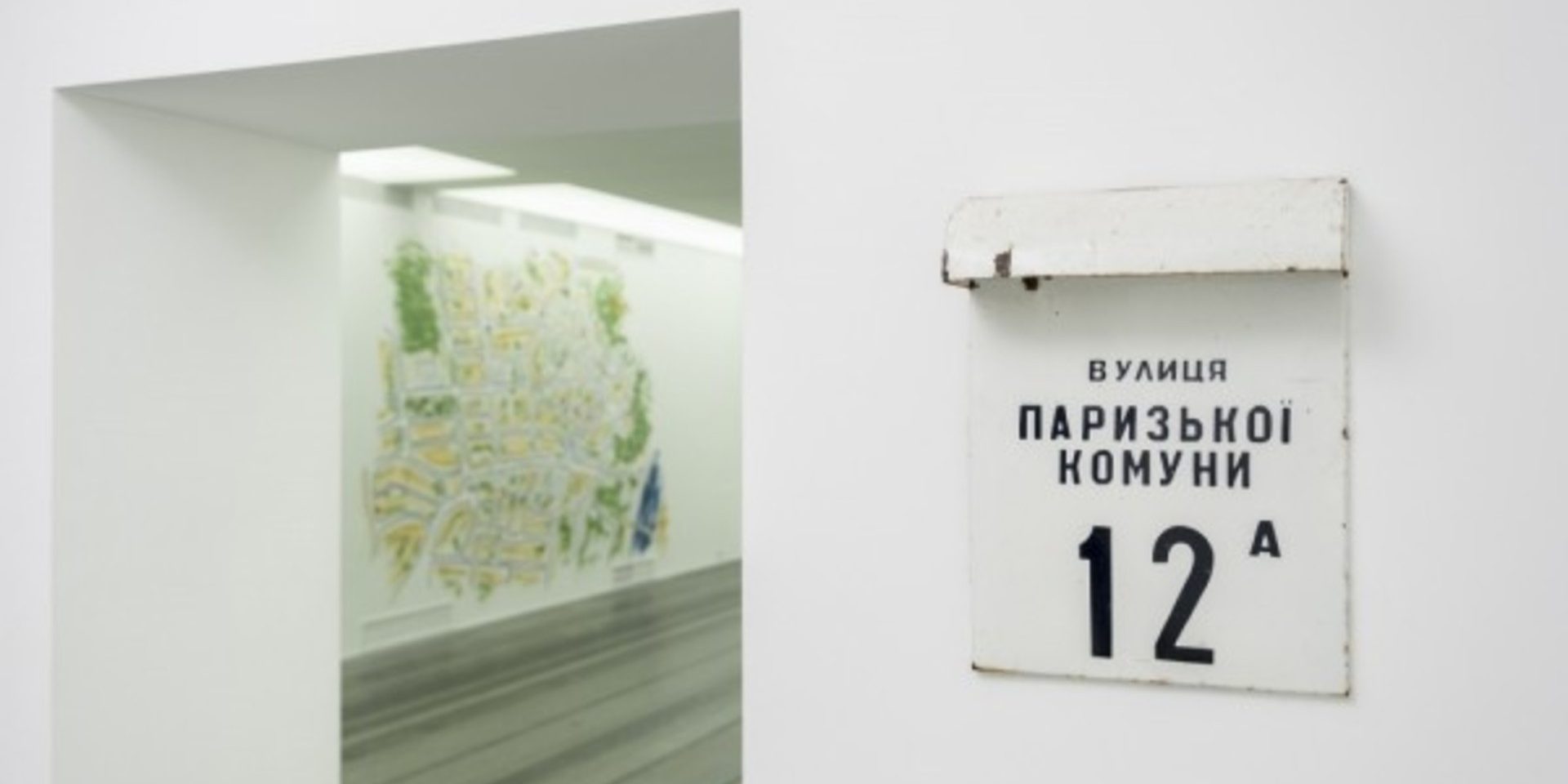
The exhibition “Parkomuna. Place. Community. Phenomenon” became one of the notable artistic events of recent years. It testified to the trend towards “new archivalness” or a “turn to memory” in Ukrainian art and at the same time became an example of this art working with its own past, its own memory, and its own oblivion. The time that has passed since then allows us to look at the exhibition from a sufficient distance and see that it significantly influenced the local artistic situation. Prostory invited the curators of “Parkomuna,” Tetiana Kochubynska and Kseniia Malykh, to publicly discuss the motivations, methodology, and pitfalls of working on the exhibition project. We publish this conversation on the eve of the presentation of the book prepared based on the exhibition materials.
Postfactum about intentions
“Parkomuna. Place. Community. Phenomenon” is a story about a squat that existed in Kyiv in the early 1990s. For us, the exhibition about Parkomuna is primarily a look at historical materials and an opportunity to outline the contours of a future archive, which we are currently working on creating. So the exhibition is also an indication of one of the possible ways of writing local art history.
The exhibition turned out to be very narrative, and we do not believe it has a strong critical potential. It is a story about a certain phenomenon that we, not being witnesses to the artistic processes of those years, can imagine and describe. It was important for us to understand what exactly “Parkomuna” was: what works were created, what the legacy of “Parkomuna” is, which artists belong to this circle. After all, the idea of Parkomuna is largely based on oral histories and memories and is primarily associated with sex, drugs & rock’n’roll. But what was behind this phenomenon? What was created then? What artworks appeared — and were they innovative? What is behind this drive and energy?
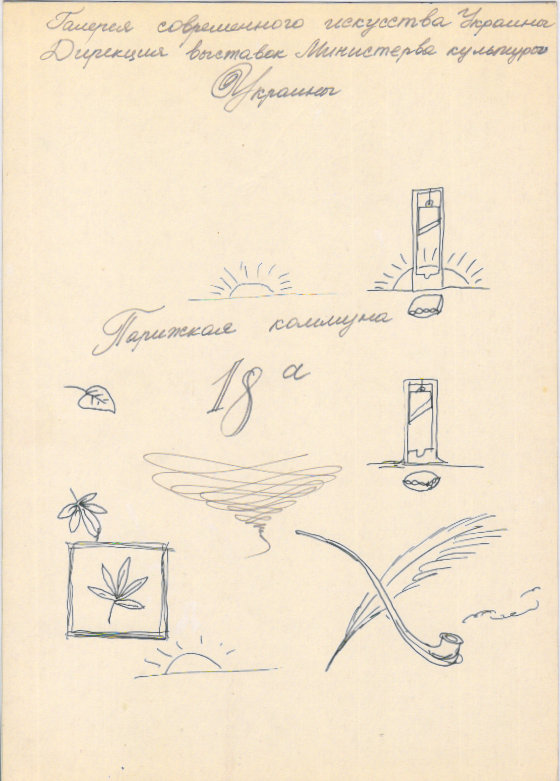
We both are not fans of purely archival exhibitions, so in “Parkomuna” it was important for us to tell the story through artworks, supplemented by archival materials, quotes from witnesses of the era, and other elements — such as a map created by Kyrylo Protsenko or a walk with Oleksandr Soloviov through places of former glory. After all, the aura of the place is a very important component of Parkomuna.
It was important and significant for us to show the connection of Parkomuna with the bureaucratic apparatus. At the beginning of preparing the exhibition, we wanted to debunk the myth of the rebelliousness of the Parkomuna members and demonstrate their connection with bureaucratic officialdom. However, closer to the opening, it became clear that there was no particular rebellion, and the connection with the apparatus was situational and a necessary condition for existence. There was no other system yet, no other mechanisms existed, and there were no alternative exhibition spaces either. Therefore, it was quite natural that they used the property of the Artists’ Union.
Thus, the main idea of the exhibition was to outline one of the possible histories of a specific phenomenon — the creativity of a circle of artists who lived in a squat on Parizka Kомуna Street and adjacent streets. The exhibition is entirely narrative, and the critical dimension, we hope, will be present in the eponymous book.
Conversation
K. M.: In general, if we talk about the myths around “Parkomuna,” the main one is the myth that this phenomenon is already well studied. It arose thanks to the charisma and success of certain participants in the process. In reality, except for Soloviov, almost no one has researched “Parkomuna” — at least there has been practically no consistent analysis of this phenomenon.
T. K.: If you look at the literature about “Parkomuna,” most materials consider it in the context of the “New Wave.” But the concepts of “New Wave” and “Parkomuna” themselves are not problematized or studied; there is no unified art historical framework, and the concept of “New Wave” remains extremely vague. Essentially, only a few texts on LiveJournal and Soloviov’s articles are publicly available. And also endless memoirs on which we relied.
K. M.: We relied on them, then stopped relying on them, and then subjected them to all sorts of doubts and analysis.
T. K.: I repeat: the idea that Parkomuna is well studied is the biggest myth. On the one hand, we do not want to resort to the rhetoric of primacy typical of the Ukrainian art environment, but, however pompous it sounds, our exhibition is the first attempt to comprehend “Parkomuna” through exhibition practice.
K. M.: Yes, of course, one can recall the exhibition “Artists of Parkomuna” in 1991. But its task was by no means to analyze this phenomenon or show the artists as a community. Not at all! Soloviov had other tasks then. First of all, to present them as a “local brand” of Ukrainian contemporary art. The first banks appeared, and with them corporate collections. Soloviov tried to use this situation to accustom the new business elite of the young country to collect and support young art. The task was completely different: to outline with a pencil that the artists of “Parkomuna” are our Ukrainian, contemporary, young art.
T. K.: In Ukrainian art discourse, there is a widespread notion that “Parkomuna” by default is the “New Wave.” Generally, any statement about the 1990s is perceived as a synonym for the “New Wave.” One can recall how during the preparation of “Parkomuna,” artists reproached us because of the Borderline exhibition: why was it made that way, why certain artists were not included. However, Borderline offered one of the possible viewpoints on the development of contemporary art in Ukraine.
K. M.: To some extent, Borderline was an attempt to delocalize the “New Wave,” that is, to expand the understanding of artistic processes of that time, not limited to Kyiv and Odesa. Such a way of telling history allows getting rid of a mythologized view of it.
In general, it seems to me that the post-Perestroika period was a time of continuous euphoria, associated, in particular, with the transition from state purchases to the first private sales. But hardly were Parkomuna members bought by art funds.
T. K.: Although the work by Roitburd that we took to the exhibition came from the Exhibition Directorate of the Artists’ Union. Actually, the late 1980s showed that the system, although not corresponding to new processes, continued to function. “Parkomuna,” catching the last manifestations of this system, used the available administrative resource.
K. M.: The same can be said about the building on Parizka Kомуna Street itself. While possible, we will live here until we are evicted. While possible, we will hold exhibitions on the platforms of the Artists’ Union. That’s how it was — while still possible… As if already allowed, but it is unknown how long it will last. It is precisely about this opportunity — to take everything you can while you can.
T. K.: To grab.
K. M.: Yes, exactly to grab. But even then it was clear that this system would no longer be able to support them, although they said they did what they wanted because they understood: they would not sell anything anyway.
T. K.: But, it seems to me, the desire to sell was largely connected with the sale of “Cleopatra’s Sorrow”…
K. M.: The precedent happened…
T. K.: Yes, it happened — and the very fact of the sale really motivated many.
K. M.: I would call it a dream of a new art system after the fall of the Soviet one.
When we just began developing the concept of the exposition, we were seized by a kind of archival excitement. At that moment, we had already collected many archival materials and wanted to show them. We wanted to demonstrate the process itself: how, to confirm established, already existing definitions, you find facts and support these definitions with archival findings. We aimed to show this whole process in the exhibition. But later we abandoned this approach and gave more space and freedom to the viewer, critic, art historian, and artist so that they could draw conclusions independently.
T. K.: Yes, indeed, we focused on the works themselves. But it is difficult to talk about a chronological approach because the period was very short, and a lot happened in four years.
K. M.: Much was defined by certain “peaks” of achievement. It seemed that after each unexpected success, they believed: it would always be like this. They went for four months to Munich, to a residency, quite rich by all standards. Probably, they thought it would continue like that: they would go to residencies, get acquainted with world art at international exhibitions, and so on. I’m not sure they were necessarily thrilled that all the achievements of Western European art fell on them at once. But at least they realized that one could live like many artists do today: from residency to residency, entering new contexts and acquiring new tools.
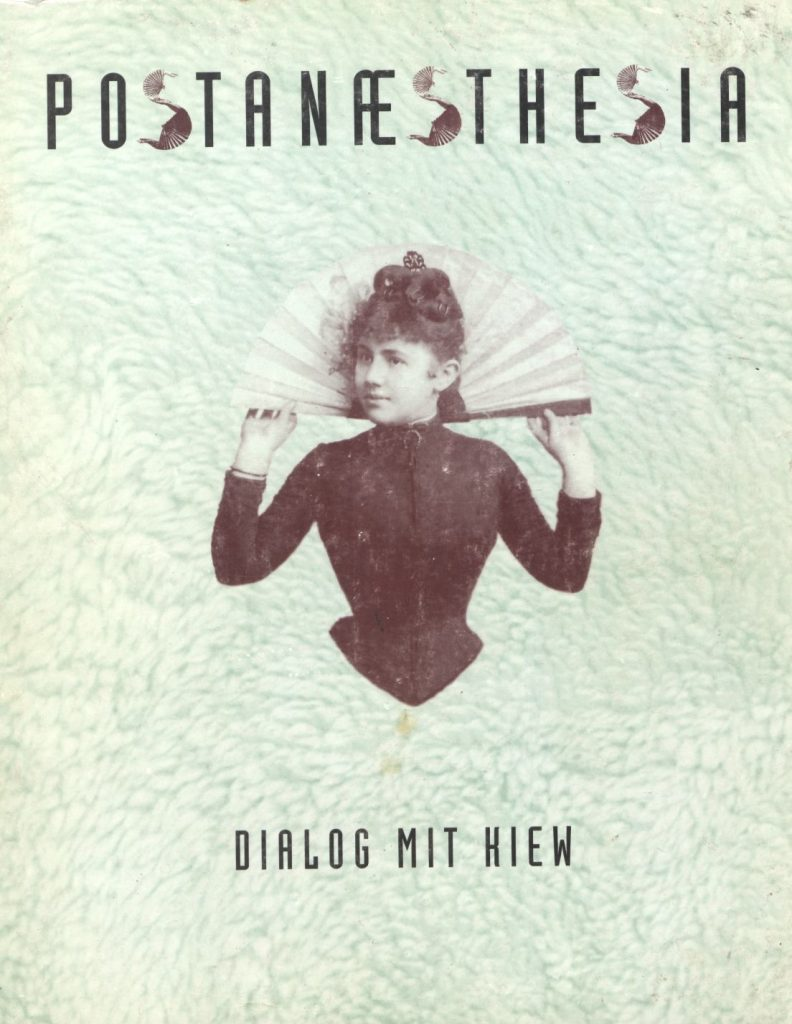
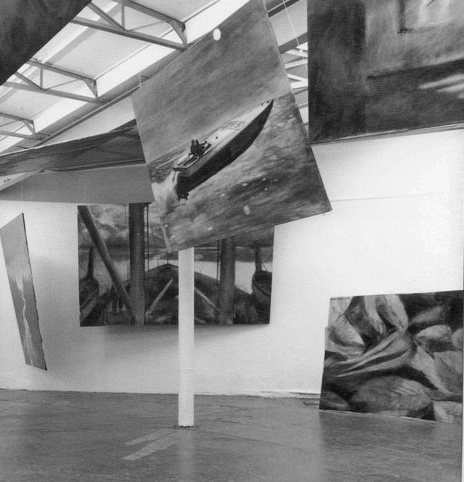
T. K.: But, it seems to me, they also felt some fear: having visited the same Documenta, all of them, painters, saw that they were working in a different artistic paradigm.
K. M.: Yes, I think they were also caught by the fear that their toolkit, which they had been perfecting for decades, was no longer needed, the fear of losing relevance. Although in the works they presented there, this fear is not felt. It would be interesting to find documentation of the “Angels over Ukraine” exhibition as well, as it was one of the loud presentations of contemporary Ukrainian art abroad — in Scotland.
T. K.: Yes, and this also testifies to the complexity of working on the exhibition. Technically, the exposition was quite simple, but each new finding was very difficult for us. Searching for works, documents, and even the most elementary information was extremely complicated, although it was about a very recent history — only twenty years ago.
K. M.: It was necessary to show all this geography, down to the artists’ routes: how they moved, where they drank coffee, where they communicated, what they read.
T. K.: By the way, we did not show the reading.
K. M.: Yes, but then our exhibition would have become cultural studies, and we still focused primarily on the works.
T. K.: If you look at it from the side, the exhibition partially turned out to be cultural studies, sociological. During that period, a huge array of artworks was created. For example, Senchenko said in a conversation that it is impressive how we managed to convey the feeling of “Parkomuna” without showing iconic works of that time. We conveyed the aura and spirit of the place, the possibility of absurd gestures in public space, the relationship of artists with the system.
K. M.: At first, it seemed like an absolute underground. Then questions arose: did the underground really exist, was there a tradition of underground and dissent in art? And what significance, for example, did the Kyiv Art Institute have? It seems to me that Soloviov’s stories about who did which diploma works and in which studios they studied helped a lot to figure this out.
T. K.: Soloviov showed that the institute had much more significance than it might seem at first glance today. We thought that an excessive emphasis on the connection with the institute would look like debunking another myth. But Soloviov himself — the person who created this phenomenon — devoted a significant part of our walk precisely to Alma Mater.
K. M.: After all, it cannot be said that they did all this despite Alma Mater.
T. K.: Especially considering that in the summer they worked in the institute’s studios. If I am not mistaken, Senchenko created “Sacred Landscape of Pieter Bruegel” in one of them.
K. M.: I imagine how they worked there and how strong their feeling of home was. On the one hand, they were looking for new house-squats where they could work and live together. In this, homelessness and orphanhood seemed to be felt. But on the other hand, they could come to the art institute, negotiate with the guard or someone from the rectorate, get a studio, and work calmly. That is, everywhere you could negotiate familiarly, without unnecessary complications. The feeling of ease that everything can be settled simply and homely seems to have accompanied them constantly. The same was with the squats: first on Lenina Street, then on Parizka Kомуna Street.
Of course, there was no stability: they understood that everything could end at any moment. Therefore, they grabbed everything from life that they could — fully using this situation. I think they already realized then that this moment was unique and would not last forever. After all, on the one hand, everything was wonderful, and on the other — as Holosiiv said: “Don’t worry, Elephant, soon everything will be bad again.” That is, in a sense, this “bad” was good.
T. K.: But probably it was already a deeply ingrained habit — to understand that if today is good, tomorrow may be bad. It is unknown what the rule of the new general secretary will bring, what living conditions will be. Perhaps it resembled the feeling during the Thaw: here is freedom, but soon it ends again with prohibitions and persecutions. Therefore, you have to use the favorable moment.
As Natalia Filonenko wrote, “at least it seemed to us that we were heroes.” The artist was a hero, albeit a marginal one — but still a hero. It seems to me that in our exhibition we rather showed what was behind these behavior models, what art was created, and did not limit ourselves to the romantic myth about squatters. Remember, we even thought about making the exhibition more archival, but honestly, I am not a fan of purely archival exhibitions.
K. M.: I think the exhibition should have shown the initial stage of working with the archive, the first conclusions, and not reveal it completely.
T. K.: That is exactly the task of the archive — to be accessible. The archive is a source with which one can work, and each researcher can formulate their own statement based on it. At the same time, the absence of an archive, the inaccessibility of collections, and the lack of information about the storage locations of the works themselves did not allow making the exhibition fuller and richer. For example, it seems to me that Vasyl Tsaholov was not expressed clearly enough. This is also related to the absence of an archive and the fact that the artists themselves did not sufficiently realize the need to create one. However, Tsaholov indeed stands somewhat apart among all of “Parkomuna.”
K. M.: But they all stand apart!
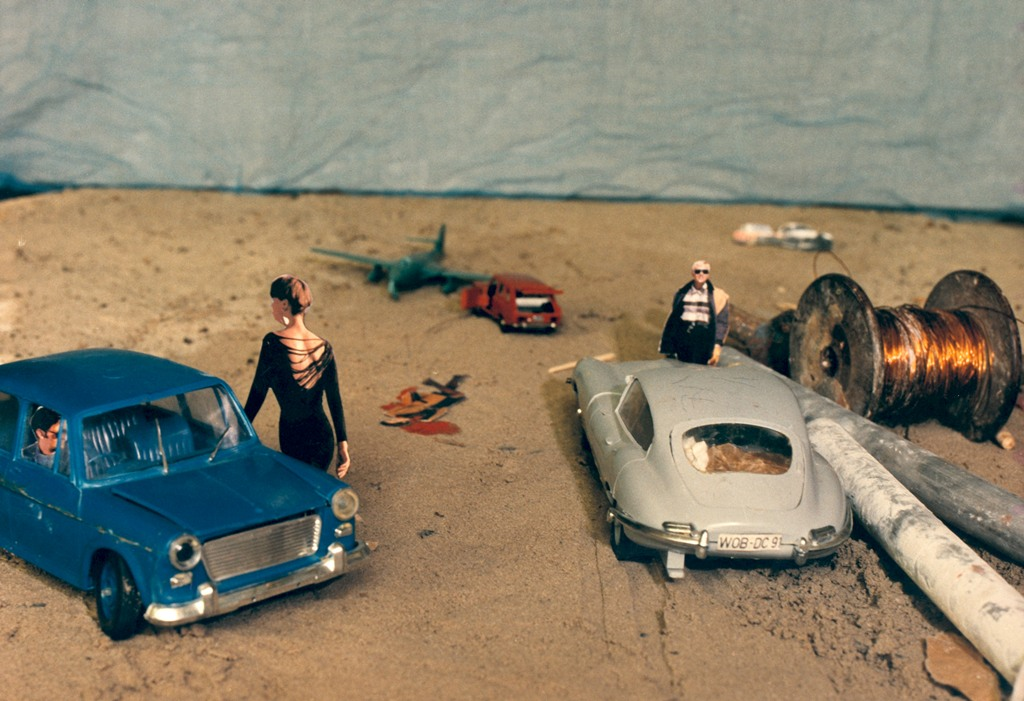
T. K.: But if we talk about mastering other media, for me Tsaholov is ahead of everyone. Other artists created alternative “small worlds,” transferring biblical plots, Eastern practices, and the carnival of their own life onto the canvas. Tsaholov looked at the world differently — not through a painting, but through new media. It seems to me that his artistic method differed from the methods of other artists. The themes of his works were also different: “Criminal Week,” “World Without Ideas.”
Savadov and Senchenko also stood apart. For example, their joint exhibition at the Central House of Artists in Moscow in 1991 was a project of already mature artists, while on Parizka Kомуna Street everything was just beginning.
K. M.: Well, of course, the old habit of orienting towards Moscow was felt: through it, all roads led to the West. It was clear that the artistic situation in Moscow was completely different. It seems to me that Marat Gelman’s “Babylon” exhibition played an important role. He tried to fit the Parkomuna members into a broader context than the “New Wave” — into the “South Russian Wave” — to find them a worthy place in the overall space of post-Soviet art. But, in my opinion, “Babylon” influenced collectors more. Probably, that is what Gelman counted on. And the Moscow art community was not very enthusiastic about the large and bright canvases of Kyiv artists.
T. K.: It was not only about habit but also about the desire to achieve success. And Moscow was the only way to it. The personal exhibitions of Holosii, Savadov, and Senchenko at the Central House of Artists testified that such success was possible. This is also evidenced by the fact that Andrew Brown, curator of the “Angels over Ukraine” exhibition in 1993 in Edinburgh, got acquainted with Kyiv art precisely through Moscow colleagues.
K. M.: It was clear that there were many more opportunities in Moscow, including commercial ones. Here, they rather sought to show their own uniqueness.
T. K.: Maybe it was necessary to create their own unique community, their own institute of criticism? And all this — already in 1990? But either it was impossible, or the attempts turned out to be unsuccessful, or there was a lack of intellectual tradition that would allow outlining self-sufficient phenomena locally. On the other hand, after the collapse of that country, the connections that existed before were preserved, and at the same time, new states were forming.
K. M.: When the tradition of going to Moscow for success still existed, many artists stayed there. Holosii lived in Moscow for some time, and a large collection of his works is still there. But probably their art did not sound as they hoped — after all, none of them stayed there in the end.
T. K.: But the same Holosii made a deal with the “Regina” gallery. So, at that time, we simply did not have appropriate offers for artists. And what happened to the corporate collections that were created then, or to Tetiana Krendeleva’s collection? We have almost no access to anything. Only now has it become possible to get acquainted with the Gradobank collection. Where are all those corporate collections? Where are they now?
If we talk about Holosii, the “Regina” gallery prepared a catalog of his works. Perhaps his creativity is still insufficiently analyzed and studied from an art historical perspective, but materials are publicly available. The catalog contains about 300 works — they can be researched and analyzed. But where is everything that was created and purchased for Ukrainian collections? Where is it now?