
KORYDOR, within the framework of cooperation with the PinchukArtCentre Research Platform, continues a series of publications dedicated to Fedor Tetianych, whose exhibition is currently ongoing at the PinchukArtCentre. This time, Tetiana Zhmurko and Tetiana Kochubinska met with Yuriy Zmorovych — an artist, director, poet, musician, and founder of the experimental theater “A-A-A” (1991–1996), which was ideologically and spiritually close to the creative practice of Fedor Tetianych. The researchers talked about the “unofficial” — what was permitted and forbidden in Soviet art, about Tetianych’s relationship with official culture, his personal qualities, and how difficult it is to be friends with a genius.
Research Platform: To start, tell us under what circumstances you met Fedor Tetianych. You both studied at the Kyiv State Art Institute (now the National Academy of Fine Arts and Architecture): you in the architecture faculty, he in painting.
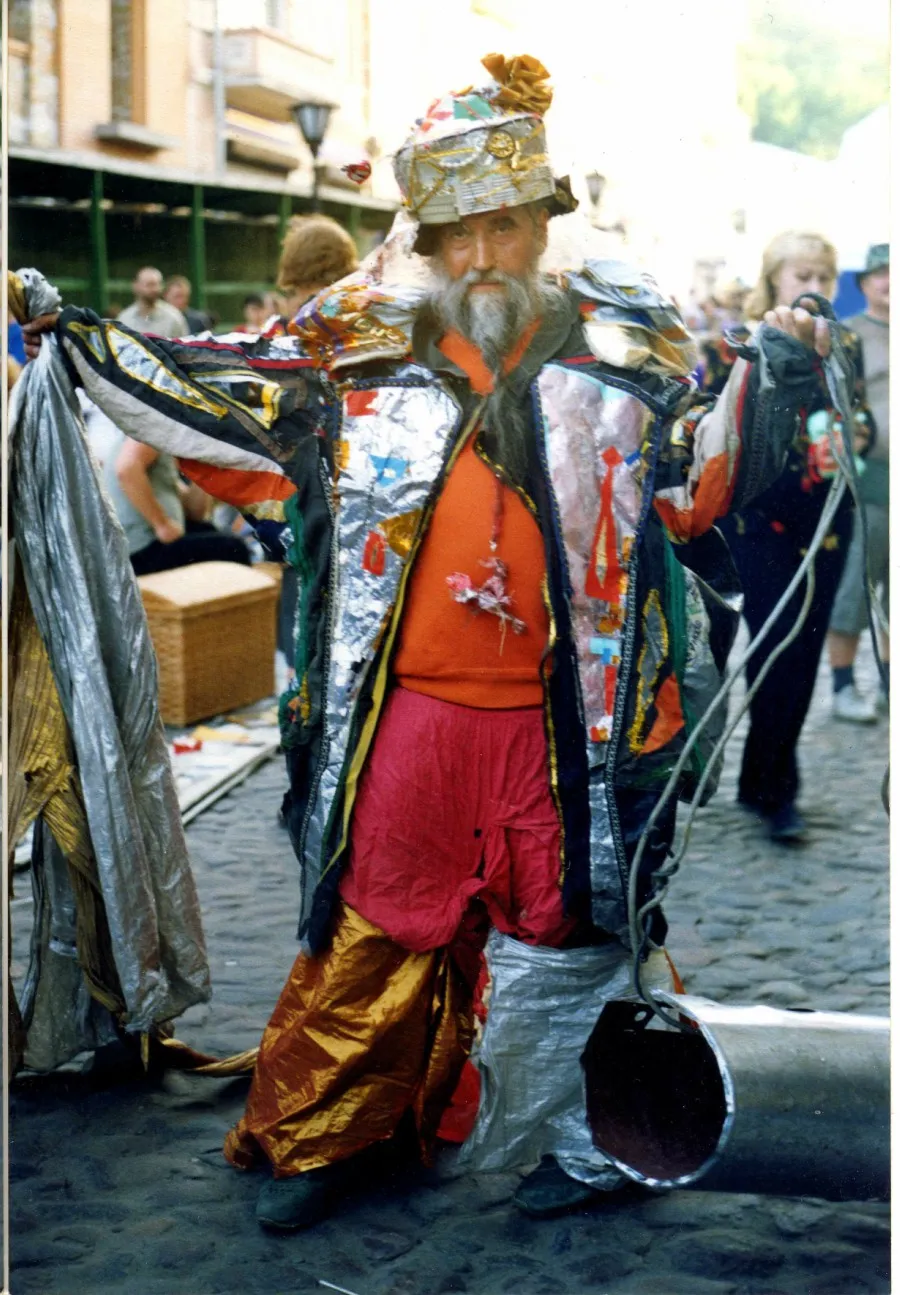
Yuriy Zmorovych: We met in the early 1980s. Our paths did not cross at the academy, although we studied around the same time. He always dressed very exotically and provocatively: homemade shoes on a high platform, with heels, even covered with foil. Tight pants, a special jacket, a wooden box-briefcase — also covered and smeared. I saw that he was generally an educated guy. His appearance did not interest me much, but I noticed him and thought: after all, this is not just a young man, there is something more behind this.
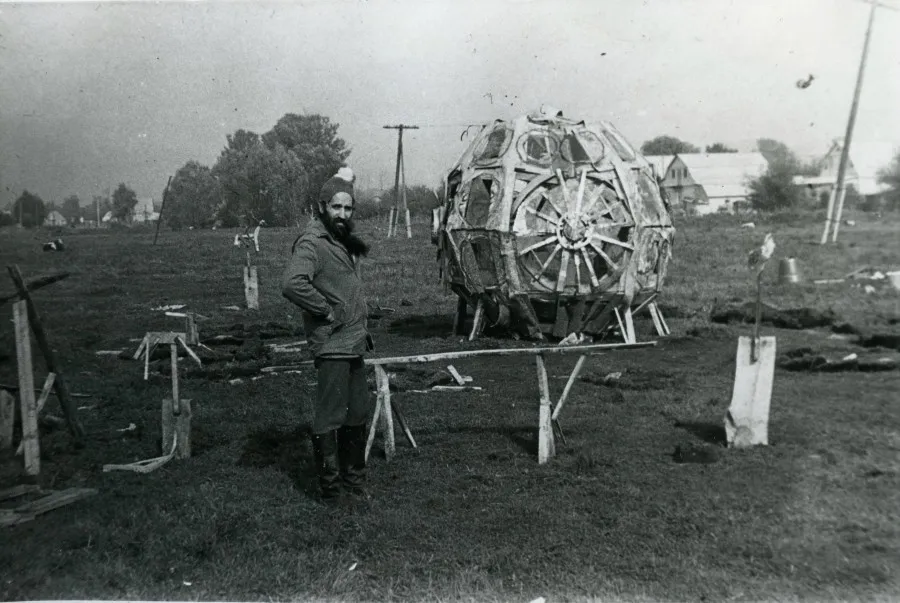
And the artist Anatol Stepanenko introduced us — in the metro. Stepanenko said: “Here, Fedya, meet Zmorovych — a cool avant-gardist.” And Fedya (Fedor Tetianych), besides himself, recognized absolutely no one. So what does “cool avant-gardist” mean? It needs to be checked, touched. And Fedya immediately, without unnecessary ceremonies: “Yes, Zmorovych, let’s go to my place. Have you seen the biotechnosphere? I’ll show you a space module in Knyazhychi.” I said: “Of course, why not.” And the next day we took the Brovary bus and went to Knyazhychi.
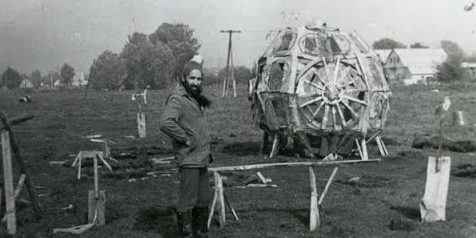
We approach the village. A huge field — plowed or unplowed. “Look!” In the middle of the field — some kind of thing. We got off the bus and went to it. I was intrigued and understood that it was some kind of mystification. And indeed, there was a spherical thing — it seemed made of cardboard or plywood. That was my first meeting with Fedor — an impressive meeting with Fedor, or Feodosius, also known as Fripulia, also Infinity.
I address him: “Fedya!” — “Zmorovych, what Fedya am I to you? I am Infinity.” And the most interesting thing is that every time he said this with such conviction that it was obvious: he believed in what he said. And he infected with his faith. Indeed, probably now the most important thing is faith in one’s own embodiment: in whom, in what, in the fact that you exist, who you are.
First of all, I try to hide altogether because I have very complicated relationships with society. After all, I do not believe in society, I do not believe in its positive side. Since childhood, I have had tense relations with it: the bureaucratic world, so-called authorities, etc. Therefore, self-identification happens differently for each of us. Someone identifies themselves with the Lord — like Fedya. He declared himself as the second coming. And I, in the end, prefer to walk in a modest human skin, and you can guess for yourselves who I really am. And he did not hide this.
Research Platform: You mentioned that Tetianych did not recognize other avant-gardists. Today he is perceived as an alternative to official Soviet culture. Was there any common alternative cultural life in Kyiv at the end of the 1970s — beginning of the 1980s?
Yuriy Zmorovych: Even when I studied at the art institute, I could not stand those wanderings through studios, hangouts, mass drinking parties. Obviously, I was always at home — it is my fortress, temple, prayer room, chapel, call it what you will. I focused on a certain spiritual sphere, on spiritual life. It’s hard for me to answer because I observed everything somewhat from the side.
There were such islands, peculiar points of contact with the great sixtiers. They had a small, select circle with whom I slightly intersected: composer Valentyn Sylvestrov, poet Serhiy Vakulenko.
By the way, one of the sixtiers knighted me. He is a wonderful person worth mentioning in the context of Kyiv’s cultural life. He was an officer, a Soviet officer, an aristocrat of spirit. He was raised in St. Petersburg, spent time in libraries there, supplied my sister with literature that was not widely available to us. He wrote poems and did translations. His name was Yuriy Heorhiyovych Hlushanovsky.
By the way, he introduced me to Oleksandr Parnis and Anna Zavarova. He also showed my poetry collection to Hennadiy Aygi — a cult poet for my circle of friends. What the poet said about my poems, I still do not know. “This is not for men’s ears,” Hlushanovsky said to me during a meeting.
He was the one who brought me to Valeriy Lamakh. After looking at my drawings, he said: “You are talented, but somehow suspiciously easy.” That’s how I am in life…
And my course supervisor, upon learning that I was an abstractionist, said: “You understand, Yuriy, abstractionists suffer, they are imprisoned, but you somehow come out too bloodlessly.” What he meant, I find it hard to say now. But all these powerful people were nearby — Hryhoriy Havrylenko, Serhiy Paradzhanov, and others.
Research Platform: And what were the relations of Fripulia and you with official art? Can your activities be called part of the underground?
Yuriy Zmorovych: You know, this is a very interesting question. And, of course, I can answer it. What impressed me about Fedya (excuse the familiarity, but I will still call him that, not Infinity) — everything was forgiven to him. Moreover, he told me that he appeared in his costumes at the meetings of the Artists’ Union. And they forgave him because he was truly such a folk, naive, holy fool. But his foolishness was non-aggressive, absolutely not malicious.
You raised a very important topic — Fedya’s relationship with the establishment. It is generally a rare case when a person was forgiven their “avant-gardism.”
Research Platform: And at the same time, he actively participated in creating official monumental art, often weaving his “fripulist” ideas into it, including the “Biotechnosphere.”
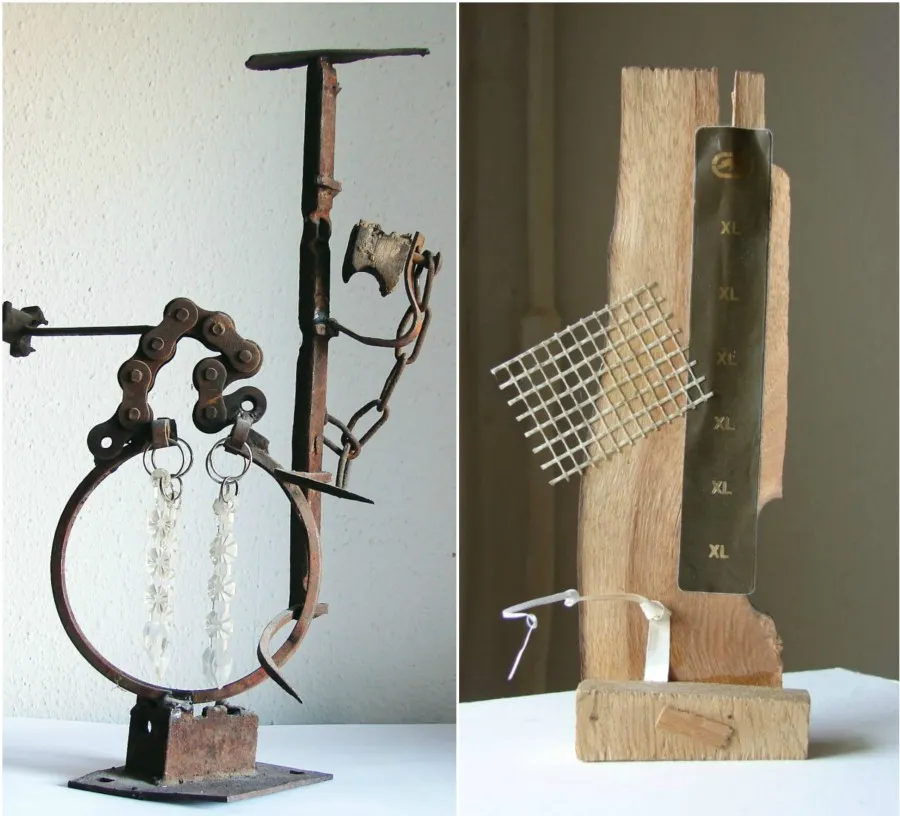
Yuriy Zmorovych: Of course, monumental art allowed, so to speak, to permit oneself many pranks unavailable in easel painting. On Lepse Boulevard, near the tram stop “Lepse Boulevard,” in the underground passage, he made a bas-relief from rusty iron and various gears. In the middle was a carved pseudo-realistic portrait of the revolutionary Lepse. I was stunned because there was nothing like that in Kyiv.
By that time, I was already engaged in sculpture from rusty iron, which was absolutely impossible to show in Kyiv then. I am a native of Kyiv, have lived here all my life, but the level of culture here is low. For example, my cinematographic career here would have ended immediately — they would have just buried me.
When I got to Moscow, it was a shock for me: unwanted, harassed, worn-out Zmorovych suddenly found himself on central television, where he later worked. And cinema is a completely different planet: a different attitude to life, to art, to the director, to the artist.
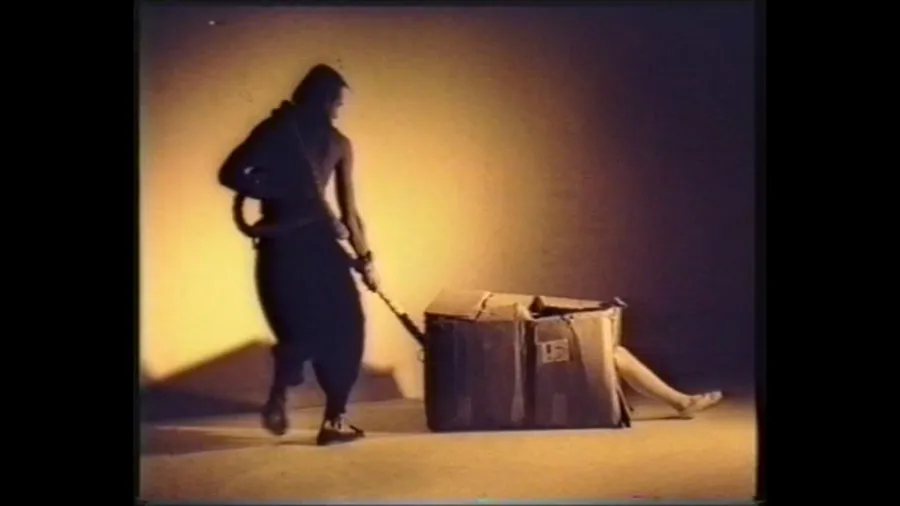
In my first film, I shot Serhiy Letov as Daedalus, as well as Lev Termen — a Russian inventor, Faust of the 20th century, an amazing figure. Letov in a red jumpsuit stood on the icy platform of the Ostankino Tower, chained himself, waved a flag — this was the film’s finale — and meditatively shouted: “Create! Create! Create!” He chained himself to manifest creativity.
The film was commissioned by the Ministry of Education. At the screening, Komsomol party officials sat and asked: “What is this?” The head of the commission rejected the film and said: “I don’t like Tarkovsky at all.” I thought: “Well, not bad if they already compare me to Tarkovsky.”
The thing is, I submitted this film together with the artistic director of the creative association Viktor Havrylovych Yurlovsky. We came out after this failure, defeat, catastrophe, and he asked: “Why the long face?” I said: “How not to be? I let you down, myself from head to toe…” And you know what he told me? Such a thing would be impossible to hear in Kyiv: “Yura, you made a good film. I want to select the best for mass screening. I’ll think about the rest myself.”
And they commissioned us another film. How do you like that? Can you imagine? He gave me the opportunity to show my works to a mass audience — two short films.
Research Platform: But Fedya — now forgive the familiarity — was forgiven and allowed a lot even in Kyiv?
Yuriy Zmorovych: He was forgiven a lot. And after the institute, he successfully worked as a monumental artist. He later told me: “Yes, I had plenty of money, so what!” Monumental commissions were a profitable business. They paid big money for frescoes and friezes.
You probably know that Fedor painted portraits of Politburo members — on his own initiative. For example, he depicted them against the backdrop of the starry sky, comets, etc. So Fripulia was still present. And here humor, vanity, ambition — all this somehow merged into one whole. There is also a beautiful explanation — his cosmism, his view of humanity, of people as a single whole.
Research Platform: But this is generally characteristic of the sixtiers. If you recall Lamakh: “I am you, you are I” — a holistic picture of the world and the perception of oneself as an inseparable part of it. Art historian Borys Lobanovskyi recalled that Lamakh was irritated by talks about politics. He said that if a person was born in the North, then their dwelling is formed according to climatic conditions. He treated politics and the system the same way.
Yuriy Zmorovych: I was in a state of acute internal opposition to official art, I simply could not stand it — all these thematic compulsions, etc. Fedya probably did not have that. Here is a paradox for you.
In general, the “Sovok” was a very strange phenomenon. On the one hand, they smashed the “Bulldozer Exhibition,” and I, for example, from the age of sixteen, calmly subscribed at the post office to the Czech magazine Výtvarné umění, dedicated exclusively to non-figurative art. I was brought up on Polish jazz. So all this was strange.
In my youth, I went to the library at the Church of St. Alexander. There was a historical library with an amazing catalog and an incredible collection of books. I still don’t know where it came from. Pre-revolutionary editions, books by Berdnikov and other authors were given to a boy without social privileges and no restrictions.
Tetianych really bestowed trust on me: he came to my home, met my children. I saw him from another side and think that this was a very important trait of his — the ability to win people over.
I recall a funny episode. In the early 1990s, I had the theater “A-A-A,” and I decided to introduce my actors to Fripulia. They gathered at Hydropark, but he came not in his usual cosmic costume fluttering in the wind. He was modestly dressed, sitting on the shore, and the actors — an ambitious and mischievous bunch — looked at him and grimaced: they said he was unimpressive.
Fedya probably noticed this too. In general, he had a sense for such things — he well caught people’s reactions to himself. And this reaction was mutually provocative: if he felt the attention weakening, he provoked people to warm it up. He really had an amazing ability to attract and hypnotize the crowd.
So Fedya sits at Hydropark. Some church, and nearby stands a jeep or even two. A classic picture: black jeeps and “brothers,” four or five men, like from a movie. The 1990s, in a word, everything like in a movie.
And Fedya went to them. A suicide! And I say to the students: “Guys, watch!” Everyone watches. Fedya approaches, the guys, of course, tensed up. He starts telling them something. And you know, they gradually warm up, start smiling, just soften before our eyes.
All this happened before our eyes. I say: “Well, do you understand anything in this life?”
Fedya always attracted attention and came where the crowd had already gathered. It was important for him to constantly be on the wave of fun, celebration.
Research Platform: Tetianych is characterized by folk energy, spontaneity. And what influenced him from outside? Fantastic literature, for example, acquaintance with Oles Berdnyk?
Yuriy Zmorovych: At first glance, he gave the impression of an absolutely spontaneous, “from the earth” person. Some witnesses say he sat in the library on Instytutska Street. Of course, he knew Malevich, read quite a lot of books. Another thing is that his spontaneous, healthy beginning really prevailed: it fantasized, generated ideas.
For example, there was a note in a Soviet newspaper about Salvador Dalí, who once became a “friend” of the Soviet Union. Earlier he was an avant-gardist, a charlatan, a pervert, and here suddenly — a friend of the Soviet Union. The newspaper wrote that psychoanalyst Dalí called the state of his consciousness “an absolutely creative state of consciousness.”
And this, in my opinion, characterizes Fedya. He often gave exactly such an impression. He gave me minutes of private conversations, talks about nothing. And he always incited me: “Zmorovych, let’s make a permanent exhibition.” Of course, from trash — we will sell, show.
Recently, he dreamed of creating a tour-exhibition route. I say: “Fedya, let’s rent a carriage.” — “What carriage? A train!” He dreamed of traveling around the world, looking out the window, which seemed to him a frame for moving painting. People had to sit and watch the world through the windows as a permanent exhibition.
Research Platform: How well did he know Western European artistic practices — avant-garde, Dadaism, “Fluxus”?
Yuriy Zmorovych: You see, most likely, he did not know the artistic practices themselves. But on a theoretical level, I think he touched them in his own way — spontaneously, intuitively, sensually, call it what you will. He never impressed me with any analytical reasoning. He felt and understood all this, but really — everything came from the first person, it was by no means a retelling of someone else’s ideas. Everything was very organic.
Research Platform: For example, at our exhibition “Fedor Tetianych. The Canon of Fripulia” (curator — Valeriy Sakharuk) we show texts.
Yuriy Zmorovych: And you do the right thing.
Research Platform: You also use texts in your film. How did Tetianych himself relate to them?
Yuriy Zmorovych: I think very few people saw these texts at all, especially among the artistic community, which imagined Tetianych as some kind of fool. After all, they show a very serious scope and ambitions — how he understands his own infinity and cosmism.
What is “I”? The other side of the skin, the insides — or, on the contrary, the side that encompasses the whole world and the entire cosmos? Do you understand the point? If it is about this side, then I am the Cosmos, Infinity. After all, an amazing thought. Sincere and deep.
Besides, he had a very expressive, original manner of declaiming his own texts. Another thing is that from an academic point of view, his speech was incorrect, inarticulate. But, of course, he did it extremely talentfully and originally. How he pronounced his “zha-zha-zha-zha” — Infinity!
Research Platform: Why do you think there is interest in Tetianych today?
Yuriy Zmorovych: I can say why Tetianych and I were spiritually close. In our realities — I mean Ukraine and especially Kyiv — art is understood quite school-like, that is, as a craft. And it is also divided by genres: painting, sculpture, decorative-applied art.
But come on, my dear! At least a hundred years ago, people like Duchamp proclaimed that art is primarily a vision of the world, the embodiment of the spiritual in the material. After all, Duchamp was the first to refuse brushes.
And so, I think Fedya is one of the few, if not the only one in our context, who again put forward this idea. At the end of his life, he also gave up painting. He painted something with children, but for him, the important things were precisely the spiritualization, the reanimation — the reanimation of living matter.
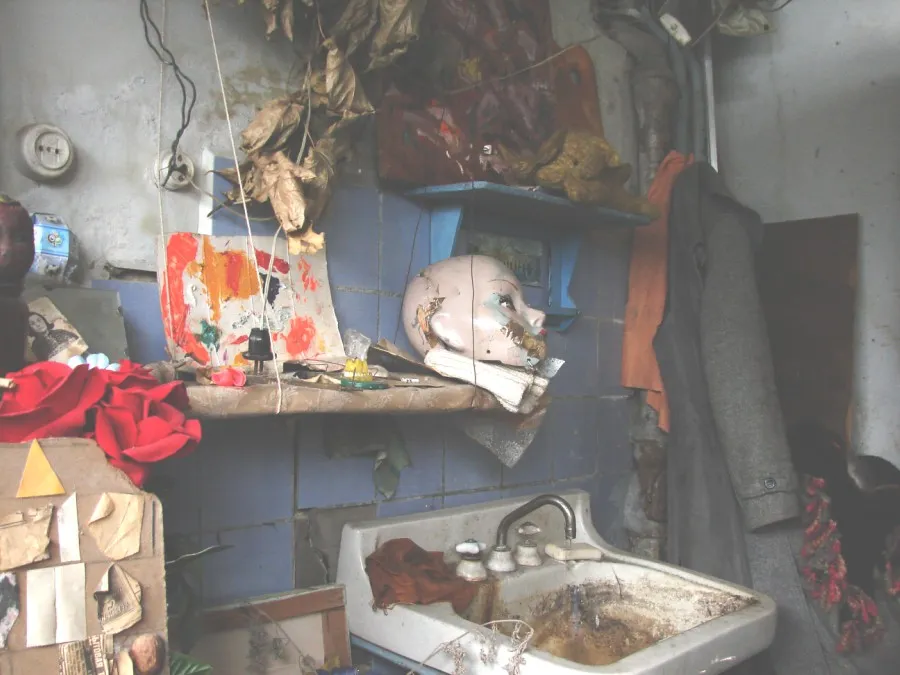
Therefore, his collages, assemblages, ultimately trash — this is matter that equally has its own life, soul, its anima, its history, its dramaturgy — anything. In my opinion, what distinguished him was the unclouded gaze of an artist, a creator! For him, objects were works of art, wonders, wonders, wonders of life, from which this wonderful field of life is composed.
By the way, Paradzhanov had the same feeling. You know, at one time I called this paneros. I think Fripulia had it too — something that excites the whole world.
Research Platform: Fedor Tetianych had a very avant-garde attitude toward museums, calling them “cemeteries of arts.”
Yuriy Zmorovych: Here Fedya and I are like-minded. You know how I called museums? “Every museum is a failed grocery store.” Indeed, museums are, as you said, “cemeteries of arts.”
Although I myself worked in a museum: I was one of the founders and an employee of the Pyrohiv Museum — the National Museum of Folk Architecture and Life of Ukraine — heading the folk architecture sector. That’s where my career started. Then I went into cinema.
By the way, we have not yet talked about why it is difficult to fit Tetianych into the official artistic canon. Because his art is by the way, art “in passing.” It is the art of seeing, finding a living object, letting it live in you — and no more.
I was struck that Tiberiy Silvashi, with whom we studied around the same time, set himself the goal of creating a “product.” And this was in those years when no one thought about products at all. But Fedya did not create products — that’s for sure.
Even I now have such a period: some scribbles that fly away, self-destruct, self-annihilate, crumble. After all, there is also a certain, and very great, meaning in this — not in this businesslike approach.
Research Platform: Therefore, his practice is extremely difficult to museify. Perhaps such art is important precisely because the feelings from it are retold and passed on?
Yuriy Zmorovych: Among my friends, I remember Fedor with a smile and sadness, but still more with a smile. He left a very bright trace, and I miss him. After all, he truly embodied the very idea of an artist.
As a person, he reminds me of Paradzhanov — I will allow myself such a comparison. Paradzhanov’s pathos was that he manifested himself as an artist. An artist is philosophy, a feeling of life, an attitude to the world. In his memoirs, Paradzhanov writes: “Such-and-such an official entered the hall.” That is, he built a whole bureaucratic world of artists. Here is where the dividing line runs.
When I come to exhibitions and see an artist surrounded by friends — like an accountant mumbling something about his creativity and listening to compliments and boring tirades — it’s just terrible.
With Fedya, everything was different. Because it was a celebration. At the directing faculty, we were taught that we must bring people a celebration, that radiation must come from us, transformation must happen. Every day we staged directing etudes on the theme “And yet life is beautiful” (laughs).
And with Fedya, I cannot recall a single moment of despair, pessimism, or depression. Neither in his vocabulary nor in his feelings was there any of this. So such art is needed by people.