
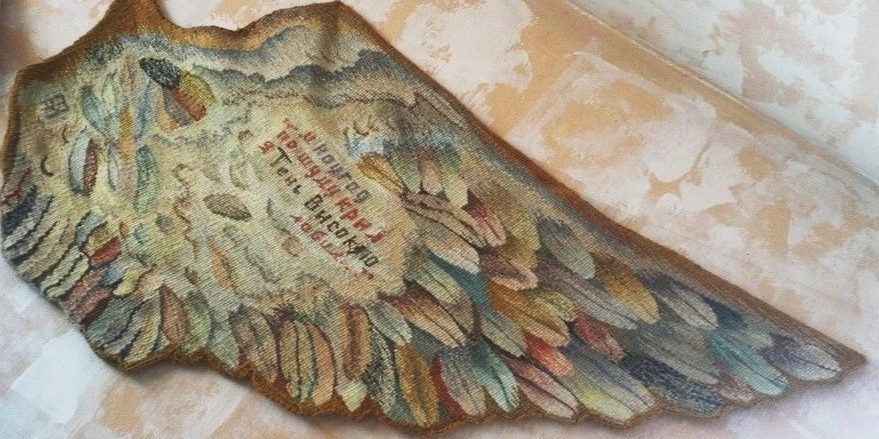
Legends circulate about Margarita Zharkova in Odessa. She is remembered as a bright, extravagant personality, the wife of Oleksandr Anufriyev [1], the mother of Serhiy Anufriyev [2], a person around whom others gathered and in whose apartment they held house concerts. In media publications, she is called the Odessa Yoko Ono. Zharkova truly played an important role in the Ukrainian artistic community. She was an artist, curator of the Center for Contemporary Art “TIRS”, one of the iconic figures of Odessa’s artistic life from the 1970s to the early 1990s. For example, artist Larysa Rezun-Zvezdochetova repeatedly mentioned Zharkova as the person who opened the world of contemporary art to her. Zharkova knew how to find talented people, captivate them, guide them, give them literature to read, and introduce them to interesting people.
Within the framework of the PinchukArtCentre Research Platform, Kateryna Yakovlenko spoke with the artist’s daughter, restorer Yuliya Zharkova, about Margarita Zharkova and her place in Odessa’s artistic environment.
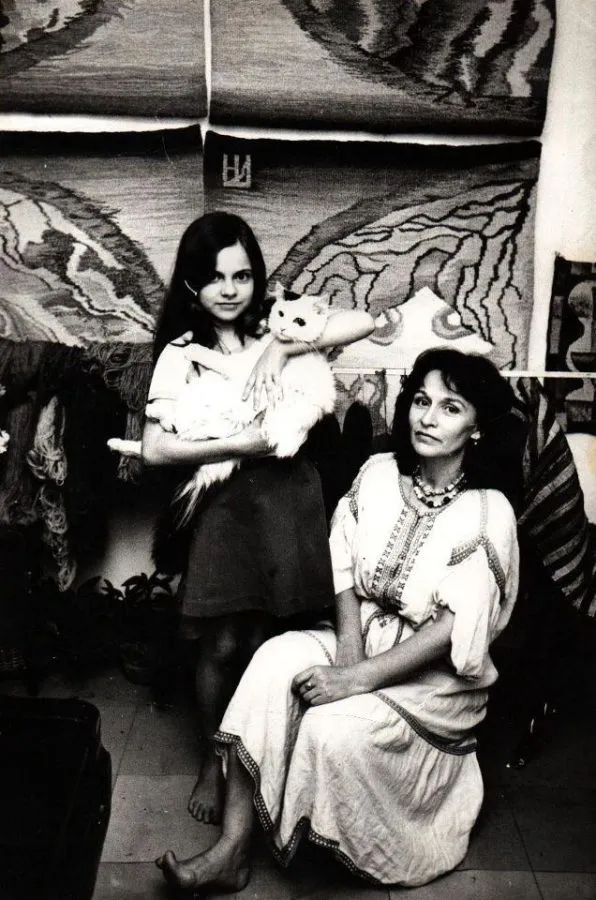
Yuliya Zharkova: We are, of course, all different — me, Serhiy, and mom. Three completely different people. Mom nurtured in us the ability to think freely and never lose our individuality.
Mom was born during wartime — July 28, 1939. Her passport states that she was born in Chelyabinsk, but in her memoirs, mom wrote that she remembers all her childhood on the shore of Lake Bezdonne in the city of Slonim (now Grodno region, Belarus). I think she was actually born there. I vaguely remember this period of her life: everything was somehow blurred. It was a difficult time — the beginning of World War II.
The lake mom remembered was indeed bottomless. The city was located on the border of Belarus and Poland. Since mom’s father, my grandfather, was Polish, her maiden name was Sheshatska. Grandma came from Siberia, from the city of Zlatoust. She was a doctor and worked in a military hospital. That was when the war started, and her help was needed. Mom’s family experienced famine in this city. Mom said they mostly ate corn porridge.
Mom found solace in reading books. She had a neighbor of aristocratic origin, Professor Alekseyev-Popov, who had an amazing library. She reread all the classics then.
Mom’s father was an artist. He studied easel painting and even went to study in Saint Petersburg. His father was also an artist — an icon painter who worked on monumental paintings in Orthodox churches. Despite their Polish origin, they converted to Orthodoxy. Unfortunately, grandfather went to war, got surrounded, and then returned. By that time, grandma had remarried for the second time. Mom lived in harsh conditions because of her stepfather. That is why she married early herself.
Mom was involved in artistic gymnastics. She was lively, sociable, popular, and had many friends. She danced rock and roll with stilyagi in the city park. Although she had a terrible stepfather, she knew how to hide all family troubles. She smiles in almost every photo from that time.
When mom got married, she was seventeen. Her husband was Czech, and they went to Czechoslovakia together. It was almost a fictitious marriage. Everything went well in Prague: mom even worked as a TV host and learned Czech. Later she went to Moscow, where she met her future husband Oleksandr Anufriyev, an Odessa artist who was then at the peak of his creative form.
Anufriyev was then, as they say, a real fire. He introduced mom to his circle — Moscow and Odessa nonconformist artists who were not favored by the authorities. Now I look at their works — and this is my personal opinion — and see that they, for example, are inferior to the Impressionists and in many ways secondary to them. At the same time, I understand that each individual work is quite interesting on its own. These paintings have their own search, a special, specifically Odessa color scheme, and bold artistic solutions.
It is now hard for us to imagine a time when people were afraid to express their own opinions. Everyone knew then: if the “kutuzka” came, a person was erased from everywhere — as if they never existed. Therefore, this fear, this fear of self-expression, is what makes these works infinitely valuable.
That generation was unique for its time. Artists lived completely isolated from society, in a parallel reality. But this also meant complete powerlessness. They had no opportunity to organize their own exhibitions, although they really worked a lot. In Odessa, there are even legends about how the famous work by Oleksandr Atsmanchuk “Flight” [3], depicting a boy and a girl in a rather socialist realist manner, was destroyed. They say the painting was simply destroyed at the art council, literally leveled to the ground.
Kateryna Yakovlenko: What was your mother’s attitude towards the Soviet authorities?
Y. Zh.: Mom came from a religious family. As I already said, grandfather was an icon painter. Therefore, mom always hid a cross under her clothes. She was a believing, Orthodox person and believed that Orthodoxy saved her and gave her support. She insisted that both I and Serhiy be churchgoers. But she did not like fanatics.
On grandma’s side, we had some wealthy relatives who were dispossessed. Mom also told that my cousin grandfather was taken to a camp for children of enemies of the people, from which great-grandma somehow managed to get him out.
It is worth saying that in those conditions everyone had to be hypocritical. At school, it was necessary to join the Komsomol. Yet in summer mom wore incredibly extravagant outfits that were a real challenge to society at that time.
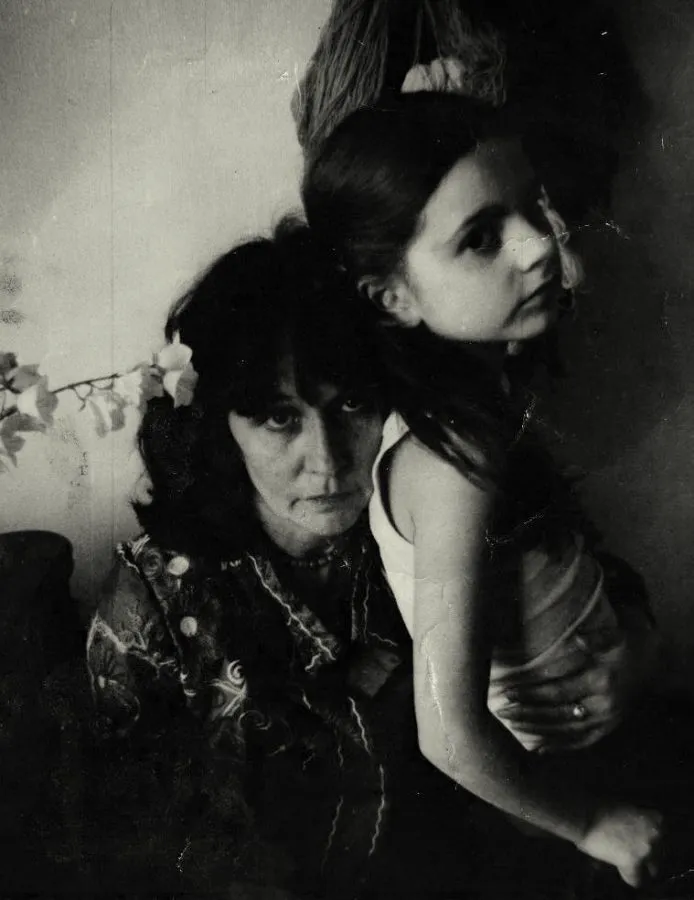
K. Y.: What were the relationships between different artistic groups in Odessa?
Y. Zh.: When mom became Anufriyev’s wife and they moved to Odessa, they settled in a communal apartment on Shchepkina Street. Sasha was egocentric and always attracted all the attention of those around him. People constantly gathered at their place, including artists who literally worshiped Anufriyev.
Some artists grouped around their own leaders. For example, Valya Khrushch [4]. He was so talented that he did not need to worship anyone. Khrushch was more gifted than Anufriyev, but Sasha knew how to gather interesting people around him, creating an atmosphere of adventure. He managed to envelop everything in mystery and a romantic aura.
Besides, all these guys, still very young then, were outsiders. They somehow got music brought by sailors. They finally found out who the Beatles were. They listened to rock “on bones” — literally on X-ray images. Some records were brought to them by sailors.
Once a person from mom’s generation told me: “You can’t imagine, Yulia, what rock and roll meant to us. Everyone on the streets was dressed in black, gray, and brown. The houses were the same — gray. Rock and roll was like fireworks for us — joyful, the brightest, the most powerful. This music simply drove us crazy.” They even managed to catch radio waves. And, of course, they read forbidden literature. I even kept some of it as an example.
I was always curious why mom, although not an extrovert — she considered herself an introvert — constantly received guests. When we already lived on Solnechnaya Street, in the morning you couldn’t open the fridge because someone was sleeping on the chest nearby, and that person’s legs prevented opening the door.
When I was little, I remember KGB searches. They took place exactly on holidays — New Year, birthdays. Every guest of ours was summoned for interrogation. Thus, the authorities deprived mom of her social circle: people were afraid to come to her. Many drank themselves into oblivion out of despair, some emigrated, and some remained here in a suspended state. When “perestroika” began, it became a bit easier, and many, on the contrary, rose on this wave.
K. Y.: How did your mother cope with the breakup with Anufriyev?
Y. Zh.: Very hard. It was the greatest love of her life. She really sacrificed a lot for him. Mom said she was everything to Anufriyev: secretary, model, lover, and wife. They lived together for seven years.
When Serhiy was born, they lived in Tashkent, in a beautiful apartment in the city center. One day there was an earthquake. The whole building collapsed, but they miraculously survived. After that, they returned to Odessa.
Sasha Anufriyev is a passionate, unstable, unpredictable, very complex person. Similar traits are in my brother too. Serhiy is also unpredictable, living as if on his own planet. There is, of course, something genius in this.
And then Sasha Anufriyev disappeared without much explanation and found another woman. Mom was left with two-year-old Serhiy — without a profession, without an apartment, without anything. But she pulled herself together. At that time, she lived with her mother in a communal apartment.
Mom studied at our university — in the graphic department of the Art and Pedagogical Institute, now the South Ukrainian National Pedagogical University named after K. D. Ushynsky. She had painting works too, although they also resembled watercolors. She was a good graphic artist and watercolorist.
Mom was a very southern gardener. Her works are characterized by delicate, tender color combinations; she loved pure colors. She was also a free listener of Yuriy Yehorov [5]. By the way, he was also a kind of leader, and I think Sasha Anufriyev learned a lot from him.
I look at Yehorov and think that there was really something magical in him. He even painted with his fingers. He was a workaholic: until old age, he got up at seven in the morning, went to the studio, and spent the whole day there. He worked a lot, extremely much — he was devoted to his talent. For mom, he was an idol. But she could not serve her own talent so devotedly because she did not believe in it much, and besides, she had too many life worries on her shoulders.
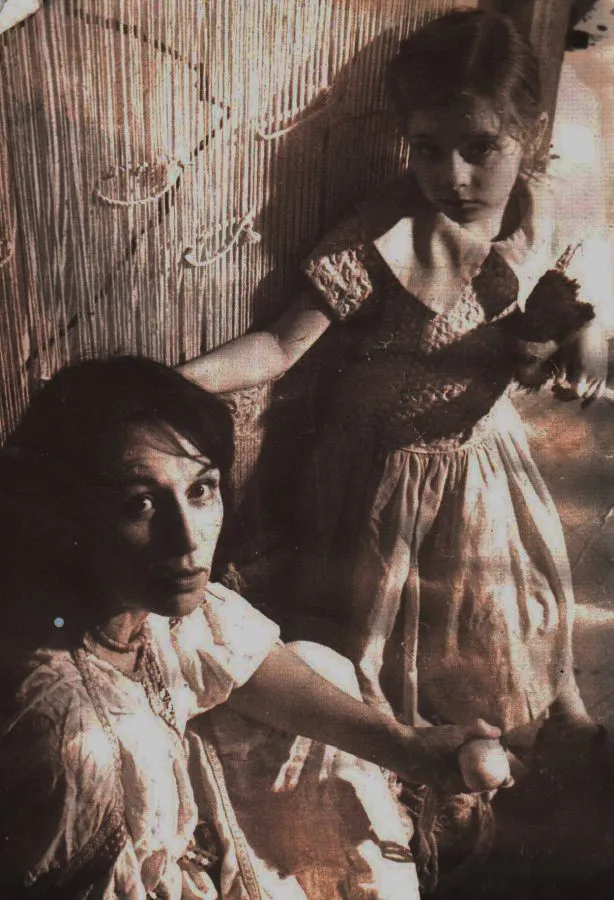
K. Y.: Tell us about your mother as an artist. Why did she decide to engage in tapestry?
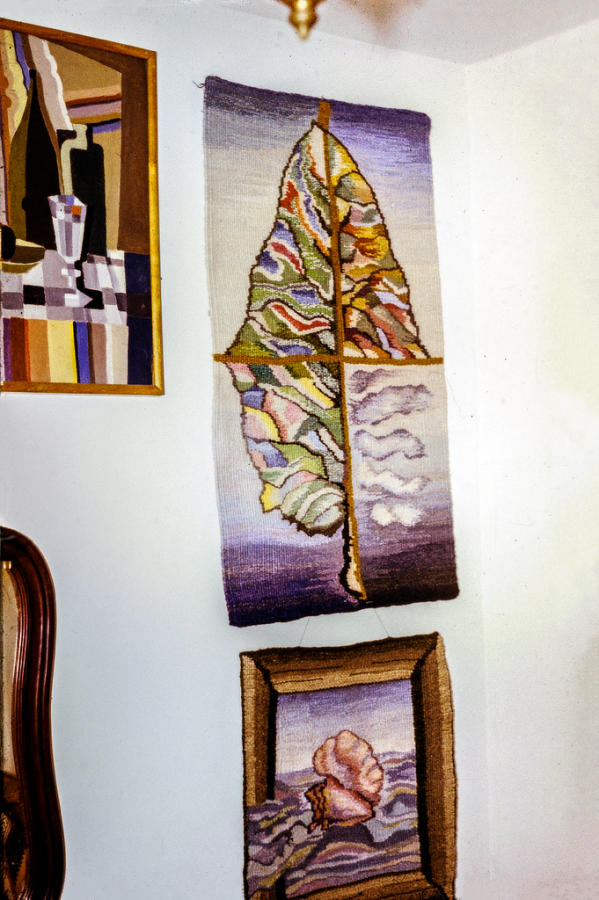
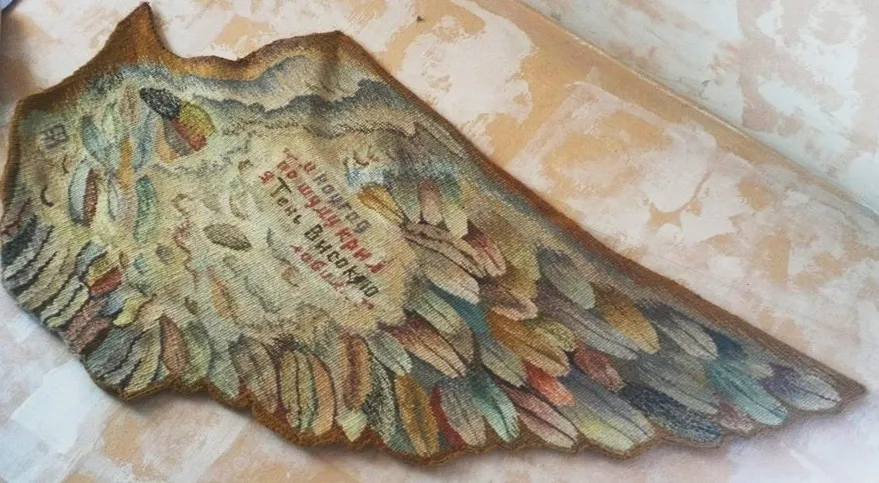
Y. Zh.: Mom was a gifted person. She went to St. Petersburg, where she studied classical tapestry with Vasya Husarov. I think she chose tapestry for the same reason as decorative and applied arts: she saw how this technique could embody innovative ideas.
The technique itself and working with such pleasant materials as threads relaxed and calmed her. This technique fully corresponded to her temperament. For me, for example, it is a difficult matter — I lack perseverance. But for her, it was comfortable, it brought happiness. This is how she distracted herself from everyday troubles and problems.
All her works are light, bright, exquisite, executed in pure colors. I remember once she bought Dutch gouache — a huge set of paint jars — locked herself in her room and worked nights.
When mom met my father, Serhiy was about ten years old. He was a wunderkind — incredibly smart, quick-witted, and charming boy. He was a unique child: very kind, smart, well-read.
Mom’s last two tapestries — the diptych “Islands” — are kept by Serhiy. These are already the 1990s. Due to illness, it was difficult for her to hold a brush. She could not even turn a key in a lock.
K. Y.: So, she raised Serhiy alone for eight years, wove tapestries at night, and taught during the day?
Y. Zh.: She studied by correspondence. She wove tapestries mainly for sale. Unfortunately, we have few of her works left. Two tapestries are with my brother. I also kept her graphics and tapestries.
By the way, mom’s best works were stolen. It happened right at an exhibition. It was already the perestroika era when it was possible to participate in exhibitions. Thanks to this, mom was given a studio and received some orders from the fund. Because it was actually unclear what all these Odessa nonconformist artists lived on. Khrushch laughed and said he lived on grandma’s savings.
There was a whole series of apartment exhibitions in mom’s apartment. Moscow conceptualist, founder of the “KD” group (“Collective Actions”) Nikita Alekseyev invented the concept of “apt-art”. Apartment exhibitions were held both in Moscow and Odessa.
At the same time, artists evaluated their own works by very high criteria. If they did not like something, they spoke sharply and frankly about it. If they liked it, they commented restrainedly: “You paint not bad, old man.”
It should be said that later mom taught for almost twenty years at the Faculty of Architecture. She taught architectural graphics. She loved students very much and was friends with them.
Since these were Soviet times, she experienced terrible pressure. She was called to party meetings. After searches in her apartment, they even wanted to expel her from the institute because of anti-Soviet literature we kept at home — the magazine “A-Ya” and some American magazines. Because of all this “anti-Sovietism,” the rector summoned her.
Then the head of the Department of Building Physics, a convinced communist who was dean of the faculty at that time, S. V. Nepomnyashchiy, stood up for mom. He stood up and said: “How can you be ashamed! She is an excellent specialist!” So mom stayed at the institute.
When perestroika began, all those who previously disliked her began to apologize. It was a terrible moment — even worse than harassment.
K. Y.: How was your mother’s work perceived in this artistic environment? How was her creativity evaluated?
Y. Zh.: Her works were really evaluated quite highly. But mom still was not completely confident in her own talent. I believe that if she had more opportunities to develop in this direction, the results would have been even better. Although I like her works very much as they are. She experimented a lot, created many collages.
Mom believed that Lyuda Yastreb [6] was much more talented than her. Lyuda became a symbol of Odessa nonconformism, largely thanks to the work “Non.” Besides, she was able to distance herself from all everyday problems and devote herself only to painting. Mom did not have such an opportunity. She had to scatter her forces and solve many different tasks.
When Lyuda learned about her illness, she began to work like crazy. And she really created quality works. She was an outstanding person.
K. Y.: Was your mother friends with Yastreb?
Y. Zh.: It was a true, deep friendship based on mutual understanding. So close that Viktor Marinyuk, Lyuda Yastreb’s husband, became the godfather of my brother Serhiy Anufriyev. And mom was a bridesmaid at Lyuda and Vitya’s wedding.
When Lyuda died of cancer, she was thirty-six years old. Her son Andryusha was then sixteen. Mom took him to us and raised him almost like her own son. He lived with us for several years, becoming another family member.
At home, we held apartment exhibitions. They exhibited works by Sasha Roitburd, Andriy Marinyuk, my brother Serhiy Anufriyev, and other artists. To a large extent, everything that happened on Solnechnaya Street already belonged to my brother’s generation.
My father received the apartment on Solnechnaya Street from the Polytechnic Institute. He was a Doctor of Philosophical Sciences, translator of Arnold Toynbee. In the 1980s, he also went to America and taught at a university in Los Angeles.
K. Y.: How did your mother react to Serhiy’s decision to become an artist and his move to Moscow?
Y. Zh.: Serhiy even scolded himself for the bad habit of drawing. We all have something similar — some habit, something attached to the hand that makes you draw. However, before leaving for the States, his father managed to teach him and show certain principles of graphics.
My father was a scientist and translator, a real walking encyclopedia. But he was also a dissident. He was not in the party, because of which he was persecuted at the Polytechnic Institute where he taught. Eventually, he moved to the States.
Here, in Odessa, he was able to provide Serhiy with a good home education. But Serhiy was quite antisocial, he did not even want to finish high school. Eventually, he finished it in a nearly grotesque way, entered Moscow State University in the psychology faculty, but studied there for a short time.
Under my father’s influence, Serhiy, of course, studied ancient dead languages and dreamed of becoming a scientist. But he was disgusted by all these Soviet social systems. Besides, because of his bright appearance, he risked being drafted into the army and sent to Afghanistan. Mom was very afraid of this. At first, she tried to protect him from this, and then sent him to Moscow.
K. Y.: Did you also draw? Did mom teach you to draw?
Y. Zh.: I did not attend art school. Mom taught me the basics of academic and spatial drawing. I am very grateful to her for this. Sometimes she was a harsh person. Perhaps that is why she managed to achieve certain results in teaching me, despite my terrible laziness.
In childhood, I also drew a lot, but later I began to protest — adolescence came. Then I hated drawing. Probably, such a period was inevitable, but eventually it passed.
When I already had a son, I went to Saint Petersburg, where I met my favorite “Mitki” [7]. They were the ones who rekindled my love for drawing and showed me a completely new approach to creativity in general.
My mom was also friends with the “Mitki.” They remember her well. In general, Muscovites, Kyivans, Odessites, and Petersburgers knew each other. Therefore, it is interesting to observe how different these artistic schools were.
When I saw Vladimir Shinkaryov’s works [8] in Petersburg, I realized that it was a real kingdom of gray color. Very cold, mournful, piercing gray. And our artists — I do not like the term “South Russian” — are closer to the Italian tradition. This was characteristic of mom too, although some of her works are done in very delicate shades. Others burst with color — as if she lives in Provence.
K. Y.: How did your mother feel about Odessa?
Y. Zh.: Life carried her to different cities, she traveled a lot in general. But mom loved Odessa. And what she liked most was what I absolutely dislike — the cult of Odessa. As Sasha Roitburd [9] aptly called it, “smt. Odesochka.” And I completely agree with him! But mom liked it all. She thought it was cute. I think she just managed to look at everything from the side and see a special color in it.
Mom said she had Polish roots. It is quite possible that we also had Jewish origins. So, being in Odessa — a city with a very large Jewish community — mom felt comfortable.
K. Y.: Tell us about the period when she headed the Center for Contemporary Art “TIRS.”
Y. Zh.: This was preceded by a long path. At first, my parents somehow did not accept contemporary art. Serhiy with his avant-garde initially found no understanding either from mom or, even more so, from my dad.
But suddenly there was some turning point, and mom decided to engage in contemporary art. Everything turned out so that she was offered to become the curator of the first contemporary art museum in Ukraine. She simply burned for it.
At that time, there were two architects in Odessa — Semen Kalyka and Heorhiy Kotov — who decided to go into business. I no longer remember exactly what they did. When their business took off, they decided to become a kind of patrons and finance Mykhailo Beschastny’s film Impressions.
The next step was supposed to be the opening of a gallery. But Kalyka and Kotov decided to go further: instead of a gallery, open the first contemporary art museum in a historical monument — the Shakhsky Palace, where they were conducting restoration work. The entire second floor was given to the museum. There were amazing stairs!
Mom worked there. I helped her. Together we organized many exhibitions. When she got sick, she completely handed the work over to me.
Even when her speech was seriously impaired by illness and she could no longer speak, mom continued to write art criticism texts. She was a strong person, full of hope and a desire to implement her own creative ideas. It’s a pity it ended like this…
All photos provided by Yuliya Zharkova.