
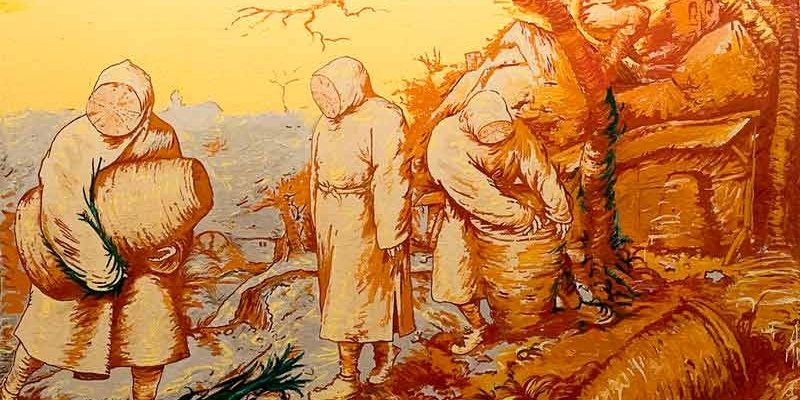
This text was written by Oleksandr Solovyov in 1989 after a landmark republican exhibition of young artists, which included representatives of the Paris Commune squat, soon to become one of the important centers of artistic life in Kyiv. However, the article remained in the author’s archive in typed form and has not yet been published. After 27 years, this text allows us to hear the voices of artists, including those who have long since left us. Perhaps for the first time here, Holosiy and Rayevskyi speak, interviews with whom are very rare. Solovyov’s text allows us to be transported to 1989, into the space of some kitchen or smoking room, and overhear a conversation among artists about what and how they create, to learn how they think, what they feel, what they talk about. Perhaps all this was said not seriously or, on the contrary, too seriously. By revealing this seriousness (or unseriousness) to us, the text provides a key to understanding the artists’ works themselves. The title of the article is the name of a popular carbonated water with ginseng extract that had just appeared on sale at that time. It could be bought at any kiosk on the streets of Kyiv.
Kateryna Yakovlenko
The exhibition of Kyiv’s “big seven” (although it could have been an eight, nine, and so on up to… two and one) falls at the very beginning of 1990.
This coincidence itself tempts one to encroach on the virginity of the nineties as a springboard for the advent of the dual end of the still only century-millennium or, in the worst case, to the destruction of the still “warm” love—the eighties. With their global “birth, rise, and… decline of the transavant-garde” (quoted from V. Tupitsyn), but also with the statement of a “spontaneous surge of postmodernist baroque in Kyiv” (quoted from O. Kovalov) in the specific conditions of the confused staginess of all our art in relation to the global one.
However, avoiding such temptation, which could result in a form of representative disclosure of such a paradoxical surge-decline, is neither the task nor the problem of this text. Nor is it to reveal the causal relationship within the “Kyiv phenomenon.” And not because, as the evangelist Luke would write, “we do not know where from,” or, following Zhuangzi’s message about “concealing the uninitiated,” but on the contrary.
It will not be about those qualities of the phenomenon when “its name is region” (see “Rakurs” in DI USSR, 1989, No. 12), nor about any fundamentality of the exhibition, which might suddenly want to encroach on the relative foundations or “fundamental indifference” (according to B. Groys) of the current Context. But it will be about the case of surprise—the surprise of the exhibition, which most captures, retains some vital state of the moment and least generalizes—but in some ways, however, also exposes the degree of internal kinship, the end of “oni-tauvu” (Fijian legends).
This is the case when, in Sartre’s interpretation, every event is considered a case. A case that holds a chance. A chance that is either used or unused, or remains unnoticed.
All this urges one to neglect that form of presentation where the informative fact reigns and develops in logical sequence, successive “analyses” of paintings, fruitless attempts to penetrate the hidden meaning of the image, and instead choose again the vital, optimally labile, that which “shifts meanings” even more, direct speech—a form close to collage dialogue… After all, “… all the time you want to escape from a concrete definition, some animal instinct, the desire to slip out of hands—you will be described, ringed, limited,”—enters the conversation O. Hnylytskyi,— “you want, constantly fleeing, to conquer some quiet corner for yourself: something your own, only your own, which after disclosure already fits into some seemingly already lived camp, museum, hostile, chasing you like an avalanche, and this just supposedly lived work becomes an enemy—on the other side; some fear of what has been experienced, some phobia; but this is like a method of movement, like a strategy, and does not concern the rest, there are many more tricks and contortions for escape—you can pretend to be an idiot, or a child, or [someone else].
— And how would you ring yourself?
O. H. [Oleksandr Hnylytskyi]: Persistent absence, presence that slips away, ringing silence, conceived emptiness; sensual truths—a sign of the era, incapable of unconditional affirmation; a symbol of the short equilibrium of being on the path from death to life, to death.
— Could V. Rayevskyi say a few words about the semantics and aura of his works in the aspect of neo-baroque, which is projected by a number of critics onto the contemporary Kyiv situation?
V. R. [Valentyn Rayevskyi]: Absurdized image-signs, survived from the dark depths of memory, the Primordial Sign, form a new sign, a new romantically absurdized environment. Each work is a theatrical multi-action of unrelated detached images and pseudo-plots. The plot is only a pretext, a provocation of energetic self-eruption. Memory crosses out childhood, dreams a dream that lasts forever… Baroque here is only language. It feels the sweet taste of the end, the end of love, the end of an era, the dense aroma of imminent death. The works are generally about the “other.” And what difference does it make in what language. Although it is pleasant to bathe in the baroque syrup of fluffy illusions for everyone, even when the “other” is indifferent—everyone must be loved. Baroque in our tradition is a regional and temporary symptom. It is pleasant, flying over one after another the seven hills of the Third Rome, to touch [the folds] of the tailcoat of lush busts of self-sufficient “Roman women” or to sit on the edges of petrified chimeras of unearthly fertility.
— They say postmodernism is experiencing a crisis. In the era already called “fundamental indifference,” reality itself reduces semiotic systems, which seemed always to be the main priority of postmodern art. It is interesting how H. Senchenko feels in this “situation”?
H. S. [Heorhiy Senchenko]: I think the artist’s relativism today is connected not so much with the ontological, much less with the social perspective, but with the anthropological perspective. Accordingly, the citationality of the situation seems to me to be the result not so much of the desire to reveal objective social-sign statuses and contexts of quotations, but of the recognition of the symbolic nature of the experience of the external world. Hence the loss of distinction between proper linguistic quotations and quotations in essence—from the world, so to speak, of facts and objects, and the definition of the above as a world of phenomena that has the ability to reflect that special type of transsubjective reality latent in the subject itself and constituting, apparently, the very concentration of our being.
— Another “illusion of subjectivity”?
H. S.: I anticipate possible skepticism; for this case, I have a quote (nothing can be done) from the “Tibetan Book of the Dead”: “… to recognize the emptiness of one’s mind as Buddha-like and at the same time observe it as one’s own consciousness.”
— You know, talks about emptiness seem to have become a commonplace in today’s cultural environment.
H. S.: Still, I have always tended more to silence on this matter, and indeed to silence in general. As is known, they talk all their lives—and say nothing, they are silent all their lives—and nothing remains unsaid.
— However, recently you have not often repeated sayings like “A great artist does not paint pictures.”
H. S.: Yes, I no longer have illusions about my greatness.
— Well, say, is the secret of “Sacred Landscape…” not connected precisely with the demonstration of such devotion? Or still with the original primitiveness of one’s own meaning as transferable, which is revealed in reproduction?
H. S.: Indeed, the classic deconstructivist task is solved here not by the traditional way of establishing a new boundary of meanings through the destruction of the existing one. Rather, I was driven by the desire to test through the description of meanings the very limits of existence. At the cost of revealing the limits of experience, to feel the birth of a constantly ongoing moment of transgressive transition into the “other,” whose cyclicity is connected with the doom of discursive attempts: through the simulation of the author and the profanation of the pictorial gesture, self-removal of the image, further—to the very source of the expressive act, to that unobjectified reality where, in fact, all discursive possibilities break off, there, where such less reliable values as the resilience of the spirit, taste, and risk, noble trust in nobility come into force.
— Well then, the invitation is accepted. Now I will turn to V. Tsagolov: how does he view citationality from inside his works, where “verbatim excerpts” from the archive text of world visual practice are also often not hidden?
V. T. [Vasyl Tsagolov]: Self-profanation gives life to the image beyond the depiction, beyond the situation, the action: the painting, its entire plane—is now a single image, a single body that creates itself as artistic consciousness: such, it is open to all artistic practice but refers nowhere. Recognizable—not quotations, but, once again, the very body of the painting. Therefore, this is a cold, dead quotation, dead fabric, which does not join the cultural game and does not breed eclecticism.
— And what would O. Holosiy say about his own, I dare say, paintings and quotations?
O. H. [Oleh Holosiy]: The I-painting differs from the “I.” The first is sometimes very passive, but sometimes—on the contrary. The second is often completely free, but this does not mean discrimination of one by the other and vice versa. In general, they are friendly. Except for the case when they hate each other. The thinnest dramaturgy stretches to the horizon lines and tries to grow into something that is the essence of the process; sometimes it seems that the essence of everything is precisely the question. My sadness is boundless, I do not want to be someone, something. Something tells me that it is better to be emptiness after all. Suddenly I am afraid of any movement: any movement is a lie. I am most there where I am not. Everything wants to become a rehearsal of one’s own life. If you lie on your side for a long time—the side goes numb. The side is given. My side is myself, my side is Uccello, my side is Nietzsche, Piero della Francesca, Warhol, Kafka, Sartre, Botticelli, Duchamp… Everything cannot be listed. I am multi-layered. Sometimes it is pleasant when the side goes numb. Sometimes I want to howl. Questions worry, arise, branch out—this is already my separate side, and it is also beautiful. In a person, any side must be beautiful.
V. T. [Valeriya Trubina]: I want to reflect on mutability (“prevratnosti”) and pretense.
Mutability (“prevratnost”)— vrat, to turn, to turn, to turn, to turn.
Privratnost— gate, return, return.
Mutability—the one who turns, lies, turns.
The guard (“privratnyk”)— the one who stands nearby, meets, sees off, etc.
Hypocrisy (“prytvorstvo”)— creativity, theft, creation, ease of action, or the one nearby, the one who does so.
There are a huge number of such series of meanings, with which one can fill or flood the entire Russian language (without knowing it), not to mention Chinese. Choosing any pair of words of the appropriate theme.
Therefore, speaking about “creativity” with the above emphasis, one must consider the question of the naturalness of its origin. So, the essence is to lie, steal, turn. To turn, transform, which further, in fact, does not matter what, but how. And then it is not so important how, but why. And this question is the one we most often stumble upon, because the answer to it “depends” or no longer depends on whether to do or not to do, but not “to be or not to be” and not “what to do.”
— A question to V. Tsagolov. From your reasoning above, it occurred to me about some insurmountable disconnection of artistic consciousness and the painting, naturally, in its external conditional interpretation. What can you add in this regard?
V. T.: The author has the unique right to be the first to interpret his work and impose the being conveyed through interpretation on the viewer and seemingly on the painting, but I must warn, this is an illusion that somehow suits everyone, including the author. Painting not only cannot appear as a voiceless adequate interpretation—it is not even able to be the language of its own element. Or, in other words, only language, a linguistic flow. Therefore, the painting always truly remains silent, and we do not hear its contradictions and self-destruction before it takes shape as language. It does not want to speak, explain—it wants to be simply a fact, an unnamed act, moreover, an unseen fact. The painting ceases to be. It becomes inaccessible reality.
— And again, returning to the first reasoning, what is self-profanation?
V. T.: If we accept thinking as “metaphorical despair,” then the metaphor itself, the movement in it, is destruction. Only the absence of metaphor, complete indifference, or complete obviousness that does not require reflection can create. Hence non-interference in the very creation. In processes, fate. The most significant thing one can do for the “common good” is to quietly and imperceptibly disappear, leaving no trace of authenticity… The image, in my understanding, is fundamentally inexpressible, has no boundaries, and any form of its “expression,” giving it “corporeality” is imperfect, moreover, destroys the image. Therefore, there is no need to invent, introduce new images into the world by willful effort, but to go the natural path of total self-profanation, forgetting the previous and not offering anything new instead—to absence and emptiness, even non-Zen. This is the path to freedom from all and everything. The ranges of such freedom: self-profanation—self-exhaustion—death—the sequence is arbitrary. I would crown my reflections on the idea of self-profanation by saying that I see nothing that would significantly distinguish one thought from another, and all the above can exist simultaneously—as a possible assertion and as something that has melted in the atmosphere of absurdity of this setup.
A question from one of the non-participants of the exhibition: “Do you only have a toilet downstairs here?”
V. Trubina continues to reflect on self-revelation: Form is not I (we, they) possess the form, but it possesses me, because I am also only form. And, therefore, the question of form falls away by itself, because one cannot speak about oneself—it will be subjective and uninteresting. Then one needs (can) to speak a lot, and this will already be literature, and therefore another form. That is, I am form, form corresponds to I and = not I, also form, purified, but the purification of form leads to its expansion, spread, transformation, and dissolution, and therefore to presence everywhere (by the way, about feces and urine). “I” is everywhere and “I” do not choose myself, the same can be said in other words. And it does not matter what, because “everywhere.” And in “nowhere” too. Thus, in the end, a general, all-encompassing deception, from beginning to end, from illusions, imitation to illusionism, to play, through self-deception, self-revelation. Moreover, self-revelation, in essence, is the greatest deception because the main thing is revealed—that deception is everything. But a paradoxical thing happens. The focus is shown, but the secret is unknown: the more is shown and is shown, the less clarity. The deeper and more mysteriously the meaning, the intention of creation, action, purpose is hidden. Since there is no goal itself, because it is everywhere and in everything, and any concretization destroys it, in the sense that the goal constantly slips out of the sphere of form activity.
Finally, since A. Savadov did not participate in recording the dialogue, having gone to paint in Paris, he has nothing left but to answer the questions with painting itself.
From Borges’ “Dialogue of the Dead”: “they said no more words because at that moment someone called them.”