
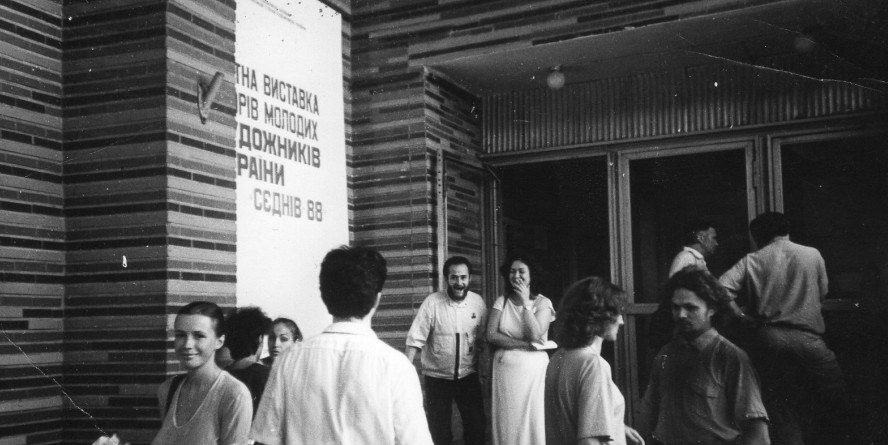
Tiberiy Silvashi is a prominent figure in contemporary Ukrainian art: a renowned artist, an outstanding cultural promoter, and an initiator of new artistic phenomena. Over the past fifty years, Silvashi’s name has appeared at every point of extreme tension and concentration of creative forces. Three trips of the youth section of the Artists’ Union to Sedniv—in 1988, 1990, and 1991—became precisely such moments when a new artistic reality emerged from the ruins of the old system.
Olga Balashova spoke with Tiberiy Silvashi about the relationship between official and unofficial art in Soviet Ukraine and about the formation of the first generation of artists of independent Ukraine.
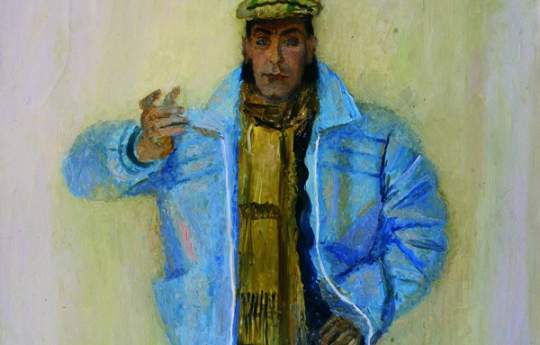
Olga Balashova: Critic Kostyantyn Akinsha, who came to Kyiv at the invitation of PinchukArtCentre, stated that there was no “other” art in Kyiv, only boring official artists. This opinion is shared by some artists from the “Paris Commune” circle. How fair do you find such a judgment?
Tiberiy Silvashi: Probably, Akinsha has his own very clear definition of what art is and what is not. This is an example of performative statements that say more about the aesthetic identity of the person making them than about the phenomenon itself. It is the statement of a fan, not a researcher.
I think today such a view is already irrelevant. It was precisely at the end of the 1980s that the term “permitted art” arose—it reflected the same black-and-white, simplified view of the artistic situation of that time.
Today we must consider this period in its historical context, try to understand the full complexity of relationships in society and the artistic environment, the entire drama of individual fates at the end of the Soviet era. So I would not be so categorical.
One of the shortcomings of Ukrainian art is that for each new generation, art history starts from zero—from their appearance on the artistic scene.
Another mistake, in my opinion, is to consider the Kyiv situation as analogous to Moscow’s. Obviously, such an approach is wrong. Each Ukrainian artistic center had its own characteristics, and they did not necessarily correspond to what was happening in the metropolis. We still have a postcolonial syndrome. All this awaits its historian and researcher. Otherwise, it is impossible to understand the entire period from the 1980s to the 2000s.
I think there was no such underground in Ukraine as in Moscow—it had a different character. The main enemy of the authorities here was nationalism. This was the difference from the Moscow situation. Of course, there were also aesthetic differences.
O. B.: Why do you think such an underground did not arise here as it did there? Were there not such radical people?
T. S.: Here again arises the problem of definitions. Probably, the “Lianozivska group” was radical compared to the socialist realists. Its members thought differently and did not associate themselves with official art. The same applies to the “Collective Actions” group: its aesthetic model was different.
It seems that there was no such thing in Kyiv. I cannot speak about other cities—I do not know. But undoubtedly, there were separate groups and individuals in Ukraine who were radical against the background of the main mass of the Artists’ Union (AU).
For example, Fedir Tetyanych was a radical artist, although at the same time he had official status: he was a member of the AU, worked in the monumental workshop, received commissions, and earned money. But simultaneously, he engaged in a separate practice, which we now know as “Fripulia.”
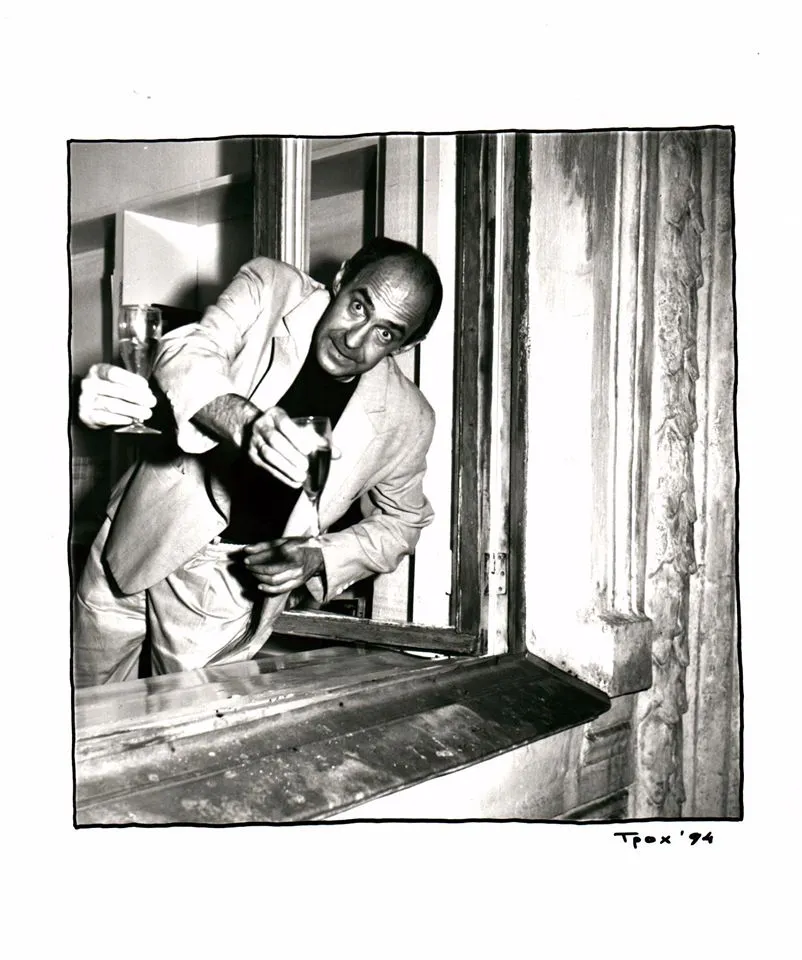
Radically thinking people often ended up precisely in the monumental workshop: there it was allowed to work with “simplified” forms and plastic metaphors. And simultaneously, in their studios, they created paintings, sculptures, and graphics, which mostly were not exhibited. Who, besides a few friends, saw the works of Valeriy Lamakh, Ernest Kotkov, Sasha Dubovyk, Sasha Pavlov, which they created not on commission? And these are only a few names.
I think the situation was similar in other cities. Some simply left. For example, hyperrealists Serhiy Heta and Serhiy Bazylev. In Odesa, artistic life had a different character. And Lviv, Kharkiv, Uzhhorod, Poltava, and other cities are still waiting for their researchers.
O. B.: So, if today we begin to talk about art that cannot be fully called Soviet, about some parallel history, are we simply inventing a new myth?
T. S.: Myths arise where there is a void—where history has not yet been described and comprehended. And then they become a convenient object of valorization. Perhaps this is also a consequence of thinking by analogy when we try to comprehend and describe our own history by foreign templates.
Where to place artists who can be called dissidents but who at the same time were members of the AU? Yes, some of them were expelled—we know these tragic stories. Formally, it was Soviet modernism, allowed only in the monumental workshop. At the same time, it continued Lenin’s plan of monumental propaganda.
There was, for example, Florian Yuriev. To which history should he be attributed? Is Parajanov Soviet art? What about Zoya Lerman? What about Havrylenko? What about sculptors Hrytsiuk and Sinkevych? Chronologically—yes, but in terms of their aesthetic ideas, they did not fit into the conventional understanding of “Soviet,” no matter what we put into this concept. Except perhaps recalling Roger Garaudy’s definition—”realism without borders.”
And what to do with artists who do not fit into the black-and-white scheme of “traditionalists—radicals”?
Let us not forget another aspect. You graduate from an institute, become a professional. There is an established system of art functioning. Yes, it is ideologized. In Soviet times, without being a member of the Union, you could not fully engage in your profession. Therefore, most of those for whom art was the first priority inevitably chose this path.
Different artists joined the AU, and not all of them will appear in art history textbooks. The levels of talent, education, luck, diligence, strength of character, and ability to resist ideological pressure varied.
Ignoring the existence of the AU and disregarding it became possible only later, after gaining independence, when the ideological dictatorship disappeared, there was no longer a need to ask permission for an exhibition, and no one came to close it. The exhibition system changed, galleries appeared, and the Union lost its privileged position. The time came when being a member of the AU or not became a personal choice.
O. B.: Why then did such a situation arise in Moscow if the ideological system was common?
T. S.: I don’t know. In general, I am not very well acquainted with nonconformist associations and movements—neither in Ukraine nor in Moscow. I observed all this from the sidelines.
But today it is clear that even within a single, “common history,” there were different variants. Perhaps in Russia, they simply allowed it. Perhaps there was more information there—after all, it was the capital of the empire. Let us not forget that in 1956 there was an exhibition of American art in Moscow, which, according to many artists, had a huge influence on them. There were libraries. Despite strict access restrictions, much could be seen and read. It is usually believed that conditions were harsher in Ukraine.
I will give an example from my own life. In Moscow, we were friends with Tetyana Nazarenko and Nataliya Nesterova. They belonged to the “left” MOSKh. For example, in the Artists’ Union restaurant on Gogol Boulevard, hardly anyone with opposing views would have sat at our table.
Could that have happened here? I don’t know. Maybe. At that time, I rarely attended artists’ gatherings. But artists who gathered at Viktor Ryzhykh and Halyna Neledva’s on Perspektyvna sometimes could sit at the same table without observing hierarchies—from Shatalin to us. Although this mostly happened on anniversaries.
Yablonska, for example, could say: “I can’t stand those black colonels, but you can talk to Shatalin.” However, the term “black colonels” referred rather to the AU leadership.
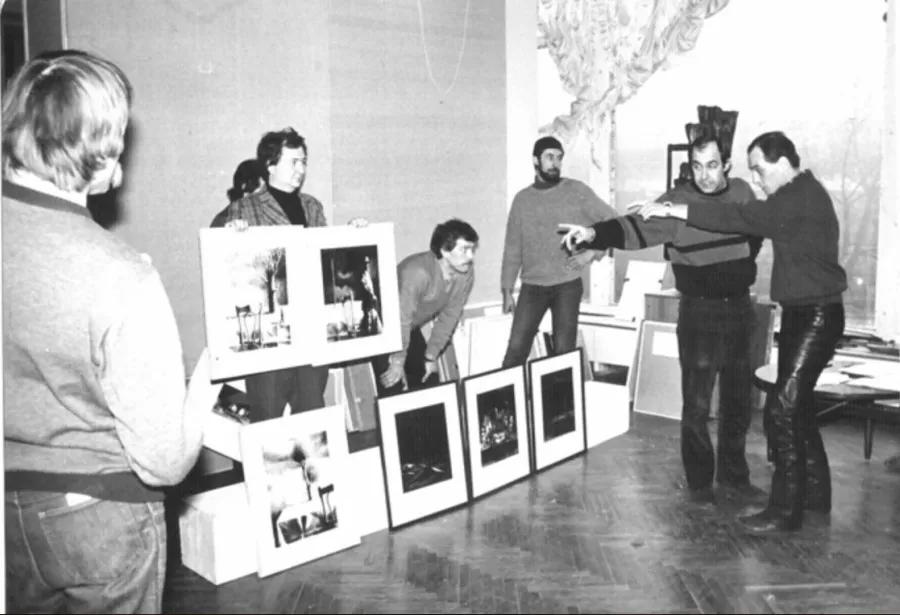
In general, it is difficult for me to describe this side of relationships. At that time, Neledva said I sat in the studio like an anchorite. When I started working in the AU, I changed my lifestyle and rarely appeared in the studio for two years.
O. B.: Was Yablonska closer to you or to them?
T. S.: She was a separate personality who belonged neither to “them” nor to “us.” I think such a definition would amuse her or maybe even upset her. Of course, she was a person of the official artistic establishment: an academician, professor, member of boards. But she could quite afford many aesthetic liberties that appeared then. She was a person of broad views. Although I am sure she disagreed with many things.
O. B.: You were involved in the emergence of a new generation of artists in the western USSR. Pavlo Makov once admitted that it was in Sedniv that he first felt part of a generation. Did you and Oleksandr Solovyov intend to form a new generation of artists? Did you set any aesthetic tasks?
T. S.: At the end of the first Sedniv, I felt that it had happened. I even said in one interview that the fate of all who came to Sedniv in 1988 and then returned there a second and third time would have formed anyway. But it so happened that Sedniv turned these young artists into a generation.
Of course, we did not set any specific aesthetic tasks. At least none clearly formulated.
It was already clear then that everything had to change. But how exactly—no one knew. Young artists were already creating works that soon became iconic, changing optics and ways of thinking. Youth exhibitions in 1987 in Moscow and Kyiv allowed seeing these works. At the same time, they revealed certain problems.
Our response to them was the idea that arose during the work of the exhibition committee of the youth exhibition: all selected artists had to be gathered together. Just gather, accumulate their energy.
I believe that if a group is at least ten percent successful, that is already a success. Because the remaining ninety percent are also involved in the situation, in the process that transforms their consciousness and sooner or later will make itself known.
There are artists with an instant reaction who immediately catch new ideas. They start very quickly thanks to their gift. And there are those who need more time to get going. What happened in Sedniv can give results even after twenty years because the corresponding impulse was laid in the intensive work during each visit.
O. B.: Tell us how this idea arose, how it all began?
T. S.: It all began at the exhibition committee of the “youth”—that’s how we called regular youth exhibitions. I participated for the first time in the work of the exhibition committee. Two weeks before that, I became the head of the youth association of the Kyiv Artists’ Union and one of its secretaries.
It was precisely that moment in history when it became clear that something could be changed. I came out of my rather closed environment and immediately joined organizational work, which I had previously known only from others’ stories. I did not quite understand how the whole system functioned, and here I had to immediately plunge into the very thick of AU affairs and the restructuring exhibition committee.
Usually, exhibition committee meetings were held behind closed doors. But for the first time, everyone interested could be present and see who voted how. By the way, the exhibition committee included young artists and art historians. I don’t remember all of them, but among them were Serhiy Yakutovych and Sasha Solovyov. In total, I think about fifteen people. It seems the late sculptor Vitaliy Shyshov was also there, the author of the monument to Princess Olga on Mykhailivska Square—a reconstruction of Ivan Kavaleridze’s monument. (Ed.)
Later, with Volodymyr Bondarenko from Kharkiv, we created a wonderful exhibition.
O. B.: Why was it so important to get into this exhibition?
T. S.: What did the exhibition committee mean in the life of a young artist who wanted to join the AU or at least the youth association? To get a recommendation to the Union, one had to participate in at least five republican and three all-Union exhibitions. Of course, for an outstanding work, one could join without meeting these requirements, but such cases were rare.
So the desire to get into the exhibition was huge, but no one knew exactly what the exhibition committee would like. A young artist brought four or five works, absolutely different in style, hoping that at least one would be accepted. And so it was.
This was one of those psychological problems we wanted to overcome. If it was clear that a person was talented and could do a lot, we could ask:
— Do you have more such works?
— Yes!
— Then take these away and bring others tomorrow. We’ll look again!
And people brought them, and we accepted their works.
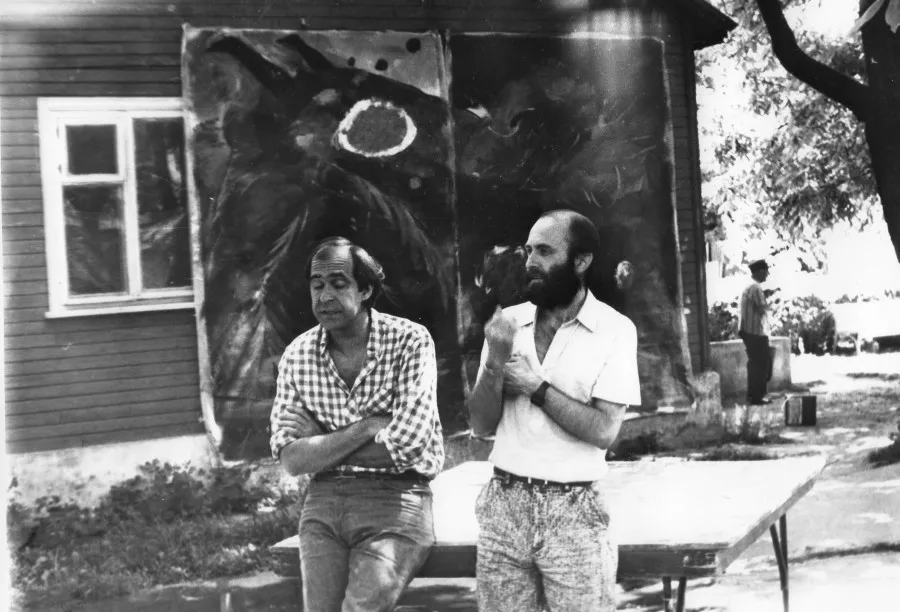
Of course, there were many disappointed. A significant part of artists continued to live by old stereotypes, by inertia. There was a lot of opportunism and no less helpless works. Only one thing was clear: something was changing, but what exactly was still unclear. There was a wonderful atmosphere of uncertainty. It was this that prompted gathering talented but confused people together.
Of course, not all were like that. Many artists were already formed and had strong works that were accepted unconditionally. Roitburd, for example, brought works to Kyiv almost in transit: if accepted—good, if not—he would take them to Moscow. But everything was accepted from him. He walked excited and joyful—there was nothing left to take to Moscow.
It was also important to collect information about the selected artists. I asked Sasha Solovyov to record their phone numbers and addresses so we could keep in touch. Thus, an archive of new young art began to form.
We understood that we would not have time to go to Sedniv that same year: it was February, and youth groups came there in April-May. So we had to wait for the next year. I immediately applied for two visits to Sedniv.
During the first visit, there were only 45 places, but about a hundred artists were selected. So some came only the second time. For example, Kolya Babak could not come to the first Sedniv, so he joined the second. Hnylytskyi also did not come on the first visit but came to live. Zhyvotkov was working on his diploma, so he missed the first visit but came to the second and later became a regular participant.
Some came only for a week or on weekends. I was told that some even lived in tents. But a core immediately formed—about ten people who participated in all visits.
O. B.: Can you name them?
T. S.: There were Makov, Heyko, Roitburd, Kerestey, Sashko Babak, Seryozha Panych, Vysheslavskyi, Roman Zhuk, Pokydanets… You know, I’d better not name more names because then I’d have to recall everyone. Besides, the composition of participants changed: some stopped coming…
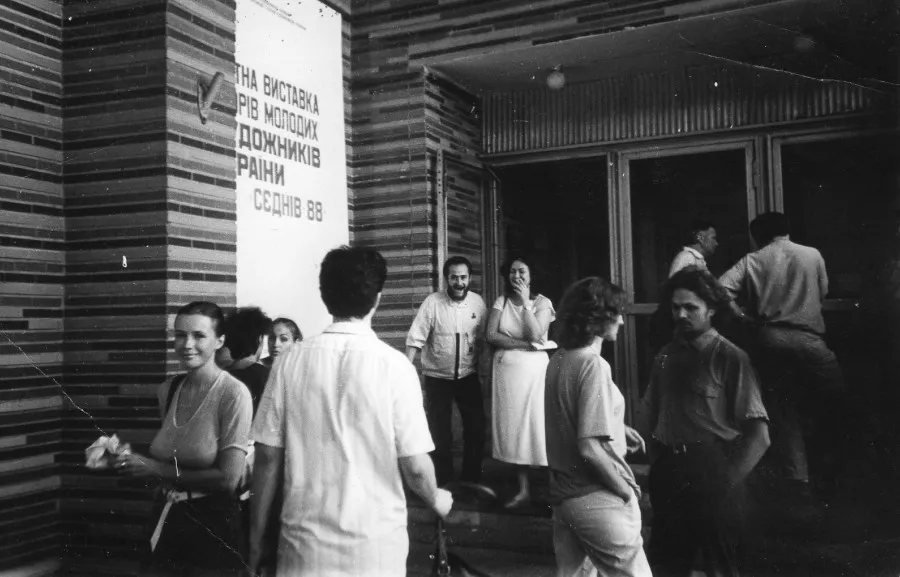
At the second Sedniv appeared Holosiy, Trubina, Vlodko Kaufman, Volodya Yakovets, Mykola Babak, Lyoka Ryzhykh, Seryozha Semernin, Anya Sydorenko, Biba, Pasha Kovach… That’s all, I won’t name more. Of course, after the success of the first Sedniv, everyone came to the second. At the third were Kryvenko, Kryvolap, Lebedynets… In a small hallway, Shereshevskyi sat with his canvases. Kostya Pobedin came from Moscow, Akilay Zell from Vienna, German artists.
The elder of the second and third visits was Dima Fishchenko, now a political technologist.
And, of course, there were art historians in the group. It seems this happened for the first time: art historians worked together with artists. It seemed important to me that they enter professional life as one generation. Lesya Avramenko, Ira Panych, Eduard Dymshyts, Oleg Sydor-Hibelinda… There were about five art historians in each visit.
This is not an attempt to single out individuals from the total number—about 150 participants of the three Sednivs. Rather, it is about giving concreteness to important episodes that took place at a certain time. The time will come to publish a book about these three visits and name all the names.
O. B.: Is there anything you would do differently or change now, knowing what all this would lead to?
T. S.: No. I would not change anything because this is precisely the case when you plan one thing, and life and circumstances develop and complicate the plan.
The necessary proportion formed between already mature, formed artists and those who had not yet defined their aesthetic program. Some understood what to do with the freedom that suddenly fell on their heads, and some in this “melting pot” managed to find their own guidelines or strengthen their positions.
I don’t think among the artists we selected there were those who intended to paint studies and nothing more. But even if there were, seeing what was happening around, they would begin to reconsider their priorities.
O. B.: Did you discuss this confusion, talk about new rules of the game, about what to do with this freedom?
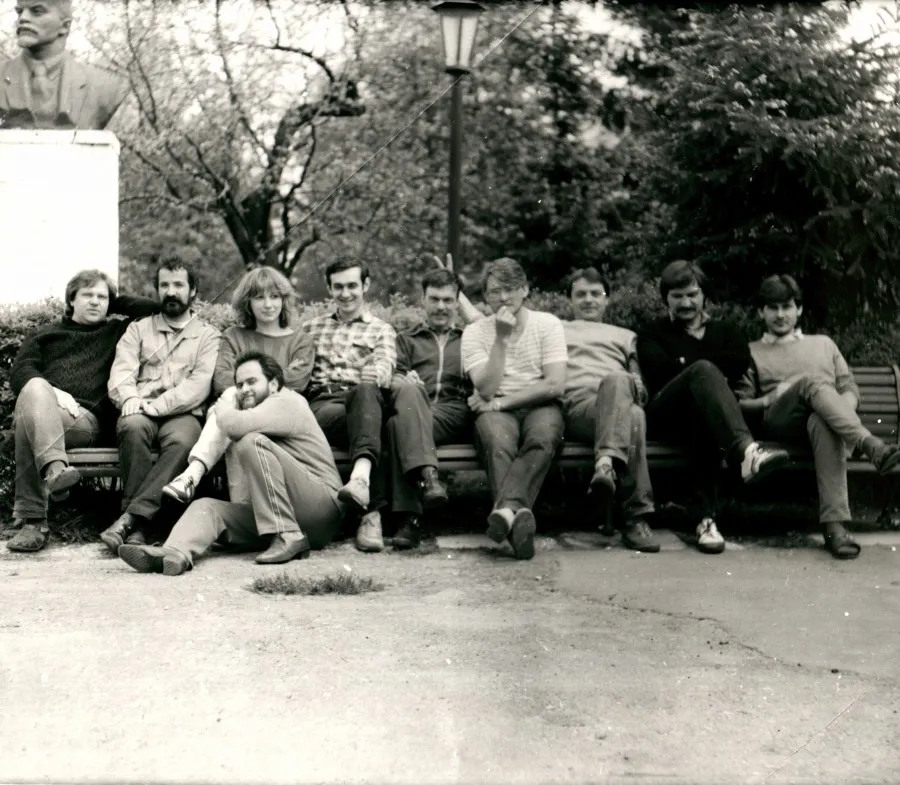
T. S.: Yes, of course. Although not immediately. Much happened spontaneously. Small groups arose but were not closed: everyone communicated with each other, adopted each other’s ideas. At first, everything happened very timidly, and then the work started. At least, that’s how it seems to me today.
An important part of the work was lectures. Sirje Helm came and talked about what Estonian artists were doing and what was happening in world art. Andriy Kovalov, Volodymyr Levashov, Kostya Akhinsha also came.
O. B.: Did everyone attend these lectures?
T. S.: I think everyone. The entire dining room on the second floor in Sedniv was filled with people. Usually, lectures took place there or in the foyer of the second floor of the hotel.
O. B.: And then did you discuss what you heard?
T. S.: Probably. Many gathered at Olena Kudinova’s. Her studio was on the first floor, and they held tea parties there. Imagine: ten to fifteen people gathered in a small room, and Olena poured tea for everyone. She had to brew it in three-liter jars. Olena’s watercolor depicting such a jar hangs on my wall.
Conversations took place there, exchanging thoughts about what was heard, discussing what was done and seen, or just chatting. And suddenly someone would jump up and run away. Then I would ask:
— Why did you run?
— An idea came—I ran to work.
That’s how the creative impulse worked. These conversations were extremely important. Similar gatherings took place in other studios, in other companies.
Gradually, the size of the works began to increase almost by itself. It seemed right to me. All canvases in the store were sold out. There were not enough stretchers; carpenters could not keep up with making them. Canvases without stretchers were nailed directly to the walls. And at the second Sedniv, large formats became the norm. Holosiy could make three such works in one night.
O. B.: Were “stars” already visible then?
T. S.: Now we can call some of them stars. But then they were young people with established views on art and already formed artistic techniques. But overall, yes—bright artists were visible immediately. There were also those who started well but later left the scene.
The energy surge was incredible. I saw it in the results, walking around studios every day. I think the artists themselves felt it too. Sukholit, Zhuk, Roitburd, Kerestey—their work started immediately. Works appeared one after another.
By the way, the first work at Sedniv was created by Roitburd. He borrowed a palette knife from me and brought me a finished work as a gift in half an hour.
Makov, Heyko, Sasha Babak, and others worked more slowly. It was interesting to observe how thinking transformed, how the plasticity changed. It seems metamorphoses happened to everyone.
I won’t name more surnames. These are the first names that came to my mind among the artists of the first visit.
I want to mention another artist when talking about different human fates. There was a graphic artist Valentin Malchenko. I deeply regret that he left art. He was a student of Ivanov-Akhmetov, and what he started in Sedniv resembled his teacher’s works: etchings, drawings. But it was clear that the work stalled, that something did not satisfy him.
Once during our conversation, I saw completely different drawings on the paper covering his table. Several lines formed a coherent plastic system. I told him: “Try making things of this type.”
By the end of the visit, he created a wonderful series of minimalist drawings. It became one of the most interesting works at the reporting exhibition in Kyiv, at the Central House of Artists, and occupied a central place in the exposition. These were extremely subtle minimalist works. One of the first examples of minimalism in Ukraine.
But then it was the late 1980s. Where to go with such a treasure? Such works were not bought. There was a family; money was needed. And he went into furniture trading. Sometimes I met him in those years. He always wanted to return to art, to start working again. He promised me.
Valik belonged to those artists with whom I wanted to continue working. But apparently, it did not work out. Such is fate. Where he is now and what happened to him, I do not know.
O. B.: Did you immediately notice people close to you in spirit? Did the “Painting Reserve” also arise from everyday experience?
T. S.: Of course. That’s how the “Reserve” arose. Probably, Roitburd is right when he says that it was there that the points of divergence also originated.
The “Reserve” was conceived and formed by me as an idea because I saw people close to me in understanding painting. This happened already at the second Sedniv.
But unlike the “Parkomuna,” the “Reserve” from the very beginning was formed as a group with a consciously developed and accepted aesthetic program by all participants. We understood that time was needed for its realization. Even when personal tastes and preferences made adjustments to the group’s work, the basic principles were not questioned.
And one more thing: we were older than the “Communards.” Even Zhyvotkov was their peer. We already had some exhibition experience and some career achievements—though not all, but that’s a separate topic. We consciously chose the path of refusal—both in life and in art.
The “Communards” expanded the field of art, its means, and language. We concentrated our research on one medium, its possibilities, and the change of optics. They worked with syntax; we—with morphology.
The painting as we understood and practiced it demanded a different attitude toward itself. In the “Reserve,” freedom and the role of the artist were understood quite differently. And we chose opposite guidelines.
Interestingly, over time, our practices seemed to have switched places. In the early 1990s, the “Reserve” defended the form of the painting, while the “Communards” engaged in “de-painting.” But by the late 1990s, they completely switched to painting on canvas, and we began working with space.
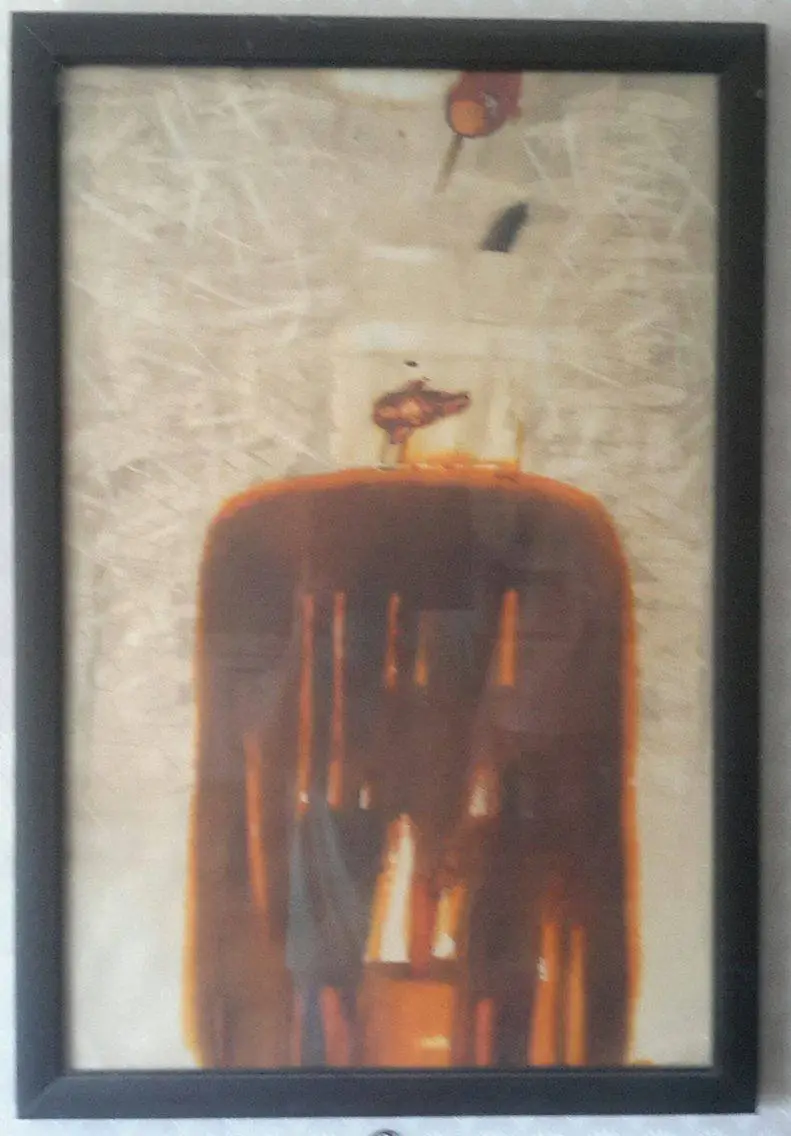
Our research of the painting medium changed the understanding of painting practice itself and the form of its presentation. For me, for example, these were no longer paintings but color objects with an open structure, where the relationships between them and their relations to space became important. Over time, Zhyvotkov began working with wood, combining sculpture and painting.
And at the end of the 1980s, I myself was at a crossroads. I knew I needed something completely different. I clearly understood what the guys in Sednev were doing, but I consciously built a different aesthetic. It was connected with the non-representational nature of painting, with the exploration of its fundamentals. My reference point immediately became Rothko, whom at that time I only saw in reproductions.
O. B.: It is interesting to reflect on the history of relationships and how the fates of the artists of “Parkomuna” and “Zapovidnyk” unfolded. In retrospect, it seems that they were competing. Is that so?
T. S.: Not exactly. You see, the problems of the 1990s, the relationship between “Zapovidnyk” and “Parkomuna,” as well as broader issues related to the “New Wave,” should have long been discussed and become part of the archive.
Back in the mid-1990s, I proposed organizing an integral exhibition: to gather all the significant works being created at that time and analyze them. But not to determine who was better or worse, who was more progressive or hopelessly backward. It was precisely in such categories that artistic phenomena were considered then, as aesthetic guidelines were changing.
Probably, a temporal distance was needed to understand what was really happening in that decade.
At the end of the 1980s — beginning of the 1990s, in my opinion, two lines clearly emerged that exist and compete with each other in Ukrainian art. I think the participants themselves hardly realized what was happening. The choice of one line or another was intuitive but at the same time corresponded to a certain historical model.
Today it is important for us to understand and trace this dispute, this struggle that lasted and, it seems, will continue throughout the entire cultural history of our region.
The fact that these lines — as problems of cultural and social life — return, reproduce, and are discussed again in the Ukrainian artistic environment in altered forms with amazing persistence indicates that the reasons for their return are not limited to generational changes, priorities, the emergence of new ideas or strategies. They lie at another level, have deeper roots, and are reproduced by different mechanisms.
These mechanisms operate at all levels of the social organism — in everyday life, culture, politics. It seems to me that reliance on “baroque identity” became the basis of this eternal Ukrainian postmodernism — from “Potemkin villages” to “Euro renovation.”
Many phenomena that seem diametrically opposed to us actually grow from the same root. It seems that the curators of the project “Myth. Ukrainian Baroque” at the National Art Museum came closest to understanding this problem. I regret that a paired project dedicated to the modernist line in Ukrainian art has not yet been realized for this exhibition.
O. B.: How would you describe the situation in the artistic environment of Kyiv and Ukraine on the eve of the collapse of the Soviet Union and immediately after it? How did you feel this border, this transitional zone?
T. S.: The empire was already cracking at the seams, but life under the dying leaders seemed unchanged. With the beginning of perestroika, there was more information, but the guardians of ideology did not yield in anything.
On the eve of the exhibition “8 Young Artists of Ukraine” at the Moscow Central House of Artists, one Moscow artist, looking at my work “Mid-Summer,” which depicted a naked female figure, said: “They will take it down.” But the work was not taken down.
During the first Sednev, besides the main group, about five “lottery participants” lived and worked separately. In Soviet times, there was an art lottery: to participate, artists came to such spring or autumn groups and painted landscapes.
They watched everything happening with us with great dissatisfaction and, it seems, regularly sent outraged letters to the Kyiv Union of Artists. When it became known that a youth commission of the USSR Union of Artists would come to accept the group, they were quite worried.
Usually, this commission almost never traveled for such a modest reason as accepting some provincial “plein air.” But here rumors that something was happening in Sednev reached Moscow. The “lottery participants” expected a scolding or even the arrest of hooligans.
But the group was accepted with applause, and their disappointment was enormous. The next day, one of them sat gloomily on a bench. Seeing me, he approached and asked confusedly: “So, now everything is allowed?”
That was roughly the situation throughout the former Union.
O. B.: How did your story with Sednev end? Why didn’t you continue these trips, since they were so successful and important for the participants?
T. S.: I remember that at the end of the stay in Sednev, everyone visited each other’s studios and exchanged works. When we returned to Kyiv, the group members did not want to disperse and spent all their days together, as if continuing a shared everyday life. They bought train tickets and then returned them. They did not want and could not part with each other.
Later, many said that after returning home, they could not start working again for a long time because they missed those two months in Sednev.
I remember at the end of the second Sednev, loading works into a truck. There were so many that I was afraid: would everything fit in one vehicle? Although maybe I am mistaken and there were two vehicles.
When the main group was already sitting on the bus, Gustavo Oranga — a Colombian revolutionary and a wonderful artist who created large drawings with naked bodies — jumped out of the bus and threw a ball to the Sednev guys with which we played football. It was a farewell.
At the third Sednev, we hardly played anymore. During the first two visits, football was a mandatory daily afternoon ritual.
The bus left, and a little later we followed the trucks in a minibus. Sukholit, who sat next to me, talked about the idea of his future project “Alphabet.” At the same time, we did not take our eyes off the truck with the works ahead, which dangerously tilted on turns under the weight of huge canvases. I was not sure everything would end well. But everything turned out fine: we arrived safely and delivered the works.
It seems that was the peak of Sednev. In 1990, we missed the visit, and in 1991 the last Sednev took place.
After that, Dima Fishchenko gathered groups of artists in Sednev for a few more years, as he said, “for pleasure.” But those were different times. Funding for the Union of Artists groups stopped. Even for the third Sednev, we looked for sponsors and eventually found them.
The atmosphere of the third group was different — calmer, or something. I don’t know, maybe it was just my feeling, but something changed. We talked with Solovyov, and he agreed that maybe this form of work had exhausted itself.
Probably, it was time for the fragmentation of large communities, time for small groups, squats, and individual efforts. The energy that was at the second Sednev and at the 1989 exhibition at the National Art Museum — then the State Museum of Ukrainian Fine Arts — was no longer there.
After the success of the first exhibition of Sednev participants at the Union of Artists, we were offered to hold a report exhibition at the National Art Museum. It was unexpected and incredibly pleasant.
O. B.: And where exactly in the museum?
T. S.: On the second floor, in the main halls.
And something unexpected happened there — an important observation for me. Before our exhibition, a large exhibition of Viktor Puzyrkov was displayed in these halls. When we brought our works, many of his canvases were still hanging on the walls.
This accidental neighborhood turned out to be amazing. Puzyrkov’s works perfectly matched the works brought from Sednev. They formed a certain unity that I could neither understand nor explain to myself at that time.
They did not contradict the works of Kerestey, Holosiiv, and others, although it seemed there should have been a decisive attempt at separation here. However, Puzyrkov’s works did not seem alien.
Of course, the unity of place and action changed, complex temporal and spatial constructions: the integrity of the narrative gave way to refined metaphors and historical allusions. The external contrast was obvious: a different function of space, a different interpretation of the figure, a different syntax. And yet there was something common above all this that united them.
Now I understand: if I had managed then to persuade the organizers to leave one or two of Puzyrkov’s works in the exposition, it would have been close to modern exhibition principles.
It was then that I first felt that these were very close things, that they had a common root. Here are masterfully painted works of a socialist realism classic, and here are works of another generation of artists executed seemingly “childishly.”
It seems that it was then that the idea of two lines forming Ukrainian visuality came to my mind. It was not a sidestep, as it seemed to us then, but a continuation. Pictorial thinking remained the same; perhaps only the language changed. In a sense, this language was reinvented. Some links of 20th-century art that we missed were activated.
But there was also something else, deeper, on another level. The baroque myth, the myth of socialist realism, and the works of young artists were united by the narrative function of the painting — the ability to continue the myth.
I want to emphasize: this is not a value judgment, not a scale of “bad — good,” but an attempt to see a certain logic in the operation of the mechanism that reproduces these two paradigmatic lines, as well as to understand their influence on society and people’s way of thinking.
That is why a few years later I created the project “Non-narrativity” to remind about the other line that also exists in Ukrainian art.