
Woman in art is one of the most interesting topics in art history: it includes both the direct depiction of the female body and the presence of women in the world of art. At the center of this article are women in the squat that existed in Kyiv on Paris Commune Street in the early 1990s, during a time of political and economic crisis, and the formation of new territorial and cultural borders. One of the important issues of the 1990s was sexual emancipation. Erotic photographs and videos became accessible. Tapes with such content could be viewed in video salons. At the same time, the issue of women’s emancipation was actualized.
“Paris Commune” was outside the feminist context. Feminism as a topic within the walls of Parkomuna was first formulated by Natalia Filonenko in 1994, and in 1995 she realized it in the exhibition “Medusa’s Mouth” (1995), where she appeared for the first time as a curator.
The metaphor of the body in the title of the article appeals to the physical aspect of connection, wholeness. The body is the corpus from which Ukrainian art is composed, the people who shape it. How dense and strong this corpus was is partly due to the efforts of female artists and women curators who at that time were part of this community.
Often the history of the “Paris Commune” squat is reduced to a list of male names: Oleg Holosiy, Oleksandr Hnylytskyi, Arsen Savadov, Heorhiy Senchenko, Vasyl Tsaholov, Kyrylo Protsenko, Illia Chichkan, Dmytro Kavsan, Yuriy Solomko, Oleksandr Roitburd, Oleksandr Klymenko, and others. However, in the Kyiv squat on Paris Commune Street lived the artist Valeria Trubina; Natalia Filonenko, then the wife of Oleksandr Hnylytskyi and later a curator; the daughter of the artist and later artist Ksenia Hnylytska; the wife of artist Vasyl Tsaholov, a student of the Faculty of Theory and History of Art and later a curator, Nadia Pryhodych; the artist and wife of critic Oleksandr Soloviy, Tetiana Lariushyna, who, by the way, was very much loved by Tetiana Yablonska. The Parkomuna community also included Viktoriya Parkhomenko and Natalia Radovinska, who took private lessons from the “classics” Arsen Savadov and Heorhiy Senchenko. Both collaborated with Mykola Trokh.
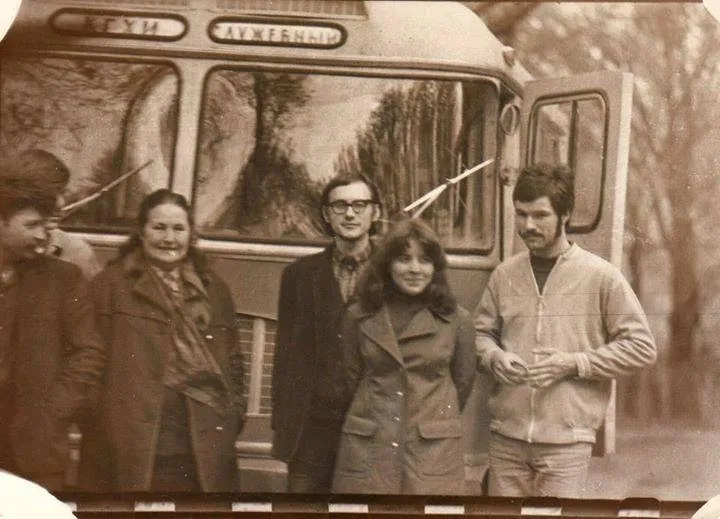
The circle of “Paris Commune” included Tetiana Hershuni (Taya Halahan), a student of the Faculty of Theory and History of Art, who also worked with Mykola Trokh and from 1994 began exhibiting her works at exhibitions.
An integral participant of the Parkomuna crowd was Tetiana Illiakhova, an artist and the first wife of Illia Chichkan. Her husband attributes the very existence of the “Paris Commune” to Tetiana. “We had a bribed housing maintenance office: 20 bucks — and you get an 8-room apartment that was put under major renovation. This lasted for decades. Once someone from the Art Institute came to me — they said, find us a space, you have connections there. The connections were more likely with my first wife, Tanya Illiakhova — and she arranged the Parkomuna for the guys,” Chichkan recounts in an interview [1].
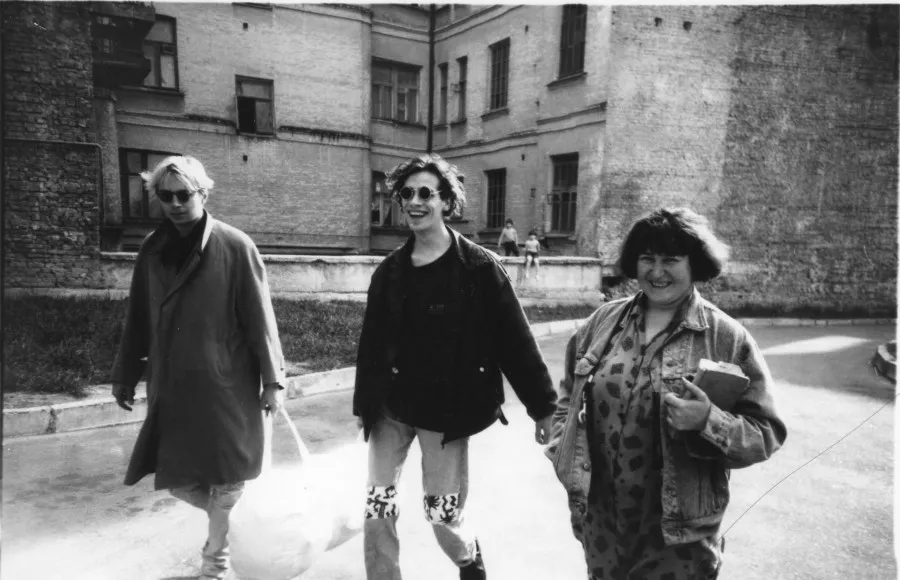
Artist Natalia Markman also collaborated with Mykola Trokh. However, her works were not shown at exhibitions of those years. Instead, early works of Tetiana Halochkina, then the wife of Arsen Savadov, could be seen there.
For some time, Ruth MacLennan from Great Britain stayed at the squat — she was engaged in sculpture and photography. The artist came to Kyiv from Moscow, where she met Ukrainian colleagues, including Valentyn Raievskyi, who invited her to a sculpture symposium in the Ukrainian capital. At that time, she also met and befriended participants of Parkomuna, lived and worked in their studios. During her stay in Kyiv, the artist worked on Raievskyi’s project “Three Elephants” (1991); participants of the action along with MacLennan were Vasyl Tsaholov and Larysa Rezun-Zvezdochetova.
Marta Kuzma, director of the Soros Center for Contemporary Art in Kyiv, also visited Parkomuna, and in 1993 the squat was visited for the first time by the artist and second wife of Oleksandr Hnylytskyi, Lesia Zaiats. Tetiana Savadova, sister of Arsen Savadov and wife of Heorhiy Senchenko, became the curator of the exhibition “Space of Cultural Revolution” in 1994 and headed the organization of the same name.
Criticism and the “female gaze” of that time, besides texts by Marta Kuzma and Kateryna Stukalova (who, together with her then husband Hlib Vysheslavskyi, edited the magazine Terra Incognita), were represented by newspaper publications of students of the Faculty of Art History, Olena Romanenko and Nadia Pryhodych.
Bohemian lifestyle, open sexuality — all this, as in the circle of surrealist artists, elevated women and female sexuality to a certain divine image. However, similar to the surrealists, artists of the “Paris Commune” circle neglected women as subjects and through their behavioral practices formed a consumer attitude toward female sexuality and the female body. None of the female artists openly voiced this issue then or now. In this community, the feminist question remained unspoken and unconscious.
Among the few publications that touched on the “women’s question” in one way or another is a text written by Nadia Pryhodych in 1993, which she dedicated to her husband Vasyl Tsaholov. Thanks to the religious metaphor, the text “Mihrab of My Soul, or Something About Centaurs” [2] becomes a personal revelation (mihrab — a niche in the wall of a mosque indicating the direction to Mecca; it is the direction faced during prayer). The illustration for the article is Sandro Botticelli’s painting “Pallas and the Centaur” (1483), signed “Vasya + Nadya in Botticelli’s exterior,” forming the image of Pryhodych as the tamer of the centaur: “The beast is neither beast nor human — a centaur, or rather a little centaur […] Dialogue is possible only on the thin and fragile edge between one’s own unreal and the opposing harsh flow of the pragmatic” [3].
One of the brightest artists of that time and the Parkomuna circle was Valeria Trubina. Her early work is often considered in connection with and in the context of other artists — Oleg Holosiy and Oleksandr Hnylytskyi. Critic Oleksandr Soloviy contrasts this trio with the experienced and well-known artists of that time, Savadov and Senchenko.
“O. Hnylytskyi is melancholic. O. Holosiy is intuitive, ‘unrestrained,’ impulsive. They are natural colorists. Painting is the strong suit of V. Trubina — she is characterized by a specific pseudo-narrativity of paintings and a textural elaboration of the pictorial fabric. Being somewhat salon and theatrical (‘Good News’), she is capable of delighting with considerable immediacy and openness of her works (‘Decorations of an Unintentional Murder’). The paradoxical position of all three, which perhaps is the cause of their inner duality, lies in the fact that, being much more productive than A. Savadov, they prefer to follow the leader-peer. Why? Of course, the charm of the art and the personality of A. Savadov, who embodies the type of an extreme individualist, a ‘prophet’ fleeing from his own prophecies, plays a huge role here” [4], writes Soloviy.
Later, the ‘pseudo-narrativity’ mentioned by Soloviy was described by another critic: Kostyantyn Akinsha noted with horror that Trubina, unlike her colleagues, does not create ‘frivolous’ painting but rather forms a multilayered symbolic narrative. Thus, Akinsha accuses her of the ‘sin of seriousness’ and calls her the ‘Zinaida Gippius of the Ukrainian wave,’ who desires ‘art that is terrible, mysterious, and profound’ [5].
Despite the declared overly symbolist character of her works, Trubina’s creativity has never been fully interpreted and ‘decoded.’
Marta Kuzma in the catalog for the exhibition “Angels over Ukraine” considers the works of Trubina and Holosiy as a single unit [6]. According to Kuzma, “Collaborating with her friend Holosiy, she also uses painting techniques, creating a mystery of cinema in her paintings. Her latest canvases are blurred frames from horror films that use myths and gothic tales — lonely castles in foggy forests, gates behind which lies the Supernatural. Holosiy immerses the viewer in the otherworldly, Trubina stops us at its threshold — depicting gatekeepers, walls, thus emphasizing that she is only an observer of this world, but does not belong to it” [7].
Trubina herself recalls that their creativity with Holosiy intersected, that they inspired each other. Often Holosiy would finish Trubina’s paintings with his own hand as he wished [8]. Symbolically, when in 2016 Trubina’s work “Tsar Fish” [9] was gifted to the National Art Museum of Ukraine [10], it turned out to be signed with Holosiy’s name.
Trubina’s personal relationship with Holosiy, an emotional and talented artist, pushed her into the background in the eyes of critics. It is known how Holosiy created his works (he could paint several huge canvases overnight or while someone was brewing tea), but it is unknown how Trubina created hers. Ruth MacLennan, who lived at Parkomuna in August 1992, recalls Trubina as a diligent artist who was constantly in the creative process and at the same time ‘managed to feed everyone’ [11]. (The fact that Trubina took on household duties is also recalled by Ksenia Hnylytska, who was fed by ‘aunt Lera.’) Still, Trubina of that time is described as a closed person who did not want to let outsiders into ‘her boat.’
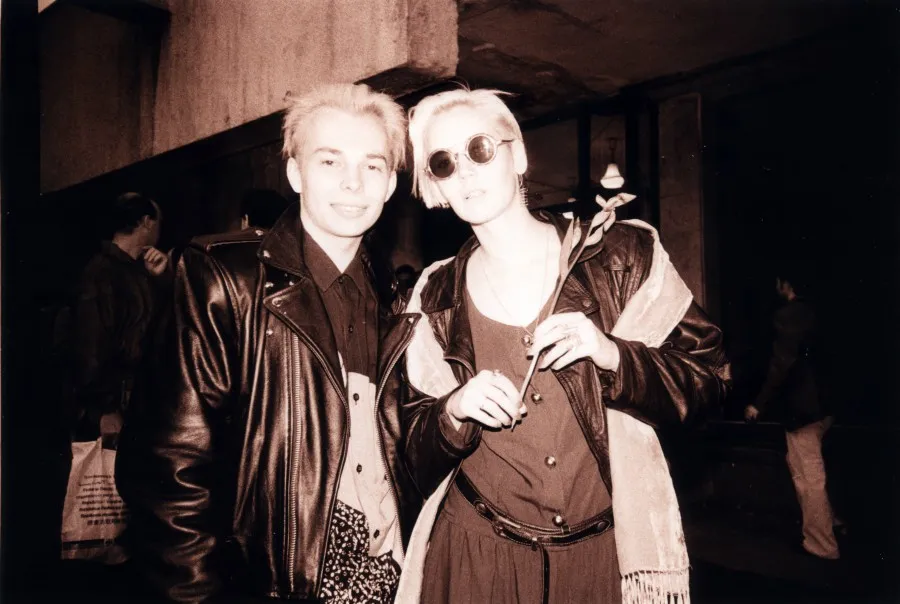
In 1993, after the exhibition “Angels over Ukraine” in Edinburgh, Trubina stayed in Great Britain and later moved to the USA. She still comes to Ukraine, participates in group and solo exhibitions, but her work remains little studied.
Thanks to critic Kostyantyn Akinsha and journalist Oleksandr Lyapin, one of Valeria Trubina’s most famous and most cited works became the painting “The Wounded Kitten Walks, Biting the Puppy’s Ear” (1989). It is interpreted as a paraphrase of Savadov and Senchenko’s “Cleopatra’s Sorrows,” endowed with “a pathos quasi-classical meaning, hypnotic pomposity, sarcasm, freedom, and hallucinations” [12]. According to Akinsha, Trubina’s work is the quintessence of the so-called children’s discourse, which artists drew from children’s magazines and texts. Trubina agrees with this and clarifies that the plot and title of the painting are taken from a poem by Yunna Morits. However, this is a formal reading of the work.
Tamara Zlobina was the first to place “Kitten…” in the context of gender and feminist criticism. The kitten, whose image occupies the central part of the composition, is a female image placed in the shell of an apparently childlike character — a cat. She moves along the road toward the viewer, having exposed her body — the viewer sees her small breasts and pubis, slightly covered by a cloud. The kitten moves toward the viewer with a strong sweeping step. The cat’s hands are positioned like those of El Greco’s characters, but this is no longer a request, gratitude, or bow, but a gesture — as if with her right hand she holds a sword, and with her left — a shield. Zlobina speaks of the puppy as the antagonist of the cat, accordingly representing the “male.”
However, if we consider “Kitten…” from the perspective of Freudian theory and analyze the sexual images in the painting, the work can be interpreted somewhat differently. From the title, we know the cat is biting the puppy’s ear, but we do not see the ear itself. According to Freud, ears in dreams symbolize the female genital organ, and bleeding ears herald the onset of menstruation. Thus, this artist’s work forms a strong image of female ‘otherness,’ which actually acts as a female manifesto of that time. In her text “History of Ukrainian Women’s Art,” Tamara Zlobina emphasizes that this work cannot be read as purely feminist, but such a reading is important for gender history: “The character is a woman-cat, that repressive female that broke out and emerged from these restrictive social circumstances, paying a high price — because the ‘kitten is wounded'” [13].
Indeed, there are many female images in Trubina’s painting. The most characteristic images of the early period are the Virgin Mary and the Muse. Since the 1990s, girls from dreams, female images from book reproductions, and heroines of mass culture (for example, the project “1000 Marilyns” at the Blank Art gallery) appear in her works.
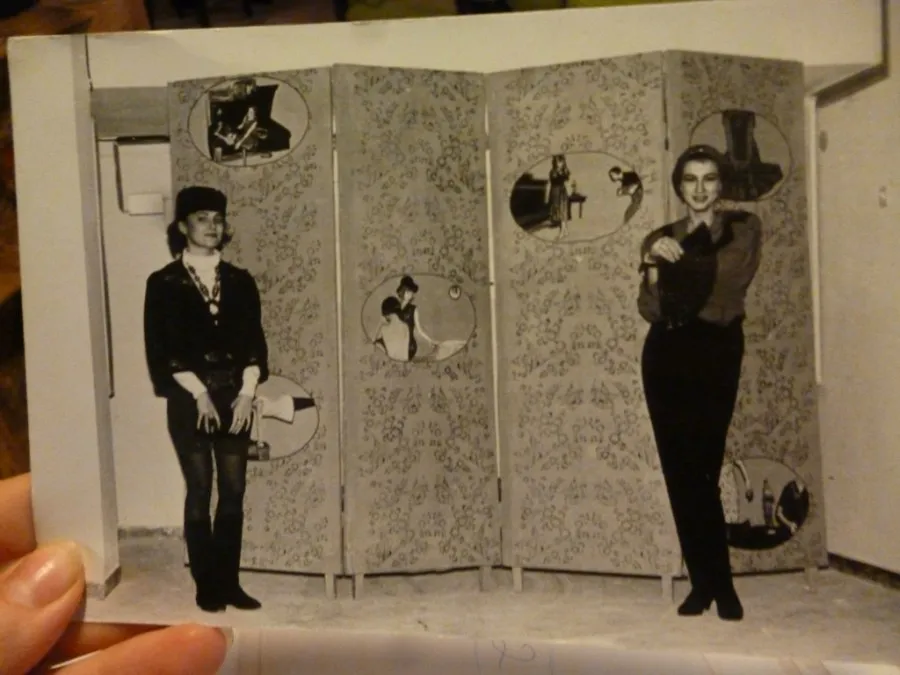
Interestingly, the works of Viktoriya Parkhomenko and Natalia Radovinska, two students of Arsen Savadov and Heorhiy Senchenko, remain practically unknown. Both worked in art for a relatively short time. Their first joint work was shown at the exhibition “Calm” (UKV Contemporary Art Gallery, 1992, curator — Oleksandr Soloviy). The “classics” Savadov and Senchenko presented the installation “Baichzhan and the Fox,” combining pop culture and Indian legends. Parkhomenko and Radovinska showed an installation with a screen consisting of several parts: a stencil, text, and screen. The work appealed to the ancient Japanese tradition of sending poems to lovers behind a screen, but behind Radovinska and Parkhomenko’s screen, no one could be. The artists used their own images applied to the screen using a stencil from photographs.
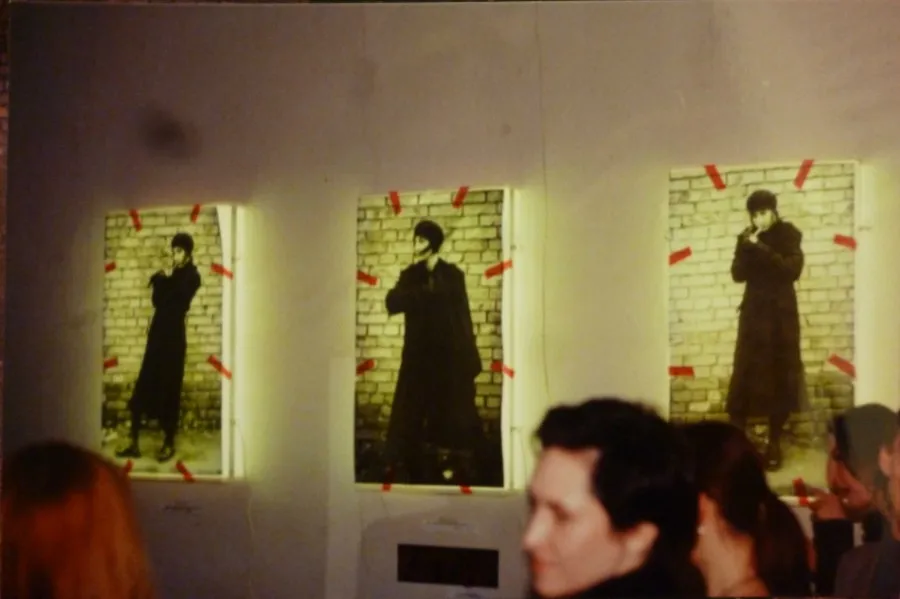
Their second joint work was the project “Knitting Hats,” shown at the “Summer” exhibition in the summer of 1993. In it, the artists also refer to their own images, painting portraits of each other in knitted hats. The poses of the artists correspond to cutouts from fashionable Soviet knitting magazines. At the bottom of the portraits is a text about the beauty of knitted hats, also borrowed from a magazine. Texts have always been an important component of Radovinska and Parkhomenko’s works.
After 1993, Radovinska stopped engaging in art. Parkhomenko continued to create her own projects. One of them was the installation “One Day in the Life of Fanny Kaplan,” shown in 1995 at Natalia Filonenko’s exhibition “Medusa’s Mouth.” As in previous works, the artist refers to her own image, so Parkhomenko appears before the viewer as Kaplan — before, during, and after the assassination attempt on Lenin.
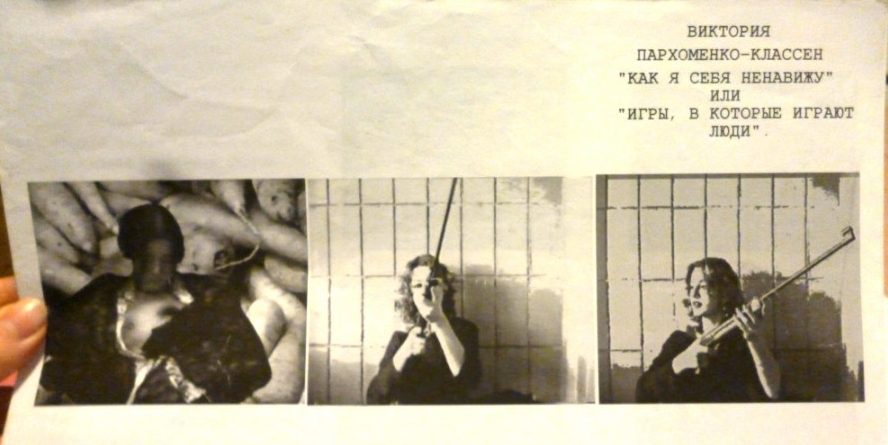
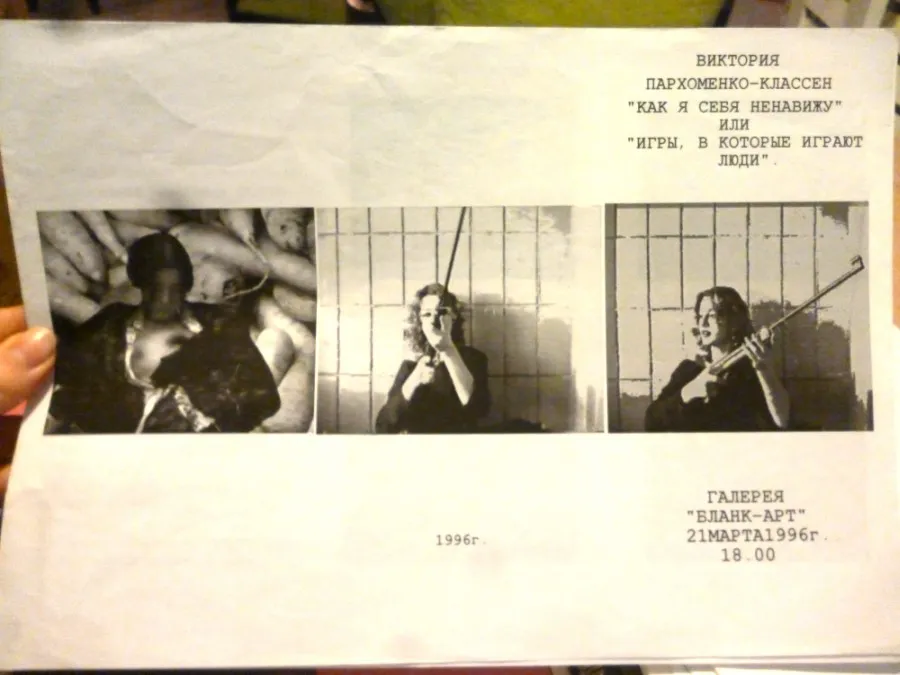
Perhaps the use of her own body in works was related to the fact that Parkhomenko was already involved as a model in the art of others: she played the role of a princess in a glass coffin masturbating in Oleksandr Hnylytskyi’s performance; her body often appeared in the works of photographer Mykola Trokh. The artist also used her own body in joint practice with Radovinska, but her later performances and videos work with this medium much more intensively. She uses her body in the project “Crazy House” (also known as “I Loved Doctors in Childhood, Now They Love Me,” lightboxes), in which she appears as a mentally ill person, as well as in the video “How I Hate Myself, or Games People Play” (1996) [14]. The latter project is described in the terminological dictionary of Vysheslavskyi and Sydor-Hibelinda as a video in which “the author loads a gun and aims at the viewer, then a half-naked girl rests among vegetables and fruits.” Such a simplified understanding of the video is not conceptualized. The naked girl, Parkhomenko herself, acts as both executioner and victim. Her half-dead, half-alive female body lies ‘ugly’ on a pile of fruits and vegetables [15]. The frank, bold poses and the naked, slightly covered body refer to images of naked women in “classical” art. Vegetables and fruits are elements of still lifes, a favorite genre of 17th-century Dutch painters. Parkhomenko strikes a blow to art with a gun, killing, among other things, herself.
In 1996, at the exhibition “From the Family Album” (curator — Natalia Filonenko), Parkhomenko presented her work for the last time. Almost all the artist’s works were sold immediately after the exhibition; today she does not know their whereabouts or whether they have survived at all and in what condition they might be. In 1995–1996, Parkhomenko participated in many group exhibitions, realized several solo projects, including at the Blank Art gallery, and tried herself as an exhibition curator. Only the fact that the artist voluntarily stopped engaging in art erased her from the history of contemporary Ukrainian art.
Like Viktoriya Parkhomenko, artist and student of the Faculty of Art History Tetiana Hershuni (Taya Halahan) worked for some time with Mykola Trokh as a photo model. She got into the “Paris Commune” crowd through her friend Kyrylo Chichkan. As the artist herself notes, she wanted to be on this side from the very beginning, and art history was needed exclusively as a point of contact with the art world. Ultimately, she never finished the Faculty of Theory and History of Art in Ukraine. Her first works were shown in Odesa and Kyiv at the exhibitions “Free Zone” and “Barbaros,” respectively. At the Kyiv exhibition, Halahan and Chichkan presented a joint project “Comparative Anatomy,” based on corporeality — a video in which the artists explore their own bodies. At Natalia Filonenko’s feminist exhibition, Halahan showed the project “I Don’t Want You to Be King,” in which she used ultraviolet. The work is a reflection on the biography of King Edward VIII of Great Britain and the British Dominions, who abdicated the throne for love of a common American woman.
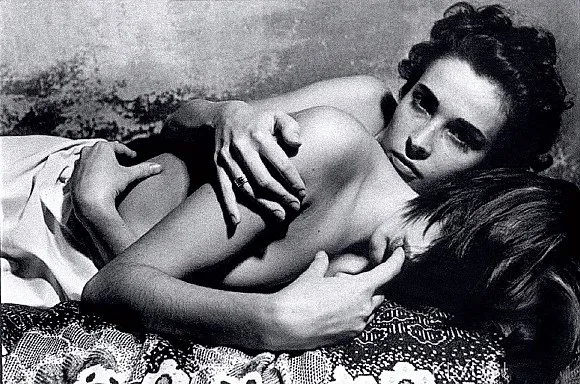
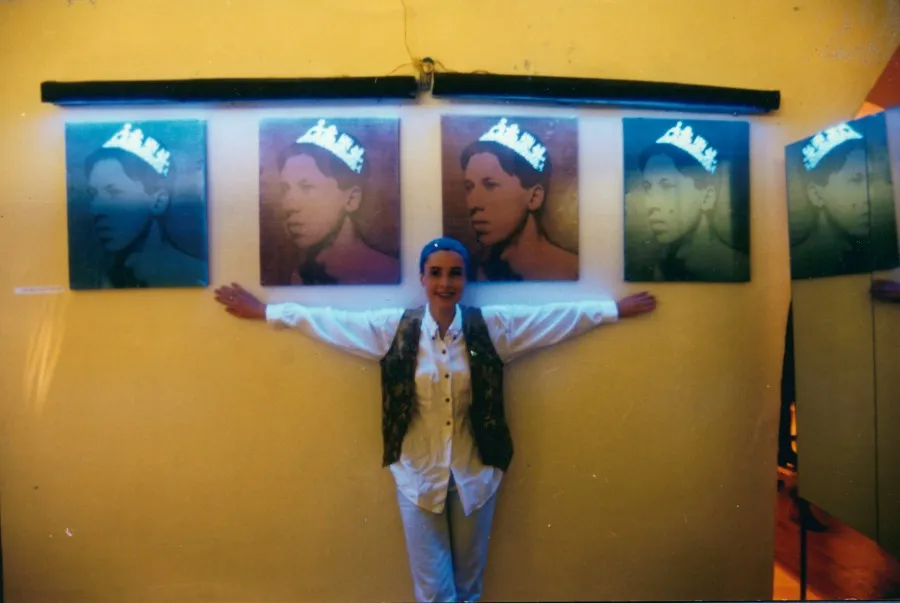
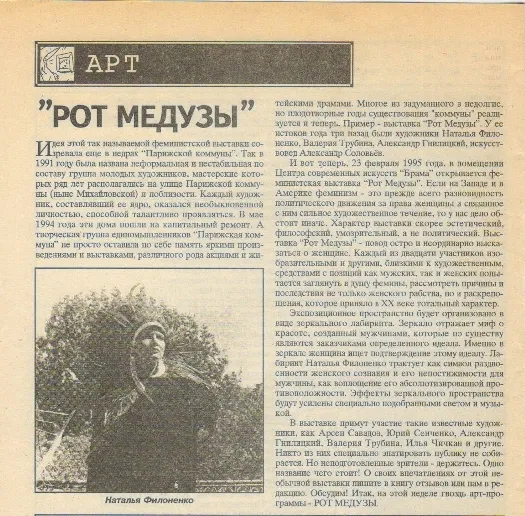
A long stay next to artist Oleksandr Hnylytskyi, “maintaining the household,” helping to form projects and participate in them gave Natalia Filonenko experience that came in handy during the first exhibition “Medusa’s Mouth” (1995), held with the support of the Soros Foundation in Kyiv. In the mid-1990s, Filonenko entered Bard College (New York, USA), where she completed one of the strongest programs in contemporary art. Returning to Kyiv, she headed Marat Gelman’s gallery. Most know Filonenko as a successful curator, the first to receive a Western education and realize a number of international projects. It is almost unknown that during the artistic boom at Parkomuna, Filonenko experimented with painting and even participated in several exhibitions, including “Artists of Paris Commune” (1991). Filonenko herself calls this experience unserious. But recalling Akinsha’s words, who attributed the “sin of seriousness” to Trubina as a certain flaw, Filonenko’s quite “unserious” painting finds itself on the opposite side and already because of its “unseriousness” recedes into the background.
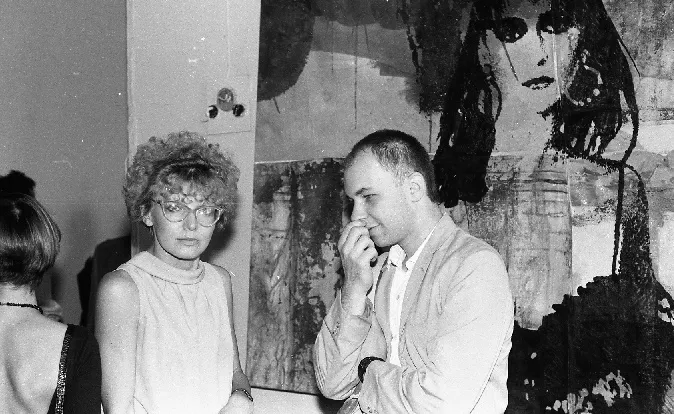
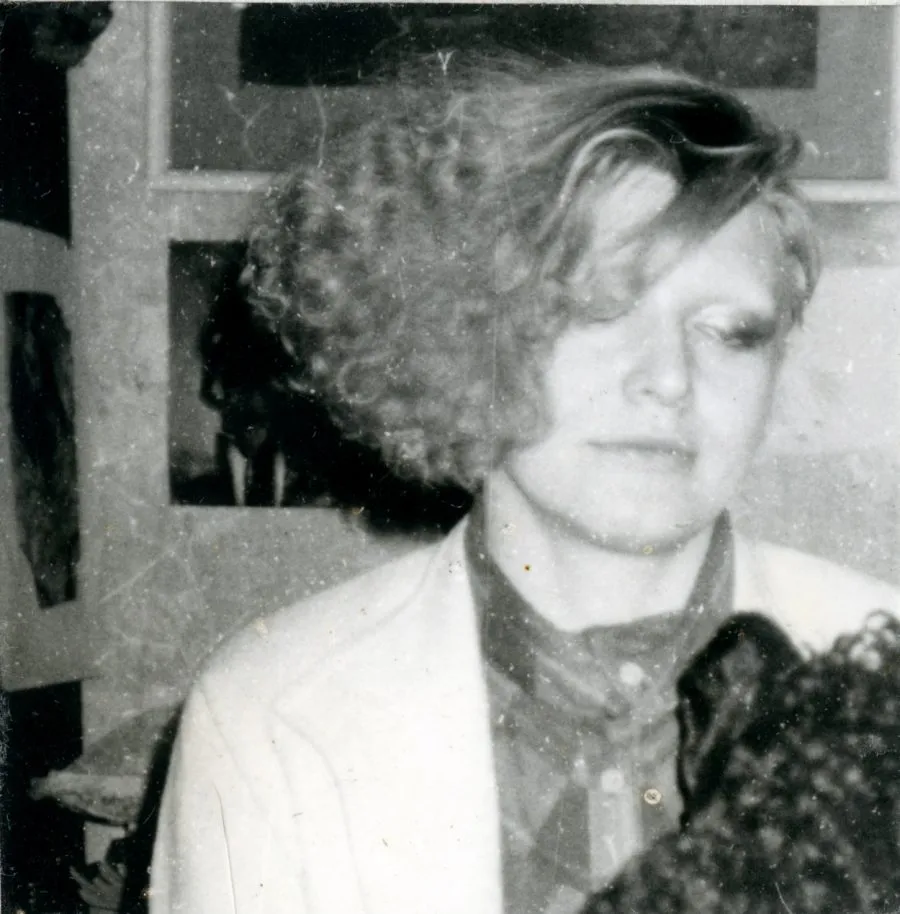
What to do with the rest of the “unserious” or insufficiently serious painting of that time? What makes sense to preserve for descendants, critics, and art historians, and what is better to hide far away in basements, clearing space for the “absolute”? And is there such an absolute? And can art then be accidental?
Natalia Filonenko’s experimental works, like many other works of that time, are primarily experiments with the freedom of representation, which involved the question of who exactly can be an artist and what belongs to the artistic plane and what does not. Works were created by everyone, even those who did not claim the title of artist, which indicates the emotionality and fertility of this period. Filonenko participated in all friendly-family performances, was one of the authors and participants (together with Hnylytskyi and Mamsikov) of video performances “Crooked Mirrors. Living Pictures” and “Real Camera.” Many participants in the artistic process of that time noted her organizational abilities.
It was at Parkomuna, in the last years of the squat’s existence, that she applied to hold the first feminist exhibition “Medusa’s Mouth” [16] and received several hundred dollars for its organization. The exhibition was also supported by the French Institute, which invited an artist from France to participate. Thus, the exhibition became international. Important in the exhibition were not only the innovative approach to the topic but also the work with space. Filonenko built special glass labyrinths, which she offered the viewer to move through from one object to another. Combining Soviet art with new art, she also tried to reveal the topic from a historical perspective, raising issues of female heroism and emancipation in the USSR. During the preparation for the exhibition, she consulted with a literary scholar who dealt with feminism (apparently, this was literary critic and translator Solomiya Pavlychko).
Ksenia Hnylytska, daughter of Oleksandr Hnylytskyi, is now a well-known artist herself. But in her work, the line of her talented father occupies an important place for self-analysis and reflection. Already in the mid-1990s, father and daughter created a joint project “Securities,” which combined graphics and texts of both Hnylytskys. Art historian Olena Romanenko recalled that at some exhibition she heard a wonderful thing from little Ksusha: Ksusha said that everything around is beauty, everything is beautiful. This made a great impression on Romanenko. According to her, this phrase characterized both Hnylytskyi’s attitude to the world and his upbringing of his daughter. Romanenko believes that only an artist could grow up in such an atmosphere.
The art of the “Paris Commune” artists is hidden in the shadow of myths, stories about parties, love, and tragedies for various reasons; it still awaits careful, detailed research. The events that took place in and around the squat also deserve the same attention: the influence of music, cinema, and mass culture on art. Of course, the female art of Parkomuna cannot be fully classified as feminist, but it is important for understanding art history — and not only women’s.