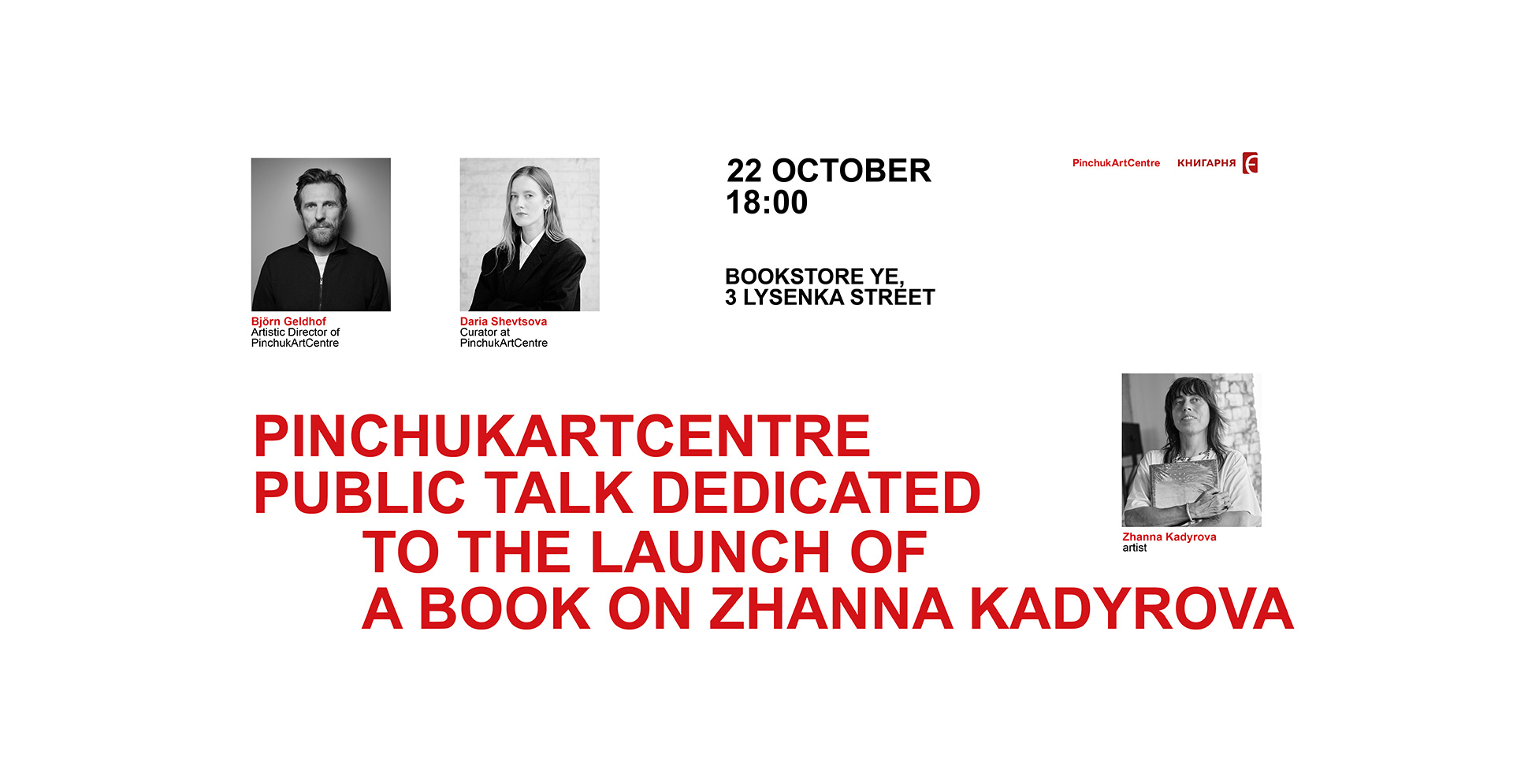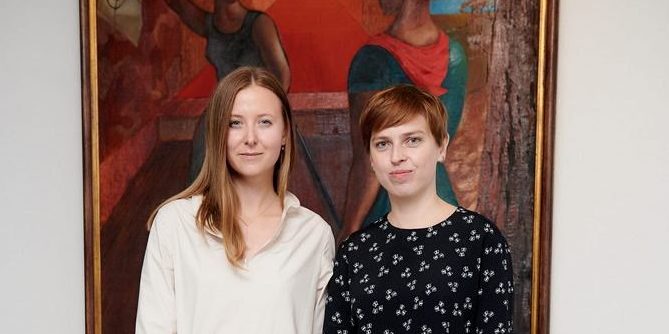
“Own Space” is an ambitious exhibition curated by Tetiana Kochubinska and Tetiana Zhmurko, in which they offer a look at the role of women artists in the history of Ukrainian art of the 20th–21st centuries. The exposition, created within the Research Platform, is located on two floors of the PinchukArtCentre and presents both works that have already entered the history of Ukrainian art and completely new pieces. Many women artists are presented at the PinchukArtCentre for the first time. Among them are Hanna Shcherbyna, Oksana Kazmina, Yana Bystrova, Maryna Skugaryova, and Margarita Zharkova, as well as Maria Prymachenko, Kateryna Bilokur, Hanna Sobachko-Shostak, and Oksana Pavlenko.
LB.ua spoke with the exhibition curators about the “female” history of Ukrainian art, as well as about the place of the woman artist and the woman curator.
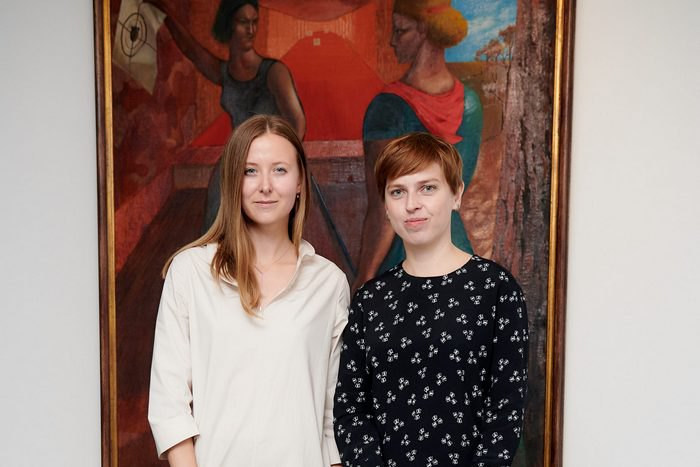
Why did you turn to the topic of the history of women artists in Ukraine? What is the institutional interest in this topic and your personal interest as curators?
Tetiana Kochubinska: The exhibitions of the Research Platform are dedicated to phenomena in the history of Ukrainian art. Previously, we made exhibitions about the squat on Paris Commune Street in Kyiv, about Fedir Tetianych, and about the art of Lviv. Chronologically, these were the 1980s–1990s — a period when women artists declared themselves less actively. If you look at the most important exhibitions of the 1990s — “Alchemical Capitulation,” “Steppes of Europe” — you will see that there are no female names, no women at all. The art of the 1990s reflects a patriarchal society where there was no place for a female voice. The exhibition “Own Space” is an attempt to tell what place the woman artist occupied in Ukrainian art at different times.
Tetiana Zhmurko: I can’t say this topic is new to me. I have been working on it at the National Art Museum of Ukraine for several years. Indeed, in the 1990s, women artists were mostly presented as wives, girlfriends, and muses, not as artists. This topic interested us back when we were preparing the exhibition and book dedicated to the “Paris Commune.” Valeria Trubina was one of the few women artists who managed to build a career.
T. K.: Last year I visited an exhibition in Vienna dedicated to Western European and American feminism. Then I thought that we had a completely different history and it would be interesting to do something similar, understanding our own context. For example, many themes presented at the Vienna exhibition had nothing to do with the processes that took place in Soviet reality in the 1960s–1970s. Speaking about the 1960s, whoever we mention, almost always bright female names will sound: Alla Horska, Tetiana Yablonska, Tetiana Holembievska, and so on. Today, there are many female voices on our art scene. Only the 1990s stand out.
For Tetiana Zhmurko, this is a new experience: you curated an exhibition for the first time. What, in your opinion, did you manage to implement in this practice?
T. Z.: This is an experience of co-curation. For me, curating is a very responsible practice. To some extent, the curator decides what to “record” in art history and what not. Moreover, in this case, the topic itself is painful and still insufficiently comprehended in Ukrainian art. It seems to me that we made a good attempt to comprehend the presence of women in Ukrainian art by reviewing the artistic experience of the 20th–21st centuries.
Although you refer to works and names from the history of Ukrainian art of the 20th century, your exhibition cannot be fully called historical, as it lacks a linear narrative. At the same time, it is difficult to call it purely contemporary and traditionally feminist, since it includes various works. How did you define its theme and genre? What new does the exhibition add to the history of similar projects initiated by Oksana Bryukhovetska and Olena Chervonik?
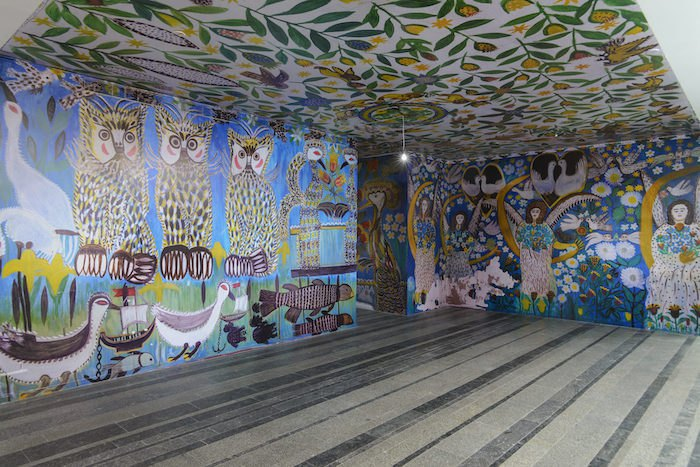
T. K.: We are conducting not a sociological but an art historical study. In our exhibition, it is precisely the works that allow telling their own story. Thanks to the juxtaposition and dialogue of works from different times and in different media, a conflict arises. For example, this is a dialogue between Polina Raiko and Anya Shcherbina. In the space where the murals of Polina Raiko’s house are recreated, Anya Shcherbina’s audio work sounds, offering new readings. In our exposition, in Polina Raiko’s “room,” strange animal sounds are heard. At the same time, it is clear that this is an interpretation we allowed ourselves.
The choice of themes, works, and names is an important question that arises when talking about “blind spots” in art history. What determined your choice? After all, there are many bright female names in art history. For example, Tetiana Yablonska, who is not in your exhibition. At the same time, you introduce the work of primitive women artists Kateryna Bilokur and Maria Prymachenko into the context of contemporary art.
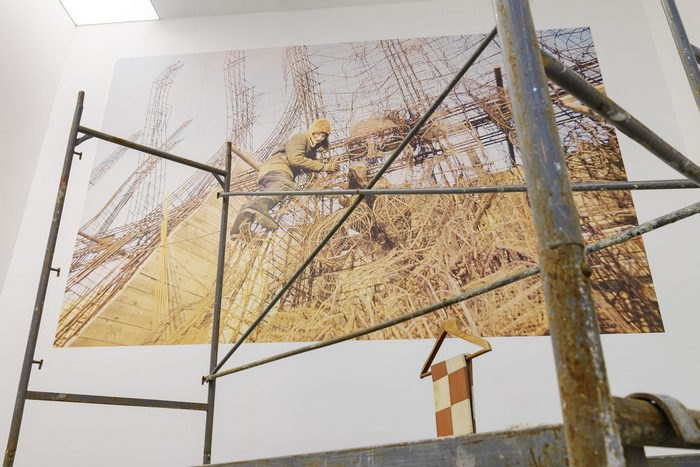
T. K.: When we were thinking about whether to include the works of women monumentalists in the exhibition, we wanted to create a composite image of that era. In the end, we settled on a photograph of Ada Rybachuk on scaffolding during work on the Wall of Memory at Baikove Cemetery. In our opinion, this image is representative of the 1960s and at the same time relevant today. The photograph raises many topics: physical labor of women and men, historical memory, contemporary perception of monumental heritage — especially considering that the Wall of Memory is still covered with concrete. Rybachuk herself adhered to humanistic views: she did not divide the work of the Artist into male and female. For her, the Artist is a person who has the courage to create a work of art.
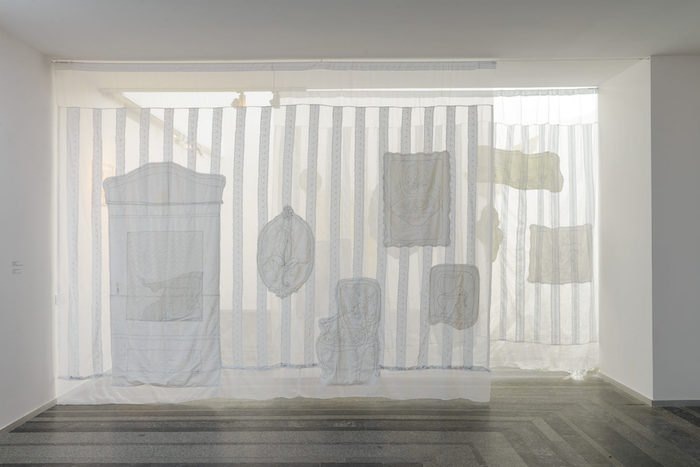
T. Z.: When we started working on the exhibition, we wanted to dedicate a whole hall to women monumentalists and show archival materials. But in the end, we concluded that both the heritage that remains and the processes around it are important. Therefore, we included Zhanna Kadyrova’s work Second Hand in the exposition, which raises themes of memory and destruction.
Indeed, the exhibition does not follow a historical-chronological principle, and many important names, including Alexandra Exter, are not represented, although Exter was undoubtedly one of the key figures of Ukrainian art. However, many themes are revealed through other elements of the exposition: accompanying texts, quotes, and the public program.
Researcher Oksana Kis writes in her texts that in the 1990s three images of women were formed — Berehynia, Barbie, and the woman leader — which still dominate Ukrainian society. Your exhibition does not include the image of Barbie, although it was one of the brightest and most widespread in the 1990s. Why did you decide not to consider it?
T. K.: At first, we wanted to include many more works in the exhibition. But an exhibition is always a choice. You need to define your own boundaries and limitations that shape the statement and influence the selection of works. The image of Barbie relates more to the cultural context of the 1990s. If we included it in the exhibition, we could only touch on this topic briefly. After all, it could well become the subject of a separate exhibition and covers other aspects, such as fashion. In addition, we had to give up the topic of women and war because we could not fully reveal it within a small exposition.
Do you mean the current war? Because the exhibition also includes memory of the Second World War — in particular, in the works of Oleksandr Chekmenov and in a quote from Svetlana Alexievich.
T. K.: Chekmenov’s work in our exposition is part of the Soviet heritage and reflects Soviet society, which was neither male nor female. To talk about today’s war, a radical gesture is needed, but I don’t know who could take responsibility for it.
The exhibition’s title refers to Virginia Woolf’s essay, which talks about the space of a writer limited by her own room. At the same time, in your exposition, space is represented either by a house (Polina Raiko’s work) or a public space (Vlada Ralko’s work), but the artistic world and art scene as a specific space are almost absent. Why?
T. Z.: From the beginning, we work in the artistic field. The question of one’s own space is raised in every hall: where is the comfort zone in which a woman artist can create and grow professionally? It is precisely the works that form the artistic space.
After the 2000s, women artists became more visible and numerous. What do you think this is related to?
T. Z.: It seems to me that this is largely related to changes in society itself. It develops and transforms. In my opinion, the strengthening of patriarchal and masculine tendencies in society occurs during crisis periods of history, such as the collapse of the USSR. Today we live in similar crisis conditions, and it is unknown how this period will affect the artistic environment. Perhaps it will transform again.
Speaking about the 1990s, the art system largely functioned thanks to informal agreements and fraternizing relationships. As artist Oleg Tistol said, the 1990s were a “men’s bathhouse,” where a woman was not so much forbidden to enter — she herself would not want to participate. The 2000s became a period of institutionalization and development of market relations, which allowed women and men to perform on equal terms. A system was formed to which women gained broader access. Therefore, the 2000s are marked by female solidarity — and not only in art.
In the exposition, you build a dialogue between women artists of different generations. Some authors, such as Katya Yermolayeva and Anna Shcherbina, reinterpret the work of their colleagues. How appropriate is it to talk about reinterpretation? How much is the work of these artists already comprehended? Do you consider such attempts successful?
T. K.: They are successful (smiles). But I would not say that all women artists reinterpret the experience of their colleagues. There are several authors whom we invited to analyze certain topics. For example, Yevhenia Bielorusets creates an authorial reinterpretation of her own 2012 work. Katya Yermolayeva uses visual materials from the 1960s as a kind of support. And Alina Kopytsia’s new work arose as a spatial solution.
T. Z.: I don’t like the word “reinterpretation.” We really wanted to create a dialogue between different generations.
In the text for her art book, Yevhenia Bielorusets mentions the exhibition “Ukrainian Body,” which once caused a public resonance. The exhibition was censored and closed. Do you think a similar situation could happen today, when we again turn to those works and reinterpret that experience? Has public perception of the depicted body changed during this time?
T. Z.: Yevhenia herself says that then there was a community organized around the “Feminist Offensive,” thanks to which she was able to create the work “I and She.” Now such a community does not exist. If we talk about the “Ukrainian Body” exhibition in the modern context, in my opinion, a similar story could unfortunately repeat. Censorship still exists today in various forms, including against the backdrop of a movement toward “traditional values.”
T. K.: Today, viewers perceive the works we show at the art center very differently. The reaction is difficult to predict: what will seem provocative, what may offend or touch. For example, during the 2015 PinchukArtCentre Prize nominees exhibition, one journalist asked why there were no provocative works, meaning images of the naked body. However, at that time, Yevhenia Bielorusets’s work “Let’s Collect Lenin’s Head!” was exhibited, which, in my opinion, was much more provocative in the context of 2015. It seems to me that we should talk about asynchrony here: progressive and archaic views coexist simultaneously in society.
This is already the third exhibition that includes works from a traditional museum collection — in this case, the National Art Museum of Ukraine. Previously, it was about part of the artistic work of the Collective of Specific Dates, but now we have a full-fledged exhibition of museum works. What do classical works that have already entered art history give to a contemporary art museum?
T. Z.: I really like this approach. It is good that art considered museified and “put away in a long drawer” becomes relevant again thanks to contemporary art, dialogues, and reinterpretations. Our society tends to forget. We perceive some things through the prism of established notions, often without even realizing whether we truly share them ourselves. It seems to me that it is necessary to constantly change the angle, adjust the optics, and look at the same things from different points of view. Moreover, in my opinion, contemporary art is almost the only tool that today successfully works with the past and history and, thanks to its own interventions, can create new meanings.
T. K.: Building a dialogue between contemporary and classical art is not always justified and appropriate. Much depends on the museum collection and the statement itself. For example, in my exhibition “Anonymous Society” (2017), there were also two works that entered into dialogue: Viktor Palmov’s “For the Power of the Soviets” from the NAMU collection and Serhiy Popov’s video “Souvenir.” In Palmov’s painting, we see a killed revolutionary lying on a red flag, and in Popov’s video, the “division” of the destroyed Lenin monument in Kyiv is documented. In dialogue, these works raised questions about death for the sake of revolution, its meaning, necessity, or futility. Later, a similar theme sounded in Sasha Kurmaz’s work “Chronicle of Current Events,” presented at the 2018 PinchukArtPrize nominees exhibition and reflected in the action “Your Victims Were in Vain.”
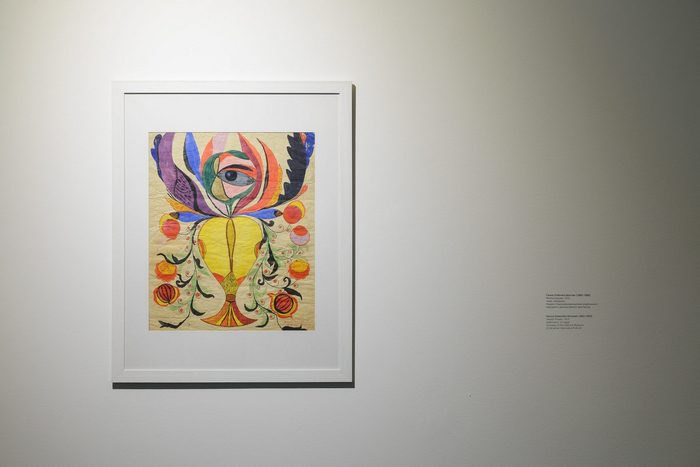
T. Z.: In the “Own Space” exhibition, I would also draw attention to the work from the National Museum of Ukrainian Folk Decorative Art collection — Anna Sobachko-Shostak’s “Flower-Radish” from 1912. Removed from a purely folk context and surrounded by works of young women artists, this piece acquires new emotional and often erotic meanings. Thus, it sheds the label of “primitive art.”
Speaking about “one’s own place,” I would like to ask you to comment on the position of curators in Ukraine. It so happened that contemporary art in our country is mostly handled by women curators. Can it be said that this profession remains marginalized in society? How do you explain this trend?
T. K.: It is difficult for me to speak about being an independent curator in Ukraine because I have always been connected with an institution. Certainly, working on an exhibition is a labor-intensive process that requires a lot of strength and energy. Unfortunately, many humanities disciplines remain low-paid here. At the same time, there is still a stereotype in society that a man should choose a “serious” profession that brings money.
T. Z.: At the same time, curating is becoming somewhat fashionable: women who see it as part of their social status begin to engage in it. But in reality, this is a very complex and ambiguous topic that deserves separate consideration.