
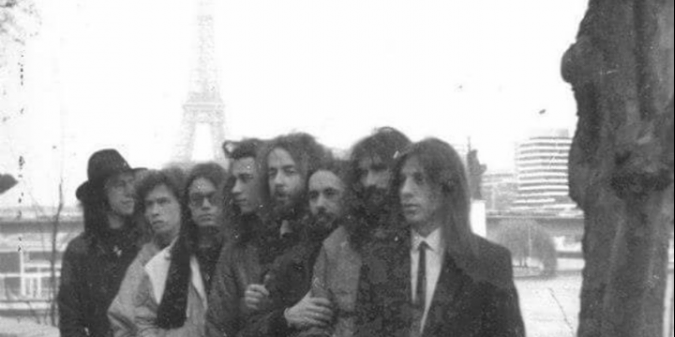
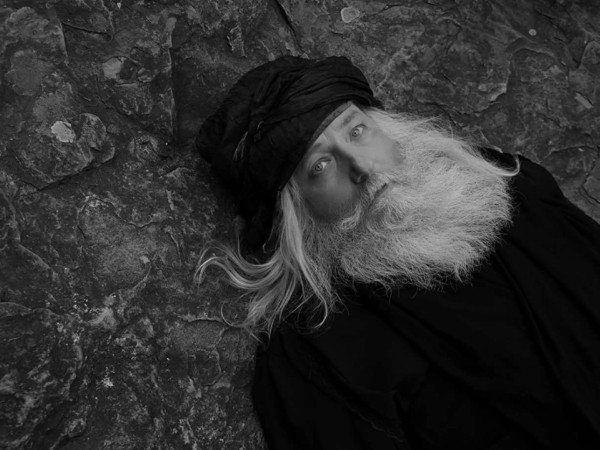
KORYDOR, within the cooperation with the Research Platform PinchukArtCentre, continues a series of publications dedicated to Fedor Tetyanych. Currently, the exhibition “Fedor Tetyanych. The Canon of Fripulya” is ongoing at PinchukArtCentre. This time, researcher and art critic Tetiana Zhmurko met with Oleksandr Dirdovsky — director, cameraman, screenwriter, artist, one of the founders of the band ErJazz — Er. J. Orchestra and the avant-garde theater “Zero Distance” (Kyiv, 1986–1987).
Oleksandr Dirdovsky collaborated with the famous psychiatrist and human rights activist Semen Hluzman on many projects related to art therapy and work with political prisoners. In 2000, he created the film-book “Others” about unique people who exist outside the system: these are psychiatric clinic patients, vagabonds, city madmen. Tetiana Zhmurko asked Dirdovsky about the fripulists, talked about the political and psychological underground of the 1980s–1990s, and about the “others” who occasionally appear in the field of art.
Tetiana Zhmurko: Oleksandr, in interviews you have repeatedly said that many of your friends are fripulists. What do you mean by this term?
Oleksandr Dirdovsky: Yes, I really know many fripulists. For example, sculptor Oleksiy Alyoshkin, a Kyiv native who now lives in Vinnytsia region, in an area with a lot of granite. By the way, he created the first Holodomor monument. Once he told me: “I am a fripulist.” Of course, we are all fripulists in our own way, especially when we were children.
T. Z.: So these are students and followers of Fripulya?
O. D.: Not necessarily. It’s more a way of life: above all, to be free, original, and unafraid. I remember we really learned from Fripulya not to be shy. Imagine Tetyanych, who during Soviet times walked the streets in his unique trash-cosmic costumes. Nowadays, there are many brave creative people, but during the “Soviet era” it was quite dangerous. Yuriy Zmorovych in an interview, and many other older generation artists, told how Fripulya appeared at meetings in the Artists’ Union in his avant-garde costumes. Imagine: all the official art authorities sitting, and then he enters. And he sharply criticizes socialist realism and them personally. The Soviet art authorities really feared him.
T. Z.: And it is still not quite clear: how did Fripulya manage to exist in the Soviet system? What was his relationship with it?
O. D.: There are unique people who are not afraid of any system. Unfortunately, among artists during the “Soviet era” there were also “informers.” For example, the story of the famous “Wall of Memory” on Baikove Hill, where the crematorium is now located (architect: Avraam Miletsky; architectural sculpture: Ada Rybachuk and Volodymyr Melnychenko. — T. Z.). The “Wall” was concreted over in the early 1980s. Volodya [Melnychenko] and the late Ada [Rybachuk] told me that the first impulse to destroy the “Wall of Memory” came not from the Soviet authorities, but from many complaints, including from artists, to which the KGB responded by destroying the largest bas-relief in Europe.
Fripulya belonged to the true artistic underground. It so happened that a few days after Fedor’s death, I was supposed to have a creative evening. Together with editor Ihor Kozynchuk, we edited the film “Blessed Islands. Fedor Fripulya” (2007) overnight. The entire evening at the Actor’s House was dedicated to Tetyanych. There were so many people that the audience sat and even lay on the stage. Volodymyr Yevtushevskyi performed at the evening. He, by the way, is a true fripulist because he and Fedor essentially invented this concept and lived in this style inside the “Soviet system.”
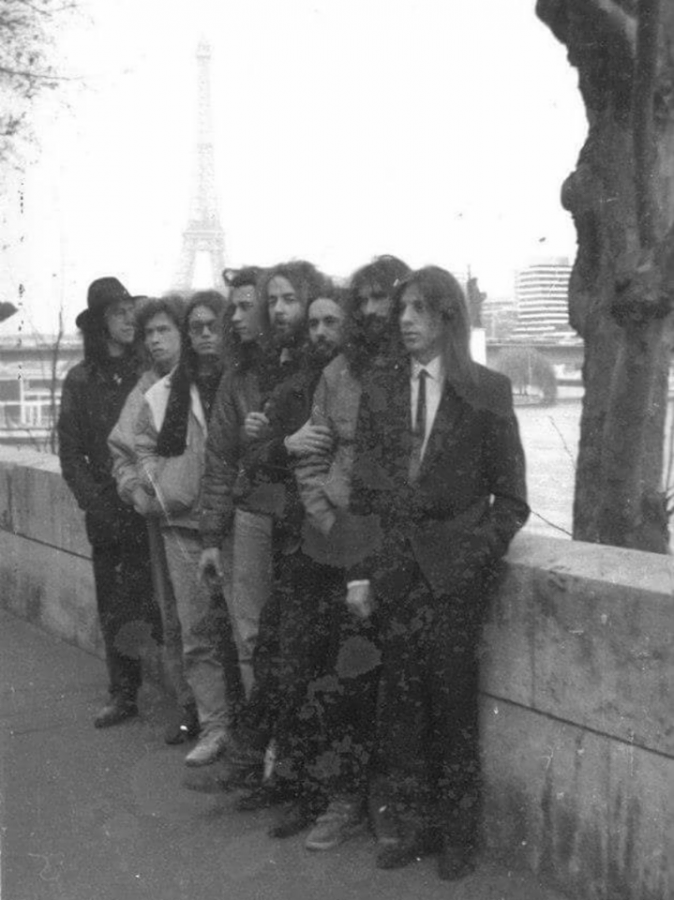
The band ErJazz — Er. J. Orchestra, which often performed with Fripulya in his biotechnospheres on the streets of Kyiv in the late 1980s — early 1990s, played. Now it is a famous Ukrainian band, one of whose albums was among the top three in Europe in the world music genre.
It is very symbolic that at the meeting at PinchukArtCentre, which took place this summer as part of the exhibition “Fedor Tetyanych. The Canon of Fripulya,” these musicians (Oleksiy Aleksandrov, Andrzej Pozdin, Viktor Krysko, Oleksiy Kabanov) played among Tetyanych’s installations. It was as if he was again beside us, ten years after Tetyanych’s death.
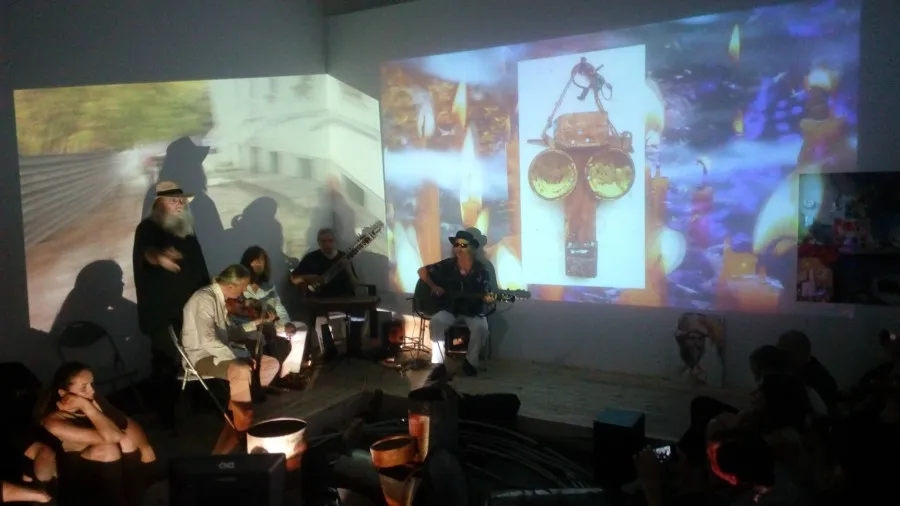
T. Z.: So Fripulya embodied the possibility of freedom for you? Through his behavior, way of life?
O. D.: Yes. Freedom. And he did it very brightly and contrastively.
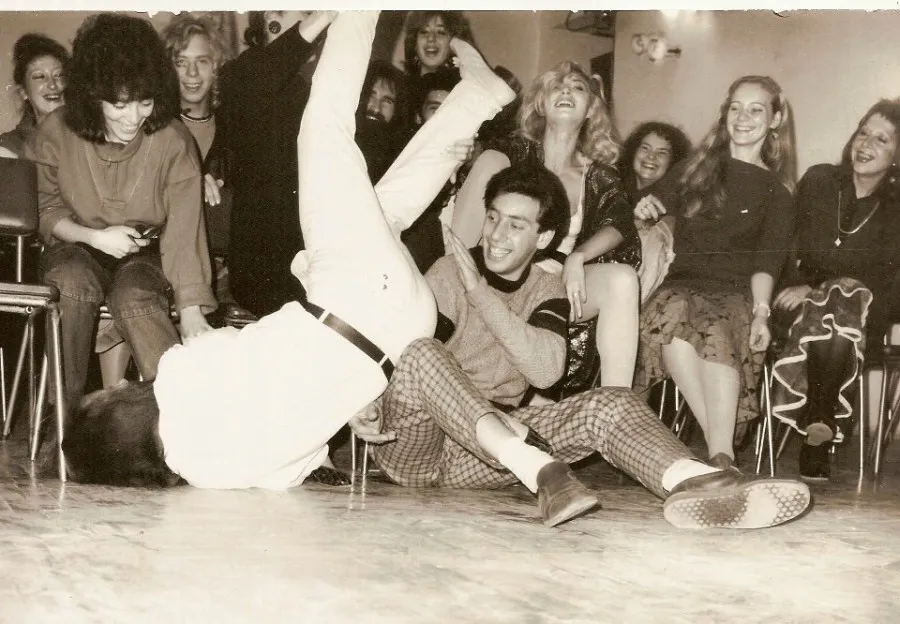
In 1986, together with Serhiy Solovyov, we staged the avant-garde play “Game in Smoke.” The theater was called “Zero Distance” and existed from 1986 to 1987. We even managed to perform in the red building of the university. There were no professional actors in the play — mostly artists and poets performed. There were characters: a man with a boar’s head, a man in a clay costume, a man in foil, a breaker (from breakdance), symbolizing the Soviet state. These were different, so to speak, human principles. Harmony was played by a black girl. Since there were no smoke machines, people in thermal jackets and construction helmets poured liquid nitrogen into hot water at the back of the stage, creating smoke. They drank vodka, played cards and dominoes. They, of course, symbolized the people.
And if in the first play, which took place in the Teachers’ House, Harmony defeated the state and human principles came out to the audience with Pushkin’s words “I love you,” then in the second production, after KGB persecutions, at the end of the play Harmony stood naked on the stage. Three human principles tore off her clothes and put a boar mask on her. This was a premonition of what is happening today in post-Soviet society, especially in Russia.
And another interesting detail. I wanted to add an original action before the play started. I bought 30 skeins of elastic for underwear and dyed it red. We wrapped the entire hall with it. We wanted the audience to walk around the hall and lift the elastic over the chairs. Many small fishing bells were hung on the elastic. It was all called the “author’s circulatory system.” Naturally, there were no posters. The play was staged underground, rehearsed mostly in apartments. The “word of mouth” worked, and a huge crowd unexpectedly burst into the hall. A lighting fixture standing at the entrance was knocked over, causing a short circuit. In complete darkness, people stumbled over the stretched elastics. It was very funny and effective. Moreover, as we were later told, some big official from the Ministry of Culture came to the play, and he got so confused that he had to bite through the elastic with his teeth, and students even trampled on him. The next week, articles appeared claiming that we ourselves turned off the lights and mocked the audience.
Why am I telling this? One artist then said a fitting phrase: “Now it is clear what can be done and what cannot.” After all, we were not harshly persecuted, not sent to a psychiatric hospital? So, it was possible! Fripulya was like a litmus test.
T. Z.: You obtained a medical education, and you have made many films with psychiatric hospital residents and simply very unusual people whom you call “others.” Is Fripulya also other?
O. D.: He is other one hundred percent. It is a unique combination of a seemingly urban madman with something completely different. But, as poet Marina Dolya said in the film, “…not every other who was in a psychiatric hospital, and not everyone who was in a psychiatric hospital is other.”
I collaborated with the art therapy center “Castalia” at Pavlov Hospital (Psychoneurological Hospital No. 1 named after Pavlov. — T. Z.), which was helped to be established by Semen Hluzman, a famous psychiatrist and human rights activist. Thanks to this center, I managed to realize my project — the film-book “Others” (2000), which was nominated for “Best Book of Ukraine 2000.” It was necessary to find talented creative people from scratch in psychiatric hospitals or on the streets of Ukrainian cities, print 500 books and 500 tapes, and distribute them for free. All this had to be done in four months. I succeeded. There was not enough money for editing. I had to edit directly from a digital camera to a tape recorder. Basically without a computer, because computer editing then cost a lot of money.
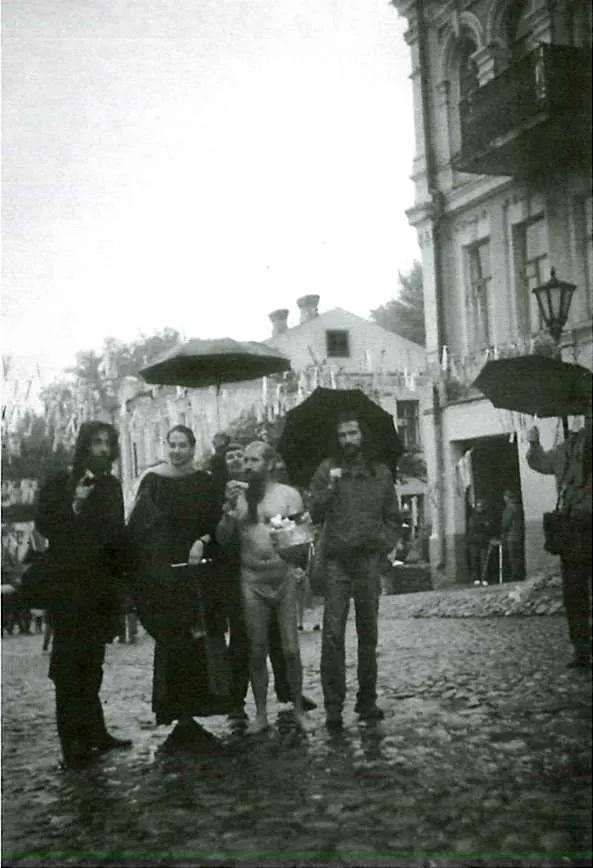
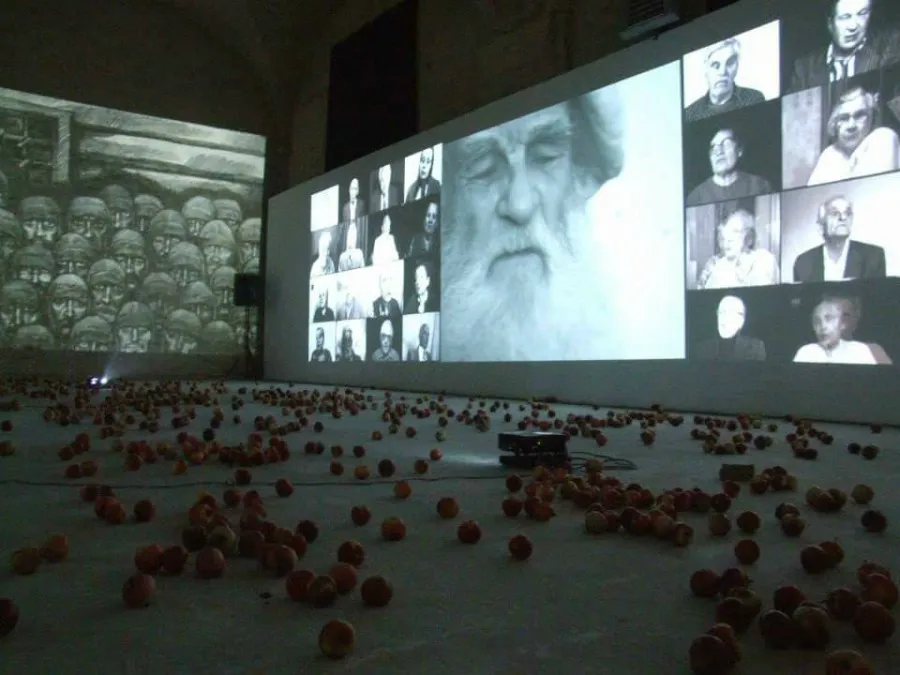
I named my film dedicated to Fripulya “Blessed Islands. Fedor Fripulya.” Because every such other like Fripulya is a wonderful blessed island. When he did performances, it was amazing to watch how the trash he worked with became a work of art. My main idea is that precisely when Fripulya appeared, this trash stopped being trash. That is why it was difficult to make the first exhibition after his death and generally very difficult to work with his art. Then we went to Knyazhychi, filmed video there, and brought a whole truck of various objects, barely fitting them in the gallery (the gallery was located on the first floor of the old “Yunist” factory building on Andriyivskyy Descent, opposite Bulgakov’s House, now a construction wasteland). Then we realized: whatever we did, no matter how hard we tried, it was still perceived as trash. Only Fripulya could turn it into amazing installations because he was a magician and was part of them himself. The catharsis moment was when we went out to Andriyivskyy Descent and for over half an hour, a big bearded company sang the word “Fripulya.” He definitely sang with us; it was both fun and sad at the same time.
Tetyanych has wonderful paintings. My favorites are “Ataman Sirko” and “History of Ukraine.” I saw “Ataman Sirko” for the first time in 1980 in the workshop of architect Anatoliy Ignashchenko, with whom Fedya was friends and planned many projects, but not everything worked out. There, in Tolya’s workshop, was a giant painting by Fripulya — a portrait of Ignashchenko made from fragments of his own works. It resembled Salvador Dalí’s painting “Slave Market with the Disappearing Bust of Voltaire”: among the trading figures, two nuns turn into Voltaire’s head. Fripulya also created a portrait of architect Ignashchenko. It is a giant work. I saw it even before personally meeting Tetyanych.
T. Z.: When did you meet him?
O. D.: We already knew each other in 1987. But we started actively communicating when the band ErJazz and our theater “Zero Distance,” which later became the “Theater of Rumors,” appeared.
T. Z.: Can Tetyanych be called part of the political underground?
O. D.: Fripulya was and was not simultaneously political underground. He was the brightest figure on the gray background of Soviet reality. He managed to create large monumental works, which I would call avant-garde socialist realism. And it is still a miracle that they did not put him in a psychiatric hospital, although once they tried in Moscow. When I studied psychiatry and visited Pavlov Hospital, there were more adequate people who were imprisoned just for practicing yoga or karate. Fripulya by his appearance was anti-Soviet. Moreover, he was a true Ukrainian and spoke Ukrainian, which was quite strict for that time. Of course, he was one of the brightest representatives of the underground artists of Ukraine.
I know what “Sovok”** is not by hearsay; my father got ten years in Kolyma for a poem when he was in his second year. At the end of the 1990s, at Semen Hluzman’s request, I filmed 264 stories of the repressed, about 500 hours of material. Many of my friends in Moscow and St. Petersburg were anti-Soviet. So now it is strange for us that we are on different sides of the barricade.
T. Z.: Let’s move on to the 1990s, when art became commercialized, and the rules and social relations generally changed in society. How did people like Fripulya and your circle, originally oriented towards non-commercial art, perceive this?
O. D.: In 1986, when we made the theater “Zero Distance,” the KGB pressured us, expelled us from institutes and jobs. Then we were conditionally called underground. Then the money disappeared — this was the early 1990s. And we defined two periods for ourselves: first was political underground, then came economic underground, when you can do whatever you want but have no money for it. For example, cinema, for which you need to buy film, etc. There were no VHS camcorders yet, so you had to buy 8- or 16-millimeter film and develop it. It was quite expensive. In the mid-1990s, psychological underground came. This is when you create art but do not want to sell it. Active art dealing began around. And many people, I know, went into psychological underground. Once I met Fripulya in the metro; he was dressed in an ordinary denim suit. I was surprised, and he said: “I have a period now when I don’t want to sell my works, I grow potatoes in Knyazhychi and sell them at the market.” And many of my friends at that time also went into this total psychological underground.
Now is a different time; every young artist makes their choice. As for grants and others, if it does not change some important inner essence of a person, then it is okay. But, I must say, we came out of the “Sovok,” it was, in its way, an idealistic society. We had to resist not to turn into Soviet idiots and keep our audacity. For us, it was fundamentally important.
T. Z.: Such personalities as Fripulya, who stand outside any systems, occasionally appear in the art field. What other others are around us, and what is decisive for their appearance?
O. D.: In the film “Blessed Islands. Fedor Tetyanych,” Tetyanych tells how he became an artist. During the war, a bomb fell near his house; he had a leg injury. And to some extent, because of this injury, he became an artist.
I made a large installation for Maria Prymachenko’s exhibition at the Mystetskyi Arsenal. She had a similar story. One leg was shorter than the other by about eight centimeters due to illness. So she could not walk normally or work in the field like other peasants. Drawing was her only outlet. Both of them, Tetyanych and Prymachenko, are from the village. And both are others, but each in their own way. At some point, the “Sovok” to show folk art somehow chose Prymachenko. Probably because she seemed “normal.” After all, she did not wear a crown made of a cardboard box from the “Kyiv” cake like Tetyanych. But for me, they are both perfect others.
Such people are always super-individualists but have their comrades. If I had not seen these brothers, I would not have understood who Fripulya was. Because if you don’t know these brothers, you might really think he was just some urban madman.
T. Z.: By the nature of your activity, you have met many unusual people. Who among them was also a “brother” of Fripulya?
O. D.: I had one absolutely unique case when I met Hennadiy Podvoiskyi. He is a true “brother” of Fripulya. In 1987, I worked at the Academy of Sciences film studio and came to Odesa to shoot a film related to psychiatry. I went out for a walk the first evening… Autumn, rain… I enter the city park on Deribasivska and see: under a tree stand three paintings without frames. They were a very attractive spot. I have a rule: if I enter an exhibition hall and see a cool spot, usually the work is good. I was magnetically drawn to these three paintings. And no one was nearby: just a tree and three works. Some microchips from human faces, some animals: dog, kitten, fly. A fantastic mix. I bent down, looked closely, and then heard behind me: “And you, Sasha, bowed to my works.” I turned around; a shaggy bearded man stood there. Blue eyes. Barefoot, although it was autumn outside. I was surprised: “How do you know my name is Sasha?” “I know, we will be friends for life!” (laughs). He gave me his address and said: “Bend down, make a tube with your hand, and look at this point where the fly is painted.” I looked and began to fall into that point. I said to him: “Actually, it’s fantastic! The center of composition is the fly!” He replied: “You will laugh, but when I was painting, a fly sat on this spot. I realized it was the center of composition.”
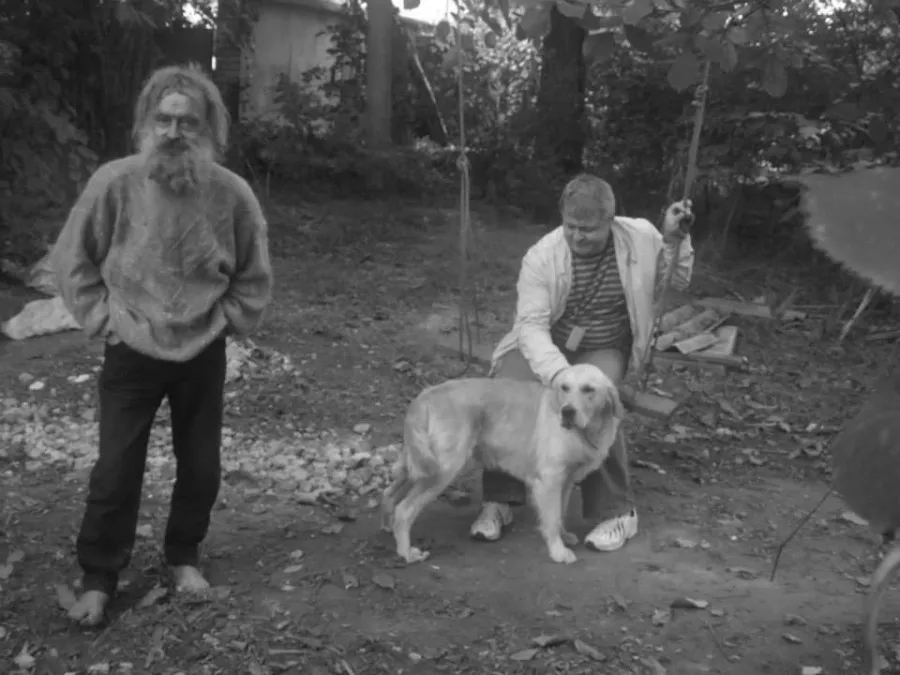
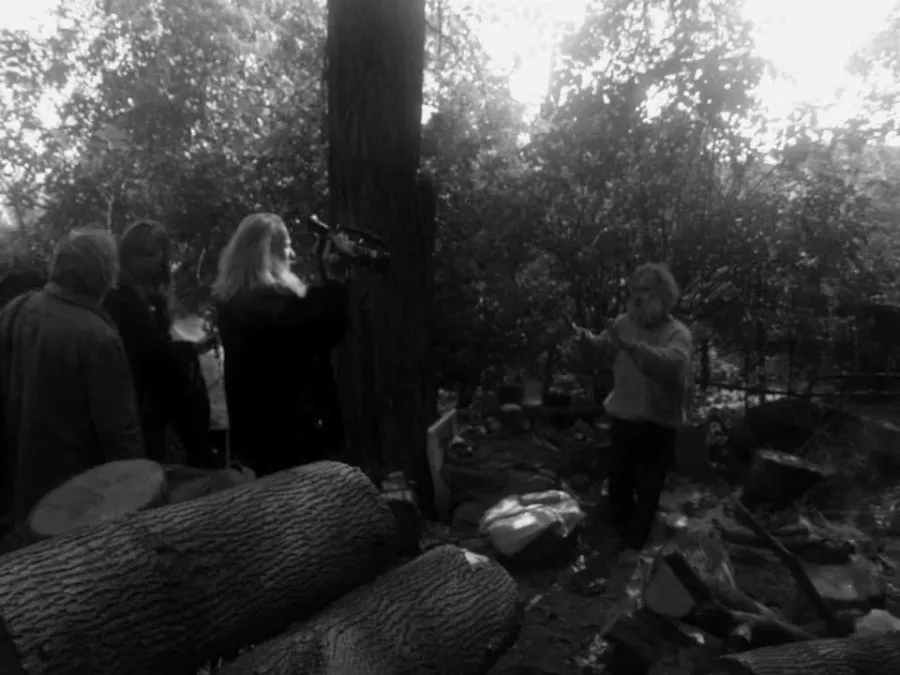
A week of rather difficult filming passes, and on Saturday I wander the city again. I meet acquaintances of the artist and photographer from Kyiv. I suggest going to the address I had in my pocket. It is raining heavily. We arrive and see what made me stop going to galleries at all. We entered the gate, and there, imagine: an autumn garden and about forty paintings lying just in the rain, in leaves and grass. Nearby was some shed where cellophane was stretched instead of glass. And no one was nearby.
Later I made several films about him, and we have been friends for 30 years. His prose and poetry are in the film-book “Others.” He has amazing poetry. And it combines with his way of life — just like Tetyanych.
It is still pleasant that there are such special people. Fripulya and Hennadiy Podvoiskyi make ordinary people think, showing that there is a parallel world. Because outside ordinary life, there is a special cosmos. When we met Tetyanych on the street, we could not just start talking to him. We had to first stir and raise our hair. And definitely shout the word “Fripulya!” It was a unique gesture. At that moment, we became one whole.