
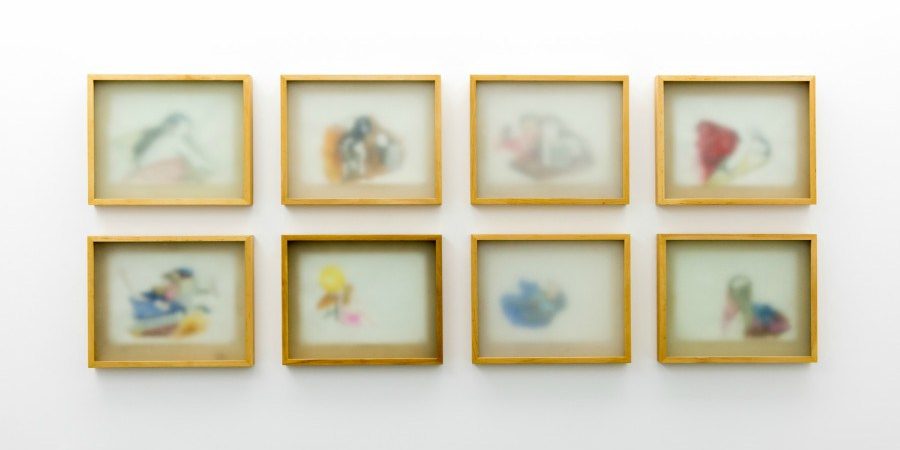
On the fourth floor of PinchukArtCentre, within the framework of the “Research Platform,” the exhibition “Guilt” is ongoing, dedicated to the awareness of guilt as a necessary condition for reconciling the past with the present and at the same time as a barrier between them. The exhibition raises questions of individual and collective responsibility before history, as well as the complexity of understanding another’s experience. One of the participants of the exhibition, Lesya Khomenko, sharpens these questions in her project “After the End.” Tetiana Kochubynska spoke with the artist about the most important changes in her creative searches in recent years.
Tetiana Kochubynska: It seems to me that changes are happening in your artistic practice now. If in your earlier works it was about what to do with the school of painting and craft, how to work with tradition and heritage, today your works leave more and more space for the viewer’s own reflections. It seems that the entire body of knowledge and skills you have mastered gives you the freedom to move to a qualitatively new stage. Your works are becoming more abstract — and not only in the formal sense. What causes these changes?
Lesya Khomenko: On the one hand, this is a natural process, a consistent development. I have always tried to work consistently. Sometimes some ideas seemed brilliant to me but did not fit into the logic of my practice, so I simply did not implement them. I work within a certain artistic language. If a work is not mine at all, I may not do it. Methodologically, I worked with my own history. In all my works, I am present — the artist, a graduate of the Kyiv Art Academy, a representative of the Kyiv art school. Every year, about a hundred people like me graduate!
My early works were very narrative. Now I am reading Gilles Deleuze’s book about Bacon — “The Logic of Sense.” I am close to his approach: he describes figurative painting not as narrative.
In the early works created in 2004–2006, I conducted an internal dialogue with official culture. These were huge, pseudo-official, loud works. I used the experience of socialist realism, whose language was simply transformed: the national idea appropriated it, changing only the attributes. A kind of decommunization without significant changes.
When the political elite changed and Viktor Yanukovych came to power, I suddenly felt that all this no longer worked, that I had no one to appeal to anymore. Language stopped working. This led us to Maidan. During the Revolution of Dignity, we saw that language as a tool of communication and trust was completely destroyed. Instead, physical confrontation arose: people acted with their bodies, not words. It was a revolution of physical interaction, no less important than intellectual.
Since about 2010, I have been looking for ways to deconstruct the narrative without leaving the boundaries of the painted canvas. I am convinced that a way of thinking can be revealed in any medium, even in levkas. Many socially critical works focus on the external world and lack self-reflection. Claire Bishop wrote that by criticizing ethically motivated but poorly made work, we risk becoming reactionaries because we criticize not the work itself but its theme.
Later I realized that I do not strive to go beyond painting. The path itself is more important to me than the final goal. For example, attempts to find the language of abstraction after socialist realism. Working with frosted glass is one such attempt to create an abstract image, but of a completely different nature.
T. K.: I wanted to ask about this work — “After the End.” We are showing it at the “Guilt” exhibition. It is a very subtle work about distanced vision, about the impossibility of fully realizing what is happening. What was the impetus for its creation?
L. H.: The impetus was frustration that began with Maidan. There, I really wanted to be effective, but I did not see what the effectiveness of an artist could be. At Maidan, the artist and art were not mandatory. As Boris Groys says, “war can describe itself.” Maidan could design and present itself through barricades. A commentator was not needed.
When the war began, including the information war, every time I came to the West, I felt that I fell into a niche of artists interesting for geopolitical reasons. I felt like a cultural diplomat. All the semantic superstructures I created in my works turned out to be less interesting than the material I worked with.
For example, my drawings from Maidan. Viewers were interested not in the fact that I present a copy as an original in the art system, but that real people are depicted in the drawings. They were interested in real portraits and real stories. As an artist, I realized that I am not obliged to limit myself to just testimony. As Alevtina Kahidze says, this is alternative journalism, a kind of cultural diplomacy. For me, all this devalues art.
T. K.: It turns out that the demand for you as an artist is determined only by your origin and geographical context. Does this limit you?
L. H.: I had the feeling that we are not subjects. It arose even before Maidan when we with “R.E.P.” made a work in Venice about euro-renovation. But this work was not heard because the discourse we proposed, as marginals, was not yet — or rather still not — present in the so-called civilized world.
I clearly realized that we cannot act as subjects on the international stage because we do not have a formed historical consciousness, a clear position regarding our own past, and we constantly close our eyes to something. Our history, for example, is written in the USA by Timothy Snyder.

«The Future Generation Art Prize @ Venice 2013». Палаццо Контаріні Поліньяк, Венеція
Фото: Сергій Іллін
T. K.: And if we return to your attempts to work with abstraction?
L. H.: I ironically call my attempts at abstraction provincial abstraction. It is a search for an adequate contemporary visual language when you carry the burden of cultural marginality, in which Ukraine has been for the last hundred years, but at the same time you do not pretend to be a provincial.
In art, I am always interested in revealing uncomfortable moments. I am a provincial artist, marginal, working with a marginal medium — painting. If we recognize our own provincialism, we will be able to understand the enemy, understand the other. In the cultural paradigm, to understand is to win.
In our circle, someone said that something needs to be overcome or defeated. It seems to me that victory lies in understanding. To put yourself in the place of an opponent or enemy means to try to understand them, not to break or destroy. Just as Anselm Kiefer put himself in the place of a German soldier…
T. K.: And what is happening in your new works?
L. H.: In a number of new works, I began to work with the uncomfortable feeling of a witness. I deal with a huge layer of stereotypes, including those related to war. Before the war in Ukraine, I myself was full of stereotypes. For example, I imagined children with Kalashnikovs in the combat zone. I think Ukrainians can also be perceived as terrorists.
Some of my new works consist of two parts. The first is the context, the circumstances of my existence and my role in them. The second is the content of the work itself, which does not correspond to this context.
The first work of this type was “Non-compulsory Drawing Courses.” I took first aid courses and received a certificate, which forms the context: it is dangerous to live in the country, so everyone must undergo such training. However, the sketches I made during the classes did not correspond to their theme at all. I drew everything except what was discussed in the courses: interior details, various objects. Then I showed these drawings together with the certificate. Hence the name — “Non-compulsory Drawing Courses.”
As an artist, I cannot remain silent, but I am not obliged to simply translate the news into the language of art.
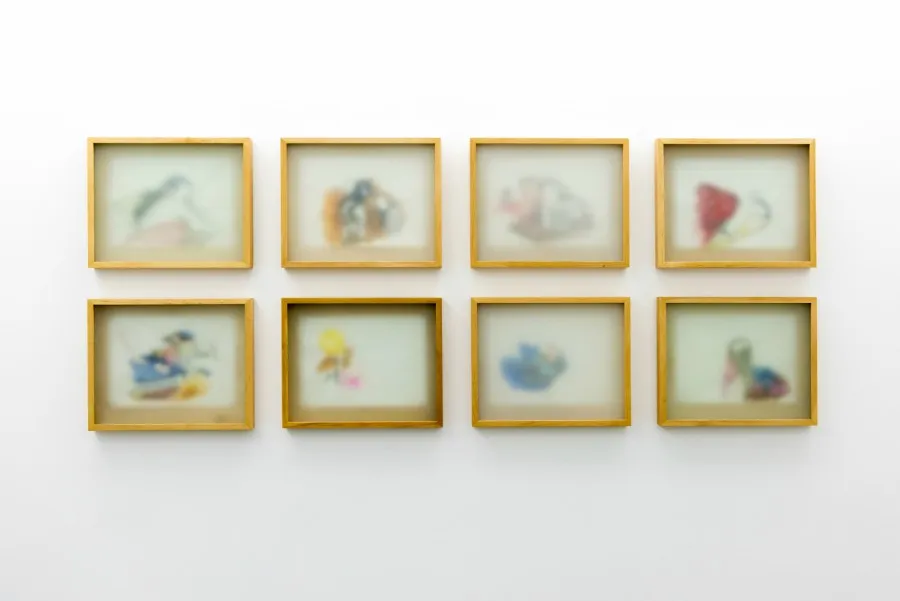
Фото: Сергій Іллін
T. K.: In your recent works, social issues are present unintentionally, implicitly.
L. H.: I am just trying to comprehend the role of the artist. How much is he obliged to be understood? How much can he remain an artist when art is needed by no one, when life is threatened?
I speak extremely honestly about what worries me, but at the same time I try to develop a language needed by contemporary art. In the work “After the End,” I also speak about the present, about our life and war, but I do not show the war itself.
At first, the idea of a blurred image arose: the glass in the frame was replaced with frosted glass. I thought: what will I show behind this frosted glass? The option of depicting hostilities was immediately discarded. I decided to be as honest as possible and show my own reality. And my reality is Kyiv, my life.
Here arises a paradox: life in Kyiv is peaceful, there is no war in the city itself. People in other countries who look at the situation from afar do not always understand this. I decided to show everything honestly — boring, routine life. It was like automatic writing: I skimmed the surface of what I saw, capturing fragments, objects.
Today, probably, the Ukrainian artist is expected to show the sharpest manifestations of reality — danger, death, pain. I live in a dangerous time and in a dangerous place, so such themes are expected from me.
For me, art works with imagination. Boredom does not excite the imagination, does not allow it to unfold. It seems meaningless, although at the same time everyone living during the war dreams of it. People dream of everyday life, but culture does not help them imagine it as a value.
Our cultural consciousness is arranged so that everything seen is immediately placed into a certain hierarchy. We already have an imaginary image of a place, and what we see automatically takes its place in it. As soon as we see something, we immediately put it on the shelves. We are deprived of the ability to perceive the world directly. In some cases, culture as a mediator does not cope with its task.
In this work, routine appears as a problem. Boredom is not considered relevant in culture, although in reality it is important for life. No one knows how to appreciate it. People begin to realize the true value of everyday life only after culture pays attention to it.
T. K.: This work operates on different levels. It appeals to the contemporary Ukrainian context but at the same time can be perceived in any country, in any context, as it operates with universal codes. However, the title itself is very dramatic — “After the End,” 2015. It involuntarily prompts one to endow the work with dramatic meanings. Associations arise with the information war, with the impossibility of seeing and comprehending what is happening.
L. H.: Yes, you are right. After Maidan, a very clear break occurred. I was strongly influenced by frustration related to the information war and the fragility of language. For two years, I did not engage in painting — I could not break free from the social context. All my works are in dialogue with the information struggle.
I returned to painting only six months ago, already with new thoughts. The historical dimension became even more pronounced for me. Until the war began in Ukraine, all wars seemed to me only an informational pretext and a set of clichés. This work is also about the impossibility of conveying experience. When art addresses extreme themes — such as childbirth and death — the viewer most often sees death or childbirth, no matter how subtle the work is.
T. K.: And what would you like the viewer to see?
L. H.: No matter how important the content of the work is for society, first of all, it benefits the art system itself. I realized this thanks to many years of discussions about whether art should be functional and useful or still maintain autonomy.
The advantage of art is that opposites can coexist in it. Both successful and unsuccessful interpretations are possible. It is walking on a razor’s edge when it is important not to fall into victimhood, not to strive to understand everything and everyone unconditionally, not to turn into a moralizer.
T. K.: I would like to recall the work “Stepan Repin.” At first, it was called “Eyewitness” and in some way resonates with the work “The Beginning of the End.” There is also distance and the idea of the impossibility of sharing another person’s experience.
The theme of war, including World War II, is very painful, especially today. In modern Ukraine, there is a reassessment of values, we are forming a certain invisible ideology that defines the official ways of reading history.
L. H.: Not reading, but writing. There is nothing to read yet.
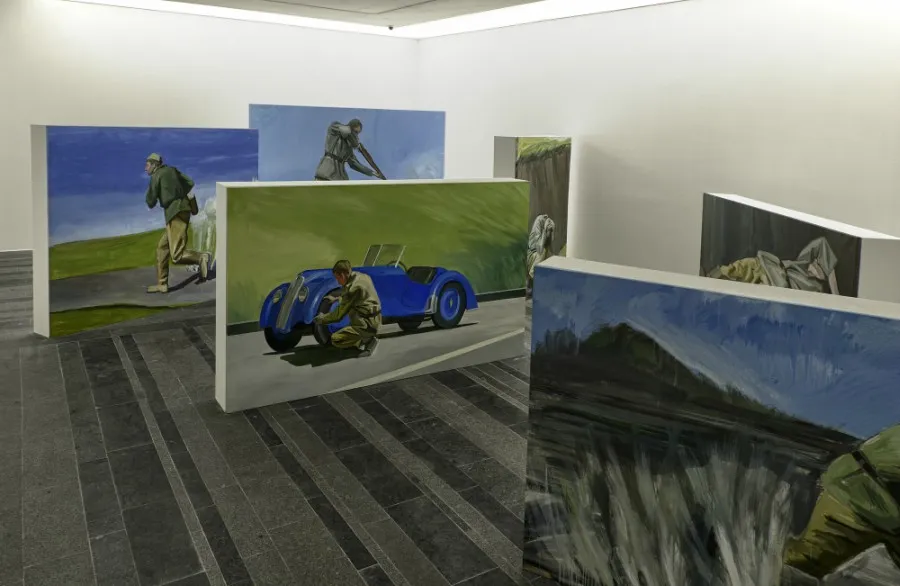
Фото: Сергій Іллін
Lesya Khomenko. “Stepan Repin.” Canvas, acrylic, stretcher, walls, text. Photo provided by PinchukArtCentre. Photographer — Serhiy Illin ©.
T. K.: Now we are not so much trying to show history in all its multifaceted interpretations as to produce new clichés. There was Soviet ideology, now there is modern Ukrainian ideology that defines how to evaluate the past. But there are also memoirs. There are many ways to look at history. How did you work on this project?
L. H.: In fact, there are many genres in which World War II is described: memoirs, multifaceted historical studies, investigations of war crimes. I discovered these genres during two years of working on the project — from 2009 to 2011. Before that, the war was not present in my life at all.
Then I came across my grandfather’s memoirs, which he wrote at the request of his daughters. They have no ideological background at all: he described the most radical episodes of his life quite neutrally.
Grandfather was a reserved person, lived alone, spoke little. He came from Kharkiv, was not subject to conscription himself, but joined the army because of hunger. Since at that time he was already an art student and had a good visual memory, during service he drew maps and fire correction schemes, constantly went on reconnaissance, and came under fire. There were enough reasons in his life to become embittered. However, he described all the terrible events in an everyday manner. All this later entered my painting.
I believe that art can oppose propaganda. It can deconstruct everything it works with — both its own language and the propagandistic language of clichés. One of the main values of art is to expose and turn inside out.
In this work, it was important for me to address the format of a large battle painting but make all its elements so obvious and transparent that it would cease to be propagandistic. In 2009, not yet knowing what war looks like, I tried to depict dryly what was described in the memoirs. If my grandfather wrote about himself, I depicted only him — the sole participant in the event — adding blue sky and green grass, which he did not mention.
I worked with the myth of the unknown soldier. Even then, I was interested in memoirs and an alternative way of telling about the war through the prism of an individual personality. I liked my grandfather’s memoirs because they lacked victimhood.
When I was studying, there was a German in our group. During drunken parties, his best friends joked about fascist topics. He was raised in the paradigm of victimhood characteristic of post-war West Germany, and it drove him crazy. Later, when he met people, he stopped saying he was German and introduced himself as Belgian because his mother was Belgian. Even the casual everyday atmosphere affected him.
I thought that this is the blind spot that can be worked on. Then a perspective opened before me: it turned out that we still do not have our own history. Why do we perceive the German as a Nazi?
I constantly try to fill the gaps in the history of 20th-century Ukraine. It seems to me that there is no need to rush. It is necessary to gradually, brick by brick, dismantle the debris.
What I felt in 2009 and then embodied in the work in 2011 became the culmination of my subjective interpretation of real history. Grandfather died, and I allowed myself to turn his original texts into rhymed song texts, thus depriving them of any claim to authenticity.
The key theme for me was mythology and its ability to replace history. We live with a mythological consciousness: we are not subjects but objects, we cannot speak on our own behalf. We live in a fairy tale and become its characters ourselves. Humanity has still not learned the lessons of World War II. The value of human life has not become unconditional.
T. K.: This is one of the issues the exhibition touches on. There is an individual person, their suffering and pain. And there is dry statistics and ideology. I would like the exhibition not to impose new clichés. It is called “Guilt.” What does this concept mean to you?
L. H.: For me as a person, the concept of guilt is unproductive. I rely on a different philosophy. In art, I am close to the possibility of “trying on” a role that does not belong to me.
I saw a parallel between artists and snipers: both objectify the body, perceive it as a set of objects. I thought about this after the shootings at Maidan when recordings of sniper negotiations were published online. It was terrible.
I was interested that for them, as well as for artists, working on the scene is the highest manifestation of professional skill. For both, the body is an object, a figure. I began to collect information about those I considered bad snipers. Then it turned out that snipers fighting on the front can be very skilled specialists, although these are the same people as at Maidan, only now they act under a military oath.
T. K.: Doctors who before the war performed their duty on the barricades — on the other side of the protesters — later found themselves in the ATO zone as military doctors.
L. H.: If you look at the situation from a certain distance, you can see professionalism in which the artist and the soldier converge at a certain point. This is an extremely uncomfortable realization: we can equate ourselves with killers, although we do not kill ourselves.
What matters is how thinking works. If it involves distancing and objectification, then how is such a way of thinking different from that used in other spheres? In this sense, it is about self-exposure. I cannot say that I admit my guilt, but I put myself on the same level as a professional who can use the same intellectual tools as our enemy.
For example, Santiago Sierra created situations of violence to show how society functions. He took on sin. There are several strategies in art for working with negative phenomena: they can be criticized or an alternative can be proposed. These are two parallel artistic methods.