
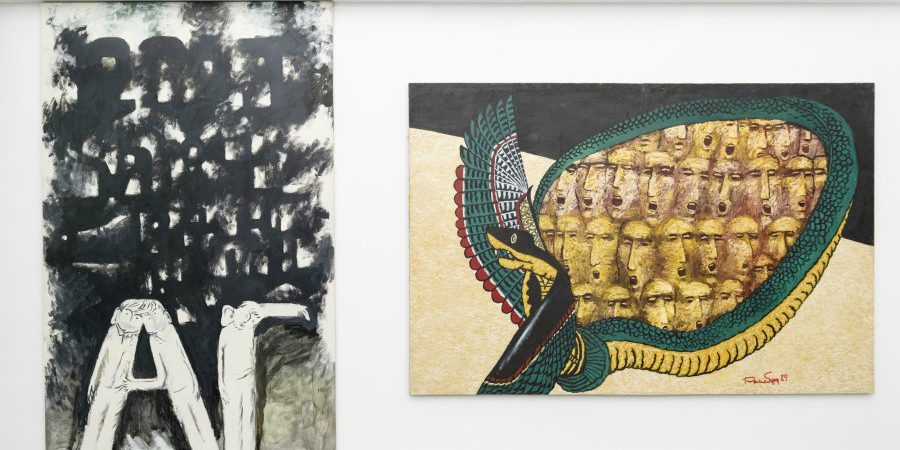
Konstantin Akinsha is an art historian, curator, author of the book Beautiful Loot. Soviet Plunder of Europe’s Art Treasures, a researcher of the modernism era and a witness to the emergence of Ukrainian contemporary art, a participant in the Kyiv art scene at “Parkomuna.” In the context of the exhibition project “Parkomuna: Place. Community. Phenomenon,” Alisa Lozhkina spoke with Akinsha about the period of the Ukrainian “new wave” and the peculiarities of the artistic process of the late 1980s – early 1990s.
Konstantin Akinsha: I left Kyiv for Moscow in 1986. Until then, Kyiv was a dead zone. There really was unofficial art here, but it was completely marginal. Yevhen Petrenko and other artists persecuted by the KGB — that was it. We must not forget that Kyiv in the 1980s was a real city, and in terms of control, it could only be compared to Leningrad. The KGB dictatorship was absolute here. What was possible and overlooked in Moscow was impossible in Kyiv by definition.
Suddenly, at the end of the 1980s, this circus happened: everyone came to the All-Union Youth Exhibition in Moscow — “The Sorrow of Cleopatra,” Roitburd, Hnylytskyi, Holosiiv, Raievskyi, and others. At that time, changes were happening in Moscow, including the creation of the first private gallery “Mars.” Where the money came from, where it was stolen from, I can’t even guess. Strange events took place, involving selected artists from Malaya Gruzinskaya and former or not-so-former KGB agents.
This exhibition arrived, and I was its consultant. I went to see it and was simply stunned: it made a huge impression on me because it was completely different from everything that could be seen before. It was unlike Moscow, where the conceptualist discourse prevailed, nor like the works of some “Fly Agarics” representing the Moscow informal segment. And suddenly — such an explosion!
At this exhibition, I bought everything that was there, except for “The Sorrow of Cleopatra,” because it was priceless.
I met all the Ukrainian artists who sold me everything that hung there. It was a shock for them: someone wanted to buy their works for real money and pay immediately. The payment was made on the principle: “Shura, how much do you need for complete happiness?” The problem arose precisely with Shura, because Roitburd immediately turned green and said, “I won’t sell for that amount, I need more.” I looked at him with contempt and replied, “Well, if you need more — take more!”
So, many paintings were purchased for the cooperative “Mars,” but unfortunately, I do not know their further fate.
Alisa Lozhkina: What was the situation in Moscow and why did Ukrainians manage to become a new fashionable trend so quickly?
K. A.: The conceptualist environment dominated in Moscow. Kabakov, who still lived in Moscow at that time, built around himself a guard called “NOMA” and decided who could do what and who could not. Meanwhile, the remnants of the Moscow artists’ union were stirring, and the “Left MOSKh” was barely flourishing. That was the Moscow art landscape.
Of course, the appearance of Ukrainian guys against this background was an unexpected explosion that shocked Moscow. It was something completely new — undoubtedly modernist, but at the same time based on a mutation of academic education. They valued conceptualists and at the same time all knew how to skillfully work with paints. Such art in Moscow could still be afforded by some members of the “Left MOSKh,” but definitely not by representatives of Malaya Gruzinskaya or conceptualists.
Moreover, this painting, albeit belatedly, somewhat corresponded to the global context. They invented their own postmodernist painting, relying on what they could see in small black-and-white reproductions and read in articles by Achille Bonito Oliva.
A. L.: What was the main idea of this movement? What was its concept?
K. A.: These guys graduated from an art institute where they were taught according to a program corresponding to the Russian academy of the 17th century. And it was then that distant rumors began to reach them — from magazines they managed to read, from small black-and-white reproductions. They learned what postmodernism was, who Oliva was, about Francesco Clemente and his colleagues who painted large oil paintings, as if trying to use the entire potential of art history. This inspired them.
They began to invent their own postmodernism, which was less ironic than Western postmodernism of that period, and often surpassed it in painting quality. In the context of Western art history, these artists are perceived as reactionary. The return to painting really looks like a reaction. Postmodernism of that time in the West and the Ukrainian wave are, to some extent, historicism but with a changed sign: undoubtedly, with a plus sign and belief in endless progress.
In postmodernism, the entire artistic heritage was perceived ironically, although the means of production — whether in the 1880s of the 19th century or the 1980s of the 20th century — remained the same. Artists had at their disposal all the cultural achievements of humanity.
That is why Cleopatra rode a tiger, Jewish prophets fought in Roitburd’s works, and baroque forms twisted in Hnylytskyi’s. All this was a reaction to several courses taken at the Kyiv Art Institute: art history, drawing, and painting — as much as they managed to absorb.
Everything was done very talentfully and very freshly. I still remember Hnylytskyi’s early paintings and what remains of them. He was wonderful.
They scared Moscow. It was undoubtedly contemporary art that contradicted all the attitudes of the Moscow elite of contemporary art. That elite resisted and denied everything that came from Kyiv.
Then Gelman came into play, who began to unite them. After he bought their works, artists from Kyiv and Odesa began to establish contacts. This period turned out to be the best. Later, they began to enter a crisis. They could no longer continue painting in the same spirit, and the potential of the fresh explosion was exhausted very quickly.
Various problems arose. After the initial painting explosion, the question arose: what to do next? And then a certain falling into naivety began, with trends of expressionism noticeable in Holosiiv. The so-called “childish discourse” began. Trubina wrote a work “The wounded kitten walks, biting the puppy’s ear,” which apparently became an unintentional parody of “The Sorrow of Cleopatra.” Savadov quite quickly experienced a creative stagnation and moved on to quite glamorous things.
A. L.: I also constantly say: “Savadov painted…” and then I remember that they worked together with Heorhiy Senchenko.
K. A.: The fate of this tandem is hard to define. At some point, Senchenko, on Baudrillard’s advice, chose silence, and Savadov remained Savadov. Undoubtedly, Senchenko played an important role: they worked together. So it is quite wrong to speak simply about “Savadov” when talking about “Cleopatra,” the monkeys, or the Munich installation.
The guys were brilliant painters. The big problem was the concept itself. If we talk about the ability to work with paints, they were excellent painters — perhaps even better than their Western inspirations. But what exactly to paint, they did not know. They learned to paint Cleopatra and then began to look for new themes.
Unfortunately, the problem of the conceptual framework remained unresolved — ultimately, it destroyed them. Of course, in the history of Ukrainian art, they occupied a more than respectable place. In a country that did not produce any serious unofficial art, where at best there were stylizations in national color — with wreaths and Cossacks — suddenly everything exploded with such force.
A. L.: But there were Barskyi, Lamakh, Havrylenko…
K. A.: There were, but it was not serious. Odesa was conceptualist, leaning more towards Moscow. There were individual artists, but they did not define an entire movement.
I am concerned that any relatively serious and active unofficial artist from Ukraine was pushed out and went to Moscow. The imperial, secondary history played a serious role in the history of Ukrainian art. This role has not yet been described, although it needs to be comprehended and discussed. For example, the short triumph of Ukrainian photorealists.
A. L.: I wanted to ask about that. What was it? We constantly mention this movement, but we know almost nothing about this generation except that this group was sometimes called “artists of the Kyiv station.”
K. A.: I knew Sherstiuk, met him in Moscow. These were guys who took American photorealism and decided to fool the system. And to some extent, they succeeded because they added socialist realist themes to photorealism. All these cosmonauts and other characters they depicted no worse than the Americans.
Sherstiuk sought monopoly in Moscow. They stormed the capital in the early 1980s. Thanks to their “khokhlyatska passionarity,” they really managed to fool the system. They showed realistic art — even more realistic than realism itself — and under this pretext began to break into official all-Union exhibitions. They exhibited their works and also designed a museum — a large hyperrealistic project, the Lenin Museum in Kazan.
They believed they were mocking the system. They communicated with Western guests who looked at their works with admiration.
It was a short triumph. As always, our guys joined photorealism at the stage of its decline. But undoubtedly, Sherstiuk and Heta deserve more serious consideration in the context of Ukrainian culture. It was one of the few successful Ukrainian modernist projects.
In the city of Aachen, at the Ludwig Forum, there is a large collection of this painting. Ludwig collected American art — from abstract expressionism to photorealism — and saw something close in these works. The fact that there were cosmonauts and Bolsheviks did not bother him: the artists spoke a language he understood. He paid a lot of money for these works.
Regarding Rodchenko, there is no serious understanding of how he became John the Baptist of the transition of the Ukrainian artistic regiment to the imperial capital. This phenomenon repeated itself in the “new wave.” But if the initial impulse was brilliant, light, and beautiful, then later declarations of self-determination and plots with heavy literary content appeared. Roitburd can be an example.
Two people fell out of this situation. Holosiiv was not inclined to such sophistry and at some point began to lean towards expressionism. Hnylytskyi, on the contrary, was inclined to more complex intellectual searches, but they pushed him out of painting, although what he did outside it was extremely interesting.
Probably, Hnylytskyi was a genius of Ukrainian art. Unfortunately, as always, almost nothing has survived. Where are those installations of Hnylytskyi in which Natasha Filonenko swam in an aquarium as a ceramic figure?
Attempts to establish contacts with the West were also difficult, and there were many reasons for this. One great Croatian artist created a famous work — a canvas “A contemporary artist must speak English.” It did not work for us. Attempts to establish themselves in Moscow had some results, but the artists who chose this path — Tistol and Reunov — never became Moscow artists. Moscow repelled them.
The first attempts to establish contacts with the West took place, in particular, through me. I brought Scots who were also engaged in painting. However, the Scots themselves were quite marginal, although at that time there was a tendency to return to painting in Great Britain. Attempts to enter the Western scene did not work. Exhibitions took place in Munich, Edinburgh…
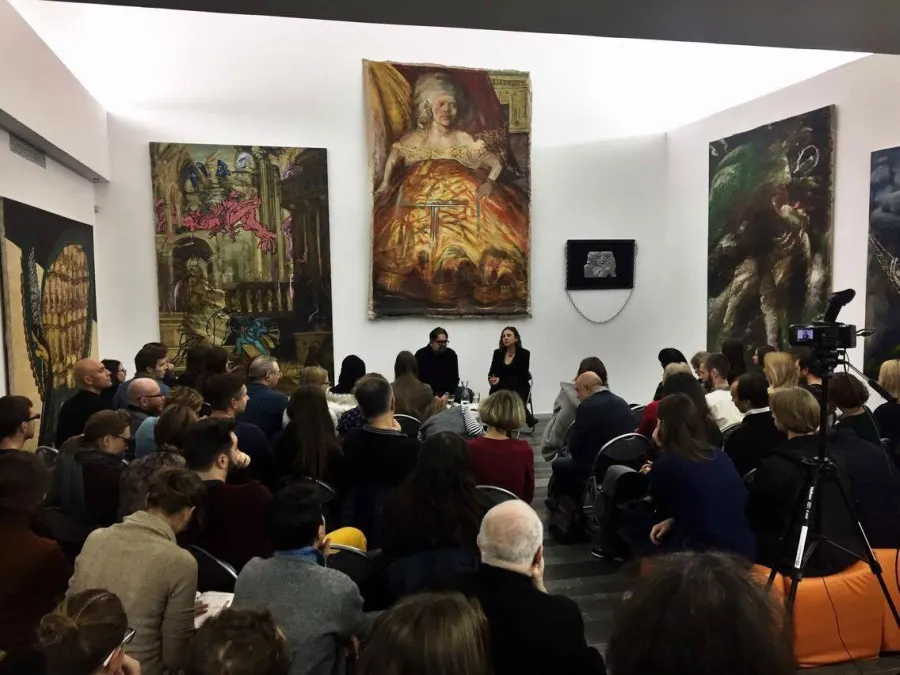
A. L.: We talked about international exhibitions that took place in the early 1990s. You mentioned a certain crisis in the presentation of our art abroad caused by misunderstanding: we did not understand the West, and the West did not understand us.
K. A.: The misunderstanding was mutual. In Edinburgh, they were all very loved: they fully corresponded to the trends of Scottish painting of that period. But Scotland is Scotland.
I remember how Savadov’s exhibition took place in America. I was almost the only one who ensured its publicity, the only mouthpiece in the international press because I constantly wrote articles, including for the British magazine Art.
The thing is, they came with their plywood suitcases on the ship of postmodernist painting just when this ship was already sailing in many countries.
I said that their project was perceived as reactionary when they just started doing it and showing their works. I will never forget a funny story: Natasha Filonenko asked someone in horror — I don’t remember who: “Katya Dyogot visited Kyiv and said that painting is over. How will we live now?” Natasha was then concerned primarily with financial, not aesthetic issues.
Painting really exhausted itself in a certain sense, and there were wanderings in search of new media. The only person who never wandered was Holosiiv: he painted and painted until he died. He was a type of artist that can be called Mozartian — Mozart playing a little violin — and Yesenin-like. He did not engage in reflection: he had paints that he applied to the canvas.
The rest, of course, began a media panic. This is visible in the example of Savadov, who decided to master photography. He did it roughly the same way as Alexander Rodchenko at the beginning of his activity. If you recall Rodchenko’s first photomontages for Mayakovsky’s poem “About This,” you can see how he worked with the photographer: cut and glued photographs, and then began to photograph himself.
Savadov became a kind of theatrical director. Senchenko also played this role when they lined up half-naked girls and boys…
A. L.: This is a separate project of Savadov. Their first project in the new aesthetics was on the ship “Hetman Sahaidachny.”
K. A.: Yes, then the ship was the flagship of the independent Ukrainian fleet. One of the first exhibitions took place on it, initiated by Marta Kuzma and the Kyiv Soros Center. As far as I remember, there was an amazing catalog designed by Chychkan, and the exhibition itself was funny in every respect.
Savadov chose the role of director of photography — first together with Senchenko, and then without him. He built the mise-en-scène, and this was his artistic role, basically limited to that.
Hnylytskyi was the only one who managed to successfully go beyond painting. What he did outside it was more than understandable and more than worthy. Unfortunately, very little of all this has survived.
Roitburd became a film director. The irony is that his most successful and best works turned out to be a rather daring experiment with the re-editing of “Battleship Potemkin” and scenes involving Misha Rashkovetsky and other Odesa intellectuals. To date, his video is the only work in the entire history of Ukrainian art selected for the curatorial program of the Venice Biennale.
A. L.: No, no. In recent years, there was, for example, Kolya Ridnyi…
K. A.: But then it was a real breakthrough. It seemed that Shura would leave the brush and engage in video art. His work was purchased by many museums worldwide. It is in the collection of the Moderna Gallery in Ljubljana and has been exhibited at numerous exhibitions.
But then Shura emigrated to America and forever returned to painting, which he obviously could not leave. This passion for painting eventually prevailed, and everyone returned to it. Experience shows that an artist who received a painter’s education cannot leave painting if he is a true artist.
I always dreamed of making an exhibition “Bad Painting of Good Artists.” I would collect late works of Malevich, late works of de Chirico, and other masters who in old age, against the backdrop of the turbulent flourishing of modernism, returned to sluggish, ugly, completely unacceptable realistic painting.
Obviously, we are moving in the same direction. But if we go back to the early 1980s, it was an amazing surge, after which the problem arose: what to do next? Ultimately, it turned out to be very short.
A. L.: You mean a media surge?
K. A.: No, a painting surge. The media surge was an attempt that turned out to be completely unrealized. It led to nothing, so eventually everyone returned to painting. You see what Savadov does today: mostly painting.
A. L.: And yet it was a self-sufficient period, a certain integrity — all those 1990s with their attempts to deconstruct the picture, with installations and video. How interesting is all this in the context of world art? Tsagolov’s video, Hnylytskyi’s installations, Roitburd… Does all this have any significance for the global art process?
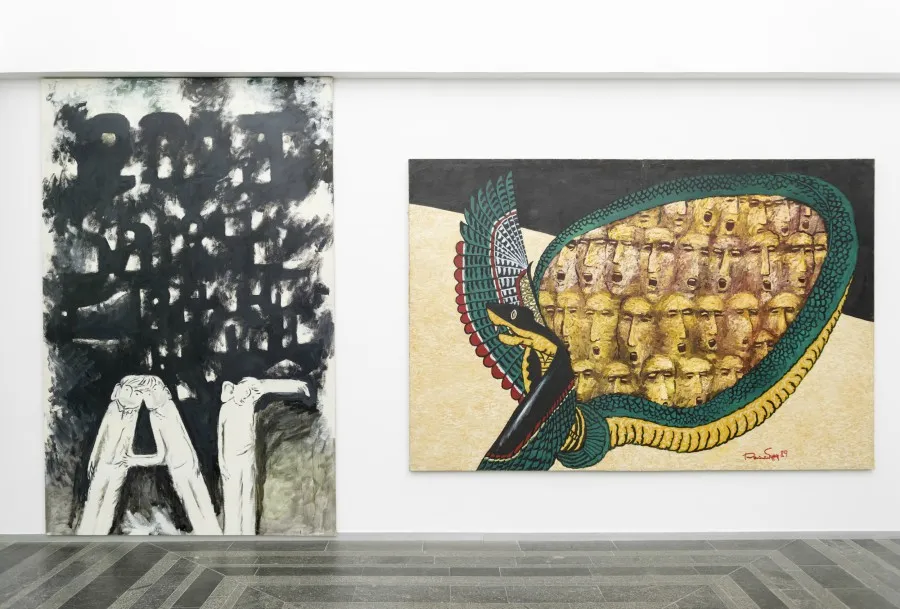
Олександр Ройтбурд. «Гімн демонам і героям», 1989. Надано художником
K. A.: I believe that internationally, Hnylytskyi as an individual figure is primarily significant. The rest — to some extent. Their work is important in the context of Ukrainian art, which, pulling up its pants, runs after the Komsomol.
In the first period, they offered perhaps a barbaric but unique product. Their early painting around Cleopatra was truly barbaric but self-sufficient. Despite obvious and direct influences of Italian figurative painting, it was different. But what they tried to do later was no longer unique.
In my opinion, Hnylytskyi could have become a figure of global scale if at that time there had been a person capable of “packaging” him, if he himself cared about his career.
If Holosiiv was Yesenin, then Hnylytskyi was Skovoroda, a philosopher about whom one can say: “The world caught me, but did not catch.” He clearly did not intend to catch the world. He did not build his own PR, did not have that vein characteristic of many Ukrainian artists today — the desire for self-promotion.
It is very interesting what all this has grown into. It is worth looking at the circle of Tistol and Matsenko: what started with painting in Tistol later turned into dried emblems. And what I see today in Matsenko indicates that he has moved further and, on the contrary, evolves interestingly.
We are already talking about a formed generation, about people who have become titans of Ukrainian art. One would like to expect radical steps from them, but I do not think it is very likely.
A. L.: And Tsagolov?
K. A.: Tsagolov recently had a very talented painting surge. But here we see the same problem: many talented works on large canvases appear, and then everything gradually begins to slide into the usual scenario.
The artist creates a dramatic work and then begins to adapt it to the tastes of certain oligarchic circles, reducing himself to the level of a salon. The danger of salonism constantly hangs over all this — and this is one of the main problems of Ukrainian art.
A. L.: Why does this happen?
K. A.: For several reasons. I understand that this is a postmodernist and dangerous category, but it is about “betrayal of tastes” — a category that is not used today.
On the other hand, it is a desire to please. Artists appeal to the local context, and the Ukrainian art market has its paradoxes. Obviously, this market influences artistic production.
A. L.: Why do you think none of these artists managed to become internationally recognized? In fact, in the world, only Mykhailov and Bratkov are known among Ukrainian artists.
K. A.: Because Mykhailov worked in another medium and quite skillfully built strategies and tactics of self-promotion. Despite the fact that Mykhailov was not an extremely educated person, he ultimately became a Western artist. But he sought this from the very beginning.
Our artists could not build a similar strategy. What Mykhailov offered the world had an exotic element. To some extent, he sold exoticism — first Soviet, sincere, and genuine. Then, in the early 1990s, he got confused and tried to become a Western photographer. In his cycles where he depicted himself naked and dancing, in my opinion, it did not work at all.
Later, the homeless appeared — then Mykhailov consciously began to create exoticism for the Western consumer. Everything was wonderfully “packaged”: homeless people in a decent London gallery, and visitors looked at them with horror. It is fascinating.
Our artists, credit to them, did not trade in exoticism, although such strategies can be viewed differently. Whether it is good or bad is another question. But they did not trade it. At the same time, they also failed to offer something so original that it would become understandable in a global context.
This is the paradox. Their place is primarily in the history of Ukrainian culture and in the history of art of the last stage of the existence of the Soviet empire.
A. L.: Recently, much has been said about the role of politics in the life of this generation of artists. At PinchukArtCentre, there was even an exhibition where they were presented as the flowers of perestroika. Curators insisted that it was perestroika that influenced the formation of this generation. How strong was the political factor in the life of this circle of artists and how did it manifest?
K. A.: This art was remarkably apolitical. Even in Savadov’s attempts to play with political discourse using actors, the aesthetic side prevailed.
That is, we are dealing with a completely apolitical generation that became the beneficiary of the empire’s collapse. These people received freedom, for which they did not particularly fight, and completely distanced themselves from understanding social changes and political processes.
Even compared to Russian art, which was much more political, Ukrainian art stood out for its apolitical nature.
What was the difference between Ukrainian and Russian artists? Among the terms used in the early 1990s was the term “new sincerity.” They were really very sincere.
What was happening in Russian conceptualism corresponded to the development of Russian culture. Conceptualism and risky political games quickly degenerated into general cynicism. It was remarkably cynical art. Maybe not in Kabakov, but definitely in his followers.
This is a very interesting and serious topic — rather of Russian than Ukrainian art. Because this cynicism defined further political processes, including those continuing to this day.
Our guys had no cynicism at all. A barely noticeable chill was felt only in Savadov. The rest were rosy-cheeked, blue-eyed boys, closer not to “Cleopatra” but to “The wounded puppy that walks.”
They had no aesthetic cynicism at all. Opposition to the political system was minimal or completely absent. They were conformist artists, and this largely defines the artistic processes happening to this day.
Whether this is good or bad — I do not dare to judge. I only state the fact: when freedom was given to them, they used it. They did not seek open confrontation with anyone or anything.
This happened against the backdrop of the complete collapse of the repressive system of the Artists’ Union and the state monopoly on art. They managed to occupy the appropriate niche and work calmly in it. No one persecuted them, their paintings were not burned in squares. On the contrary, the state treated them without particular objections.
This became a positive impulse for the emergence of contemporary Ukrainian art in the form in which it exists today. It is a reaction to the apolitical nature of previous generations.
A. L.: What was happening around “Paris Commune”?
K. A.: I witnessed many events there and spent a lot of time. It was very romantic and funny. A wonderful squat where all the artists drank, partied, and even in free time engaged in painting.
It was a process parallel to what was happening in Moscow. Art squats in our countries appeared almost simultaneously.
“Parkomuna” was formed during a period of loss of orientation when the “childish discourse” began and artists fell into expressionism. But Furmannyi and Tryokhprudnyi also had a practical side: they were not just about drinking and painting there. They were a kind of department store because during perestroika art from squats became extremely fashionable. Every art dealer, even a semi-rogue who came to Moscow, headed there to buy desired works.
And “Paris Commune” was a squat for the sake of the squat — art squat for art squat’s sake. It was a cute circle of endless artistic communication, occasionally interrupted by visits of Ukrainian sponsors. They appeared on the horizon as future stars, financed something — and immediately disappeared.
Everything was cute and funny, life was boiling. Of course, all this was still naive: artists constantly communicated with each other. It was the most romantic period in the history of this generation.
A. L.: How did the history of curatorship develop in Ukraine? What was the role of the main figures?
K. A.: It is difficult to talk about this because I was rather a guest in this process. I did not live in Ukraine, came, decided something, etc.
In general, the main role was played by Solovyov. He is truly a national pride and value that must be preserved and protected. Besides, he performed a huge educational role: he endlessly talked with artists, trying to explain and tell them something.
Then came the era of Marta Kuzma and the Soros Center in Ukraine. Marta was engaged in curatorial activities and curated exhibitions herself. Roitburd played a certain role in Odesa, but the father of all this was Solovyov.
A. L.: What was the role of the Soros Center in the context of the 1990s? What was happening there and what did it ultimately lead to?
K. A.: The history of Soros international centers deserves a separate conversation.
In Ukraine, an unexpected source of support suddenly appeared, thanks to which contemporary art was able to exist for many more years. Don’t forget, there was also the Odessa Soros Center, into which significant funds were invested.
Sasha Roitburd came up with a wonderful song: “Two sponsors of clear minds sat on an oak: one sponsor — Soros, the other sponsor — also.”
This center was a monopoly in supporting contemporary art. Of course, later there were certain historical claims about what was done there. But a lot was done: exhibitions were organized, endless catalogs were printed. For many years, the center became a guarantor of the survival of Ukrainian art — at a time when there were no independent sponsors yet, and oligarchs were not yet interested in art.
The most interesting project of the center was the exhibition on the cruiser “Sahaydachny.” There were few visitors, and it all looked very funny. A military cruiser is not quite a typical exhibition venue.
One of the best works there was a spontaneous, unreflected work by Hnylytskyi. He simply aimed the cruiser’s cannon at the Moon, which ended up in the center of the sight. By the way, Mykhailov, Bratkov, and Savadov also participated in this project.
The center was opened, as similar institutions were in other countries. All this happened rather due to a misunderstanding: Soros did not want to support contemporary art, but since such support was considered part of the development of democratic processes in transforming societies, he decided to finance it.
A. L.: It was said about Soros that contemporary art was, so to speak, sold to him as a package.
K. A.: Yes, contemporary art was imposed on him, which he could never understand and did not like. It caused problems everywhere, including huge problems in Ukraine, because the leadership of the Renaissance Foundation sincerely hated this art and tried to shut everything down. Eventually, they succeeded.
But, again, there was a long period when support literally fell from the sky like a miracle.
A. L.: Why is there constantly a conflict in Ukraine between conservative official culture and contemporary art? After all, in many countries, for example Slovenia, contemporary art at one time became a kind of calling card of the state.
K. A.: Slovenia is a special example. There they decided that at a certain point they managed to turn contemporary art into an important national resource. However, this also ended quite quickly: a right-wing government came to power that sincerely hated all this.
But there was a period when Slovenia relied on three pillars: Žižek, Laibach, and Neue Slowenische Kunst. In this small country, they even managed to decorate all Slovenian embassies with art.
I was at the ambassador’s in Washington and came across deer with antlers, crosses, and offices literally hung with contemporary Slovenian art. It was a state project — a kind of “packaging” of Slovenia through contemporary culture. This does not happen in many countries.
Contemporary art causes strong irritation in Poland as well, where scandals constantly flare up. If you remember the story of the removal of Anda Rotenberg and other similar cases, it happens, of course, more civilized than in Ukraine, but conflicts do not disappear.
I think this is not surprising for Central Europe. In Ukraine, the level of tolerance is perhaps even higher than in Hungary and Poland. In this sense, Ukraine is not unique. And compared to the Russian neighbor, we are, I would say, a rather peaceful country. So far, no one has been imprisoned for performances here.
Confrontation with politicians is natural because contemporary art is a complete anathema to them. They do not understand it, and it causes genuine irritation in them.
A. L.: And when did you start following Ukrainian art again?
K. A.: I generally did not engage in contemporary art for a very long time — in any form.
A. L.: Why?
K. A.: First of all, I was engaged in classical modernism, that is, my profession. To some extent, I am not very convinced by contemporary art. I like individual artists, but the artistic process itself does not captivate me.
As for the political component, I suddenly began to follow all this and engage in it during the Maidan. The Maidan was a surprise. It gave a very short opportunity — judging by what is happening now — for an aesthetic explosion and the creation of a real work of art. To some extent, it was a return to modernism. And it was very interesting.
Many things became relevant again: from the political poster, which practically disappeared and no longer played any role in any context, to works by artists ranging from Semesiuk to Mykyta Shalenyi.
Then I, like all people born in Ukraine, naturally experienced these events and followed them. I wanted to do something, and we organized two large exhibitions — I Am a Drop in the Ocean: Art of the Ukrainian Revolution — in Vienna and Krakow.
But, again, in Ukrainian art there are several short explosive periods, after which stagnation sets in. We just talked about the surges of neorealism, hyperrealism, about the explosion of the late 1980s, which later also turned into stagnation. All these periods are quite short.
The period of political art in the mid-2010s can essentially be limited to the Maidan. I am not talking about professional political artists like Kadan. I mean non-professional activity in this sense — situations when an artist feels the need to immediately join the political process.