
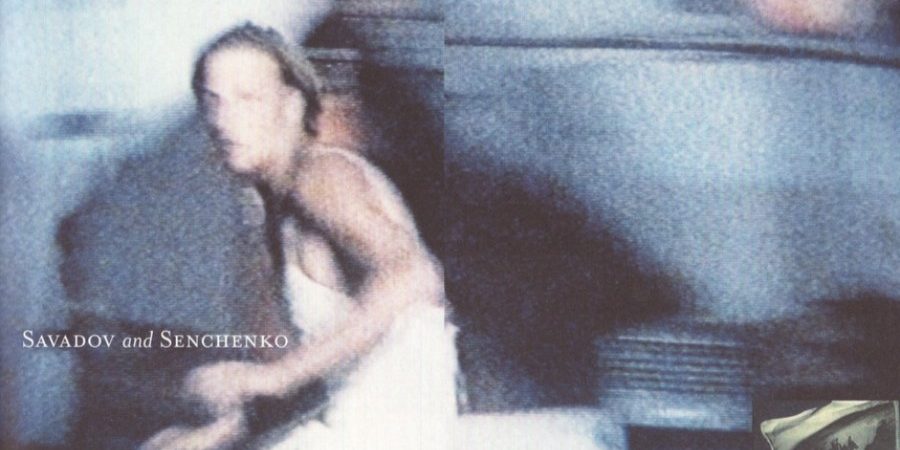
“Voices of Love” is a legendary artistic project by Heorhiy Senchenko and Arsen Savadov, realized in 1994 in Sevastopol on the ship “Slavutych” as part of the exhibition “Alchemical Capitulation” (curator — Marta Kuzma). The project was created in the midst of the conflict related to the division of the Black Sea Fleet. Almost 25 years later, the ephemeral, poetic, and grandiloquent phrase “Voices of Love” suddenly becomes relevant again in the Ukrainian artistic field. On November 16, 2018, a press conference was held at the Ukrinform agency, during which a new eponymous artistic project by Arsen Savadov was presented (curators — Peter Doroshenko, Oleksandr Solovyov, and Olesya Ostrovska-Lyuta). This work was nominated for participation in the 2019 Venice Biennale, but it did not pass the competitive selection.
Art historian Valeria Shiller tries to understand the semantics, symbolism, and connotations of the first “Voices of Love” project (1994), hoping to approach an understanding of the connection between it and Arsen Savadov’s new work. The material is published within the cooperation of the PinchukArtCentre Research Platform and KORYDOR.
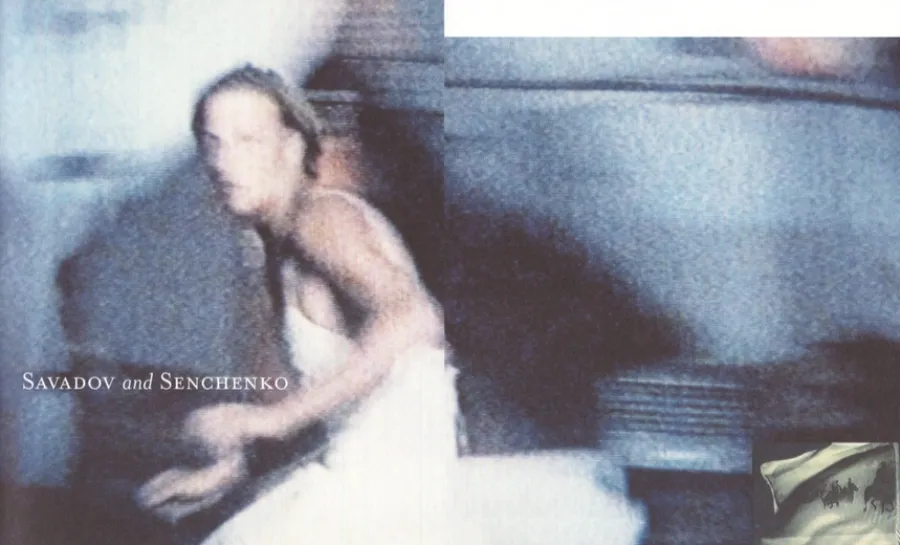
The work “Voices of Love” by Arsen Savadov and Heorhiy Senchenko was created for the exhibition “Alchemical Capitulation” under the curatorship of Marta Kuzma — art historian and director of the George Soros Center for Contemporary Art in Kyiv. The military ship “Slavutych,” which briefly became an exhibition space, was commissioned in 1992, and in March 2014 it came under the command of the Russian Federation’s Black Sea Fleet.
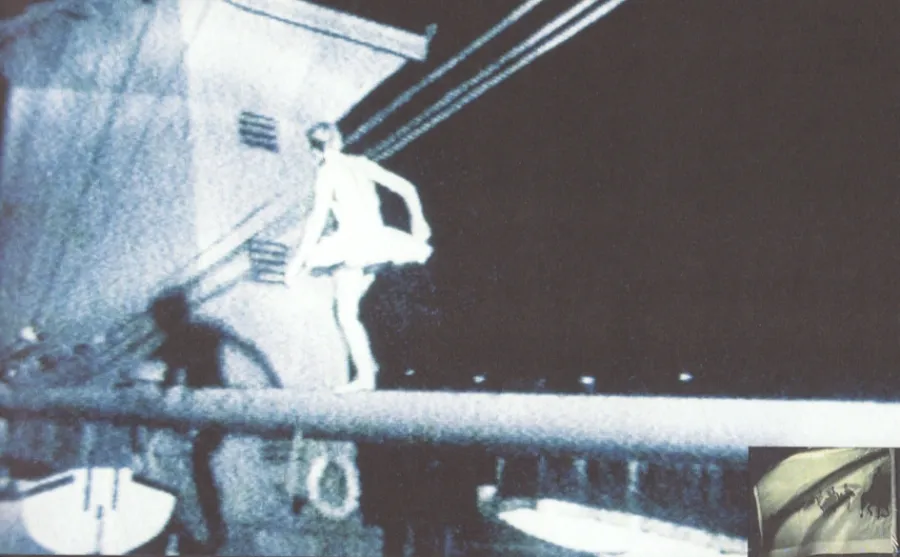
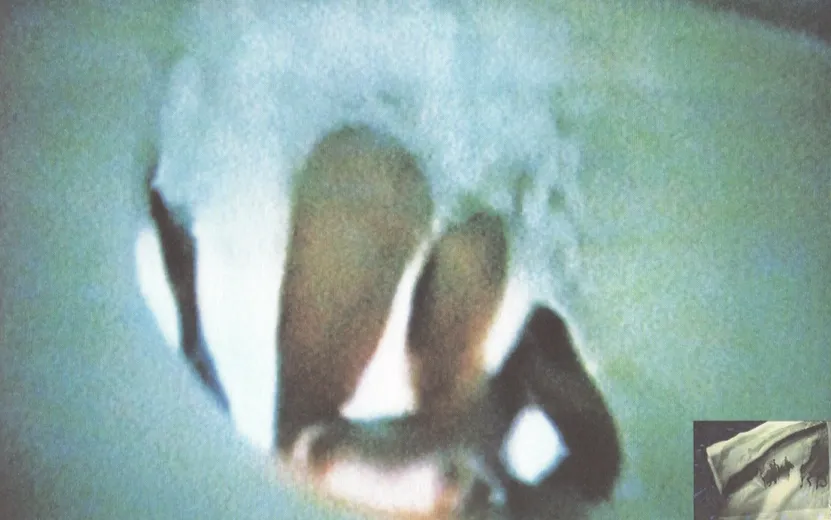
“Voices of Love” are filled with absurd scenes. In one episode, a sailor in a ballet tutu spins on the deck, tied by his legs to the ship’s capstan drum. In his hands, he holds two models of German Messerschmitt fighters. On the other side of the capstan sits Oleksiy Degtyar, nicknamed “Makiet,” a member of the Kyiv rock band Ivanov Down, playing the accordion. After this episode, shots occasionally appear where sailors transport another sailor in a tutu on the deck — in a wheelbarrow moving along rails.
The video is permeated by a recurring motif of repeated, monotonous, seemingly work-related routine actions: sailors spin, tied to the capstan drums[1], or one of the characters in a tutu gets stuck in the porthole frame and unsuccessfully tries to get out. Then four sailors in tutus meditatively rotate a model ship on the deck, immersing the viewer in a hypnotic state. In the last part of the video, the sailors, like burlaks, drag an anchor through a narrow enclosed corridor — the internal exhibition hall of the “Defense of Sevastopol 1854–1855” panorama museum. The entire video sequence is accompanied by monotonous sounds of dripping drops or the oppressive hum of an engine. The work literally radiates a feeling of senseless labor and hopelessness.
The characters in the video often do not hesitate to show tenderness for their task: their actions are full of love and warmth. In one episode, a sailor gently hugs and caresses a model ship decorated with multicolored lights. Another character, also in a ballet tutu, slowly and playfully kisses the ship model and nibbles it, and sometimes, caught up in the kiss, even puts the lights in his mouth. The next scene begins with a shot where two sailors in tutus spin in circles in the wheelhouse. One calmly sits and looks through the periscope, while the other spins in the cramped space, elegantly performing ballet steps. At the end of the scene, the shots alternate: the characters either sit embraced or together hold the base of the rotating periscope.
There is no definitive interpretation of this work. Perhaps this is explained by the fear of destroying the entire “magic” of art by trying to explain it rationally. The authors themselves, Arsen Savadov and Heorhiy Senchenko, wrote a poetic text for the “Voices of Love” project, which was included in the catalog of the “Alchemical Capitulation” exhibition. However, this text does not clarify what is seen nor break down the artistic component of the project into separate elements. It can rather be considered a continuation of the work than its analytical description.
Translation:
“Voices of Love
Fate, like a rattling motif, drifts and intertwines with virtues such as hope, embodied in the symbol of the anchor. The semantics of the sea do not limit their dialogue with positive awareness. The ancient Chinese idea of alchemy as the guardian of the soul. Cultivating the immortal cell within oneself… A concise representation arises within the balanced naval discourse.
Save our souls.
Allusions to the transformative nature of ship semantics… The Morse code and its sequences of long and short dashes resemble the changing strokes of Eastern symbols… Einstein hired three ships. Not planes nor a tank division. In his experiments with the divergence of space… Ultimately, a ship is only a unit of measurement in the national practice of hallucinogens…
The ship in the paradigm of change… We approach a hermetic ritual that implies not only the hierarchy of internal and external spaces but also the transformation of one into the other… The possibility to dock and set sail from the port…
A ship docked in an exhibition space within a certain cultural context becomes a mediator that launches the reality of the objects presented inside… Interaction that goes beyond any conventional reflection of emptiness… In the manner of transreal messages… Like a fragment of the statue of Saint George, a ballet tutu, a boat filled with water, the search for light sending distress signals into the darkness… With hope that the Universe will hear our voices filled with faith, hope, and love…
Savadov and Senchenko
However, many researchers have managed to approach an interpretation of the project. Exhibition curator Marta Kuzma, in her text for the “Alchemical Capitulation” catalog, emphasizes the theme of corporeality: “The goal of Savadov and Senchenko’s video project is to show the intersection of gender role relationships in the study of the behavior of real sailors who served on the ‘Slavutych’ within the strictly male ship discipline”[2]. Kuzma refers to the works of French anthropologist Jean-Pierre Vernant, who described a new sense of masculinity — devoid of all manly and perhaps even sexual traits.
In a lecture dedicated to Ukrainian media art of the 1990s, delivered as part of the exhibition “Flashback. Ukrainian Media Art of the 1990s,” artist, curator, and publicist Oksana Bryukhovetska continued the conversation started by Marta Kuzma about the change in the nature of masculinity. Bryukhovetska draws attention to the fact that the tender, semi-naked bodies of the video characters contrast with the metal hull of the ship. Moreover, the constant cyclical movements of the sailors contrast, in her observation, with the idea of linear movement in the USSR, which was always purposeful and directed toward the future — communism. In “Voices of Love,” instead, there is an endless slow rotational movement: sailors spin inside mooring drums, wander the panorama corridor, and so on. All this induces the viewer into a psychedelic trance[3].
Russian art historian Katerina Andreyeva notes that the plot of “ballerinas and soldiers,” which the artists refer to, is characteristic of imperial culture as it is associated with discipline and drill[4]. Ukrainian art historian and researcher Halyna Sklyarenko, analyzing Arsen Savadov’s work, also emphasizes the exhausting labor of ballerinas[5] — an aspect that the viewer does not immediately notice.
Many art historians, including Marta Kuzma, Halyna Sklyarenko, and Oleksandr Solovyov, note allusions to Sergei Eisenstein’s film “Battleship Potemkin” in the work “Voices of Love.” This parallel becomes obvious not only due to the dominance of ship and military symbolism but also literally: the authors used props from the Oleksandr Dovzhenko Film Studio, which were once involved in the film. In the 1990s, Sergei Eisenstein’s film became cult again. Artists Oleksandr Roitburd[6] and Hlib Katchuk[7] quote it in their video works, using the then-common artistic method of re-editing archival films[8]. Mastering new media, Ukrainian artists turn to the pioneer of the Soviet film industry, who once also revolutionized traditional art.
Since 1994, the work has been exhibited repeatedly in various versions: with or without sound, on one or several screens, and sometimes in a shortened version. At the “Flashback. Ukrainian Media Art of the 1990s” exhibition at Mystetskyi Arsenal, the work concluded the exposition and was shown on one large screen. Meanwhile, at the “On the Edge. Ukrainian Art 1985–2004” exhibition at PinchukArtCentre in 2015, “Voices of Love” was shown as a three-channel video projection, alongside Serhiy Bratkov’s work “Airborne Forces Day.” Bratkov’s work also addresses the theme of romanticizing military rank. Here, the euphoria of realizing one’s significance intersected with the military triumph presented in “Voices of Love.”
The venue of the exhibition largely determined the themes and plots of the presented works. Sevastopol — a hero city that in 1994 was still closed to everyone except its residents, military personnel, and their families. After Ukraine’s independence declaration, representatives of other professions moved to the city very slowly. That is why military power continued to occupy a special place in the lives of the townspeople.
After the collapse of the USSR and at the time of the exhibition, most military ships of the former Soviet fleet were still under a single command, despite signed agreements on the planned division. Later, in 1997, another agreement was signed — on the lease of Ukrainian territory for the basing of the Russian Black Sea Fleet for the next 20 years. In connection with this, the number of Russian military personnel and their families in Sevastopol gradually increased, deepening tensions and exacerbating the military conflict.
The city’s residents were accustomed to living in an atmosphere of constant triumph of military power. Besides the cult of two city defenses — during the Crimean War of 1854–1855 and World War II of 1941–1942 — supported by active school, museum, and cultural programs, there was also competition between the Ukrainian and Russian fleets. It became an additional factor fueling this triumph. The tradition of competing salutes of the fleets of both countries, parade rehearsals, and the parades themselves, aimed at glorifying the valor of Sevastopol’s defenders and demonstrating military strength — all this was a usual, inseparable, and quite natural part of everyday life for Sevastopol residents.
In the “Voices of Love” project, Savadov and Senchenko find a new way to work with the hero: the artists familiarize themselves with the context in which they will work, interact with real participants of the events, persuade them to take part in the filming, and dress them in ballet tutus[9].
Who and where do the voices of love call? Is it a cry for help? In the book “Fragments of a Lover’s Discourse,” Roland Barthes notes that the loving subject, attaching to the object of their love, fears the unreality of the world, which can freeze and become unrecognizable. Therefore, the subject constructs an illusory “world” in which one can live at least somewhat tolerably[10]. If we conventionally call the exemplary citizen the loving subject and the native country the object of love, then by this logic, the obsessive demonstration of military power, the cultivation of national ideas, and the heroization of war can be seen as the same illusion. They are meant to prevent the catastrophe that appears as a hypothetical rupture between the subject and the object of love.
This may also be indicated by the semantics of ballet, to which Ukrainian artists have actively turned since the 1990s. Works on this topic exist in the creations of Vasyl Tsagolov (painting and sculpture), Oleksandr Roitburd (video “Mechanical Ballet,” 2002), Stas Volyazlovsky (graphics on textile “Ballet, Hockey, Football,” year unknown), and other artists. Primarily, this is related to the fact that after the August 1991 coup, ballet, especially Pyotr Tchaikovsky’s “Swan Lake,” became a symbol of the events accompanying the collapse of the USSR. In “Voices of Love,” the artists could emphasize not only the obvious confusion about what is happening and the crossing of gender roles but also the theatricality of glorifying the military power of the fleet using the image of ballet. They could bring the idea of a military show to absurdity. By dressing in ballet tutus, the military become theatrical actors playing according to the script of the high command. The audience of this performance is primarily the soldiers themselves, as well as their families, compatriots, and residents of other countries.
The inability of the Ukrainian fleet to defend itself during the events of 2014 may indicate the illusory nature of its power. In this case, the myth of military strength appears as an artificially created illusion that has nothing to do with reality — a fantasy that must be discarded to see the true state of affairs. And according to Roland Barthes, the only way to get rid of the love illusion is to realize death. After this realization comes capitulation, and then — rebirth.
In the new work, Arsen Savadov turns to the image of Marilyn Monroe, who inspired American soldiers during a series of concerts organized after the end of active combat in the Korean War (1950–1953). The artist creates an absurd historical reconstruction of the events of 1954 already in the Ukrainian context and invites Ukrainian singer Andriy Kravchuk (EL Kravchuk) and Russian opera singer Maria Maksakova to play the role of Marilyn. While working on the piece, Savadov interacted with real Ukrainian military personnel who, after the pseudo-Marilyn’s performance, supposedly truly inspiredly went to the real war.
How does Arsen Savadov’s new work continue the 1994 “Voices of Love”? In the new project, the author again addresses the theme of femininity, combining the images of Athena Pallas, the Motherland, and Marilyn Monroe — female figures who inspire young people to fight. However, in the new work, besides the gesture of cross-dressing, which Savadov has been using since the early 1990s, the plot turns into an outright parody and absurd travesty show. Despite the deliberate carnivalization, the filming itself has an epic look, but it remains unclear whether there is room for self-irony.
The 1994 “Voices of Love” project is a landmark and innovative work that had a huge impact on the Ukrainian artistic environment of the 1990s. In subsequent works — “Book of the Dead,” “Donbas Chocolate,” “Collective Red” — Savadov developed the artistic strategy initiated in “Voices,” revolutionary for its time: provocative, built on creating a performance and theatrical show. Provocation, mixing images of femininity and masculinity, using a common military theme — all this truly aligns well with the artistic processes of the 1990s. Fortunately, all these techniques remain far in the past — just like the 1990s themselves.