
Autocommentary by Valeriy Sakharuk on the exhibition he curated “Fedir Tetyanych. The Canon of Fripulia,” which took place within the Research Platform of PinchukArtCentre from June 17 to October 15, 2017.
Art is a text seeking context.
Joseph Kosuth
I do not recall reading curators’ texts written about their own exhibitions after their conclusion, although I assume they exist. Usually, the verbal field of a project is limited to the concept, annotation, and eventually interviews, and when it becomes public property, the baton passes to critics and media representatives. Writing such a text is problematic not only for ethical reasons; a more important obstacle is the usual authorial bias, which prevents one from taking the position of another and looking at the exhibition from the outside. What remains is to share thoughts, remarks, and observations that accompanied the process of working on it and for various reasons did not enter the public discourse.
The quote from Kosuth was not accidental. While leafing through notes made during the maturation of the idea of the “Canon of Fripulia,” I came across a definition that captured the essence of the project: “An exhibition of an idea, stripped of the husk of form,” which recalled the classic Idea As Idea As Idea. It is immediately necessary to warn against attempts to classify Fedir Tetyanych as conceptual art, since the visual coincidences of the “Canon” with the formal discoveries of the great contemporary are superficial. The ghost of Joseph Kosuth appeared much later, when the decision was already made to show Tetyanych’s texts through the prism of black-and-white imagery.
This refers to Passagen-Werk (Documenta Flanerie), realized by Kosuth in June 1992 at Documenta 9 — in two long museum enfilades of the Neue Galerie in Kassel, the artist covered the works located there with canvases bearing identification inscriptions (some in white letters on a black background, others black on white). The installation, whose purpose was to create a complex interpretive network consisting of Walter Benjamin’s text, the museum exhibition, and Documenta itself, had nothing in common with the curatorial concept of the “Canon of Fripulia” except one thing — the black-and-white denominator. This formal similarity not only did not prevent the exhibition at PinchukArtCentre from achieving its goal but also emphasized its fundamental difference from previous presentations of the Ukrainian artist’s work.
The quote from Kurt Schwitters was also not accidental; it sounded like a tuning fork in the first hall of the exhibition. I will cite an extensive fragment from the popular but professionally substantiated publication “Masterpieces of 20th Century Art”: “Merz — this term <...> Schwitters used to name all his art. He was close to the Dadaists, <...> later developed a real passion for collecting all kinds of trash — bus tickets, corks, worn-out shoes (Hans Richter continues this list: ‘every envelope, packaging, cigar band, destroyed sole, piece of shoelace, wire, feather, rag — everything someone threw away somewhere could count on a place in his heart.’ — V. S.), creating ‘art from non-art.’ <...> During his lifetime, Schwitters hardly gained recognition. Only recently has his enormous contribution to the development of art been duly appreciated.” Replacing the artists’ names, and Merz with Fripulia, we get a characterization of Tetyanych.
One could write a separate study on the parallels between the works of both artists. The places where they settled or worked for a long time turned into total works of art. For Schwitters, these were houses in Hanover, later in Norway and England; for Tetyanych — the family estate in Knyazhychi, the house in Hintsi, the residence on Kurganivska, the studio on Perspektivna. Hans Richter tells about another characteristic feature of Kurt Schwitters: “People laughed at him, and Schwitters wanted them to laugh. But he also wanted them to know why they laughed. However, he did everything with deadly respect, and in this ambiguity lay Schwitters’ incredible strength.” I think comments here are unnecessary.
After the curatorial tour, Lyudmyla Lysenko drew attention to the domestic source of inspirations close to the imagery of the “Canon of Fripulia” project — the theoretical works of Valeriy Lamakh. Most of his schemes are built on harmonious balance, mutual penetration of white and black. Here is one example: “The circle of interaction of two principles (the emergence of color)” begins “white-black (unity. The color of silver (the color of Tetyanych’s biotechnosphere! – V. S.)”, in the formation of subsequent configurations black and white play a dominant role, the circle ends with the statement “Everything goes. Only white-black remains.” Essentially, between these poles exists the “fullness of form” (“purity of white / purity of black / there was fullness of form”).
Valeriy Lamakh’s first book of schemes titled “The Circle of Signs” ends with a poetic fragment concerning the key category of Fedir Tetyanych’s philosophy: “There is One. / There are two. / One is always one. / Two are always two. / One can create two. / Two cannot create One. / One is the creator. / Two is the world. / One is Eternity. / Two is Infinity.” Undoubtedly, Tetyanych was not familiar with either Lamakh’s texts published in 2015 or Schwitters’ work, but is that important? The main thing is the consonance of Tetyanych’s searches with the demands of the time in which he lived and created.
Finally, I will move on to the project itself. Its character was determined not so much by what and how it sought to show, but by distancing from the opposite — in the fourth point (the only one emphasized) of the working concept it is stated: “No paintings, collages, clothing, and especially no video.” The fifth point is a poem by Fedir Tetyanych: “And I will not settle each of you in an apartment — / you will be my companions, / and with my intention — will make a person immortal / convincing the wise, / amusing the unwise.” In it lies the main key to reading the curatorial message.
Almost everyone involved in presenting Fedir Tetyanych’s work over the last ten years was attracted by its external, spectacular side. The first attempt to break this tradition, largely initiated by the artist himself, was the project “Malevich / Tetyanych. We Flew,” realized in 2003 at the Kyiv gallery “K–11” in cooperation with Halyna Sklyarenko. This exhibition was also for the “wise” — only texts, working drawings, and Biotechnospheres. One of the requirements that curators then set for Tetyanych concerned his appearance, particularly clothing, and warned against the use of buffoon aesthetics (“amusing the unwise”).
In the final analysis, the content and composition of the “Canon of Fripulia” were dictated by the exhibition halls of PinchukArtCentre — their number, size, and configuration. I emphasize once again that in my curatorial hierarchy of values, space is decisive. It was space that accommodated Tetyanych’s poetic cycles in full, subordinating the rest of the exhibits to them. The idea to place one in “white” and the other in “black” was born later and became the result of prolonged rereading of the artist’s texts. Those who try to read “white” and “black” from the position of everyday morality and related judgments are mistaken — by visually dividing the cycles, they not only emphasized their thematic difference but also achieved that “fullness of form” that Valeriy Lamakh writes about.
Is it worth dwelling on the phonetic peculiarities of the words “Biotechnosphere” and “Fripulia,” which mark both cycles? Arthur Rimbaud, in his famous sonnet “Vowels,” laid the foundations of so-called “color poetry,” based on the physical properties of sounds: the latter evoke certain emotional impressions that do not always coincide with the meaning of the word. Having acquired color, they become carriers of a new, different function — the function of direct influence, direct action on feelings, suggestiveness. I confess, the realization of the corresponding white and black coloring of the words “Biotechnosphere” and “Fripulia” was like a flash, which Rimbaud also called “illumination.” For a long time, it seemed like a curatorial whim until a poster by Fedir Tetyanych titled “Black-and-white temperature of Fripulia in the space of vital necessity” came into my hands; included in the exhibition, it became another key to reading the project’s imagery.
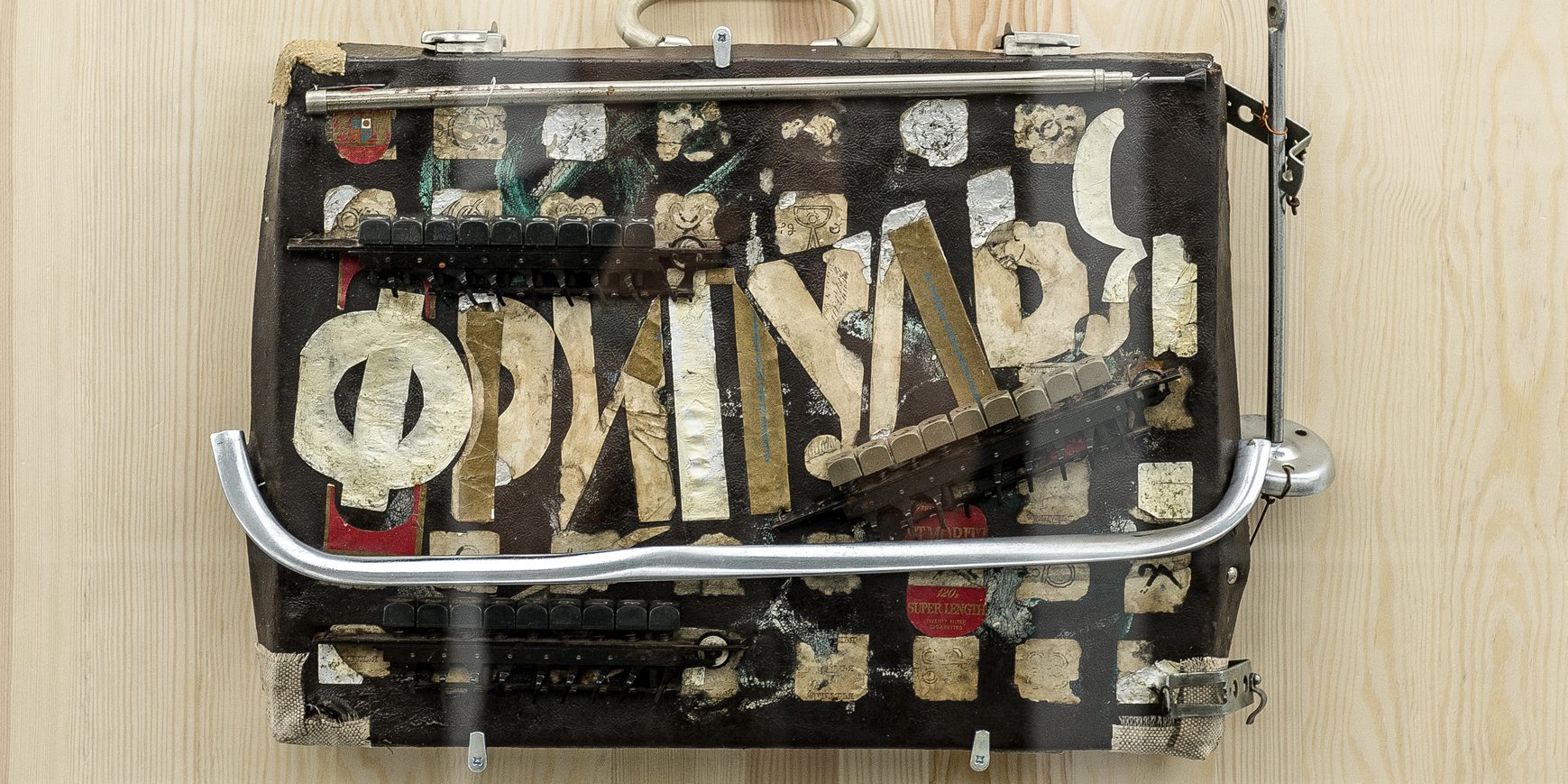
Another feature of the exhibition structure of the “Canon of Fripulia,” dictated by the exhibition space, is the display table. Its length reached 10 meters and, contrary to logic, it did not hide but emphasized the characteristic proportions of the second hall. It gathered documentary materials that constitute a significant part of Fedir Tetyanych’s oeuvre — objects, drawings, texts, author books. Opposite the table, on the wall, in three museum glass showcase boxes, one could see the artist’s programmatic assemblages: “Kefir Woman,” “Diplomat of Fripulia,” and “Stefka Tsap.” They were carefully restored and served as a kind of commentary on Tetyanych’s prophecy made during his lifetime: “Do not laugh at my creation / Do not make usurper faces / When I die, you will sing a hymn to me / My trash will be bought a million times more expensive.”
The length of the table also played a symbolic role, directing viewers’ attention to the idea of infinity, embodied by the exhibition itself — it had neither beginning nor end, or rather, the end was its beginning and vice versa. Once again, I cannot help but quote Lamakh: “For something to be / Something must somehow close / the end must meet the beginning.” To achieve this, the count of poetic fragments of the second “canon” began from the reverse, right side, preserving the traditional order in the first. Meeting in the second hall, they turned the interested back to their beginnings, which were located at opposite ends of the exhibition space — a hint given by the artist himself, who similarly arranged the book dedicated to his work.
Fedir Tetyanych built several Biotechnospheres; assembled from so-called civilizational waste, they were fundamentally different from the model fixed in numerous drawings and sketches. The dream to realize the Biotechnosphere according to this drawing remained a dream, as it was understood in time that this was the task of a separate project, the goal of which was to create a “working,” interactive structure. Realizing that the exhibition could not lack the symbol of Fripulia, they settled on the model of the Biotechnosphere (at a scale of 1:3) and the Moving Module for human movement (life-size). About the latter, Fedir Tetyanych said: “Just as peas spill out of a pod, Biotechnospheres can spill out of a plane. They can break into 12 slices, separate chairs, which can also fly independently, can swim, can run on new legs, move on wheels, escaping like cockroaches, and so on to infinity.”
The Moving Module, made by Tetyanych from aluminum profile and a chair, also stood on Perspektivna: hidden from prying eyes on the second “level” of the studio, it was always “at hand” for him. Its image greeted visitors of the fourth hall, which lurked at the epicenter of the exhibition. Before entering it, I suggest returning to 2003. Preparing the project “We Flew,” we arranged a meeting with the artist in the studio — the impression it made was forever imprinted. Unconstrained by social or everyday limitations, Fedir Tetyanych built a total work of art consisting of a labyrinth of streets, passages, oases of rest and communication, all sorts of junk, and his own works. One lonely comparison comes to mind — Kurt Schwitters’ merzbau.
The hall in PinchukArtCentre in question reminded me of former impressions. Its architecture, distinctiveness, remoteness from the through enfilade of the other halls — all spoke of the exclusivity of this place. The decision to cover the floor with remnants of the artist’s installations and objects arose immediately but for a long time was not ideologically motivated. Photodocumentation by Yuriy Zmorovych, made by him after Fedir Tetyanych’s death, helped — it completed the image of the artist’s studio that they sought to achieve. The dialogue that arose between real objects and their images in large, close-to-life-scale photographs was a dialogue in time — between the artist, whose presence is still felt in them, and us, witnesses of his triumphant return.
One of the symbols of the exhibition for me was the wooden platform laid along the walls of the fourth hall. Besides the conceptual load — creating the effect of an archaeological excavation — it served a practical function — visitors could move only on it. Thousands of feet during the three months of the exhibition’s operation turned the unpainted wood of the platform from light to dark (another unexpected and, most importantly, unpredictable allusion to the black-and-white imagery of the project). Many people discovered the phenomenon of Fripulia for the first time, the rest saw its new, museum dimension. Paraphrasing Kosuth, one can assert that the exhibition not only literally and figuratively showed the artist’s text but also created a context for it.