
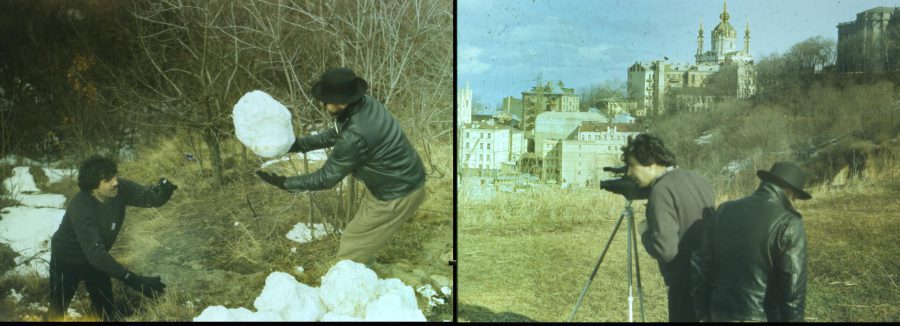
One of the important figures in Ukrainian art of the late 1980s — early 1990s, according to many artists and critics, was Heorhiy Senchenko. A Kyiv native, son of the artist Mykola Senchenko, he graduated in 1986 from the theatrical and decorative department of the Kyiv State Art Institute (studied under Danylo Lider and Ihor Nesmiyanov). From 1982 until 1996, he worked together with Arsen Savadov. Already in 1991, the Savadov and Senchenko exhibition took place at the Central House of Artists in Moscow, and in 1992 — in New York, at the Berman Gallery. In 1996, Senchenko interrupted his artistic career to, perhaps (?), return to it 20 years later.
Stories of Ukrainian art, which mostly exist in the form of oral traditions, tend to be quickly forgotten. Therefore, Senchenko’s name and his role in the art of the late 1980s–1990s gradually fade away, as in recent years the artist has not given a single interview.
Kateryna Yakovlenko spoke with Heorhiy Senchenko about that time, about mutual influences, about the life and creativity of Kyiv artists of the late 1980s — early 1990s.
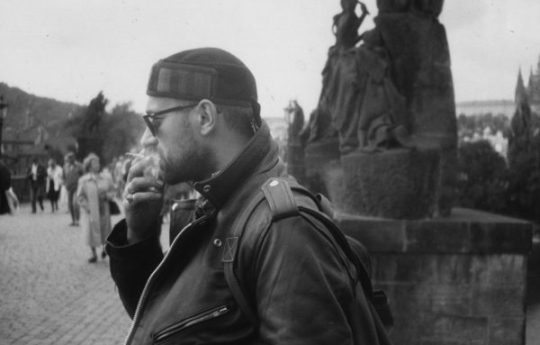
Kateryna Yakovlenko: Most artists of the new era (artists of the New Wave, including the “Paris Commune”) were connected with the Kyiv Art Institute, participated in official exhibitions, went on plein airs organized by the Union of Artists. Tell us about this connection with the institute, how much did it really influence you?
Heorhiy Senchenko: Yes, there is such an opinion that, supposedly, they taught the guys to paint pictures, and they only managed to adapt them to fashionable trends. This is superficial, of course, and very vulgar. Well, let’s start with the fact that no one taught us “like that.” On the contrary, they constantly tried to expel us from the institute because we did everything differently. There was such a formulation — professional incompetence, used to fight dissent. What saved us, of course, was that although we studied at the painting faculty, we had specializations: Arsen in monumental painting, me in theatrical and decorative art. There (in these departments) it was freer.
Well, yes, there was a general trend — painting for a certain time regained its rights as perhaps the most important of the arts, and specifically figurative painting. There was such an international movement. Not only Italians — they were just the first Oliva framed as a phenomenon. We knew something about it, saw something — not much, but enough to start asking ourselves similar questions: about representative codes as such, about how art functions as a language. And to look for answers. And the general mood was very close to us — subjectivity, irrationalism, and irony… Of course, painting turned out to be the perfect tool to realize all this. By the way, at that time the term “transavantgarde” was initially hardly ever applied to us. More was said about postmodernism. In Moscow, almost no one thought like us, all free spaces were occupied by conceptualism. And the conceptual tradition is, strictly speaking, a neo-avant-garde tradition. Here we started from a clean slate, everything just coincided. So our painting education is only part of this whole story. Important, but I think not the main thing.
K. Y.: Today we talk a lot about the context of the late 1980s — early 1990s, describing the squat of the “Paris Commune.” Their history largely begins with your “Cleopatra’s Sorrow.” Can you describe the context of 1986–1987, which greatly influenced your work? How much did society then feel the need for something different, how free did it feel?
H. S.: Here, I think, it is very important to understand how uniquely two socio-cultural contexts intersected — “here” and “there.” Two great dismantlings. No one really describes this. Here, the collapse of an empire built on the idea of social equality was brewing. It was already obvious to everyone that the experiment failed and the ideology was falling apart. But “there” too, everything was also changing greatly in the world of ideas — one of the great illusions of the 20th century was being dismantled. Charles Jencks even names the exact date and place of the event symbolizing the collapse of the modernist utopia: in St. Louis, the city authorities evicted residents and blew up a housing complex built according to Le Corbusier’s principles. The story of this complex, conceived as a social paradise, ended with the area gradually becoming a hotbed of crime, an absolutely infernal “hole,” and the authorities came up with nothing better than to simply erase it from the face of the earth. And this demolition seemed to confirm the futility of artistic will’s efforts in positively arranging the world. The echo of 1968 was barely audible. The time of neoconservatism came — the time of Reagan and Thatcher. And as a reaction to this in the mindset — escapism, social skepticism, social irresponsibility, and sarcasm… Amazingly, everything that happened “here,” although developing according to a completely different scenario, was at the same time very consonant in the cultural environment. However, all the tags were exactly the same. As I said, apoliticism was already fully programmatic globally at that moment. Existentialism still strongly influenced. Sartre, Camus were officially published here, mostly because of their leftist views (I mean their artistic works). Although until Sartre published something anti-Soviet there. Almost all the classics of tragic philosophy were in samizdat. A little later, when the book boom began, new French philosophy, post-structuralists, the Frankfurt School — a lot suddenly began to be translated, published here and, of course, resonated.
In music — post-punk (by the way, “Einstürzende Neubauten” — those very destroyed new buildings in St. Louis mentioned above were meant). Kyiv had a unique movement in this regard.
And here is something else common — we were all imbued with the East.
Well, yes, we could not afford to go to India for half a year, wander as Clemente did. But there were plenty of various esoteric practices (underground and semi-underground) here, and all kinds of such literature. Including academic, by the way. For example, everyone was reading V. V. Malyavin’s book “Zhuangzi.” Jung’s foreword to “Bardo Thodol” became a programmatic thing for us. I would make this text mandatory to study where contemporary art is now taught: “To recognize the emptiness of one’s mind as Buddha-like and at the same time observe it as one’s own consciousness means to hold oneself in the state of the divine mind of Buddha.” Therefore, when I hear today all these repeated talks about the social conditioning of our generation or even social infantilism, it seems very vulgar to me. Everything we did and how we behaved was programmatic and quite deliberate.
K. Y.: How did you start collaborating with Arsen Savadov? What was the basis of your friendship and creative duo?
H. S.: Arsen and I were friends since the Republican Art Secondary School (RASS). We listened to the same music, exchanged discs. Later we bought books from scalpers: the art history taught to us almost did not include, for example, the Pre-Raphaelites, whom we were in love with, or De Chirico. In the first year, Arsen already had his own studio — on Chkalova Street — an unthinkable thing at that time. He inherited it from Misha Turovsky, who emigrated to the States. On the beam under the ceiling of the studio, two phrases were scratched. The first — by Boris Savinkov: “While we fought for the purity of ideals, the Bolsheviks made the revolution.” The second — by Friedrich Nietzsche: “One can do without the necessary, but not without the superfluous.” Once Arsen decided to paint my full-length portrait in the style of Cranach. We started inventing such a pseudo-historical costume for it together. I was studying “History of External Culture” then — my favorite subject. Then another project was born. We shot such costume mini-performances on Orwochrom. All this happened in the studio. Once neighbors called the police, we were probably very noisy. So in costumes, they took us all away… Then there were plein air shootings. There was even a moment when we thought about transferring to film directing. At that time, it was possible to do this in Kyiv. We changed our minds, though… We had a lot of fun at scientific communism lectures. Lenin’s titles still inspire me. There are such plots, simply hermeneutic: “The Childhood Illness of Leftism in Communism,” “One Step Forward, Two Steps Back,” “Three Sources and Three Component Parts of Marxism.” Just think about it! We sat at the last table and drew on these assigned topics. It looked something like this: I drew the horizon line, Arsen added Lenin in a monument pose, I added some Masonic construction slope to the outstretched hand, he put the figure on skis… Well, generally, etc., in that spirit.
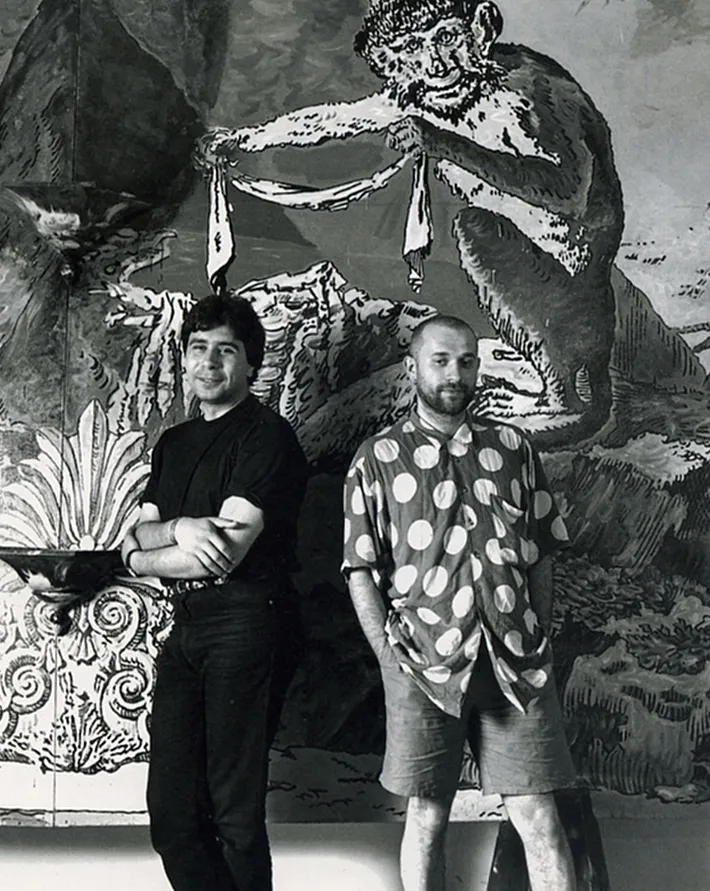
K. Y.: How did you personally perceive the success of “Cleopatra”?
H. S.: When we took the work to Moscow, we were not sure if we would manage to exhibit it, but we did not doubt that we had done something special. Then there was a whole story. Even before the exhibition opening (it was the Youth Exhibition of 1987) at the Manege, a representative of “Galerie de France,” Jose Alvarez, appeared. He was then buying for a collection of unofficial Soviet art and decided to see if something had leaked into the Manege that interested him. When he saw our work, he immediately said he would buy it, and as he was leaving, he threw in: “Well, if it’s not at the exhibition, we’ll see what kind of ‘glasnost’ you have” (the word “perestroika” was not yet in use). Because of this phrase, they did not dare to remove it, although there was such an instruction — from the KGB culture department. Later, when we met with him, he brought us photocopies of publications in the newspapers “Le Monde,” “Paris Match,” “Libération,” “L’Humanité” — all who wrote about FIAC-87 illustrated the material with our painting. He told us: “Guys, you are so young, but you know the phrase ‘and in the morning they woke up famous’? That’s about you.” How did we perceive this success? I can say one thing for sure: not like a young artist who grew up in market conditions and fierce competition would. He would definitely, without hesitation, paint pictures with a green sky in the next three years.
K. Y.: You received many offers to live in Moscow or abroad, but you still stayed in Kyiv. Why?
H. S.: The first was exactly Alvarez. He said: “I bought about 50 artists for our collection, but only you I offer a gallery contract.” Do you know what we answered him: “This is not in our plans yet.” We were very young and ambitious, and the only thing we feared was losing independence. Probably feared too much.
K. Y.: What does the “Paris Commune” mean to you? Can it be said that it was a community, or was it united? How open was it?
H. S.: I think the “Paris Commune” is primarily a phenomenon. A phenomenon with its own history. This circle of artists began to form even before the squat on Franko Street. Then at Parkomuna, it all took shape as a community, naturally acquiring its own mythology.
Kyrylo drew the correct map at the exhibition: territorially it was really dispersed. The house at Parkomuna was just the largest, and everything eventually flowed there. For example, we did not like guests, especially did not let anyone into the studio. I remember when Marat dared to offer us an exhibition, his Sasha Hnylytsky brought him to our door, rang the bell, and ran away. In general, in “our” house on Sofiivska, the main person was Tanya Illiakhova, Chychkan’s first wife. She handled all the issues with the housing office and generally.
And the whole story began with these two all-Union youth exhibitions at the Manege in 1987 and 1988. At the first, there were us with our work and Sasha Roitburd. I’m not sure exactly, but I think no one else from the circle. Everyone, of course, was very inspired by our success… So much press and noise, then FIAC, the price. If it weren’t for this success, for example, if the KGB had arrived earlier than Alvarez, the work would have been removed from the exhibition (they missed each other by an hour, they say). I think everything could have turned out differently here, completely differently. The energy was boiling here — yes, but everything would have looked different. Hnylytsky, for example, was then writing rather non-figurative things. Holosiy was also doing something semi-abstract. And literally in a year and a half, everything suddenly took shape as a phenomenon. At the exhibition in autumn 1988, the whole circle was already gathered — and everything started spinning. By the way, the “Mars” gallery appeared just then, and Marat with “Babylon” — that was later. And suddenly it happened that this circle of artists found itself here in a privileged position. Kyiv’s artistic environment had not known such attention before. Because what was known before? Only that there is Kyiv hyperrealism — Serhiy Bazilev and company. But they suddenly all became Muscovites. So, of course, what was happening around us was immediately mythologized. And probably the most interesting thing is that none of us did anything for self-promotion. It was enough just to create something talented, and then everything somehow worked out by itself. Constantly some interviews were taken from us, TV people filmed something. And there were sales. It was not, of course, a real market like a real market. But it allowed us to live and not think much. And another important thing: no one planned anything. We all lived genuinely. Here and now. This happens very rarely. It was a lifestyle, more like the style of Western indie rockers, the same “Neubauten,” or jazzmen of New York’s downtown in the second half of the 1980s. And it was very consonant with that time. After all, the figure of the artist was mythologized then very differently than it is now. Art is generally a myth. But life without this myth is sometimes unbearable.
I remember, later, in the mid-1990s, there was a very funny case when Oliva came, and we sat drinking with him. He has such a trick. He wears socks and underwear with the same pattern. This is so that in the heat of fun he can say: “Look at my cool socks, right? Well, my underwear is the same!” And suddenly everyone started showing what kind of underwear they had. No one was prepared. It was something! The best were Kyrylo Protsenko’s — striped to the knee, Chychkan’s, of course, had something too. But everyone, everyone! You had to see Oliva’s face and the two younger art historians who were with him. I imagine what they were shown in Moscow.
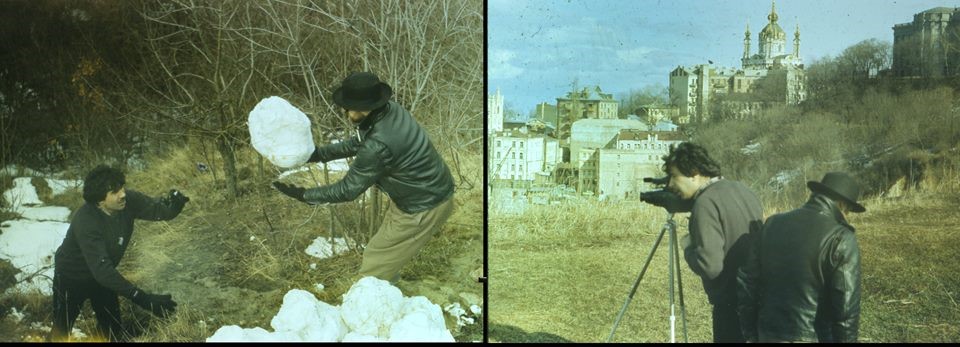
K. Y.: After Ukraine’s independence, some of the first joint international art projects were projects in Munich and Edinburgh. For example, in the catalog for the Edinburgh exhibition, there are speeches by representatives of the Kyiv city council and Edinburgh. It turns out that you and your works officially represented the new Ukrainian culture abroad. Was it really so, and did you have the opportunity to fulfill this “mission”? For many artists of the “Paris Commune,” these trips were their first experiences abroad. In your opinion, how successful were they?
H. S.: Here two words immediately sounded that cause me idiosyncrasy. “Mission” — a word long privatized by marketers, sounds like from a press release of some brand. Remember, there was such a project here — “Brand ‘Ukrainian.’” I think artists who talk a lot about their mission should go to a psychologist. And also “officialdom.” As they say in Odesa, listen, where are we and where is officialdom?
Why did we exhibit in the halls of the Union of Artists? Well, there were no other halls then. Why were cultural departments involved in foreign projects? It was attached as a trailer right away. These two projects you mentioned were completely different.
The Munich one was like this. BMW has a structure created to properly spend money allocated for sponsorship — German laws support patronage activities. They remembered that Munich has a sister city Kyiv. A curator was appointed. He went to the library. Took newspapers, magazines to read about Kyiv contemporary art. There he found something only about Savadov & Senchenko. He came to Kyiv, but here they led him in circles, hid us from him. But someone gave him Arsen’s father’s phone. We met with him, set conditions: either our team or we do not participate. And then we got a fax in New York: “All ok. We start the project.”
By today’s standards, the project was, of course, unreal in terms of funding. How successful it was — I definitely can’t answer. For example, Oleg wrote some of his best works there. The second exhibition was in a very proper place — at Lothringer Str., 13. But existentially for most guys it was a difficult time. Life there turned out to be too different. Building a success strategy, it turns out, must be step by step, and it feels like someone invisible watches you all the time. This immediately caused an internal protest. And I think this is the reason for all the mistakes that happened there.
Edinburgh is completely different. Andrew Brown — co-owner of gallery 369, a famous partygoer — was simply in love with what was happening here. He knew everything from the inside. He had been to Kyiv more than once. Although his resources were not the same at all, he arranged everything there very romantically. We arrived in Edinburgh at dawn completely. A six-meter table covered with a white tablecloth, windows open, white curtains fluttering in the wind. Candelabra on the table, candles already melted. “Love for Three Oranges” is playing. Everyone in white shirts is waiting for us. Edinburgh is a party city. The largest number of organs per capita. We played on one of them — invited by Prince Alberto di Massimo, conductor of the Edinburgh municipal symphony orchestra. He was surprised how Tata (Tetyana Savadova, Heorhiy Senchenko’s wife) plays. And you ask who opened the exhibition? I think the mayor of Edinburgh.
K. Y.: This period (early 90s) is very romanticized, especially because there is no factual information and the whole story is built on oral accounts. If you were to write the history of this period, which names would you mention, which exhibitions would you include, what features would you highlight?
H. S.: Why? The history, factual material is perfectly described and even cataloged by Sasha Solovyov. With all key names, events, artifacts. As if everything is in its place. What I lack is art historical analysis. Recently the word “relevance” was mentioned. The question was how relevant to the global processes was what happened here at the turn of the 1980s and 1990s? Were local artists late? Is it only me who sees marketing here again? In general, cultural processes never develop linearly. And attempts to describe them linearly are never relevant. Tell me, was the New Leipzig School also late somewhere? Or did it anticipate something?
It’s not only us, of course. Take the example of Cy Twombly. Also funny. Only in my memory, depending on the fashion prevailing in art circles, critics’ attitudes to his works changed at least three times — from endlessly admiring, when he was called almost the main artist of the second half of the 20th century and the inventor of a universal artistic metamanguage, to completely contemptuous, when his works were called naive scribbles. So if young people have scientific interest, it is undoubtedly very pleasant to me. I wish you thoughtful, professional work with archives and facts. And direct participants of those events (those still alive today), people today are quite elderly, have every right to color their memories in romantic or even sentimental tones. Our opinion — the time was heroic and we made very talented things.
K. Y.: Art of the late 80s and early 90s, even 1990–1992, differs greatly. Plots change, attempts to create some mixed genres arise. The search for new ones begins. How successful was all this, what fueled this search?
H. S.: Well, what does the market want from an artist? Recognizability. It disciplines. What does a “free artist” want? New experience. What discipline is there? We were not truly integrated into the market, so we did what we wanted.
If we talk about media, yes, new opportunities appeared: video cameras, editing, computers — it was a sin not to use them.
How successful? Mostly they write about Roitburd’s success and his video at the Venice Biennale and MoMA. But in fact, a whole list of festivals and media exhibitions can be written with the participation of Ukrainian artists. Just all media and video art stood somewhat aside then. Our “Voices of Love,” for example, were projected onto the Bauhaus building at the video art festival in Dessau — a very impressive sight.
K. Y.: About the project “Space of Cultural Revolution.” It is one of the strongest exhibition projects of that time, it still attracts the attention of critics and artists today. However, P. C. R. is not only an exhibition but also an organization that arose after Parkomuna. Tell us about its activities.
H. S.: Yes, the exhibition project was strong, it still looks relevant. For Arsen, Tata, and me, it was the first curatorial experience. The organization of the same name was headed by Tata. At first, Sasha Klimenko came to us with a proposal to make a non-commercial part at the Kyiv art fair. P. C. R. existed for several years. Most projects were in the field of new media. The organization was non-commercial, and the main mistake was hoping for support from the then establishment. If in the 1980s, when we said: “Let’s invest in contemporary art, we will give you such connections worldwide,” — they did not hear us, they were busy trading faxes and toilets, then in 1994 it was even less about us — they were already cutting everything on a large scale. Later, when they realized they needed to legitimize themselves somehow, we no longer really wanted to.
K. Y.: You said you stopped doing art because art became different. But recently you said everything is changing back again. What did you mean? What is this new feature?
H. S.: Let me better tell one more story at the end. About our trip to Munich. We traveled by train through all this devastation. It was 1992. And here we are in Nuremberg, going out to smoke, and the station just rings with cleanliness and order. Everything is designed with matte ultraviolet light. And Holosiy looks at all this and cries. And Sasha Hnylytsky hugs him and says: “Don’t cry, Elephant, don’t cry… Everything will be fine yet — everything will be bad again…”