
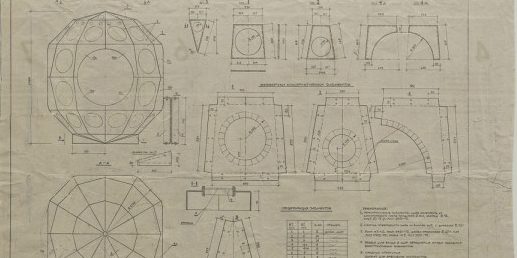
On June 16, 2017, within the framework of the PinchukArtCentre Research Platform, the exhibition “Fedir Tetianych. The Canon of Fripulia” opened, which was an attempt to conceptualize the creative practice of one of the most prominent Ukrainian artists of the second half of the 20th century — Fedir Tetianych (1942–2007). The exhibition is built around the idea of Tetianych’s “Biotechnosphere” and his texts, which emerge as one of the artist’s main media.
Tetiana Kochubinska, curator of the PinchukArtCentre Research Platform, spoke with art historian and guest curator of the exhibition Valerii Sakharuk about the preparation of the exhibition, the formation of the exhibition solution, the curator’s responsibility, and the museification of an artist who affirmed processuality through his creativity and way of life, and whose philosophy was about preserving “all living things.”
Tetiana Kochubinska: In your curatorial practice, you often turn to the work of, so to speak, marginal artists. From this perspective, Tetianych fits perfectly into your sphere of interest. To begin with, I would like to ask what prompted your interest in marginal positions and how Fedir Tetianych came into this orbit? Under what circumstances did you meet him?
Valerii Sakharuk: You asked a very good question because every curator has an internal logic that determines the choice of authors and topics that interest them. In this sense, Tetianych’s place among the names I turn to is quite justified and natural.
I first heard about him from the artist Anatolii Stepanenko. It was in the late 1980s — early 1990s. Strangely enough, before that, I knew nothing about Tetianych. My experience as an art historian, who graduated from the Kyiv Art Institute in the early 1980s, then left Kyiv and later returned, did not foresee particular familiarity with those phenomena that, as it turned out later, became defining for the development of Ukrainian art.
When Stepanenko suggested I write a text related to his projects, he mentioned Tetianych. He said that he was one of the few artists engaged in conceptual searches in Ukrainian art. Then I began to look for information about him, and we met in the early 2000s. Perhaps before that, we crossed paths somewhere, but not so closely and specifically, because for me every meeting and every contact with an artist has practical significance.
I am a practitioner and always turn to the artist when I have a specific proposal regarding a certain project I have conceived. When the idea of the project “Malevich / Tetianych. Let’s Fly” arose, which we implemented together with Halyna Skliarenko in 2003 at the “K-11” gallery on Kostolna Street, we arranged a meeting and went to Tetianych’s studio on Perspektyvna Street.
I still remember that meeting. It left a very vivid impression on me that did not fade all these years. So the impressions and memories of it indirectly became part of the current project “Fedir Tetianych. The Canon of Fripulia.”
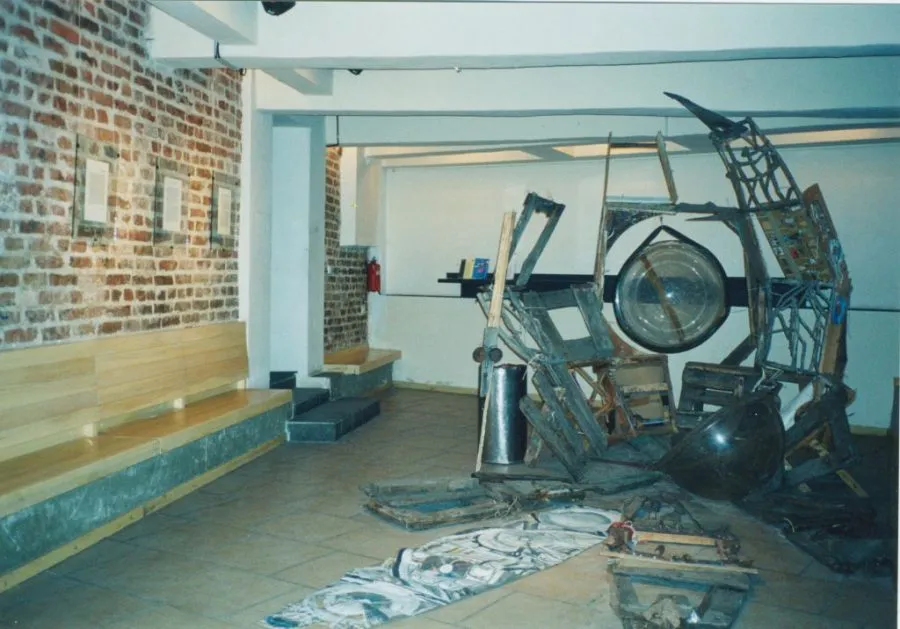
That exhibition was somewhat similar to the one we made with you at PinchukArtCentre. There were also texts — Malevich’s and Tetianych’s, though very selectively, only two or three. There were also installations of “Biotechnospheres” — real spheres created by Tetianych. One of them came from the village of Knyazhychi. It was kept outdoors, gradually sinking into the ground, partially disappearing, turning into some initial, primary materials, some of which survived. Tetianych brought these fragments and laid them out in one of the halls: it was no longer possible to assemble them into a whole structure.
Another “Biotechnosphere” was made from canvases stretched with white fabric and primed with white paint. These were trapezoidal modules that made up the “Biotechnosphere.” We showed it in the last, small and very cramped hall.
T. K.: So your acquaintance was directly related to the preparation of the exhibition?
V. S.: Yes, of course. It was a purely practical process. Everything happened very concretely and calmly, without euphoria and unnecessary emotions.
I have documentation of this project. I photographed the installation, and one of the photos reminded me of Vladimir Tatlin. There is a famous photo of the installation of the Monument to the Third International, in which an assistant with a hammer in hand connects its parts. So, in my photo, Tetianych is also with a hammer — assembling his “Biotechnosphere.”
Regarding the Monument to the Third International, another analogy can be drawn with Tetianych’s “Biotechnosphere.” The original models created by both authors at the time have not survived. In 1967–1968, the Tatlin tower was recreated at the Museum of Modern Art in Stockholm (Moderna Museet), and later, in 1979, again within the exhibition “Paris — Moscow” at the Pompidou Center in Paris. We reconstructed the “Biotechnosphere” for the first time, albeit at a scale of 1:3, as well as the “Module for Human Movement,” using drawings made by the author himself.
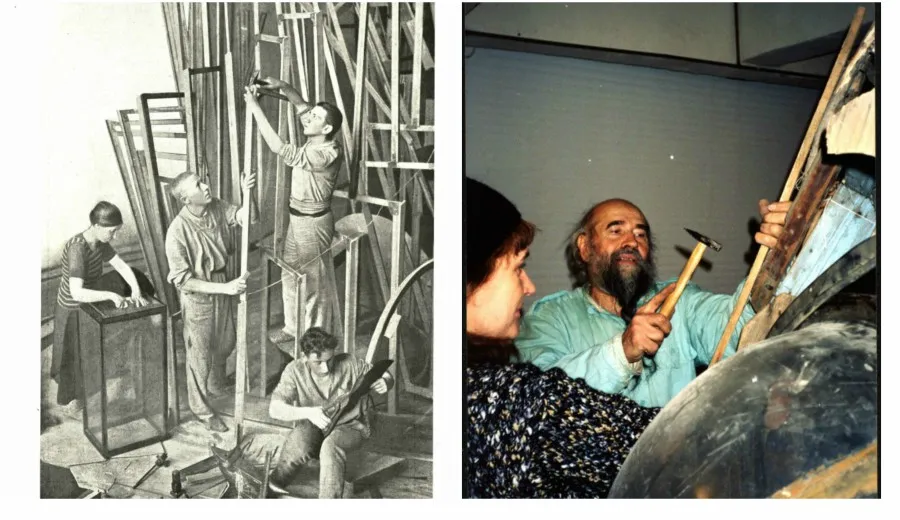
2. Федір Тетянич під час монтажу виставки «Малевич / Тетянич. Полетіли». 2003 рік. Фото надано Валерієм Сахаруком
T. K.: It seems to me that the exhibition shows only one facet of Tetianych’s creativity — a very “pure” one. If we talk about an artist for whom the statement “Trash transforms into a work of art” was important, then we essentially reject the “trash aesthetics” and do not highlight the idea of processuality, which was also very significant for him. Why did you choose this particular angle? The project “Malevich / Tetianych. Let’s Fly” already attempted to conceptualize Tetianych’s position.
V. S.: I do not quite agree that we show only one facet of Tetianych. In fact, the entire artist, the whole Tetianych, is represented here. I am convinced that text became a more fundamental and deeper medium for him, through which he was able to convey his philosophy, his view on creativity, people, and himself.
Of course, Tetianych’s happenings are also part of “Fripulia” and his philosophy, but they do not touch the deepest levels. Therefore, the main thing at the exhibition is the texts.
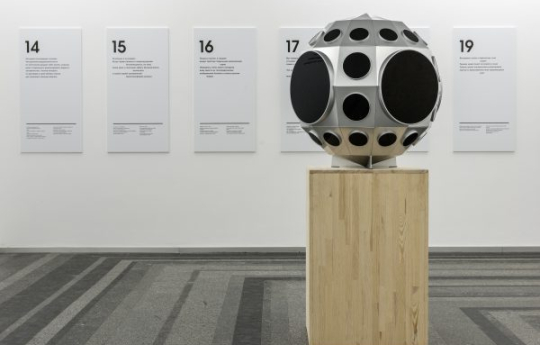
The first canon is dedicated precisely to the phenomenon of the “Biotechnosphere” (by the way, you will not find the word “Fripulia” in it) and consists of 19 poetic fragments. The second canon contains 73 fragments and tells about “Fripulia,” its opposite Zodiac, the factory-theater and the worker-artist, the philosophy of life and the future, the artist’s worldview. All other objects in the exhibition are subordinate to the main concept and play an auxiliary role.
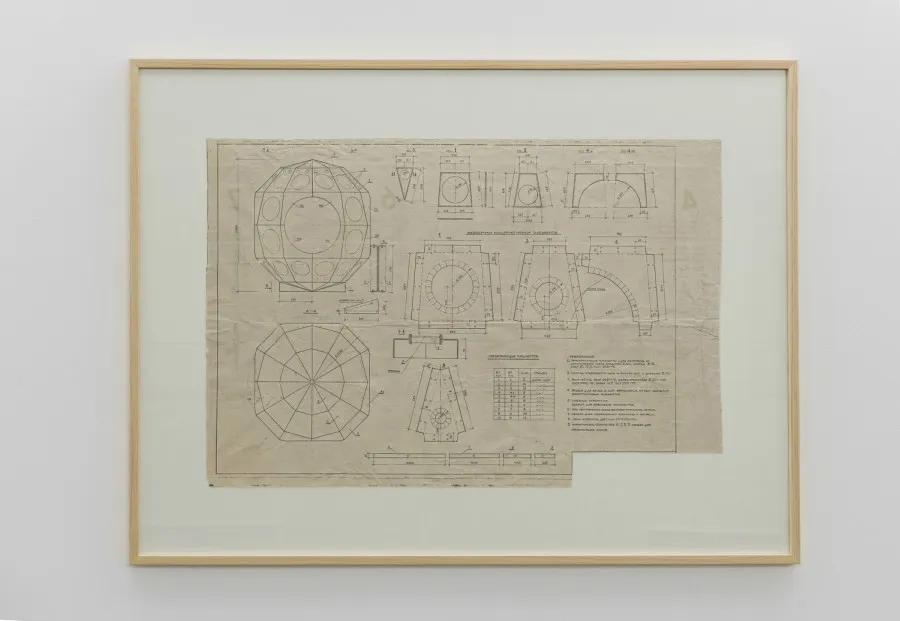
T. K.: How did the exhibition and conceptual decision to give the two canons certain coloring — black and white — arise?
V. S.: This decision was born purely intuitively. First, I wanted to visually and formally separate these two cycles. They differ in theme, content, and meaning.
I worked with these poems for a long time: I read them, pondered. The more you read, the more they open up, revealing details. Just yesterday, I spoke with Kateryna Nosko, and she said it would be great to conduct a literary analysis of these texts: to identify, for example, words and phrases that are repeated most often, to trace their development and interconnections. This is a very interesting proposal, a very interesting idea.
So, at a certain point, I realized that for me the word “Biotechnosphere” — the first block of 19 poems — has a distinct white coloring, as if filled with white color and light. In contrast, “Fripulia” consists of some dark, muffled sounds. “Fripulia” is the cosmos, the Universe; it is black.
Later, this impression, which at first seemed arbitrary, did not disappear but, on the contrary, strengthened. I became more and more convinced that such a formal decision was justified. I admit, it was bold, in some ways even arbitrary, but I could not abandon it.
I constantly found confirmations and hints that indirectly testified to the appropriateness of the black-and-white imagery. The first of them is an analogy with the famous work of Joseph Kosuth, presented at the ninth Documenta exhibition in Kassel in 1992. It was called Passagen-Werk (Documenta-Flânerie), and the impetus for its creation was the famous work of Walter Benjamin Das Passagen-Werk.
Kosuth created two corridors, two enfilades, in the Neue Galerie in Kassel. One was completely black — floor, walls, and ceiling — the other completely white. In these enfilades, in the corridors, Kosuth covered artworks that were constantly exhibited in the gallery with black and white fabric. Identification texts were placed on the fabric and walls: white on a black background and vice versa. There were 60 quotes on the first floor and 50 on the second.
Then I remembered where this analogy came from. In the early 1990s, I actively collaborated with Polish curators, working on the exhibition Kyiv Art Meeting. Then I got hold of the magazine Obieg, published by the Center for Contemporary Art Zamek Ujazdowski. It contained a detailed analysis of this work.
At some point, this association surfaced during the preparation of the Tetianych exhibition. It turns out this is a hommage to Joseph Kosuth, since we are creating a conceptual project in which texts play the main role. In his commentary on Passagen-Werk, Kosuth talks about the viewer who reads these texts. The pace slows down, the rhythm of perception changes — it differs from the rhythm of reading visual information. The viewer must immerse themselves in the texts if they want to grasp the essence of the exhibition statement.
A quarter of a century later, I am convinced that Kosuth’s remark is indeed valid: in the halls of the “Canon,” I see people — young and not so young — who carefully read Tetianych’s texts. This is the main thing we managed to achieve.
Of course, it would be wrong to reduce everything to Kosuth. It is enough to recall Arthur Rimbaud, whose volume of poems I discovered shortly before the exhibition opening on the page with the famous sonnet “Vowels”: “A” black, white “E”, “I” red, “U” green, / “O” blue — colors of a whimsical riddle. Coincidence?
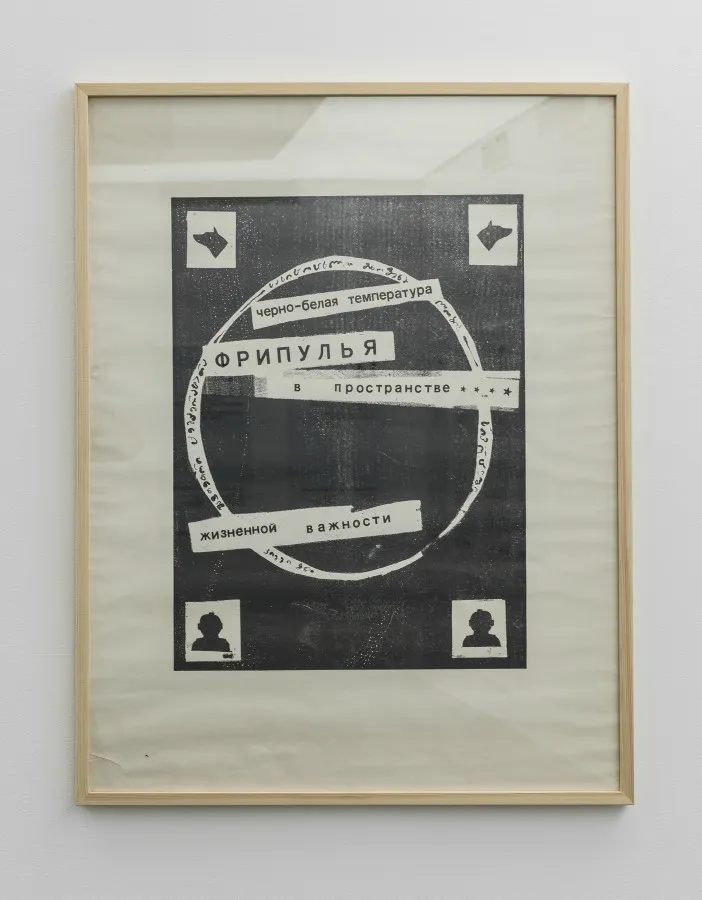
And finally, the ultimate confirmation of this idea I received directly from Tetianych — it is the poster “Black-and-white temperature of Fripulia in the space of vital importance,” which we found and added to the exhibition at the last moment. It opens the exhibition, becoming one of the keys to reading the curatorial statement.
T. K.: It is interesting that you mention Tetianych’s participation in the installation of the “Let’s Fly” exhibition. At the same time, later he wrote: “Art historians attribute a utopian vision to me.” Did you discuss these parallels with the avant-garde with him?
V. S.: I am not familiar with this statement, but I can assume that Tetianych had reasons to say so. After his death, I was haunted by the idea of creating a large project. One — at the Institute of Contemporary Art Problems, another — at the Ivan Honchar Museum.
During these attempts, Hanna Tetianych, the artist’s wife, once said that Fedir did not always agree with how others showed him, particularly in the “Let’s Fly” project. Then I realized that his view somewhat differed from the curators’ vision of this project.
T. K.: But in that case, it turns out that we completely museify him and place him in a white cube.
V. S.: The time has come. The time has come.
T. K.: After lengthy discussions of the exhibition concept and its implementation, already after the opening, I had the feeling that it was somewhat didactic. Considering that the history of contemporary Ukrainian art is still unwritten, we partially write it through this exhibition. Do you feel responsible for such construction of art history and the image of “Fripulia”?
V. S.: Responsibility is always present. When you work with an artist, especially if they are no longer alive and you are free to “do with them what you consider necessary” — what seems important today — you are responsible for your own vision of this artist.
The exhibition takes place within the framework of the PinchukArtCentre Research Platform, whose goal is to create an archive of contemporary art. There have been many attempts: every gallery, every center accumulated certain information, collected data about artists. But all this ended with small private initiatives that did not develop and did not provide broad access to the collected materials.
The fact that we are creating this exhibition within the program indicates another level of responsibility — institutional.
T. K.: Could you tell us about your archive and how, in your opinion, Tetianych’s legacy can be archived and preserved today? After all, these are mostly objects that literally crumble before our eyes, especially those left in Knyazhychi. What tools can be developed to preserve this legacy?
V. S.: Recently, we talked about the problem of archiving the contemporary artistic process during the presentation of the book “Parkomuna. Place. Community. Phenomenon” at the “Book Arsenal.” When the question arose about what exactly should be preserved and by what criteria, I answered that everything should be preserved. Today we cannot be completely sure which materials are valuable and important and which are not. What now seems secondary may turn out to be much more important over time.
Ten years ago, it was precisely Tetianych’s death and reflections on the fate of his legacy that inspired me to create an archive of contemporary art, in which fund No. 1 would bear Tetianych’s name. I addressed this proposal to Hanna Tetianych, his wife. She agreed, and I gained access to the artist’s archive.
The materials I worked with then formed the basis of the study “Fedir Tetianych. Fragment of an Archive.” I very much hope that within the exhibition project this text will be published.
T. K.: And one more question regarding the preservation and conservation of this legacy. How can this be implemented in practice? Who can take on such responsibility?
V. S.: Undoubtedly, this is the task of museums. While we do not have a museum of contemporary art, in my opinion, the National Art Museum should take care of this. I know that today Hanna Tetianych actively cooperates with it and transfers part of the materials.
I do not see other institutions that by their purpose could deal with archiving the legacy not only of Tetianych but also of other contemporary artists. I understand how large these expenses are — not only material but also intellectual. But this work must be done.
During the preparation of the exhibition, we managed to restore several important works by Tetianych, including “Diplomat ‘Fripulia'” and “Paper Woman” (or “Kefir Woman,” as it is also called), as well as several small assemblages. But these are just drops in the ocean, grains.
T. K.: How do you explain the current interest in Tetianych’s personality? We conceived the exhibition last summer, and this year exhibitions took place at the “Dukat” gallery and later at the National Art Museum. The Art Council is also working on a similar project.
V. S.: In my opinion, this interest is somewhat artificial. I very much hope that all these exhibitions will have a continuation in the form of research, publications, reflection, and professional response. Without this, they lose their meaning.
On the other hand, the interest in Tetianych is easily explained: it is now that people begin to realize that he is a central figure in Ukrainian art of the second half of the 20th century.
When I was taking works from Knyazhychi, I talked with the artist’s son, Bohdan. He said that his father predicted that his work would be truly appreciated in about fifty years. Tetianych was wrong. It did not take even ten years for everyone to understand the scale of his personality.
T. K.: You say he is a central, defining figure. But what exactly does he define? What is his significance?
V. S.: In him, not only formal and intellectual searches but also, if you like, national ones combined. The 1970s–1980s were a very difficult period in the history of contemporary Ukrainian art. What was considered leadership then is increasingly moving to the periphery today, and figures like Tetianych come to the forefront.
He was a marginal, an outsider all his life. At the same time, he constantly cared about staying in the attention of colleagues and mass media, and often initiated such processes himself.
I know that Tetianych’s video archive contains dozens of tapes recording his actions and happenings, his views, interviews, and meetings. From these tapes, a film by Sviatoslav Feofilaktov (2011) was edited. It is a selection of materials from the archive that requires study, reflection, and analysis, as it contains many testimonies of the artist himself.
One such testimony is the artist’s diary, presented at the exhibition. It is dated 1983–1984 and is a large general notebook in which each entry sheds light not only on the circumstances of Tetianych’s life but also on his thoughts, impressions, and emotions. It reflects the era itself.
T. K.: We have already discussed this earlier. Essentially, there are almost no works physically created by the artist at the exhibition. And to some extent, you take on the function of the “curator as artist,” whose point of view shapes the viewer’s experience.
V. S.: Everything you talk about was formed during the work on the exhibition when its formal and visual aspects emerged. I do not think the structure of the exposition suppresses the artist. On the contrary, it reveals previously hidden facets of his creativity, which, according to Vlada Ralko, before this exhibition “were overshadowed by carnival and protective folly.” This is an exhibition of the “other” Tetianych.
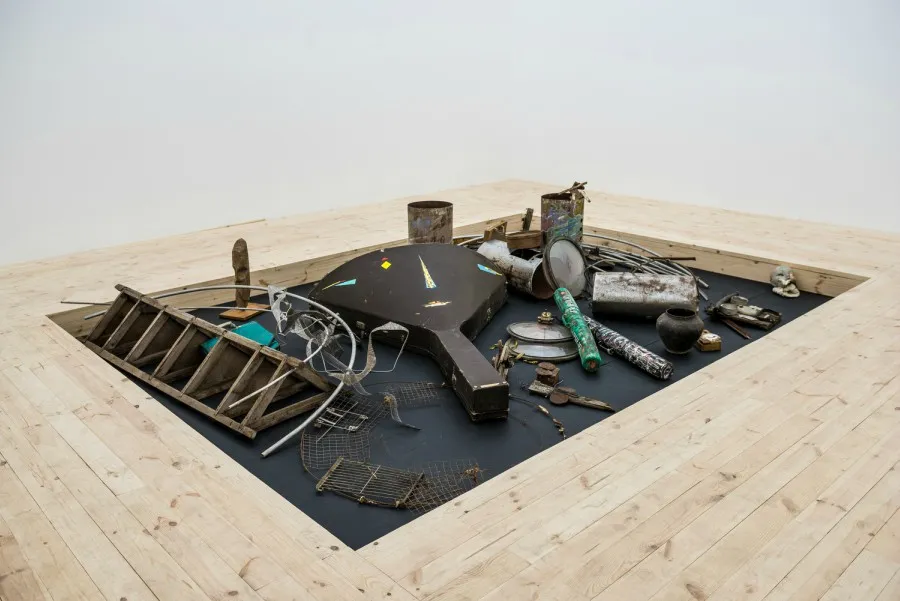
T. K.: There is a hall in the exhibition whose space suggested the idea of an “archaeological excavation.” Did you conceive this from the very beginning?
V. S.: For me, the decisive factor is always the space — the physical space of the room in which I create the exhibition. Space comes first, the author second, the work third.
T. K.: So space comes first?
V. S.: Yes, space. Then the author. Then the work. Although maybe the order is: author — space — work.
It is the space that suggests which works to choose for the exhibition and often determines the very concept of the exposition. It is impossible to create a quality exhibition without considering the features of the premises.
In this sense, the decisive factor for me was the space of the four halls provided for the exhibition “Fedir Tetianych. The Canon of Fripulia.” From here came the idea to place two blocks of texts: they fit perfectly into the first hall and the next two. The plan of the second hall suggested the idea of a long showcase table ten meters long.
The halls we are talking about surround a special, sacred space — as you called it — which is the center of the entire exhibition. I was impressed when I saw that this space reproduces not only physically but also mentally the space of Tetianych’s studio on Perspektyvna Street. The entrance is located in the same place, the plans of the premises and their proportions coincide.
I knew that photo documentation of the studio, made by Yurii Zmorovych after the artist’s death in 2007, had been preserved. Thus, the idea arose to recreate the image of this studio. The things that were there were taken away by Hanna Tetianych; now they are partially kept in Knyazhychi, partially in Kyiv.
Correlating these things with Zmorovych’s photographs seemed very interesting and productive to me. After all, most of the objects we see in the photo frescoes — as if we are clearing them from layers of time — are physically present in this “excavation.”
It is also worth saying that the exhibition reflects the idea of “Fripulia” as a living infinity. Its structure is built so that it has neither a beginning nor an end: it can be “read” both from left to right and from right to left. I found this hint in the book created by the artist himself and published by Hanna Tetianych in 2009.