
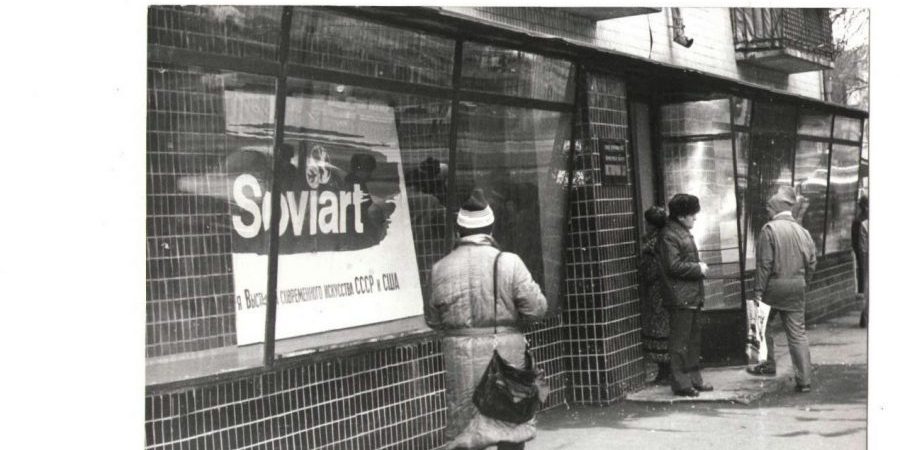
Viktor Khamatov is the founder of the first non-governmental art institution in Ukraine, the contemporary art center “Soviart.” Since 1987, “Soviart” has developed according to the model of a Western European contemporary art institution. It is a pioneer among organizers of large-scale international art exhibitions in Ukraine. In numerous projects, Khamatov manages to attract resources from the cultural sector, business, and the public sector by implementing strategic management models.
The research platform PinchukArtCentre begins work with the personal archive of Viktor Khamatov and the CMC “Soviart.” Within the framework of cooperation with KORYDOR, we publish the first interview in a series of conversations with the gallerist. The conversation was conducted by Tetiana Kochubynska and Kseniia Malykh.
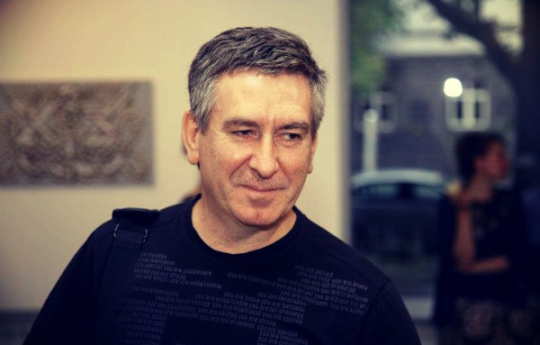
Tetiana Kochubynska, Kseniia Malykh: You graduated from the Faculty of Cybernetics at Taras Shevchenko Kyiv State University. How did your interest in art arise, and how did it happen that you founded the first non-governmental art institution in Ukraine?
Viktor Khamatov: I will start with the necessary background. After graduating from the Faculty of Cybernetics in 1979, I was assigned to the scientific-production association “Kvant,” which belonged to the system of the Ministry of Shipbuilding Industry of the USSR. At the enterprise, I worked on automated control systems. Now it can be talked about openly. Later, I became a Komsomol activist, first at the department level, where at least a hundred people worked, and then for the entire association. This opened many opportunities. On business trips, I traveled across Ukraine and the Soviet Union; of course, I had connections in Moscow, the Baltics, and the Far East.
In total, more than 10,000 people worked at the association. It was a large team with a rich internal life: thousands of engineers and leading specialists in their fields, who had higher education and various hobbies outside of work. Therefore, theaters, studios, newspapers, and radio newspapers operated at such enterprises, and various festivals, football championships, and other sports events were held. These were extremely interesting years of work and communication.
During my studies, I was part of the university teams in athletics and hockey, and together with friends, I created a student club. Later, while engaged in public work at the association, I organized youth radio, a newspaper, the first discos, a youth club, and the first festivals. A team of friends and partners gathered around these projects.
Organizational and communication skills helped me determine future priorities. Among them was contemporary art as an important component of innovation.
Tetiana Kochubynska: Which direction in art attracted you the most at that time?
V. K.: In art — conceptualism, which at that time was mostly represented in the country by socialist art and non-figurative art. But initially, it was rather an interest, a hobby. I was engaged in programming. At the same time, I was almost immediately fascinated by various theories and management models — this is how it all began.
I had the opportunity to read specialized literature about management models in Japan, the USA, Germany, Scandinavia, and other countries. The military-industrial complex where I worked was at the forefront, including in management. Project and program management, planning were actively applied and developed in this field.
I headed the Komsomol committee, which included about three thousand Komsomol members. I was interested in communicative management models and began organizing youth leisure activities. In the 1980s, this was very relevant.
I began to study, in particular, the Soviet history of this direction and came across the story of an experiment conducted in the 1960s in the Novosibirsk academic town. There were many young scientists who sought professional development, organizing leisure, and realizing themselves in creativity and science. Within the experiment, they were allowed to create self-financing associations. They demonstrated fantastic scientific and management results: literally within a few years, they began earning millions of rubles. Then the question arose: what to spend this money on? They wanted to build their own cultural centers and sports grounds — that is, to develop their own youth economy and culture. Thus, with the emergence of resources, questions of culture and innovation naturally arose.
Kseniia Malykh: So it was like a small state within a state?
V. K.: Youth scientific and creative teams, realizing their scientific potential and enthusiasm, began earning very large sums of money. Eventually, the experiment was recognized as successful — and closed. Because if it had been expanded, a situation would have arisen where enterprises would operate on the basis of economic calculation, and a completely new economic reality would have formed in the Soviet Union.
Many people were searching for new opportunities for youth associations. At that time, the creative role of youth in culture and art was actively discussed. Young people demanded airtime, venues, concert studios, etc. But all this was occupied by well-known performers, and naturally, youth had no social elevators that would allow them to realize themselves. As a result, protest potential accumulated.
Youth life was boiling in science, technology, culture, and art. Until 1985, when Gorbachev came to power and perestroika was announced, new opportunities opened. Through the Komsomol, it was possible to achieve a decision to restore the model of youth associations in the field of scientific and technical creativity: self-financing organizations subordinated to the Komsomol were created.
Since I was directly involved in these processes, we continued moving in this direction and simultaneously planned large festivals. In Kyiv, it all began with the multidisciplinary festival “Youth Crossroads,” on which a large team worked.
It was the time of the emergence of the first non-governmental youth studios and theaters. Rock music actively penetrated mass culture: the first large concerts of the bands “Kino,” “Alisa,” “Mashina Vremeni” took place, and the St. Petersburg rock club and Moscow rock scene were talked about throughout the country.
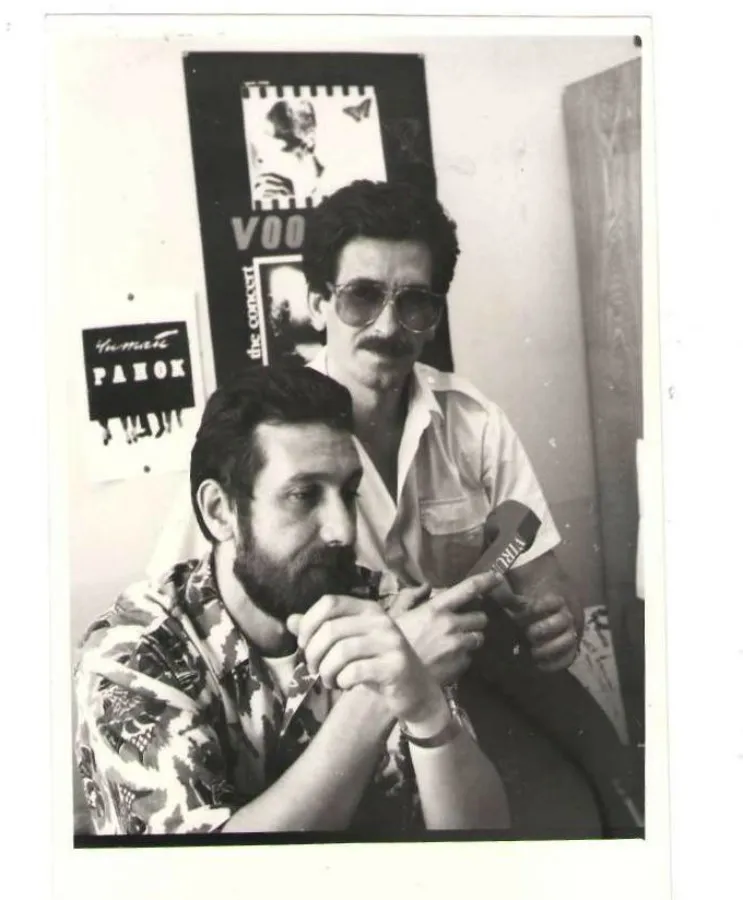
Within “Youth Crossroads,” we began organizing exhibitions, including joint projects with other republics — Lithuania, Estonia, etc. These exhibitions led us to cooperation with the magazine “Ranok” — an all-Ukrainian youth publication that interacted with the magazines “Yunost” and “Molodost” in various parts of the Union. At that time, youth magazines accumulated new trends of youth subcultures that later undermined the usual foundations of culture and society.
Based on the “Youth Crossroads” festival, which took place over three years — from 1985 to 1987 — I created a youth club on Vasylkivska Street. Later it turned into the CMC “Soviart.” It is worth noting that the name Soviart is an abbreviation of “современное визуальное искусство” (modern visual art), not an indication of Soviet origin, as it is often interpreted.
Kseniia Malykh: In what form did the gallery exist then?
V. K.: Since 1987, “Soviart” operated as a cooperative, as there was no other way to legalize a legal entity, open a bank account, and conduct financially independent project activities at that time.
In 1987, I began creating the first sectoral youth scientific and technical center in the Union under the Ministry of Shipbuilding Industry. For this, I united five Kyiv enterprises: “Leninska Kuznia,” Petrovsky Plant, “Hydroprylad,” NPO “Kvant,” and “Burevestnik” plant. The center was called IRVUS. This abbreviation reflects the full innovation cycle: research, development, implementation, unification, service.
This center became the investment platform for all subsequent cultural and artistic practices of Soviart. As I said, I studied management models and mechanisms of American foundations in the field of science and technology. From their experience, I saw how important a source of resources such funds are for museums and contemporary art centers worldwide, as well as for culture in general. Understanding the relevance of this model and the principles of its functioning and development, I aimed to organize the work of “Soviart” accordingly.
In 1989, IRVUS became a small enterprise after the adoption of the law on small enterprises in the Soviet Union. In 1991, shortly before the collapse of the USSR, it transformed into a corporation that united dozens of enterprises and organizations. The corporation had branches in Ukraine, the Baltics, Moscow, and the Far East. Working from Kyiv, we built a system where Moscow structures were branches of the corporation.
At the initial stages, “Soviart” developed similarly. We immediately established friendly and partnership relations with the squat in Furmannyi Lane, the Central House of Artists on Krymsky Val, cooperated with them, and also presented ourselves at Sotheby’s in 1988. We maintained ties with MARS — one of the first non-governmental contemporary art galleries in Moscow, created funds there to support business and culture, developed a project to transform the Lenin Museum in Kyiv into a cultural center based on a public-private partnership model, and took care of the theater on Andriyivskyi Descent. Through our publishing structures, with the support of the Kyiv Department of Culture, the magazine “Courier Muse” was published, and many other projects were implemented.
Over time, the status of “Soviart” also changed. In 1990, it became a public organization.
Tetiana Kochubynska: One of the first high-profile projects was the First Soviet-American Exhibition. How was it organized?
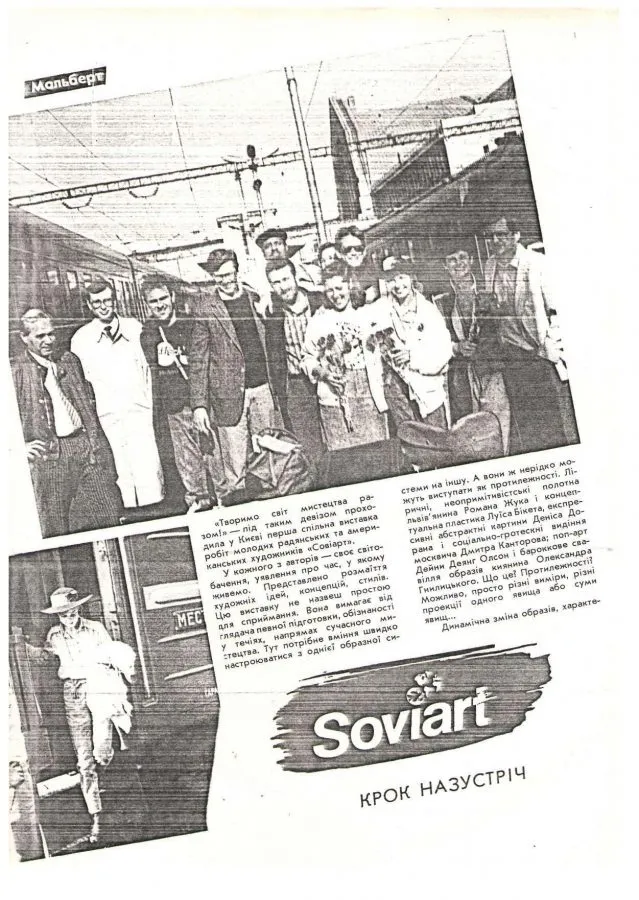
V. K.: “Soviart” from the very beginning worked according to the model of a classic Western contemporary art center. We found American partners and agreed to implement the Soviart program as a series of art projects. The first of them was an exhibition of young artists from the USSR and the USA, organized with the assistance of the US Embassy and with support from our authorities.
In 1988, for international communication, we had to use a teletype. To purchase an international teletype, it was necessary to obtain permission from the KGB. And every week we had to submit teletype tapes to the KGB so they could check whether we were engaged in espionage activities.
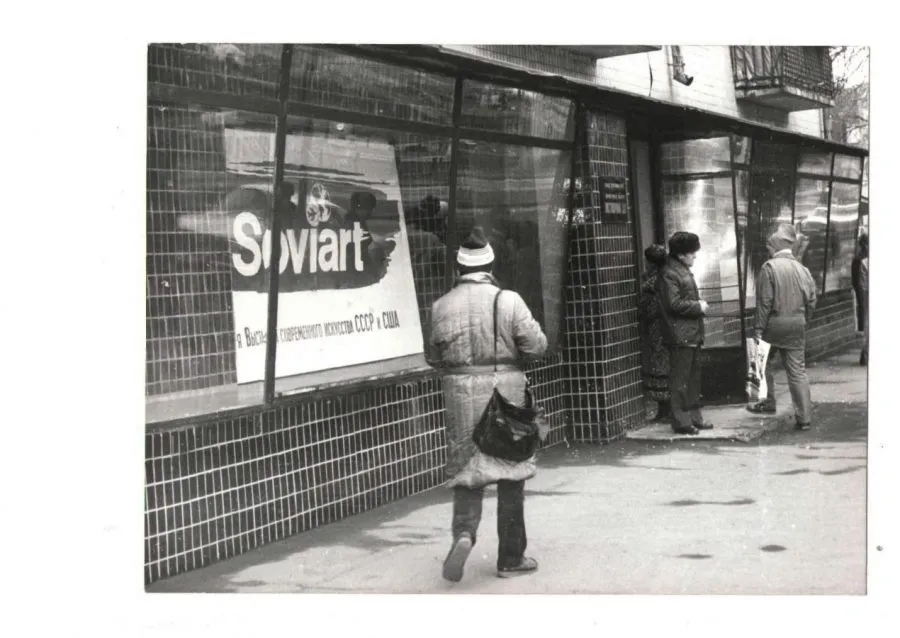
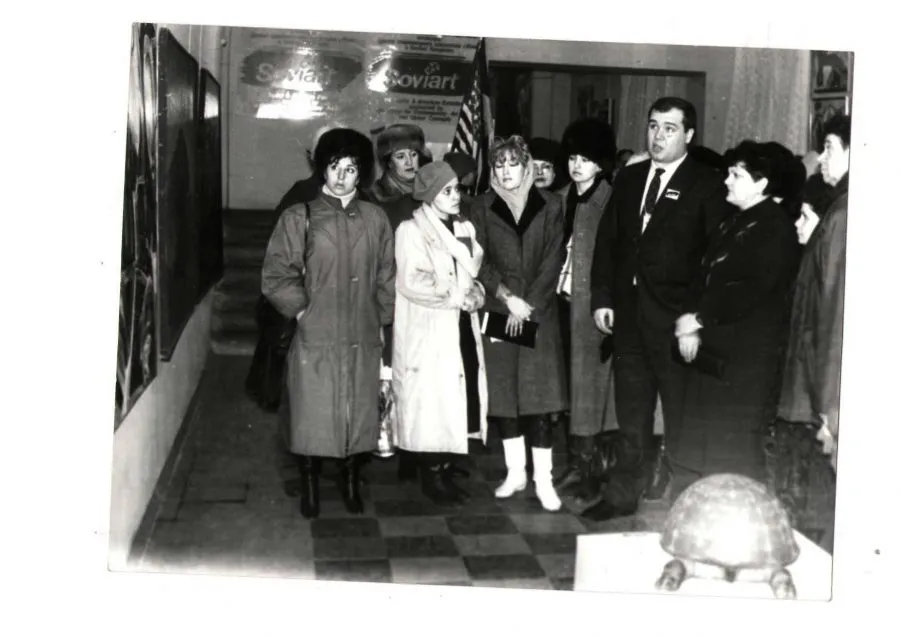
Виставкова зала Обласної спілки художників
In my opinion, to this day, there has been no other project in our country implemented on such a scale. First, the exhibition lasted one and a half years: about a month in a series of regional centers of Ukraine, in Tbilisi, Moscow, and Texas.
It was the first experience of implementing the so-called “Hollywood model”: along with the exhibition, we organized the sale of souvenir products — T-shirts, posters, booklets, posters, pennants, and memorable gifts for artists. We also held press conferences, round tables, and brainstorming sessions with new partners, discussing prospects for future projects.
We even had a guard who accompanied the exhibition during its travels around the country, and the exhibition was transported by its own trailer with the “Soviart” emblem. Flags of the USA and the Soviet Union were hung at the entrance to the exhibition halls.
In Kyiv, the exhibition took place in the hall of the Artists’ Union on Volodymyrska Street, opposite the Opera Theater. Long queues formed there. A guestbook has been preserved, in which visitors wrote: “Stalin is not on you! Shoot!”, “Abstractionism,” “Undermining the Soviet Union’s economy,” etc.
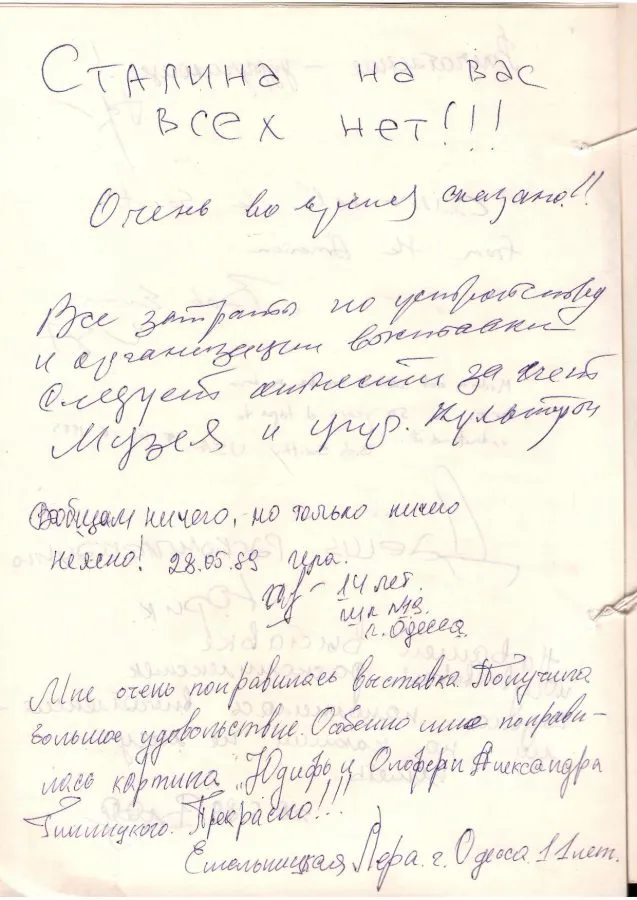
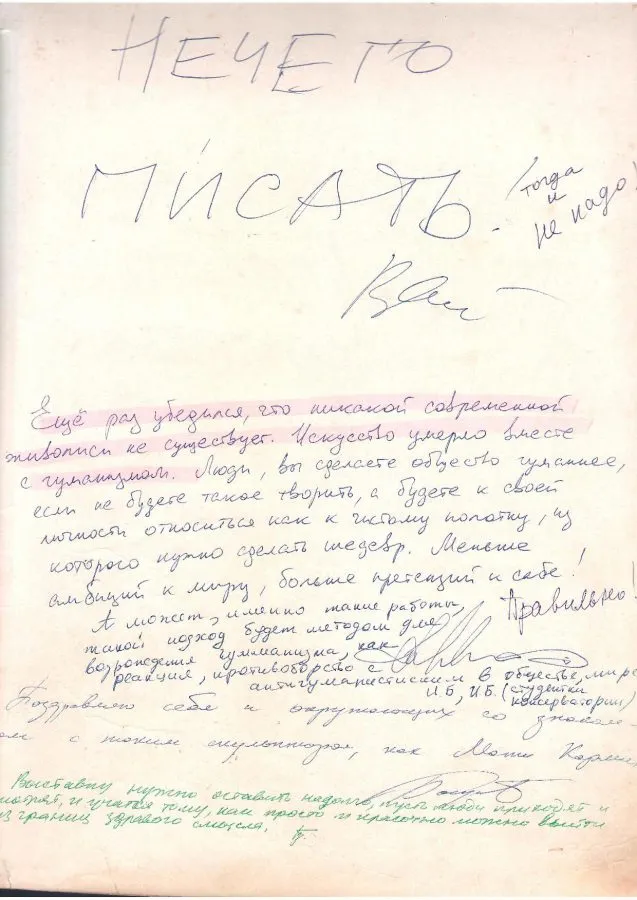
In the showcases, we installed the first televisions with VCRs, on which Mickey Mouse cartoons were shown at night. People stood in front of the showcases all night watching them.
It was autumn 1988 — an amazing time, a real explosion of cultural life, the first large-scale exhibitions with catalogs, etc. In Tbilisi, our exhibition was held simultaneously with Robert Rauschenberg’s exhibition, placing the expositions on two floors of the National Gallery of Georgia in the city center.
At that time, the famous tragedy with sapper shovels occurred, and the gallery windows were broken. The then US Ambassador to the USSR, John Matlock, visited the exhibition in Simferopol and left a warm review for “Soviart.”
An important result of organizing the exhibition was that our American partners — the public organization “Global Concepts” — received a grant for the first time to implement a joint program with “Soviart.”
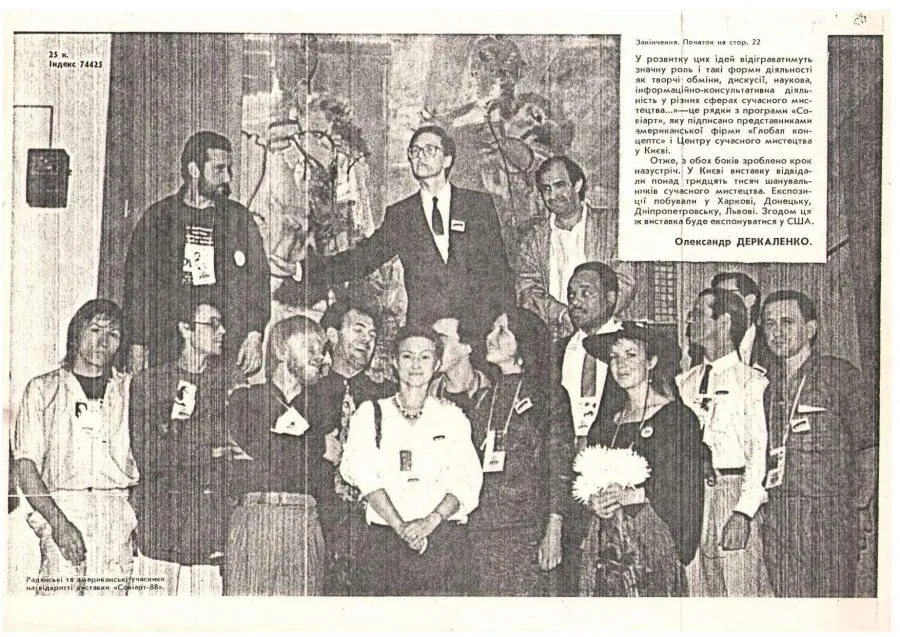
Tetiana Kochubynska: This exhibition defined the structural foundations of “Soviart’s” activities.
V. K.: Yes. In the 1990s, “Soviart” acquired the status of a public organization. In particular, this was related to the fact that in the Soviet reality, cooperatives were perceived as centers of “cursed speculators.”
What does the structure of a contemporary art center imply? First of all, project activities that are not limited to their own space but cover projects of various scales, up to international ones. In addition, there are informational, publishing, educational, research, and coordination directions.
At different times, the scale of these directions changed depending on available resources, but structurally and functionally we continue this work: we develop an art management school, the “Soviart” publishing house, implement national and international projects, joint international programs, etc.
In recent years, we have paid special attention to the development and implementation of socio-cultural transformation projects, including the creation of appropriate infrastructure.
Kseniia Malykh: Since what year has “Soviart” been operating in its current premises?
V. K.: During the first “Youth Crossroads” festivals, we received premises at 11 Vasylkivska Street. Credit must be given to the anti-alcohol campaign. On this street, there was a two-story beer bar — with a basement and the first floor. Since I was then in charge of the youth festival and organizing leisure, we appealed to party and other authorities with the demand: “Give us the beer bar for a youth club!”
Eventually, we managed to achieve this. We received the premises, renovated it, and equipped a youth club that retained the name “Youth Crossroads.” In 1987, “Soviart” began operating there — as an office and gallery.
Kseniia Malykh: Already without the beer bar?
V. K.: Yes, without the beer bar. Since 1987, the scientific and technical center and “Soviart” operated there. Some employees also ensured the work of “Soviart” within the framework of a ten-year joint Ukrainian-Danish program. This continued until 1998.
Later, we began holding the first international art festivals in the Ukrainian House and created an association of galleries. Our office and gallery were located there for some time. An expert council also began operating there, which implemented the project “Art of Ukraine of the 20th Century.”
In 1998, when we undertook the implementation of this large-scale project, we cooperated with the Pechersk District Administration. It offered us premises on Kostolna Street, where the young technicians’ club had previously been located but had not operated for several years.
We received these premises and completely rebuilt them into a gallery. Both the administrative office and “Soviart” were located there, but for the first time, several separate halls were allocated purely for exhibitions. Thus, in 1998, the “Soviart” center began functioning on Kostolna Street.
In 2000, against the backdrop of various election campaigns, Marat Gelman visited us. He proposed holding the youth subculture festival “Cultural Heroes,” asking me to rent him the gallery on Kostolna and become the director-coordinator of the festival. After that, “Soviart” moved to 22a Andriyivskyi Descent.
All archival materials are provided by the CMC “Soviart.”