
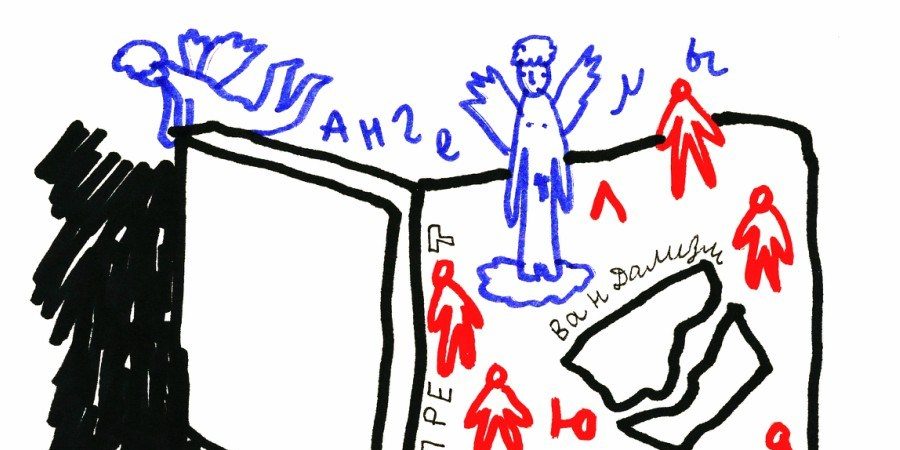
Text inspired by the 11th project of the PAC-UA space — an exhibition by Ukrainian artist Sasha Kurmaz “Marble angels with bows trembled in the shadows with little dicks, drew their bows and laughed carefreely at death.” The material is published as part of the cooperation between KORYDOR and the PinchukArtCentre Research Platform.
— Tell me, is the exhibition as cheerful as its title?
— There is some cheerfulness in it from the associations with colorful confetti in the photographs and images in those very places, which can embarrass, intrigue, cause scandal, leave indifferent, excite.
— And what kind of places are these?
— I am sure: as soon as I name those places in a calm voice, you will be absolutely free in how to relate to them… But if I refuse to name them, evade the question, then the question of what kind of places these are will definitely interest you and not let you rest.
— So you will say what kind of places these are?
— Certainly, I will say — I am going to describe the exhibition with all the important details.
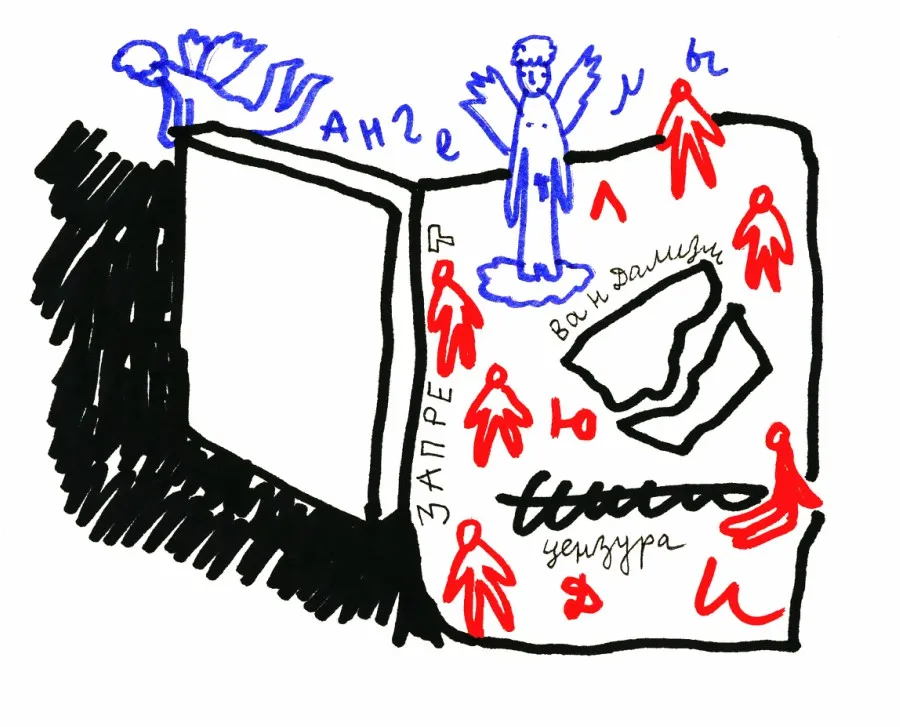
Two rooms of one exhibition
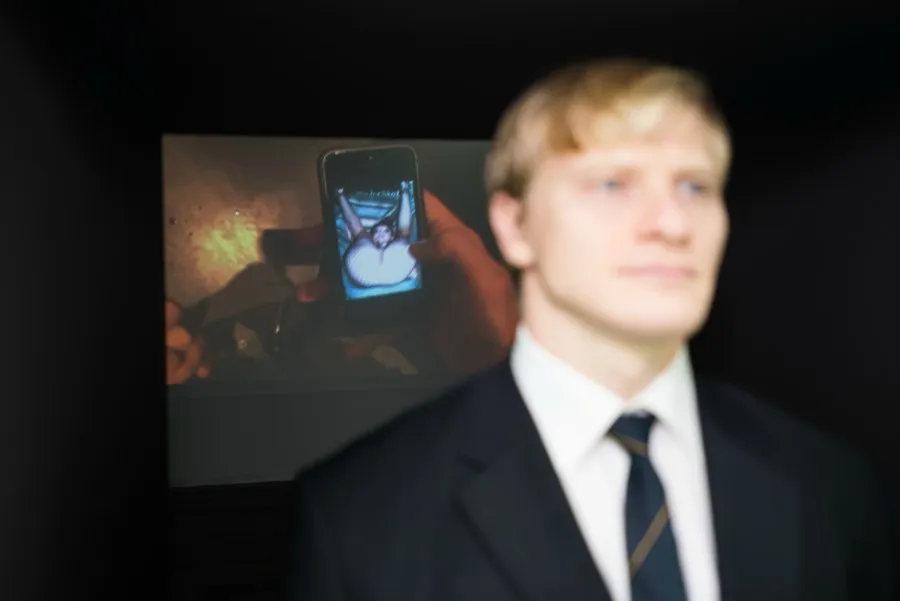
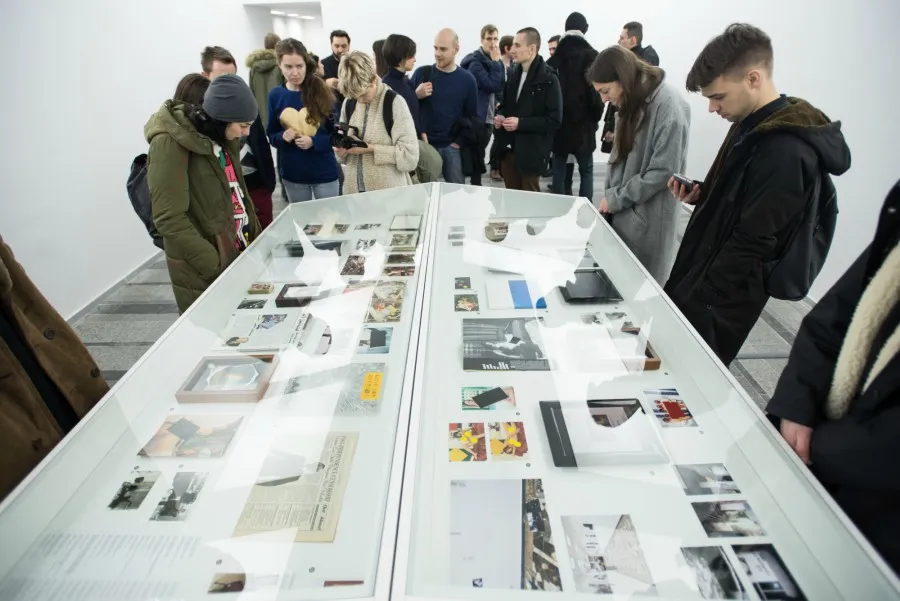
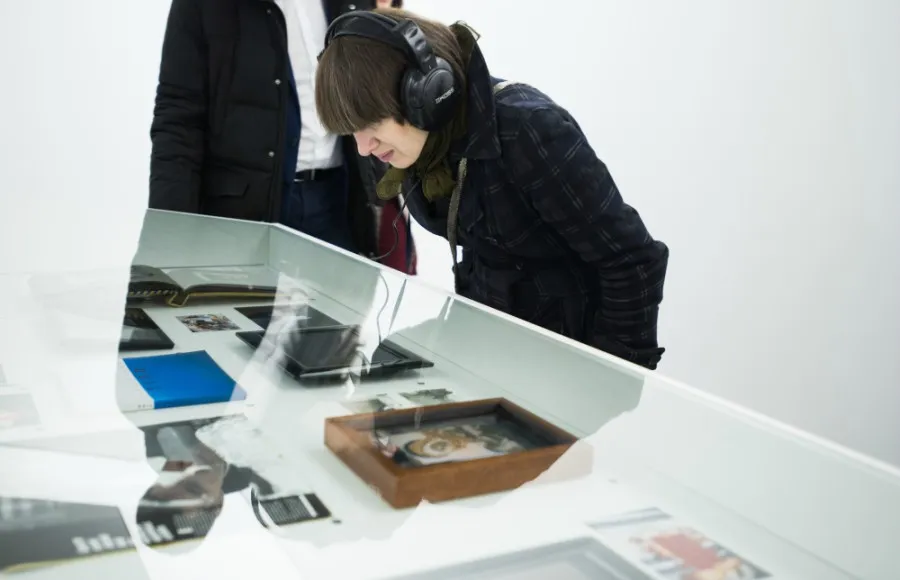
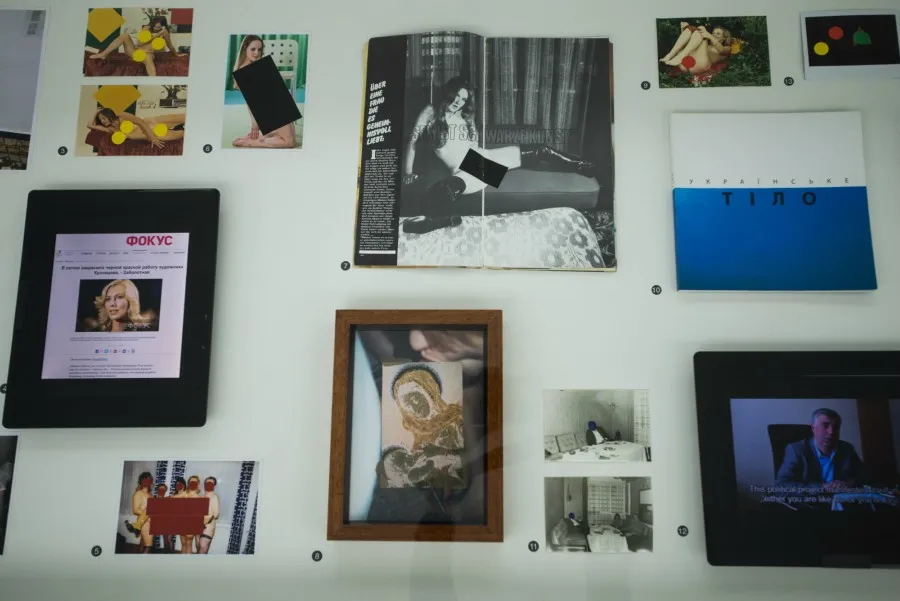
So, in the first room of the exhibition there are only two glass display cases. Inside them — photographs, digital images, several catalogs, pages from printed publications — magazines and newspapers, video materials. Some photographs and images cannot be fully seen: genitals, female breasts, faces, parts of naked bodies are covered with colorful round marks resembling confetti or pieces of colored paper. In other photographs something is painted over with paint or scribbled over with a ballpoint pen. The third are presented without intervention. Everything displayed in those showcases is carefully numbered and captioned. It becomes clear: time and effort are needed to understand how all these materials are connected to the exhibition title “Marble angels with bows trembled in the shadows with little dicks, drew their bows and laughed carefreely at death.” But you leave this for later… The exhibition has another room! What if there is something easier to perceive there? “After all, it is human nature to avoid difficult tasks!” — you tell yourself, heading to the other room of the exhibition, and you do not reach your goal. On your way — a guard in a flawless suit and impeccable bearing. You ask him a question: “May I pass?”
He: “No.”
— Why?
— I give no explanations…
— Can I later?
— No.
— Not ready for the exhibition yet?
— There is nothing interesting there…
You manage, standing on tiptoe or squatting, to see behind the guard some paintings and video projections on the walls of the room. There is no renovation in the space, no signs of changing the exhibition. The light in the room is off, you cannot make out what is on the paintings, but you manage to watch the video projections. But it is uncomfortable to watch them. The guard does not take his eyes off you. And you recall his last phrase said a few minutes ago: “There is nothing interesting there!” You feel that what is happening to you is what the hero of the film Inception (“Inception,” director Christopher Nolan — Ed. note) describes: “If you are told — don’t think about elephants, what will you think about? Certainly, you will think about elephants.” That is, certainly, you will think that there is something interesting in that room!
Those paintings? You remember that you are at an exhibition. What is on the paintings does not matter at all, the artist designed the mechanism of prohibition! You noticed it. Your next step is to correlate it with your past experience. You recall the Soviet school and your class teacher: “If you get to Soho, you will never return from there the same — you will be corrupted forever. Soho is the den of the decaying West. Not a foot in there!”
After some time you get to London, already from modern Ukraine. And where do you not forget to go? Certainly, you go to Soho. You will always strive for the forbidden object.
One of the stages of viewing the exhibition is passed — one of the rooms becomes clear to you. At this stage, clear! You return to the display cases to immerse yourself in studying the materials placed in them. You look at the photographs, referring to the captions for each, read newspaper texts, get acquainted with video materials, and after some time, no less than forty minutes, you understand the difference between the two rooms: the room with the lights off, guarded by security, illustrates prohibition, and the materials displayed in the showcases illustrate acts of censorship and vandalism.
Video materials preserve portraits of those who committed acts of censorship over the images. In their interviews, they explain why access to those images was forbidden. Those who committed acts of vandalism are presented with quotes. Those representing authority resort less often to vandalism because they have the opportunity to censor.
You find a certain connection with the place where this exhibition takes place — the video materials talk about artists who were shown here. You get distracted by memories of these projects (“Sex, medical, rock’n’roll” by Anatoliy Belov within the PinchukArtCentre Prize 2013, “If I were German” by the Rapid Response Group at the “Guilt” exhibition within the PinchukArtCentre Research Platform — Ed. note).
But still you conclude: censorship is not quite prohibition. Censorship is control, so there is always room for the factor of randomness! Something from those places in the photos has a chance to remain open for viewing, like those round marks resembling confetti that fell on the photos in the showcases: somewhere too much, somewhere inaccurately. Censorship is partly a zone of uncertainty, even randomness, until it comes to prohibition.
Another stage of viewing the exhibition is coming to an end: the artist showed you the mechanism of censorship. For this, he even had to play the role of censor: he himself put marks on genitals, female breasts, faces, parts of naked bodies in photographs and images, imitating acts of censorship, that is, “laughing carefreely.”
You are commendably attentive, you notice that in the showcases there are also materials borrowed from someone or found — the captions to the materials in the showcases give you an answer to the question where the role of censor was played by the artist, and where by someone else… You cannot get rid of the thought: acts of censorship are sometimes accidental steps. And sometimes something may seem like an act of censorship: what if paint accidentally spilled exactly on that spot?
Space beyond the two rooms of the exhibition
You are about to leave — you no longer have reflections about “Marble angels…” But you realize that the two rooms of the exhibition, or rather, their sequence, mean something. You find the answer: from censorship to prohibition — a few steps, like to that room guarded by the security.
You go outside. The structured and now clear to you space of the two rooms of the exhibition changes to a complex reality. In front of you is a city where angels do not live. You criticize your former calm: but aren’t there things that need to be forbidden, right?! And you shift your gaze to the sign of the exhibition you just visited — “Sasha Kurmaz. Marble angels with bows trembled in the shadows with little dicks, drew their bows and laughed carefreely at death.”
You answer yourself: today it was important to figure out the dicks. You recall that in one of the video materials the size of the dick is discussed, the image of which later falls under an act of censorship. You laugh. Someone passes by you and lights a cigarette. You recall your words to the psychotherapist: “And I smoke?!” — and his answer: “Smoke if you want!”
The absence of prohibition means being alone with what is your personal discomfort. This is definitely the final conclusion for today in the context of the art exhibition — the conclusion you make.
Some time after the two rooms of the exhibition
You recall that in David Polzin’s work “Information Exchange Department,” presented at the 6th Moscow Biennale, a similar method was used as in Sasha Kurmaz’s exhibition “Marble angels.” Both Kurmaz and Polzin arrange the space of these exhibitions to illustrate certain mechanisms of systems. Polzin unfolds before the viewer a panorama of bureaucracy, Kurmaz — of censorship and prohibition.
Each of their works must have a performer. In the “Marble angels” exhibition, the performative role is played by the guard, in the “Information Exchange Department” exhibition — by the one who is in a closed space and receives information through a narrow window with the text: “Wait a bit. Wait a bit more. Next!”.
- Photographs provided by PinchukArtCentre © 2017