
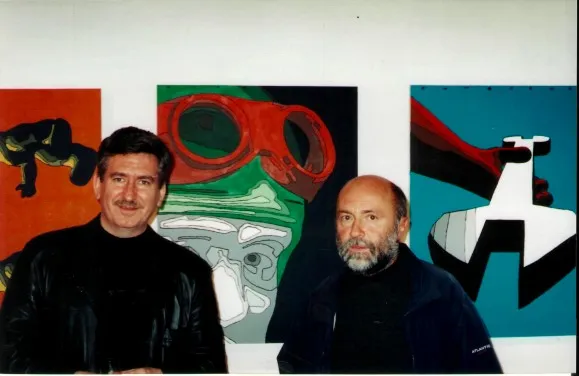
Viktor Khamatov is the founder of the first non-governmental art institution in Ukraine — the Soviart Center for Contemporary Art. Since 1987, Soviart has been developing a Western European-style institution. It is a pioneer among organizers of large-scale international art exhibitions in our country. In his numerous projects, Khamatov manages to attract resources from the cultural sphere, business, and the public sector, implementing strategic management models.
The “Research Platform” of the PinchukArtCentre continues to work with the personal archive of Viktor Khamatov and the Soviart CCA. Within the framework of cooperation with KORYDOR, the second in a series of interviews with the gallerist is published. The conversation was conducted by Kseniya Malykh.
Kseniya Malykh: There is a common approach to start the count of Ukrainian contemporary art from the moment the Soros Center opened in Kyiv (1993).
Viktor Khamatov: If we talk about the artistic process, then the main artistic forces of the country and the art history community, working on the project “Art of Ukraine in the 20th Century,” agreed in the catalog articles and exhibition projects at the NHMU and other institutions to start the count from the late 1950s — early 1960s. Then came the 1970s and, of course, the new wave of the 1980s, convincingly shown by the Soviart project “Three Generations of Ukrainian Visual Art.” If we look in the institutional context, the start dates back to the creation and first projects of the Soviart CCA in 1987.
For comparison: the total project budget of the Soviart CCA from 1988 to 2005 was up to $200,000 annually, which was quite comparable to the peak budgets of the Soros Center in its early years.
The geography, scale, and project directions of Soviart in Ukraine and abroad were obviously broader and more significant.
K. M.: I think the mood was such that it seemed possible to build an art system that would be effective, not bureaucratic, and would offer many opportunities, especially in the second half of the 1980s?
V. K.: Yes, this was the time of “perestroika.” In 1985, a signal was received from Gorbachev, which fostered enormous hope for system transformation even before the mass mood changed to expectations of collapse and awareness of the Soviet Union’s weakness. It was a time when the third sector began to form in Ukraine, public organizations, especially in culture and art. The first rock clubs, amateur theater studios, creative groups in visual arts.
K. M.: So the main impulse was not destruction?
V. K.: Not destruction, but the idea to take the best, neutralize the bad sides, and transform the system. Essentially, what was later proclaimed with the creation of the CIS (Commonwealth of Independent States), and in Ukraine — with the declaration of independence. It was actually about transformation with simultaneous inclusion in the process of European integration. Soviart joined these processes from 1987: initially with Lithuanians, Estonians, in 1988 — with Americans, from 1989 to 1998 — with a program with Denmark, in the 1990s — projects with Germany, France, and others.
K. M.: Was this a process of adapting Soviet standards to European ones?
V. K.: Yes, there were attempts to implement mechanisms of evolution — through soft transformative forms, not through destruction and radical, shock technologies. It was a time of experiments with transforming economic forms. But the Communist Party Soviet nomenclature that came to power was unable to implement new management schemes. We have what we have.
At that time, management science paid considerable attention to culture and art as the most important ideological and communicative tools.
Contemporary art in global experience was an important field of investment, innovation, integrated into the general fabric of Western society.
Unfortunately, politically and legislatively, little was done to support art — this is a minus. At the same time, the state did not hinder the activities of independent art institutions — this is a plus.
However, underestimating the role of contemporary art in the development of culture, economy, and social sphere leads society to provincialism and marginalization of life forms.
K. M.: We are now witnessing the consequences.
V. K.: An obvious consequence for many is the lack of funding. Meanwhile, a deeper and more professional question remains out of sight — the effectiveness of cultural and artistic activities, not to mention its profitability as a sector.
Among the main reasons for inefficiency and, accordingly, underfunding — the Soviet administrative-departmental management system still operates, built on budget financing, planning, not on project management principles.
Based on the results of the “Youth Crossroads” festivals in 1985–1987, and later after large international projects of the 1980s, we came to the conviction that there should not be isolated events prepared for a month or half a year, but a pilot institution producing and implementing project packages.
K. M.: On what scale?
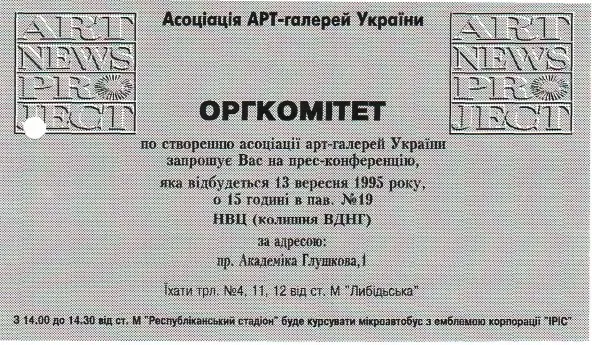
V. K.: We set ambitious tasks in the context of the entire Union, then Ukraine, but in an international context. At the same time, we understood that concentration on one direction was ineffective. Thus, we came to a multidisciplinary, integrated program-target approach. A core idea of a holding was needed to build priorities. This idea became contemporary art. We wanted to show that the cultural product in modern life is not inferior in investment attractiveness and innovativeness to other products. Moreover, they can be mutually integrated. Thus, in 1995, we created the Association of Art Galleries of Ukraine.
K. M.: At that time, the cultural infrastructure was alive and functioning. There were networks of cultural centers, exhibition halls of the Artists’ Union, etc. The potential in these networks was great.
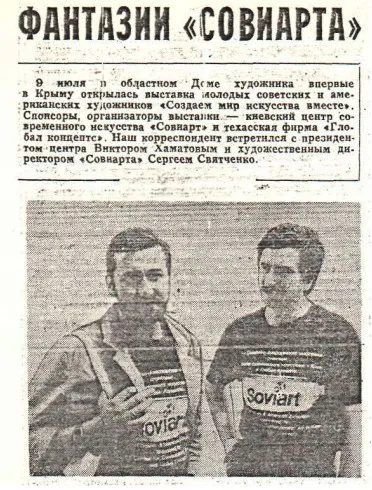
V. K.: Yes. At the very first stage, counting on this infrastructure, we aimed at the most powerful project in terms of image — with America, the most developed country in the world. Circumstances made this possible. During “perestroika,” the first public organizations were formed. Many foreign charitable foundations immediately entered the Union space. We were lucky to meet such an organization whose task was to enter the computer market of the Union — or rather, a market that practically did not exist.
K. M.: I understand your plans went beyond the successfully conducted large-scale series of exhibitions called “The First Soviet-American Exhibition.”
V. K.: Under Gorbachev’s “perestroika,” we understood that successful cooperation with a foreign company and supporting organizations would allow us to develop a model that could be used in the future, considering the colossal resource potential of contemporary art in Ukraine.
K. M.: What was new for the country in this model?
V. K.: Besides the management model and mechanisms I mentioned earlier, we managed to implement the principles of creative industries on the platform of visual art exhibitions, about which so much is talked about today. Moments in Ukraine [1], World Press Photo, projects with Denmark, France, Germany, the first corporate presentations of Samsung in Ukraine, as well as Lego in the form of an art project. We tested new forms of presentation: prize lotteries, video support, a “touring” format through cities of Ukraine. This required a modern approach in staff selection, equipment, transport, logistics, and publishing activities.
K. M.: How did you manage to successfully build work with the regions?
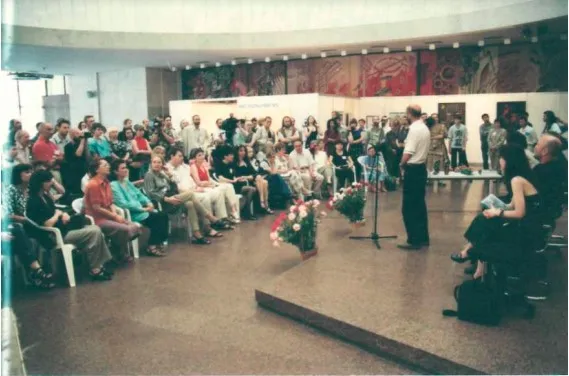
V. K.: We launched the “touring” mechanism with the American exhibition. It was absolutely new because no state institutions could handle it, and there were no others. And there was no product that could tour and would cause not only general interest but also audience readiness to pay for what they saw.
We tried to establish new standards of working with the press: before the exhibition, we held not just a press conference but created a press club with journalists we knew from the “Youth Crossroads” festival, introduced them to the material, and agreed to cover the entire project process. In addition, we implemented a large line of promotional products: posters, booklets, badges, T-shirts, bags, programs, etc. Some of this was given to each visitor. The entrance ticket cost one ruble. At that time, this was a high price since a ticket to any film cost 25 kopecks. To set a price that did not comply with cultural event regulations, permission from state authorities was required, and tickets were ordered from the state printing house because there were no other printing houses.
K. M.: How long did you prepare the Soviet-American exhibition? From the moment you realized you could implement it?
V. K.: American partners were shocked: we prepared it in half a year — from idea to opening.
K. M.: That’s very fast.
V. K.: Meanwhile, our partners in America had to gather experts, apply to funds, get a grant, find a curator, etc.
K. M.: Weren’t they afraid to come here in 1987?
V. K.: They came with water and air purifiers. Naturally, it is worth remembering that for the Soviet Union, this was a terrible time — after the Chernobyl disaster. The support of the US ambassador in Moscow, Jack Matlock, played a big role.
K. M.: And from the Ukrainian side, who supervised the process, selected the artists — an expert council?
V. K.: The art director at that time was Serhiy Svyatchenko. He formed the main group of artists in cooperation with our Moscow partners, with republican artists’ unions of Estonia, Lithuania, Latvia, and was in contact with Kyiv artists.
The partner was the Artists’ Union. Tiberiy Silvashi gave a report on the relevance of the project, and Andriy Chebykin, head of the Kyiv Artists’ Union, supported it.
I think the scale of the project, its scope, the level of American support, and Soviart’s status as organizer caused quiet shock in the Communist Party and state management and permitting institutions. They shrugged but dared not refuse. That’s how everything came together.
K. M.: You needed access to all these exhibition venues across the country. How did you work with the audience?
V. K.: We worked on two levels. I took on the official party level: I met with city party committee secretaries for ideology, conveyed greetings from the US ambassador, the party Central Committee, and the Komsomol, presented the Soviart brand style and exhibitions, invited them to openings, and asked for assistance in guarding the US and USSR flags over the exhibition hall.
There was also an informal level. We placed ads and interviews in local press, on radio, announced the exhibition and “round tables.” During exhibitions, we developed the form of an art club, held brainstorming sessions. In each city, we gathered the artistic community: artists, critics, museum workers, cultural functionaries, etc. We collected data on cultural problems in the regions, which projects they would like to initiate — all this was recorded and analyzed. Much of it was later implemented.
K. M.: How did you manage to build cooperation with regional art institutions on market terms if they still fully operated within the Soviet system?
V. K.: We predicted the development of cultural infrastructure, institutionalization of contemporary art, but nothing of this happened before Ukraine’s independence was declared.
We had to develop all mechanisms from scratch and resource them. For example, renting premises, providing exhibition, transport, and display services. Buying was out of the question. Renting was also practically not considered. The concept of contract price did not yet exist. Therefore, many services were paid for by the main Soviart partner — an investment company legalized as an economic-calculation scientific and technical center of union scale.
Nevertheless, we predicted all this for the future and built such a model, understanding that sooner or later it would be possible.
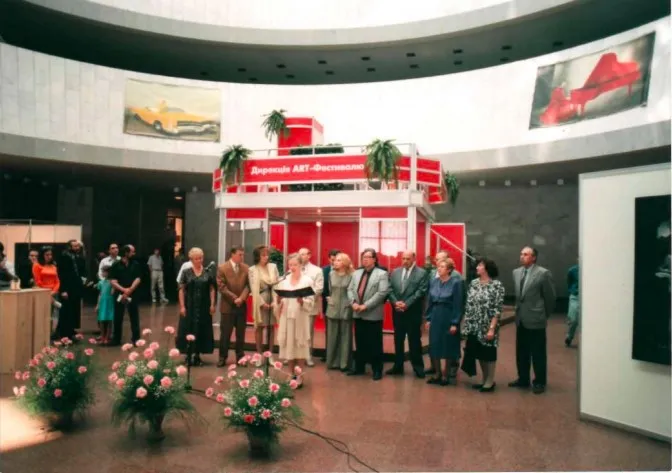
It was already obvious that the state could not maintain all funds and property. From the first steps, we closely cooperated with Kharkiv — with the art museum, Kharkiv Artists’ Union, and other regional museums as the only functioning specialized art institutions with exhibition venues and trained staff. In the 1990s and 2000s, these contacts yielded results in presenting our projects, in the “Cultural Heroes” project, co-produced by Soviart.
K. M.: So, essentially, you supplied local institutions with ready cultural products?
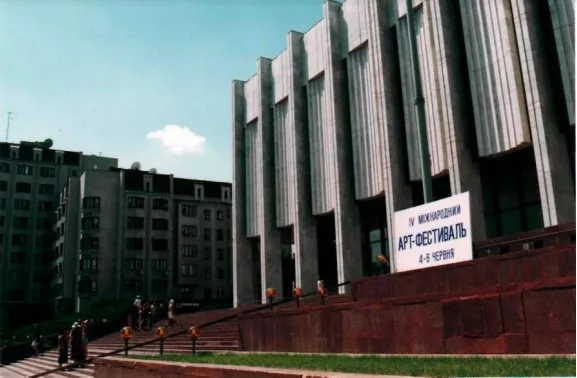
V. K.: Yes, product, security, support, transport, advertising, documentation, souvenirs, etc. — all this was ours. Exhibitions only needed to be adapted to existing conditions. Local institutions had the opportunity to earn from our cooperation, and they were, of course, interested. Moreover, the exhibition brought a noticeable influx of visitors and increased the popularity of the institutions themselves. This happened not only with the American project but with the entire package up to the first art fest under the aegis of the Association of Art Galleries of Ukraine in 1995.
K. M.: How much did you earn in the end?
V. K.: On the Ukrainian part of the American exhibition tour, we earned over 200,000 rubles. Considering prices at that time, a new “Volga” could be bought for 25,000, and for the same money, you could buy a dacha near Kyiv. At the same time, expenses were also considerable. We invested about 50,000 rubles in this project.
But it was a profitable project, and it was built on a commercial basis. This shows that a good cultural product at that time caused great mass demand. And this is also one of the principles we laid down in this project and subsequent ones. We researched what needed to be done for the first time. This principle was very important in terms of PR and project profitability. It is impossible to talk about total sums from projects because most funds were reinvested in subsequent program projects, which allowed us to ensure a high level of project funding until 2005.
K. M.: And then it was not as difficult as it might seem.
V. K.: Of course, international art projects in regions and industrial cities were virgin territory. Much was done for the first time.
K. M.: How did you share expenses with American partners?
V. K.: We agreed to split expenses in half. But it turned out we spent more. They asked to cover part of the difference with computers and gave us a small batch — in 1988 (!) — of laptops. We could not understand, although I am a cyberneticist myself, what to do with them.
K. M.: Really, what did you do with them?
V. K.: Only after a year did we find someone to officially sell them to. We sold some in Moscow, some in Kyiv. But the main thing is that 30 years ago, we managed to show American partners how to establish economic ties through culture and art.
K. M.: But to establish those ties, the product itself had to be of a certain quality.
V. K.: Obviously, if you conduct some district competition, it is unlikely you will establish contacts at a large corporate level. You need to take on a super-task.
K. M.: But that does not mean you should work only with experienced, “proven” artists?
V. K.: We had a ten-year program. One priority was to “raise the young.” The first in this direction was the “21 Views” project, implemented in 1988–1989. Then, showing continuity in Ukrainian art, Soviart, in cooperation with curators Halyna Sklyarenko and Oleksandr Kuzyanets, presented the project “Ukrainian SmallART. Three Generations of Ukrainian Painting.” Then there were projects with Denmark “7+7” and a series of joint program projects. Separately, Soviart initiated an annual competition for debut projects of young artists.
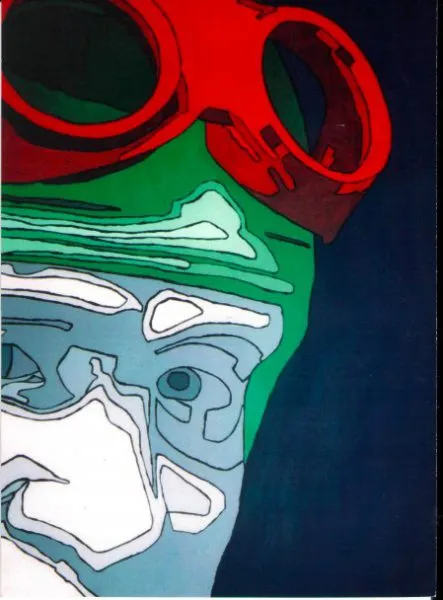
K. M.: The “21 Views” exhibition opened at the House of Artists in Kyiv in 1989 and later in Odense, Denmark. How did you enter the international scene?
V. K.: Besides bilateral international projects with European art institutions, foundations, embassies, we decided to revive the sister city cultural exchange program and sent letters to almost all cities connected with Kyiv by this program. Among the already known (Tampere, Toulouse, Munich, Chicago) were newcomers.
The city of Odense in Denmark responded. We helped the city authorities conclude a sister city agreement with Odense and undertook, with official and methodological support from the city administration, to implement a cultural exchange program at our own and partner’s expense for ten years, with contemporary art as the core.
We already had the implemented “First Soviet-American Exhibition” behind us, along with successful experience in building economic ties through a cultural project. And since I headed an investment company, was a member of the Ukrainian Chamber of Commerce, and founder of the Union of Industrialists and Entrepreneurs of Ukraine, it was not difficult for me to establish contacts useful to the Danish side in Kyiv and Moscow.
K. M.: In Western Europe, there is a tradition of supporting projects related to culture and art. But here, there is neither tradition nor legislation to support this.
V. K.: Well, what is tradition? Tradition practically grows into various forms adequate to the mentality and landscape in which society lives. Ukraine has traditions that can also promote culture. For example, I am not talking about nepotism but what we call “by friendship.” In few European countries is it possible for someone to come and say: “Give me a venue for two days, well, by friendship.” Volunteering is developed there, but not free partnership at a professional level.
K. M.: Yes, here you can do a project completely free.
V. K.: Yes, but there it is impossible because the thought does not arise. A professional who does a project assumes his work will be paid, then understands that involving experts means you cannot not pay them according to their professionalism. Moreover, there are contracts, intellectual property, which we did not have. Soviart, through the Association, spread this experience, and from 2004 to 2011, ran an annual Art School with project management courses.
K. M.: But in the West, big business willingly cooperates with culture.
V. K.: Such cooperation, of course, indicates a formed culture of corporate social responsibility. Moreover, there are legislatively formalized and business-beneficial tax mechanisms, and cultural products are included in stock and exchange resource circulation mechanisms. If contemporary art works are given the status of investment, innovative products — this also causes a deep transformation of socio-economic life.
When we did the “7+7” project [2], Danish artists were supported by the famous LEGO company. I think we also have many opportunities in museum and gallery work to implement merchandising principles as an important component of cultural industries.