
Lesya Zayats is an artist, the second wife of Oleksandr Hnylytskyi (1961–2009), one of the co-founders of the Institution of Unstable Thoughts (1996) — a non-commercial art organization focused on collaboration, interdisciplinarity, mixing different media and methods, and the eponymous artistic duo. The most famous projects involving Zayats — “Room” and “Mediacomfort.” In 2007, together with Hnylytskyi — as the Institution of Unstable Thoughts — they created a multimedia installation for the project “Poem about the Inner Sea” within the Ukrainian pavilion at the 52nd Venice Biennale.
Lesya Zayats met Hnylytskyi during a residency of eight Ukrainian artists in Munich. She first came to Parkomuna at a time when the squat was just beginning to decline. Zayats was not integrated into the Parkomuna community, so she was deprived of a romanticized view of the artists and their environment; on the contrary, she had a more impartial view of the inner affairs of the scene.
Kateryna Yakovlenko and Tetiana Kochubinska spoke with Lesya Zayats about her feelings towards Ukrainian artists, their behavior and worldview, identity, and first impressions of Parkomuna.
The material is published as part of the cooperation between the PinchukArtCentre Research Platform and KORYDOR.
Tetiana Kochubinska, Kateryna Yakovlenko: When we were preparing for the interview, it turned out that we know nothing about you as a person. We know that your grandmother and grandfather were from Western Ukraine, you were born in Munich in a completely different environment. Did connections with Ukraine remain in it? What influenced the formation of your identity? And was this question even relevant to you?
Lesya Zayats: I don’t know how to answer this briefly. Yes, I was born and raised in Munich. Strangely enough, my first language was Ukrainian, and I learned German at school. However, my vocabulary in German was much larger. Like every child in Germany, I went to a German school five days a week, but on Saturdays also to a Ukrainian one. I grew up in the diaspora, in a close microcosm of patriotic nationalists. After World War II, Munich was a hub for immigration, and many stayed there permanently. Grandma and grandpa were going to emigrate overseas, like most of my family. But my grandmother had tuberculosis, so she was not granted permission to immigrate to the USA, so they stayed in Germany.
Until 1943, they were politically active bourgeois intellectuals. Grandma was imprisoned several times for her principles and underground activities. But then, in exile, they became DPs (displaced persons) for a long time. Later they were active in the local community, had to adapt somehow, even integrate, but they never became Germans. The “preservation of Ukrainianness” was passed from generation to generation. At the same time, they were very moderate nationalists: no, not Banderites, yes, Plast members. Zealous.
I did not have German citizenship. I didn’t even want to have it on principle. Until I married Sashko (Hnylytskyi. — K.Y., T.K.), I had this fantastic blue passport with two black stripes. Nowadays, this is a terribly relevant refugee status. That is, it is a passport issued by Germany, with the right to stay, but without citizenship. A relic of the Geneva Convention. To go, for example, to Austria, you had to apply for a visa. I even lived in London for a while and worked at Universal Pictures and always had problems because of that cursed passport. Many of my friends said: “You’re crazy!” But I still had hope that someday there would really be independence. Maybe some very interesting country would grow here. Maybe I would want to be Ukrainian. Yes, there were such naive thoughts.
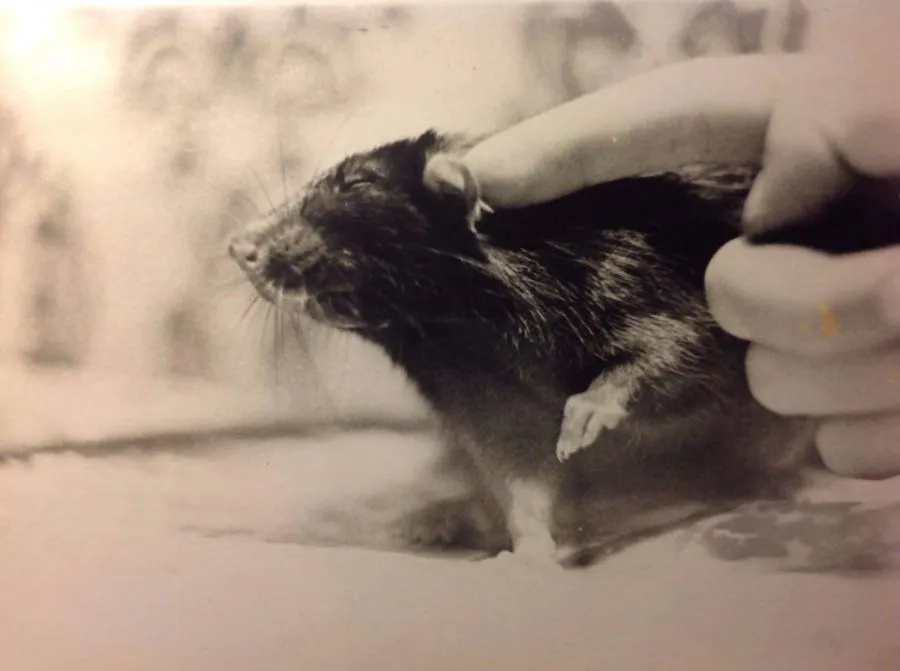
In 1991, I came to Ukraine for the first time, and my grandmother returned (to Ukraine) only in May 1993, just when the tragedy with Holosiiv slightly subsided. She was then also at Parkomuna (in the squat “Paris Commune”), in Lera Trubina’s studio. We had a great time there because Lera had a rat named Hans, and my grandmother was on familiar terms with rats, they were her friends from the times of solitary confinement and isolation. It was generally freaky — grandma at Parkomuna with that rat…
T.K., K.Y.: And how did the artists living at “Paris Commune” perceive the language, since it was a Russian-speaking environment?
L.Z.: Trubina and everyone who could speak tried very hard, and those who couldn’t, like Oleksandr Solovyov, I didn’t understand at all in the first years. And he didn’t understand me. Probably he understood more than I did. For me, Russian was completely incomprehensible then. Once, as I was walking from Parkomuna from the fifth to the valley, I was following a woman, and the woman said: “Zabylá!” (Forgot!). And I said: “Who?” Neither I understood her, nor she me. There were many incidents, communication problems arose. And this is actually a big dilemma to this day for all people from the diaspora. They come here, and the locals who respond in Russian think that they supposedly don’t understand Russian. Because for me, Russian is a different language, honestly. I learned it much later. Even Sashko didn’t believe for a long time: “Are you pretending?” And I had to prove to him that it sounds different to my ears.
T.K., K.Y.: When you met Hnylytskyi, Holosiiv, Savadov, Senchenko, and others in Munich in 1992, what did the Ukrainian artist environment seem like to you? How different was it from the Munich one? What did you think about Soviet art?
L.Z.: I can answer this question generally. Back in the 1980s, when there was a wave of forced emigration of the Sixtiers, my family actively bought everything important. This includes Lyuda Yastreb, Volodymyr Tsyupka, Volodymyr Strelnikov… nonconformists. At some point, my mother even had a lover who belonged to the Odessa art scene — Vitaliy Sazonov. He was a participant in the first “Bulldozer Exhibition” in Moscow.
We knew nothing about socialist realism. Since we couldn’t travel here, it was considered imperialist, it didn’t matter, but we read Vasyl Stus and others at a time when they were all political prisoners. We were passionate about idealists. Then everything possible was done. My grandfather zealously supported the Helsinki Group. I even fasted every year on the Day of Political Prisoners, January 11.
My family was very interested in contemporary culture; I was aware that you have a lot of interesting things here. I remember, for example, director Andriy Zholdak came to us. This was before independence. At least then, he was wildly cool, he even looked like on our (German) level, a person who went further in theater.
When artists from Kyiv arrived, a small gallery “Szuper” (Szuper Gallery) opened in Munich, where Pavlo Kerestey later worked. Here, I think, it was Makov’s discovery, and I came to get to know those artists. Not Makov, but those who came for the residency and had already made an exhibition at Stuck Villa, which I missed.
I approached the gallery from outside, and it was already dark outside, but inside it was bright. And the first thing I saw was a guy in a trench coat, which was lowered like this (Oleksandr Hnylytskyi). As if in the air, he gracefully walked and stood somewhere… like Nureyev or Baryshnikov… And at that very moment, I felt chemistry, thinking: “Wow! Who is this?” It was hard for me to enter because my heart was pounding. I thought everyone would look at me now. I didn’t know if he was a guest or who he was at all. But others rushed to me — Holosiiv and Roitburd.
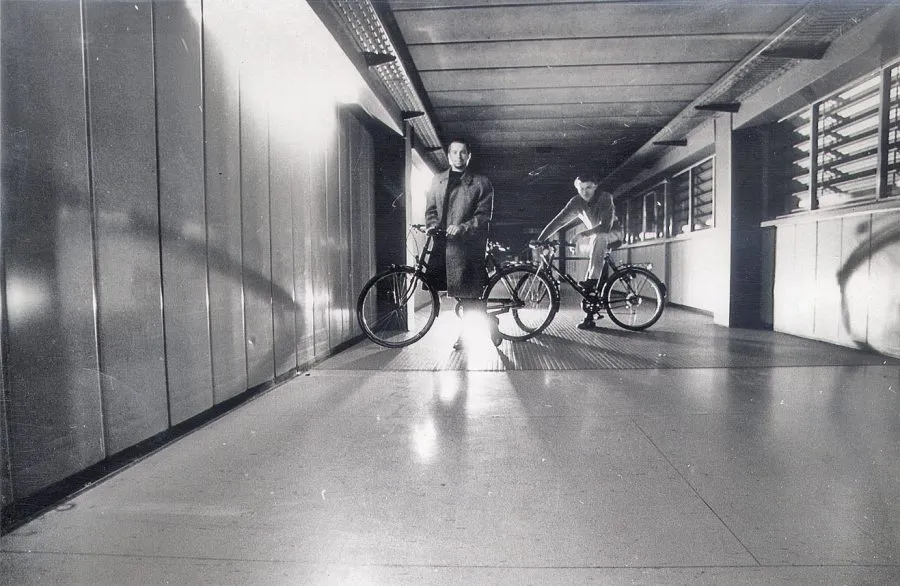
By the way, Sashko completely ignored me; he didn’t pay any attention to me at all. But this works very well because then it becomes even more interesting. My friend Olenka and I quickly found contact with the artists. At some point, they asked us to finally come to their old airport, which was closed. Visually, it looked like a science fiction plot, a post-atomic state. It was an airport where I supposedly landed six months earlier, but now it was dead: all clocks stopped at one number, frozen boards, very long corridors. The premises were psychedelically freaky. It seemed that being completely sober, the roof could go off. And there were very funny moments. Hnylytskyi came up with how to eat in the studio: they had half-kilowatt lamps, and he fried eggs on that lamp. Or they bought an avocado — looked from all sides how to cut it because suddenly they saw a pit. They really tore it apart (laughs).
When I met them in 1992, it was hard for me to understand what kind of world they came from. You could say that for quite a long time there was a moment of lost-in-translation. But it was also interesting — teaching each other context. Sashko and I did quite well. I quickly knew who Cheburashka was and learned that “bryuki prevrashchayutsya…” (pants are turning into something…). Because if you are not from that context, it’s Chinese to you. It was also hard for Sashko at first to understand my jokes or listen to something else — some event he didn’t know about or a film. But he managed.
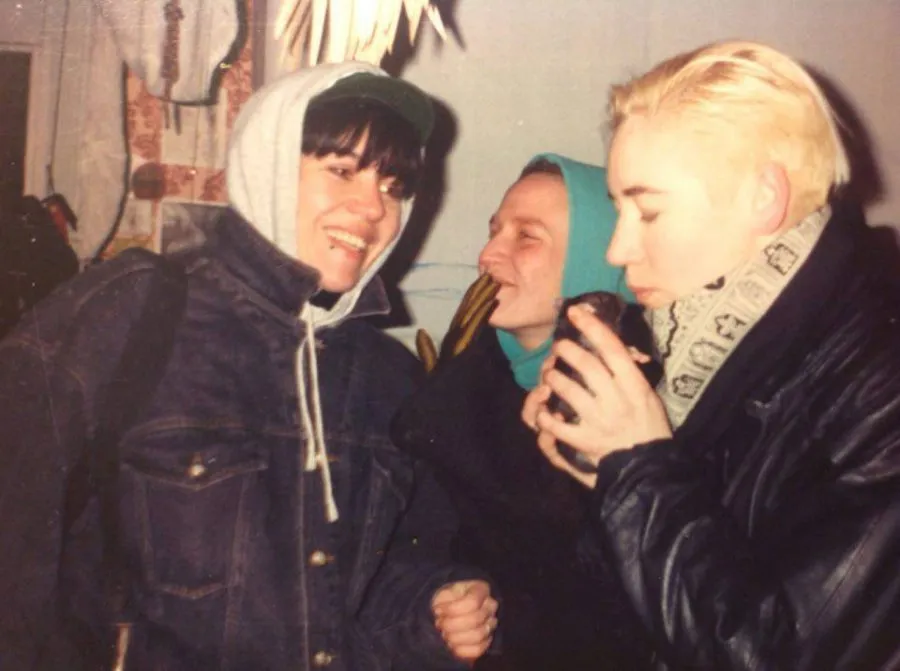
T.K., K.Y.: When did you first get to “Paris Commune”?
L.Z.: In 1993. I arrived the day after Holosiiv did not return from the park.
T.K.: So you first got to Parkomuna after Holosiiv’s death?
L.Z.: That’s the point. I was late…
We called everyone. He was a playboy (I say this in the most positive sense). He really, like a sailor, had a girlfriend in every port. It was already hard for him to coordinate everything because everyone wanted something. We thought maybe he was hiding somewhere…
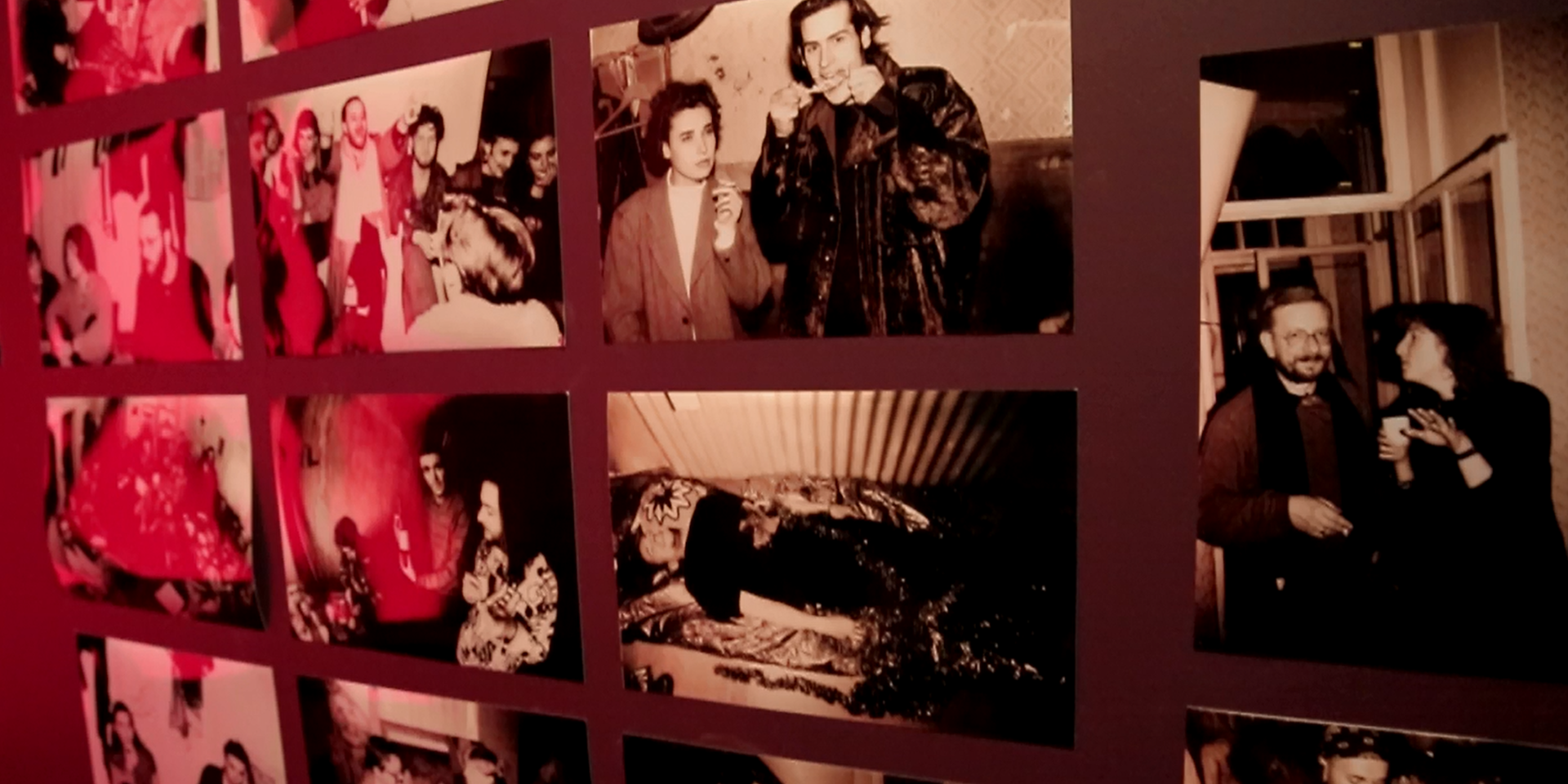
At that time, they were in the phase of sex, drugs, rock&roll. Well, all these things: sexual revolution, psychedelics, everything that had long happened in the West.
I knew from the very beginning that he was in danger, and it was visible. I told them for a long time that you have to be very careful with all substances. As Timothy Leary said, “set, setting, dosage.” It was already understood in the 1960s that you have to treat it with respect, otherwise you become some idiot who doesn’t use the substance, but the substance uses him. I tried to make them understand this. Then everyone was very used to huge amounts of alcohol, and they exhausted everything they wanted to get from it. So they chose another direction. It wasn’t that I didn’t understand what they wanted to achieve in such an artificial way. I was just worried because they overdid everything. Such user behavior — I can’t call it otherwise — is playing with fire. But, on the other hand, they were like children who for a long time were not allowed these and other candies that everyone else had access to, and here they began to binge crazily. Now we say it censored “beep-beep-beep”: “None of that, please.”
No, it is just necessary to understand that there was such a phase then. I met wonderful but slightly crazy people in Munich then. And also at Parkomuna; to some extent. I just say that a lot seemed inadequate to me. For example, the attitude towards all material things. They, like some damn rock stars, completely dismantled their hotel rooms! Good thing they didn’t light a fire there! Well, it’s such a Soviet mentality — everything that is not someone’s property can just be destroyed or stolen. They stole everywhere and everything. And Sashko stole a bike and sat in a Bavarian prison for three days. But he confirmed to me that the bike was not locked because he found it somewhere in the bushes.
T.K.: But it seems to me that it was a distorted understanding of freedom. When you are in one vice, and then…
L.Z.: Yes! They have everything in the West, so you can take it! That was later, when we all went to Edinburgh for an exhibition. Everything was very fun, but sometimes I was just ashamed that I was with these people who could behave like that. Especially when they were drunk as hell. And they could drink much more than even those English.
T.K.: And when sober, did they behave like that?
L.Z.: They were all extremely interesting characters, sober or not. There was some punk charm in it. It was their way to get rid of feelings of inequality. And not all of them abused! Then everyone wildly wanted to catch up with the West, or even surpass it!
T.K., K.Y.: And how did they paint? Did this state affect their painting style?
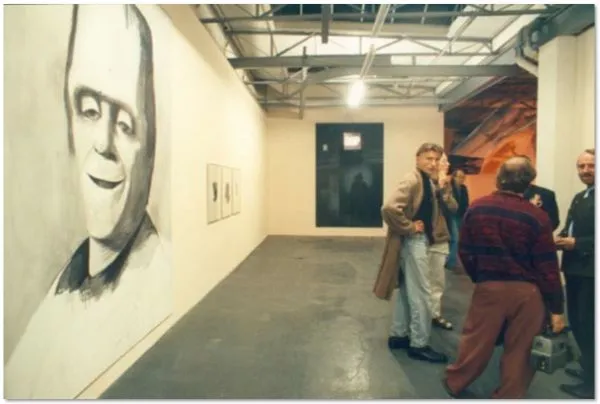
L.Z.: Here we return to something else. I can only speak about Holosiiv and Hnylytskyi (although I also interacted with others then). They decided to show what they had done. Holosiiv invited us (Olenka and me) to the studio at the airport. We saw very strange painting. We just went crazy! Each of us is the sum of our neuroses and talents. Holosiiv was disciplined. Productivity and creative state — everything could reach madness. He loved to “burn out.” Then you had to do that, then rest, then again. And I thought: “When did he do this? Last night? Wow! How?” Sashko had a different phase. When we returned to him after that and asked: “Well, what about you?” he said: “I don’t do painting.” He made something for himself, one or two paintings, and didn’t know whether to exhibit them. He loved to postpone until the last moment. (Everything was supposed to be for the final exhibition in a very cool place then on Lothringer Strasse. It’s a small alternative space that had a fantastic program for many years.)
Exhibition exposition “Postanesthesia” on Lothringer Strasse, Munich.
T.K., K.Y.: Today it seems like a somewhat romanticized phenomenon, more than 20 years have passed… It sounds beautiful that we are making an exhibition about an informal group, a community. However, in your opinion, could this phenomenon be considered an artist community? What were the communication mechanisms?
L.Z.: These are very different artists united by one time space. These are not art groups. This is an analog scene that shared inspiration, where one influenced another, and circumstances influenced everyone. Parkomuna sociologically, culturally — that’s one thing, and the artists of that scene — that’s another. Each figure had its function. What this means in a non-local context is a question for researchers and art historians.
But this is one of those local moments that must be recognized as a phenomenon of a transitional period. It is not a romantic mystification but an indisputable fact. And at the same time, there were other groups, like “Poglyad,” for example. There were scenes that did not intersect. If I were to analyze that time, I would say that Parkomuna might have looked decadent and scandalous from the outside, but in reality, it was a very productive and communicative hub.
An important aspect: the squats themselves were not only a place for the local scene but also a place where outsiders stayed, who came to Kyiv not only from the Western abroad but also from the East. This is the function of a hub. Unlike today, in the time of Facebook, where your identity is some comment feed. It was a time of communication on another level; each person was a carrier of interesting information. Communication was physical. As in ancient times, before technology, people were messengers themselves; they carried some philosophy or stories that then multiplied. Parkomuna was a place for narrative exchange. Each person who came had either some favorite music on a cassette that everyone then copied or a cool video that everyone had to watch. Guests were all very welcome — tea, coffee, cappuccino. I remember endless conversations in the kitchen and studios. I was also one of those figures who carried some information, some new films, mix-tapes!!! Like many others, I was a carrier. And I knew who could be pleased with what. For example, a video cassette with Derek Jarman — for Roitburd. Or “Barbarella.” And I taught who “Amphibian Man” was or Viktor Tsoi. Everyone was interested.
T.K., K.Y.: You said that everyone had their function. What functions did people have?
L.Z.: This is about stereotypes and dynamics in such a microsocium. It seemed to me then that someone was a radical and had to die (hero), someone was an opportunist and survived (marginal); someone had the roles of a muse or squat woman; someone carried Eastern philosophy for show, someone else embodied it; someone liked to stand in front with the whole entourage, and someone hid completely; someone had the role of a young lover, and the other was called “papa” (this is about Hnila)… And further speaking in such clichés, someone (English-speaking with a foreign passport) was the foreign minister; someone was a shaman, like Serhiy Anufriyev, who dropped by on the way; someone was an ideologist-resident (Solovyov). Natasha Filonenko took care of the atmosphere of the bohemian salon (grand dame), as did Chicha’s woman Tetiana. And Chicha himself was already a fashionable dandy (when he still sewed his own rags). And Protsenko, for example, had very refined taste in musical matters (impresario). Such banal simplification can be spun further, but the research has just begun. Not everyone was closely friends with everyone, but there were connections and “transitions.” The main thing is that everyone used the exchange; it was practical and fruitful. Because all together it created a kind of “field.” It probably has to exist like that. It’s your art history business to interpret this. The Parkomuna phenomenon was limited in time. When it all fell apart, there were attempts to have communal studios, but the time was such that probably everyone began to go in their own direction more than in such a synergetic one.
T.K., K.Y.: And what was your role, besides introducing them to Western films and culture?
L.Z.: I think none. Maybe to be a thorn. A thorn in the sense that I got into the system but am not really part of the system. Maybe that was my role? This may be my psychological interpretation of it. To put it mildly, I was a guest. Neither stranger nor one of them. One thing I definitely carried was some other Ukrainianness, either in a positive or irritating sense. But the new government, which just changed into vyshyvankas, turned out to be idiots themselves. This made self-identification not very attractive. The fatal polarization began then. And I often think about this: what could have been if it all went differently? I didn’t really believe in such independence, but that’s another matter. In my eyes, Germany was not independent then either — everyone understands now — neoliberal capitalism! Everyone depends on everyone, and everything depends on everything… Uuuu!
That probably touched Sashko then. I had a different history and experience and did not hold a passport of some society responsible for me, but still believed that a Ukrainian is no worse than a Russian or a German. That was F*****G exotic then!
I also came from another, parallel generation (post-flowerpower and post-punk!), so I already knew that the whole illusion that we are free and cool has a flip side. Relationships don’t get better if everyone sleeps with everyone. A person doesn’t become happier if they accept everything they can accept.
Sources: Kochubinska T. LESYA ZAYATS: “PARIS COMMUNE” IS A COMMUNICATIVE HUB WHERE EVERYONE HAD THEIR ROLES” [Electronic resource] / T. Kochubinska, K. Yakovlenko // Korydor. – 2016. – Access mode: http://www.korydor.in.ua/ua/voices/lesia-zayats-parkomuna.html.