
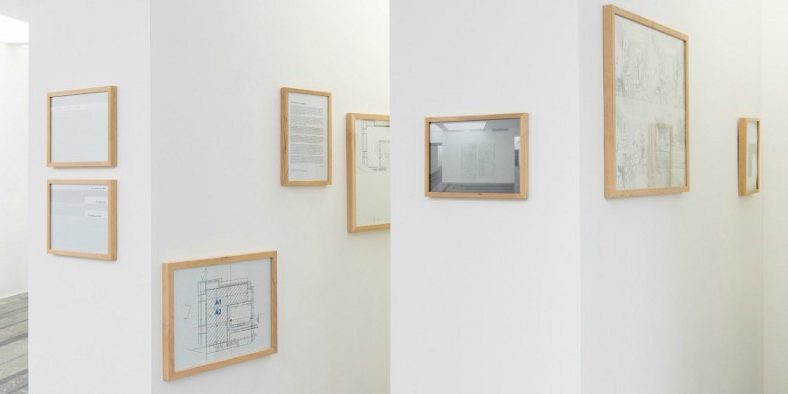
Within the cooperation framework of the PinchukArtCentre Research Platform and the online publication Korydor, we continue the topic of contemporary art research. This time, it will be about curatorial experience and institutional critique. The interlocutor of Tetiana Kochubinska was Anna Smolak — the invited curator of the project “Reconsideration.” It is worth noting that PinchukArtCentre invited external curators for the first time in its activities, thus implementing a policy of polyphony. Within “Reconsideration,” Anna Smolak became the curator of Lada Nakonechna’s project “Exhibition.”
Anna studied art history at the Jagiellonian University, completed postgraduate studies in cultural diplomacy at Collegium Civitas. Currently — she is the chief curator of the BWA SOKÓŁ gallery in Nowy Sącz. Anna collaborates with the Adam Mickiewicz Institute in Warsaw on the development of projects related to the Eastern Partnership countries. From 2004 to 2012, she worked at the “Bunkier Sztuki” gallery in Krakow. Anna is interested in themes of exclusion, locality, and the problem of institutional critique.
Tetiana Kochubinska: First, I would like to hear your impressions of the “Reconsideration” project. It is closely connected with the study of the local art environment and was conceived as a response to the thesis that the history of Ukrainian art is a “history of interruptions.” Within this project, we invite artists to reconsider their own practice and, conversely, to highlight the connections that exist between artistic practices of different generations. To some extent, we give artists a task. Since you are the curator of one of the exhibitions within this project, this “task” automatically fell to you as well.
How did you perceive it? What does reconsideration of tradition mean to you? How does it relate to your curatorial experience?
Anna Smolak: Firstly, it seems to me that artists and curators face different tasks, especially in my case, as I have the perspective of an outsider. When you invited me to participate in the “Reconsideration” project, I felt that I could contribute my part since the project’s theme resonated with research I conducted in the territory of the former Soviet Union. At the same time, I understood the numerous practical and content limitations that complicated fulfilling the task. The project was very time-limited, and my knowledge of Ukrainian art history was insufficient to formulate a certain statement.
As I said, I am from another country, but of course, we share a common history, and the transformation processes we are currently going through, albeit at different paces, are also our shared experience. For any society, it is important not to get stuck in the past to have the opportunity to review its traditions (regardless of which traditions we mean). I would rather see this as a continuous process, not a one-time task.
As a curator, I look for various artistic formats to make such experiences and expectations a topic for discussion and to reflect together with artists on the complexity of issues inherent in the context we are in. The process of working on the exhibition is as important to me as its result, and the project itself becomes research based on practical experience.
T. K.: You mentioned research based on practical experience. How did the idea of reconsidering the institution, rather than artistic practice, arise? Is it somehow connected with your meeting with Lada Nakonechna?
A. S.: I would say it was a coincidence of many things in time. My first acquaintance with PinchukArtCentre took place only in December [1]. From my observations, the general perception of the center did not correspond to its vision of its own role. I was lucky to catch a very interesting moment in the institution’s life when it was reviewing its own program through the creation of the Research Platform, the development of which you and Bjorn are working on as curators.
Meeting Lada Nakonechna and getting closer to her practice really made me think about the difficulties within the institution, about its responsibility — these are the topics we touch upon in the exhibition. As a result of the discussion, the idea arose to turn to the Research Platform, which also refers to history, but a history that has already “passed” through the filters of institutional narratives. It is about the archive, an exhibition on the theme of guilt, and the collection. All this created a dense context of the space in which we had to work.
T. K.: You are the invited curator of a separate exhibition, which is also part of a larger program. Regarding the content — did you try to correlate your project with the overall program of the new Research Platform with its various exhibition directions?
A. S.: Yes. Actually, our conversation started with the space. We looked at the plan of the fourth floor and saw that our place on the Research Platform was at the very end. To get to us, one had to go through all the exhibitions. Considering this, we began to think about what stories these exhibitions tell. What do they embody? How are they constructed? What is visible, and what is hidden from view? Take, for example, the PinchukArtCentre collection — does it represent a certain period or embody the center’s mission? Who is it intended for? Similar questions can be asked about the archive. What primary sources are collected in it? How are the materials selected and presented? “Exhibition” touches on all these questions. This may be somewhat confusing, as we are discussing not a single aspect of the exhibition. On the contrary, we want to show how complex a medium the exhibition is. Lada speaks on behalf of her generation. She tries to define her own place among historical narratives. You will see that many of Lada’s reflections contradict the works presented within the collection.
T. K.: So Lada’s project is a critical reflection on the institutional format, but this concerns not only a specific institution — PinchukArtCentre. I am talking about the rapid “production” of thoughts (globally in the world). When an artist does not have enough time for reflection and is forced to focus on rapid production. Is this one of the issues that “Exhibition” also raises?
A. S.: As the title suggests, it could be any exhibition in any institution. But we made it specific, responding to the spatial and ideological circumstances of a particular place. If you want to classify it, Lada’s exhibition is institutional critique, an artistic strategy aimed at reflecting on the complexity of institutional intricacies. It is about “negotiations” between the internal and external parts of the institution, about undermining the mechanisms of artists’ expression and their limitations, about how art manifests itself through various forms of reflection.
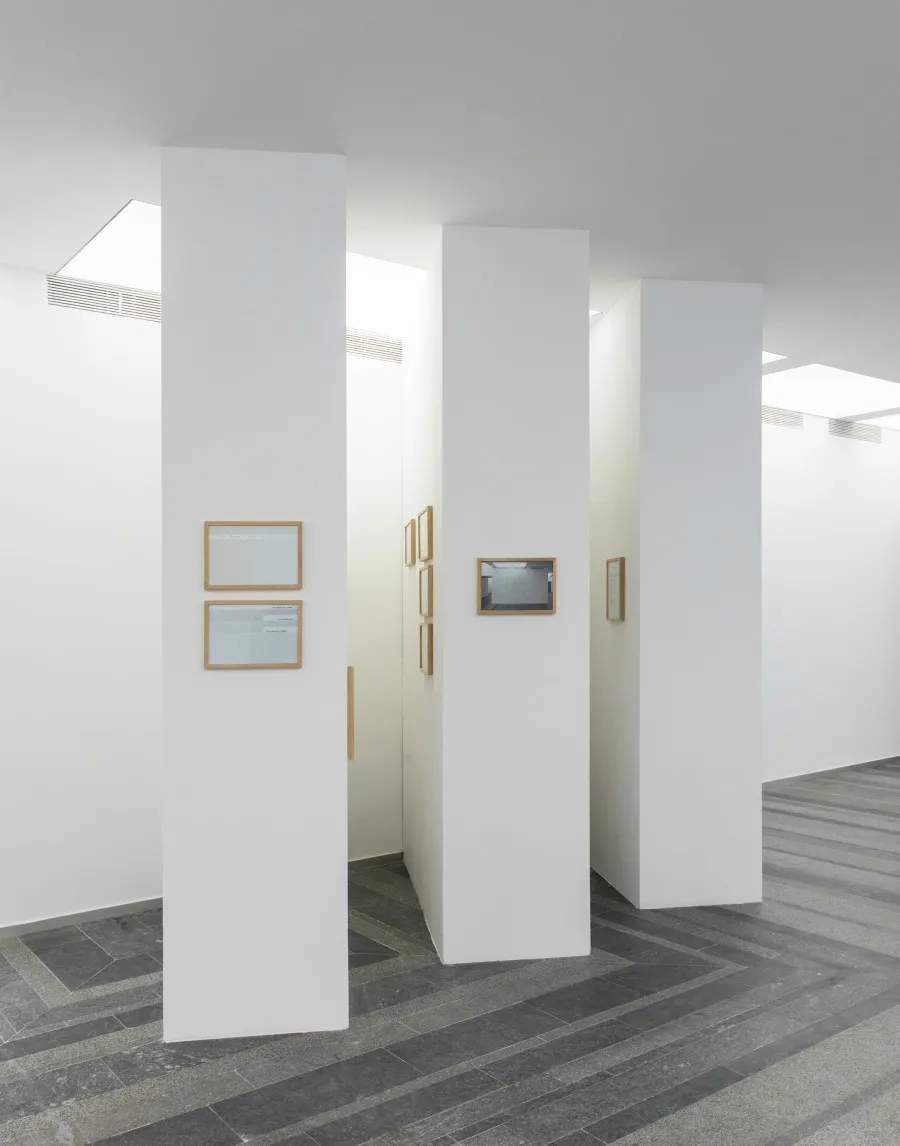
Our starting point is the exhibition space — the archetypal white cube with closed windows isolating the room from the outside, artificial daylight from the ceiling, and whitewashed, “prepared” walls. It was once conceived to provide artworks with an autonomous, almost sacred space. We question the neutrality of such conditions; in fact, they rather determine how art is perceived and how the message is formulated.
T. K.: You mentioned institutional critique. In Western Europe, this concept has a certain history — it implies something established. In Ukraine, it is only developing. For me, it is currently important to show the institution’s readiness for self-reflection. How do you assess such cooperation within our institution compared to your experience in Europe?
A. S.: Institutional critical analysis has been used by Western institutions as a means to track and redirect decisions they have made since the 1990s. But even in Poland, as far as I know, there are very few organizations that consciously implement institutional critique strategies. It is difficult to propose a project that criticizes the institution in which it is realized. However, critical analysis does not mean denial but rather awareness of the circumstances you are dealing with. Given the institution’s policy, voicing these things can be problematic or even intimidating. Problems that cause embarrassment are rarely voiced within the institution, especially when it comes to personal relationships, issues of hierarchy, exhaustion, or even funding. I believe that once we acknowledge that they exist in our daily life and affect our activities, we can start discussing them.
I am far from making radical statements. I do not believe in such a way of discussing things. Also, I no longer believe in dividing things into black and white. The strength of Lada’s project is that it very subtly and humorously combines various topics that lead you to the most important aspects of the institutional role. At the same time, it allows you to choose what exactly you want to see.
T. K.: You emphasized the confusion caused by Lada’s space due to its emptiness, but at the same time, this emptiness is full of meaning. Could you describe some aspects of the work, its difficulties?
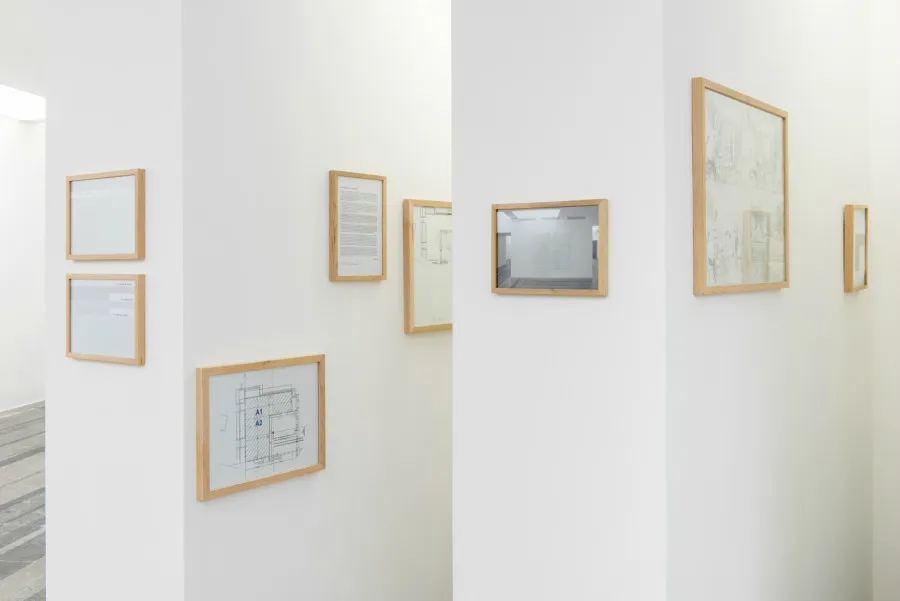
A. S.: First, we must return to the title — “Exhibition.” Very simple. Any visitor to an art institution expects to see an exhibition. However, if you think about the means used in an exhibition, what comes to mind are artworks, the selection process, ways of directing viewers, processes preceding the exhibition, people involved, costs, etc. Lada’s project consists of reused works and their fragments. She also added new parts, drawings, and sketches, although they have no autonomy within the space. On the contrary, they are embedded in the space, and the space itself becomes a very important element of the exhibition. The emptiness you encounter is an illusion. It contains various visual properties, but to recognize the artistic gesture and its meaning, effort is required. Hence the confusion.
The walls are covered with wallpaper featuring popular motifs taken from visual culture, Photoshop, and the internet. Through this wallpaper, Lada addresses issues of transparency as means of manipulating the public (or society in a broader sense). They are contrasted with artificial walls on which something resembling the exhibition archive is placed. There you can see various materials illustrating the artistic process, including our collaboration. These are reflections on the decision-making process and our attitude towards the institution and visitors, and not least towards each other. The archive seems accessible only at first glance. There are physical limitations on obtaining information, and it is unclear which of it is factual and which is distorted. The archive tells about the method of collecting, displaying, and selecting materials, about the clarity of procedures. Moreover, we talk about transparency that gives more opportunities to see — not only things but also through them; we point out to visitors that they are responsible for perception and a critical view of the information they receive.
Using “peepholes” in the walls, Lada connected the external and internal parts of the institution to signify the context in which her own artistic expression takes place.
T. K.: One of the issues your exhibition raises is the artist’s position. In my opinion, this figure is key in the art system. And this artist’s position is conveyed in the exhibition through intervention in the collection space you mentioned. Did you intend to highlight the artist’s position, to make it more visible and present inside the exhibition space?
A. S.: Probably many artists would disagree with this, as today they feel as if the art system exploits them rather than they being its driving force.
In “Exhibition,” the artist and I both try to redefine the positions from which we speak. Of course, we want this position to be central. The “center of gravity” of the space, which we defined through simple geometric calculations, reflects this desire. Interestingly and even amusingly, this point on the L-shaped floor plan is located outside the exhibition space. It turned out that it is situated in the neighboring collection. This may sound like a denial of reality, but we actually followed the logic of geometry and checked all steps with the architect. You can compare this with the same white cube and the responsibility of art and art institutions to society nowadays. Being in the room containing the collection, we can undermine traditional institutional museum-type narratives that offer a linear way of thinking, where gaps function as obstacles rather than pointers.
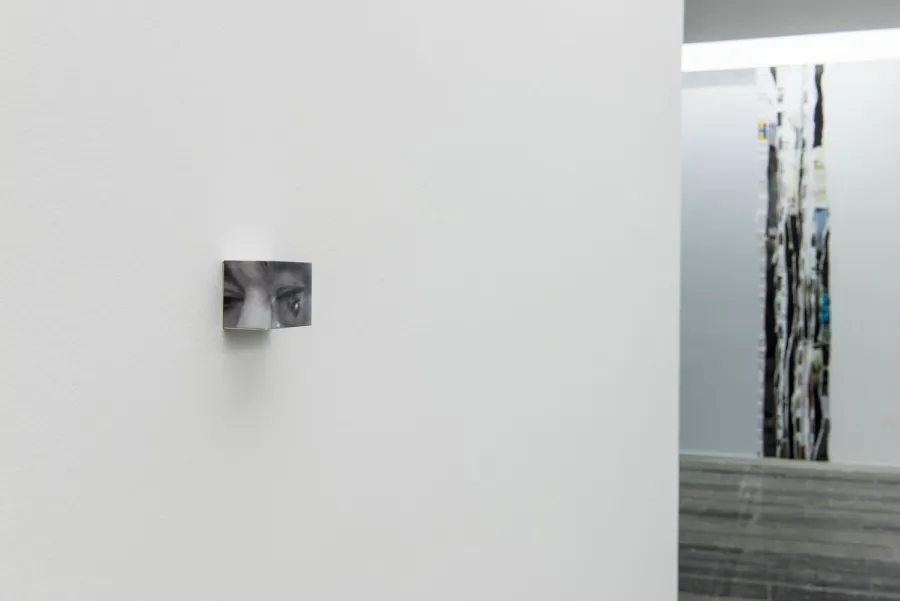
In our space, there is a small photograph of a damaged eye. It turns out that this is a wound from contemplation. Vision is not a politically neutral process and can be costly, but it would be ignorance to refuse the opportunity to see. If you ask about the artist’s position within the institution in general, I am afraid they have to maneuver in the dark, as many aspects of such cooperation are still not fully formed. Because of this, the artist is in a very uncomfortable position, becoming part of a blurred mechanism. The dominance of the institution in the art system closes the way to negotiations, although I would like it to be about dialogue.