
“HARD TELEVISION”

“Hard television” is a fundamental artistic and philosophical concept by Vasyl Tsagolov, within which the artist primarily worked in the 1990s. Tsagolov formulated this idea in his program text “Hard Television” (1993) as “an assumption of the immateriality of the world and the idea of it as a solid biological fiction” [1]. The artist first embodied the ideas of “hard television” in the projects “World Without Ideas,” “Karl Marx—Père Lachaise,” and “Mimicry and Mimic Experiments” in 1992–1993, when he lived in a squat on Paris Commune Street (now Mykhailivska) in Kyiv.
In the program text, the artist states that his works are an attempt to go beyond imaginary reality, since the artworks themselves, according to him, were never that reality but always the result of imitation or reflection of something. “The awareness of the world and reality as a solid volumetric television broadcast, and the real space as television, allows one to discover in oneself a teleprototype or telecharacter and, as a result, to work more organically in the space of solid ether. Thus, having discovered ‘hard television’ for oneself, the viewer is freed from splitting and experiencing the imaginary; for him, fate, adventures, and actions are only a series of visuals intended to somehow enrich this meaningless, endless series” [2],” the text says.
Tsagolov claimed the fictitiousness of reality, since the reality and “truth” retransmitted through the “blue screen” are perceived as actuality. “With the development of the mediacratic era, the current existential maxim ‘to be means to exist in the world’ will be replaced by a new maxim ‘to be means to be shown live on television,'” the artist emphasized [3]. According to this statement, life, history, and the world are only a stream of events arranged into a coherent narrative line, so “the number of interpretations far exceeds the number of phenomena being interpreted” [4].
The idea of reality being absorbed by the world of television fascinated the artist so much that he wished to witness a television interference (tele-effect) in real life [5].
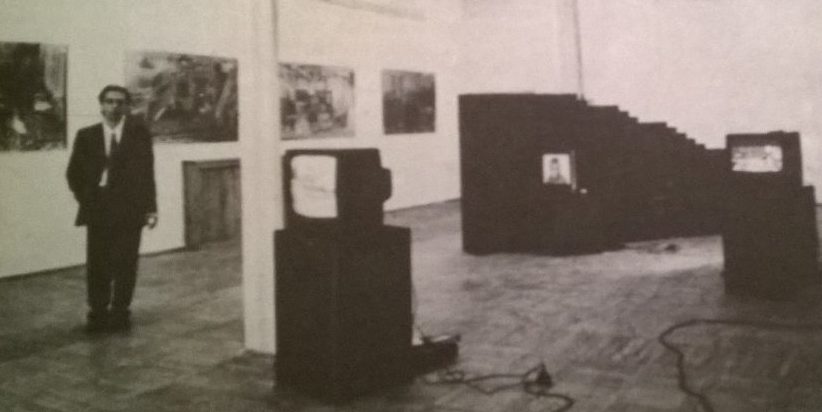
Analyzing Tsagolov’s work, art historian Kateryna Stukalova highlighted important components on which the corpus of “hard television” works is built. According to her, these are the release of corporeality (or the feeling of the physical presence of the body) and the rejection of the Primordial [6]. The latter, in her opinion, is most vividly embodied in the work “World Without Ideas”: initially, it was a series of photographs in which the artist constructs reality using an aquarium, toy decorations, and magazine cutouts; later it became a total installation-exhibition held at the UKV Contemporary Art Gallery in 1993.

Vasyl Tsagolov at the UKV Contemporary Art Gallery during the solo exhibition “World Without Ideas.” The photograph was published in the magazine “Terra incognita”
The concept of “hard television” was vividly realized in Vasyl Tsagolov’s curatorial project “Mazepa” (1995, Kosyi Kaponir). The “Mazepa” exposition consisted of a single television screen standing in the middle of the large empty space of Kosyi Kaponir [7], on which video works by Oleg Kulik, Oleksandr Brener, Hlib Vysheslavskyi, Ihor Dyurych, Anton Lytvyn, Mykola Mandrych, Artur Novikov, Oleksandr Sydorenko, Kateryna Stukalova, Oleksandr Sokolov, Oleg Sydor-Hibelinda, Olha Petrova, Yurii Khorovskyi, Illia Chichkan, Serhii Yakunin, and Vasyl Tsagolov were broadcast one after another, like TV programs [8].
Tsagolov recounts that the viewer fell into a “trap” because they could not “switch the works” and had to watch them from beginning to end. According to him, the greatest surprise and irritation was caused by Oleg Kulik’s work, who was constantly swearing from the screen [9]. Tsagolov himself presented a joint video work with Sydor-Hibelinda titled “Project of Shared Life (choreography by V. Mukhina),” created based on Vera Mukhina’s sculpture “Worker and Kolkhoz Woman.” Sydor-Hibelinda described this experience in the text “‘Mazepa’ and Others” as a postmodern unserious joke, simultaneously characterizing all mid-1990s art in the same ironic tone [10]. Kateryna Stukalova’s ironic comment on the crisis of exhibition, published in the “Mazepa” newspaper, which became part of the project, was also ironic. “Now there is no artist either. The painting has died, the installation is in agony, the performance is in intensive care,” there is only the eternal struggle of Kyiv artists with Kyiv artists and institutions over fame, money, and opportunities [11].

First page of the “Mazepa” newspaper. A4. Photograph.
Tsagolov embodied the idea of replacing reality in the work “Teleauction” (1995) [12], creating a series of news read on camera by members of the artistic community — Oleksandr Solovyov, Oleksandr Hnylytskyi, Serhii Bratkov, and others. The news texts partly corresponded to the everyday life of the time, partly they were invented by Tsagolov and invited artists. For example, in one story, the image of an ordinary Kyiv woman can be recognized as Ukrainian artist Vlada Ralko, who impartially comments to reporter Tsagolov on Oleg Tistol’s latest art project “Project of Ukrainian Money.” A viewer unfamiliar with the context could not notice the substitution and did not understand the boundary between fictitious and real. The effect was enhanced by the fact that these stories were broadcast on the Ukrainian TV channel ICTV: May 30 at 19:40, May 1 at 09:15, May 7 at 14:20. The linearity and sequence of the television announcers’ narration gave no reason to doubt the truthfulness of what was voiced. Thus, the stories from Tsagolov’s project were legitimized by the announcers’ voices and shown to a wide audience as the true course of events and “the truth of the day.”
In 1998, at the “Intermedia” exhibition (curator — Oleksandr Solovyov) at the Soros Center for Contemporary Art, Tsagolov constructed a television studio where the viewer was invited to try on the role of a TV host. The installation was created in the middle of the gallery space, which caught the viewer by surprise and forced them to act actively. In the work, the artist recreated the space of a television studio, where against the backdrop of photo wallpapers stood a table and chair for the announcer (who could be anyone from the audience), a camera aimed at the potential announcer, lights, and a television broadcasting the announcer’s speech live. In this work, Tsagolov raises the question of constructing reality, which, through the television camera and television setting, acquires the meaning of documentary. The myth of television truthfulness is debunked by the fact that behind the announcer’s back, in the landscape background, we see the back of a chair — revealing that the background is constructed in the studio and the landscape is not real but only a photograph.

Vasyl Tsagolov. From the series “Soft Horrors.” 1997–1998. Reproduction from the magazine “Parta.”
In 2002, the artist created a second version of the “Hard Television Studio” installation, abandoning interactivity. The studio was located on a high podium, adding theatricality, but the audience was no longer required to act actively — it was enough to watch passively.
Vasyl Tsagolov’s 2002 work inspired Ukrainian artist Alevtina Kakhidze to create the exhibition “TV Studios / Space Without Doors,” which took place in 2014 at PinchukArtCentre as part of the “PAC UA: Rethinking” project. In an interview with Tetiana Kochubinska, she commented on Tsagolov’s installation: “His work for me is an illustration of how a non-existent reality in a television studio can be shown as reality. And since all this is shown to the viewer, he is not deceived — the viewer gains knowledge. The most essential detail in his installation is the photograph. The photograph shown on the TV screen is unclear: was it taken in reality (from the window of the 4th floor space of PinchukArtCentre) or from the wall in the TV studio? The only element in the photograph that reveals that this reality is commensurate with the viewer’s reality is the reflection of the back of a chair on the photo. Thus, the installation has three landscapes as three realities: one landscape was taken by a photographer and processed in Photoshop, the second was made by a “drawer,” and the third can simply be seen through the window. Roughly speaking, there are three ways to consume reality”[13].

Solo exhibition of Alevtina Kakhidze “TV Studios / Space Without Doors” as part of the “PAC-UA Rethinking” project. Photographs provided by PinchukArtCentre © 2014. Photographer: Serhii Iliin
The artist, as Kakhidze says, resembles a science fiction writer who constructs reality, and the only thing corresponding to reality becomes human memory, which allows interpreting certain events. “It is impossible to create a new imaginary world or situation without having images from memory. Another question is how a person remembers reality, how long they can keep it to then combine and build new connections. We allow the idea that we can connect reality and unreality, which, in turn, can contribute to building a new reality, which is essentially what art does. Art is an invented form, an invented story. When you enter the space of art, any objects, signs, and symbols are transformed by the artist — he imagines them differently,” the artist noted[14].

Solo exhibition of Alevtina Kakhidze “TV Studios / Space Without Doors” as part of the “PAC-UA Rethinking” project. Photographs provided by PinchukArtCentre © 2014. Photographer: Serhii Iliin
In the mid-1990s, the theme of television interested many Ukrainian artists [15], but Tsagolov practically turned to television as a separate reality, under which society and reality mimic.
In the early 1990s, Vasyl Tsagolov noted that “hard television” is the essence of the 21st century [16]. Meanwhile, the digital media revolution, social networks, and new technologies that accelerate the news flow actualize the idea of “hard television” in the context of post-truth — an era of mass communication development when “objective facts become less important for shaping public opinion than appeals to emotions and personal beliefs” [17].
Notes:
[1] Tsagolov, Vasiliy. Hard Television [Manuscript]. — Kyiv, 1993. — p. 1 .
[2] ibid.
[3] Quoted from: Solovyov, Alexander. Photoshock without Photoshop / Alexander Solovyov // Art Journal [Electronic resource]. — 1999. — No. 23. — Access mode: http://www.guelman.ru/xz/362/xx23/x2322.htm (available 20.04.2018).
[4] Stukalova, Kateryna. Drifting around the Tower of Babel / Kateryna Stukalova // Courier of Music. — [1993]. — [No. ?]. — p. 5.
[5] See: Tsagolov, Vasiliy. Towards overcoming the ritual: [text for performance] / Vasiliy Tsagolov // Invitation. Kyiv, March 22, 1993.
[6] See: Stukalova, Kateryna. Drifting around the Tower of Babel / Kateryna Stukalova // Courier of Music. — [1993]. — [No. ?]. — p. 5.
[7] See: Conversation of Oleksandr Solovyov with Vasiliy Tsagolov about “Mazepa” // Parta. — Kyiv, 1997. — No. 1. — p. 49.
[8] See: Mazepa: [Newspaper]. — 1995. — February 27. — 8 p.
[9] Comment by Vasiliy Tsagolov to Kateryna Yakovlenko.
[10] Sydor-Hibelinda, Oleg. “Mazepa” and others / Oleg Sydor-Hibelinda // All-Ukrainian Gazette. — 1995. — February 4. — p. 10.
[11] Stukalova, Kateryna. As an art historian, I sincerely pity the artists / Kateryna Stukalova // Mazepa. — 1995. — February 27. — p. 4.
[12] Invitation text to the project “Teleauction. Vasyl Tsagolov’s Invasion” at the “Blank Art” gallery (March, 1995).
[13] Alevtina Kakhidze in conversation with Tetiana Kochubinska // PinchukArtCentre. — 2014. — Access mode: http://pinchukartcentre.org/ua/interviews/kakhidze
[14] ibid.
[15] Quoted from: Solovyov, Alexander. Photoshock without Photoshop / Alexander Solovyov // Art Journal [Electronic resource]. — 1999. — No. 23: Access mode: http://www.guelman.ru/xz/362/xx23/x2322.htm (available 20.04.2018).
[16] Tsagolov, Vasiliy. Hard Television [Manuscript]. — Kyiv, 1993. — p. 1.
[17] https://en.oxforddictionaries.com/definition/post-truth

Comment type: Research Platform Publications
Author: Kateryna Yakovlenko
Sources: Yakovlenko K. “HARD TELEVISION” [Electronic resource] / Kateryna Yakovlenko // Rorydor. – 2018. – Access mode to the resource: http://www.korydor.in.ua/ua/glossary/tverde-telebachennia.html.