
ANDRIY KAZANDZHIY: “WE BROADCASTED ON ODESSA TRAMS”
KATERYNA YAKOVLENKO APRIL 20, 2017 1553
Andriy Kazandzhiy, “Heartfelt Flowers”

Little is known about the artist ANDRIY KAZANDZHIY. He did not belong to an artistic dynasty and did not graduate from a specialized art school or institute. He entered Ukrainian art in the early 1990s thanks to Hennadiy Podvoiskyi and Oleksandr Roitburd. Kazandzhiy tried himself in various types of art — painting, video, installation. A large part of his creative life is connected with Dmytro Dulfan, with whom they created absurdist paintings as a duo. Kazandzhiy was an active participant in exhibitions in Kyiv and Odessa, but by the mid-1990s he moved into the field of design and now practically does not engage in contemporary art. Kateryna Yakovlenko spoke with the artist about Odessa in the early 1990s, contemporary Ukrainian art, “depainting,” and the transition to new media.
Published as part of the cooperation between the PinchukArtCentre Research Platform and KORYDOR.

Andriy Kazandzhiy, Little Ship (one of the artist’s first works). Canvas, oil
Kateryna Yakovlenko: Tell us about yourself, who your parents are, how you first connected yourself with art.
Andriy Kazandzhiy: I was born in Vinnytsia, in a family of chemical engineers, and at four years old moved to Odessa. I must say that my parents, being somewhat distant from art, were quite skeptical about my hobbies and creative pursuits. Although a refined nature, striving for beauty, manifested itself early in childhood. I drew, wrote poems, loved handicrafts, and did woodburning. The first money I earned at school age I spent entirely on paints. The passion for creativity did not leave me even as I grew older. Usually, this fades, but for me, as it later turned out, it did not. And when I turned 18, fate unexpectedly brought me together with a wonderful and very interesting person — the artist Hennadiy Podvoiskyi. He lived in a semi-ruined hut among a wild lush garden. Picturesque canvases seemed to grow from the ground along with flowers, bushes, trees. Walking through the garden, you could find a painting in the most unexpected corners. There I first tried painting with oil. To the question “Gena, where did the paints come from?” he answered: “They fell from the sky!” That was the whole Podvoiskyi!

Hennadiy Podvoiskyi
A huge number of people came to Podvoiskyi. Listening to Gena was a special pleasure. He spoke in his metaphorical language, incredibly figuratively, often paradoxically, delving into and bringing us closer to the very essence of things. Probably, he became my first guru, my mentor.
There I also met Sashko Roitburd. And it can be said that from that moment I “joined the ranks” of young Odessa artists, whose guiding and directing force was, undoubtedly, Oleksandr Roitburd.
Although, of course, one must also mention Yuriy Chebotar. An incorrigible enthusiast, director of the Odessa rock club, he provided young musicians and artists with opportunities for self-expression. One of such cultural underground places was the bomb shelter on Lev Tolstoy Street, which simultaneously housed rehearsal spaces and studios of young artists. And until the late 1980s, I played in my own rock band, painted pictures, and made objects and installations.
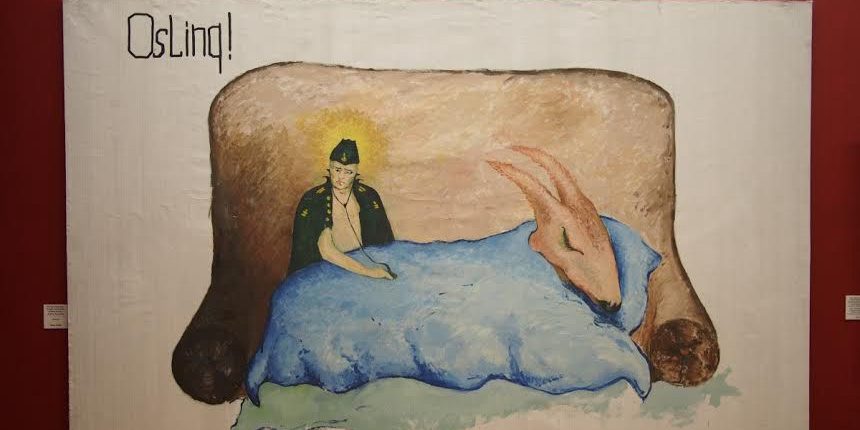
K. Y.: Your early work is known to many for the painting “Osling!”, created together with Dmytro Dulfan. How did your duo come about? How did you work with images?
A. K.: Besides the bomb shelter basement, Odessa had several iconic places. One of them was the legendary cafe “Zosya.” There we met Dima Dulfan. We were united by youth, the desire to create, communicate, exchange ideas, and make something. I often came to Dima’s studio, and during our conversations, ideas arose that we wanted to realize. That’s how “Osling!” was born. It emerged at the intersection of the then-popular children’s and medical discourses with penetration into taboo zones. After “Osling!” several similar works were created. They were united by postmodern irony, schizo-narrativity, and maximal hermeticism of meaning. It was a rather bright and productive period of our joint creativity, yielding many good results. But Dulfan’s studio, where his father — the famous nonconformist artist Lucien Dulfan — had worked earlier, gradually became a psychedelic art object itself, transforming into the “Laboratory of Meaning.” For a while, we abandoned painting practice, becoming its regular lab assistants.
Later, together with Serhiy Bakumenko, leader of the “Dead Theater” association, under the guise of working on a TV program, we engaged in experimental video art and weekly aired the TV show “Callipso.” The program was not only a cover for our “subversive” artistic activity but also an excellent representative platform: thanks to TV we gained access to a large audience. At that time, we really wanted to find not only our TV viewer but also a radio listener. With the artist Ruslan Rubansky, we carried out the project “Radio Station ‘Inner Voice.'” We broadcasted on Odessa trams. We arranged with the driver (usually female drivers who found it hard to resist the charismatic appearance of the artist Rubansky), they handed us the microphone and loudspeaker, through which stops were announced, and we read our postmodern texts to the passengers.
By that time, Dima Dulfan had fully taken the side of Light and was creating surreal light objects and installations, fantastic lamps. Neon tubes and lasers were used. The studio smoothly transformed from a temple of painting into a realm of applied psychedelia.
A few years ago, Dima Dulfan and I made another joint work. It was a yin-yang symbol laid out from socks. The work was called “The Path.” Perhaps it is a dedication to that segment of the creative path we went through together. Later it was exhibited at the National Art Museum of Ukraine in the exhibition “ENFANT TERRIBLE. Odessa Conceptualism.”

Dmytro Dulfan, Andriy Kazandzhiy, 2013, The Way of Dao, canvas, socks, paint, 70 × 70 cm
K. Y.: Please tell us about your individual work. What themes concerned you?
A. K.: It is difficult for me to talk about my work and the methods of its creation. They are quite irrational. I almost never created works by a mathematical laboratory method, calculating them, refusing something during the process, adding and bringing something new. Although, undoubtedly, this is the true exciting process of creativity, a creative experiment.
My ideas, and sometimes even finished images of works, came from nowhere. Paintings, objects, installations… Sometimes these were entire personal or collective exhibitions with many absolutely different works made in various techniques and materials with detailed elaboration. I could only marvel and try at least imagine how boundless our imagination is. Sometimes it seemed to me that someone else, not I, was the author of these works. Therefore, I never signed them. Techniques were often very diverse. Form was, in a sense, secondary for me. I remember how we, young artists, gradually left the plane of the painting, where it seemed cramped within its limits and frames. So, at first, dioramic elements appeared in the works, when the painting played the role of a picturesque backdrop, a decoration for the object, and then I completely abandoned painting and started doing installations. One of them was “Meditative Cabin.” It was a small room lined with felt and artificial fur, covered outside with rather vulgar photo wallpapers with views of a waterfall. Inside, relaxing music played à la the movie “Emmanuelle.” A kind of island of relaxation right at the exhibition. Each visitor could isolate themselves, admire the waterfall views, stroke the fur, listen to music, and perhaps understand at that moment that art, including contemporary (which often shocks and is uncomfortable for perception), can also be beautiful.
In 1993, I moved to Moscow, where I began studying computer technologies at the New Media Laboratory. I participated in the group exhibition NewMediaTopia with the installation “Bonfire” and mastered computer graphics. So, probably, this was the smooth transition from the contemporary art environment to computer design, which became the main means of my creative self-expression and still is.

Installation “Bonfire”
K. Y.: What was the cultural environment in Odessa like in the 1990s?
A. K.: It was a time rich in cultural events. A large number of successful works were made during this short period. Many exhibitions were organized. The central exhibition venue was the Museum of Contemporary Art “TIRS,” whose chief curator was Rita Zharkova (Margarita Zharkova (née Sheshatska; 1939–1998) — artist, critic, graduate of Odessa “Art Graphic,” student of artist Yuriy Yehorov, wife of Oleksandr Anufriyev, mother of Serhiy Anufriyev. — Ed. note.). Contemporary art exhibitions were also held at the Odessa Art Museum, where Mykhailo Rashkovetsky worked at the time, actively participating in creating the city’s contemporary cultural background.
A whole generation of new young artists appeared in Odessa, some of whom became bright stars of the Ukrainian and international art scene. These include Husev, Hankevych… Not to mention such a master, a living classic, as Oleksandr Roitburd. In many ways, thanks to him, at the turn of the 1980s and 1990s, a cultural situation arose in Odessa that served as a starting point for the development of contemporary art for many years ahead, when new young names of a later wave began to appear on the orbit of Soviet art. His apartment on Shchepkina Street was the city headquarters of the cultural, psychedelic, and sexual revolution for many, many years. Of course, he set not only the artistic and ideological vector for our young community, which aspired to “great” art (even the CAMUNITY — the poetics of existentialism then raged in our heads and young hearts), but also influenced each of us in one way or another. Sometimes I thought the reason was Sasha’s artistic and pedagogical education, the talent of a mentor, and his sincere love for youth. I remember an incident when — and this is no exaggeration — Sashko changed the course of my fate. It was 1991. I graduated from the economic institute and had to somehow decide on life. I was even going to work in a bank by profession. If Sasha hadn’t said to me once: “Well, look at yourself. What the hell bank? You are an artist!” This significantly influenced my choice of future profession. He was very interested and always found new young and talented artists, for whom such acquaintance became the beginning of their artistic career.

1991–1992, Andriy Kazandzhiy, Ihor Husev, Serhiy Bakumenko, Volodymyr Nessi. Photo provided by Andriy Kazandzhiy
Speaking of the 1990s, this time is remembered by me as an amazing synergy. We, then young artists, were part of one family. We lived almost together, inseparable. We worked together, communicated, wrote texts, pondered, shared ideas, theorized. Many, including myself, worked collaboratively. What united us? A lot — shared visual practices, fanatical passion for contemporary art, and probably most importantly — sincere deep sympathy for each other.

Andriy Kazandzhiy, early 1990s, Katya’s Eyelashes, canvas, oil, 150 × 100 cm

Dmytro Dulfan, Andriy Kazandzhiy, 1990, Lyopa Died, canvas, oil, 200 × 300 cm

Dmytro Dulfan, Andriy Kazandzhiy, early 1990s, Tarakhtyt, canvas, oil

Dmytro Dulfan, Andriy Kazandzhiy, 1991, Baby, canvas, oil, 195 × 148 cm
K. Y.: You often visited Kyiv and stayed at the “Paris Commune.” How did this influence your creativity?
A. K.: The first time I had to come to Kyiv was around 1990. With Dima Dulfan, we brought the painting “Osling!” It was taken to some official republican exhibition (I no longer remember what kind of exhibition it was), and the painting had to pass the art council. For some reason, we thought that much depended on its decision in our careers as artists and that now could be the beginning of our rise to success.
The painting was large, 3 × 2 meters. Arsen Savadov and Oleksandr Roitburd carried it to the art council together. The fact that they represented our painting before the art council undoubtedly played a decisive role. We ended up in the exhibition, although it might not have happened with a high probability. The reaction of the art council members (judging by their respectable age and representative appearance, they were recognized masters of the academic school) ranged from nervous laughter to mild cultural shock. It was visible on their faces. But overall, they treated us quite kindly, probably attributing everything to our adolescent hooliganism.

Dmytro Dulfan, Andriy Kazandzhiy, 1991, osling!, canvas, oil, 300 × 200 cm
Then I came to Kyiv many times. Mostly these were group exhibitions in which I participated — “Shtyl,” “Leto,” “Space of Cultural Revolution.” But there were also quite spontaneous trips. I remember at the Odessa station we saw off our artist friend to Kyiv. At the last moment, we jumped on the train’s step and went with him. We stayed for a week at the “Paris Commune,” then also returned back.
“Parkomuna” was an absolutely open space for communication and interaction. We were always sincerely welcomed there. Perhaps that’s why we wanted to come there again and again. Communication was always pleasant and useful. We saw new works of artists among the first. We gained impressions, learned to think differently. Of course, all this had a very powerful influence on us.
Some Odessa artists lived and worked at “Parkomuna” for some time. Serhiy Anufriyev, Dmytro Ligeiros… I was lucky to work in Arsen Savadov’s studio, which was located nearby on Sofiivska Street. He was leaving and left me the studio for a whole month. It was summer. I got up early. Walked through the quiet, almost deserted center, descended to the Dnipro River. Worked during the day and visited “Parkomuna” in the evenings. That’s when I fell in love with this beautiful city and still love it.
The result of my creative “business trip” in 1992 was six paintings created for the exhibition “Suspicious Reality,” which took place that year at the Museum of Contemporary Art “TIRS.” Together with Anatoliy Hankevych, I was co-curator and participant of this exhibition. The exhibition also featured works by other young Odessa authors — Ihor Husev, Oleh Mighas, Volodymyr Yakobchuk, Yevhen Heraskinin.
K. Y.: I’m curious, how did Arsen Savadov and Oleksandr Roitburd defend your work before the art council, what did they say?
A. K.: I think these are residual phenomena of the old artistic-nomenclature system, which was living its last days at that time.
“Cleopatra’s Sorrow” was painted in 1987. It was a revolution in Ukrainian contemporary art. I don’t think all this went unnoticed and no one knew about Arsen Savadov. Moreover, about three years had passed since then.
Roitburd was also a notable figure. He participated in many republican exhibitions and began working in the early 1980s. And, as I said, Roitburd did a lot to promote young authors. Further proof is that he and Savadov — two already well-known artists — represented our work. Perhaps it was an advance of trust from them and a desire to support us, beginner authors.

Andriy Kazandzhiy, 2013, Just Add Water, paper, tea bags, ink, 10 × 13
K. Y.: What was the reaction of the Kyiv and Odessa public to these exhibitions, to your works? Did it matter to you?
A. K.: At that time, the population was mostly engaged in accumulating initial capital, and no one cared about art. Especially contemporary art, whose perception requires some preparation and knowledge of cultural codes. Therefore, exhibitions were organized by artists for artists and their close friends. It was a kind of closed club. Later, after 10–15 years, interest in contemporary art became fashionable and elite, and respectable audiences flooded the halls.
K. Y.: You stepped away from art in the mid-1990s, as did many Ukrainian artists who stopped painting. Some returned, but you did not. Why?
A. K.: A difficult question. There are other examples in my memory. But perhaps I would answer with Bernard Shaw’s words: better never than late. I laugh, of course. And I hope not for the last time…
Sources