
“THE WILLFUL EDGE”. ART THAT USES SURZHIK

“The Willful Edge of National Post-Eclecticism” (“The Limit of Efforts of National Post-Eclecticism”) is an unwritten artistic program proposed by artists Oleg Tistol and Kostyantyn Reunov in 1987 — at the turning point of aesthetic, social, and political changes in the USSR. The creative ideas that formed the basis of the program arose among the artists during their service in the military unit Makarov-1 in Zhytomyr region, where both served their conscription.
The essence of the program was the struggle for the beauty of the national stereotype. More precisely, the artistic strategy of the artists was described by Kostyantyn Akinscha, who defined the work of Tistol and Reunov as nat-art — art that uses surzhik: “Reunov and Tistol use not so much clichés of national culture as a peculiar subculture characteristic of eastern Ukraine, which can be defined as the culture of surzhik. […] However, surzhik is not only a language. It is also a falsified history, filled with clichés, and a lush blossoming of national kitsch. It is both a chestnut candle, a girl in a wreath, and thousands of meters of canvas spent by Kyiv artists depicting ‘Kyiv slopes,’ and landscapes of ‘Picturesque Ukraine’”[1].
The term “national” is important for understanding the artists’ work, as the myths and symbols of both Ukrainian and Russian cultures (as well as Soviet mass culture) formed the basis of their artistic language and formal searches. Later, in an interview with Radio Svoboda, Oleg Tistol noted: “It was no coincidence that the word ‘national’ was there — not to be confused with nationalist. It means that we felt responsible for creating the so-called new cultural brand. It was semi-ironic and at the same time serious. I am responsible for everything. […] I am very sensitive to questions — culture as a real process and culture as imitation”[2].
Reunov, in turn, explained: “Like every new generation, we strive to create something new, and we see this new in a significantly different level of visual means with citation and largely eclecticism of various layers of contemporary classical art culture, relying mainly on the classical painterly mode of expression. In this regard, it is important to decipher the thesis ‘struggle for the beauty of the stereotype.’ By confronting various cultural stereotypes as the brightest ideas of what is ‘beautiful’ in the debate about beauty, we strive to realize and perhaps create a qualitatively new stereotype. A stereotype as a compressed system of values of a new idea and, accordingly, new art. On the one hand, every artist works with classical culture, and on the other — brings new elements and forms, means of expression, and also forms new ideas”[3].
Kostyantyn Akinscha considers the work of Tistol and Reunov as something revolutionary in Ukrainian art. Moreover, he ironically distinguishes between the concepts of “украинская волна” (Ukrainian wave) and “українська хвиля” (Ukrainian wave), attributing the former to postmodernists such as Savadov, Senchenko, Holosiy, and Hnylytskyi, who work with the heritage of European culture (referring to the Ukrainian version of transavantgarde), and the latter — “The Willful Edge,” focused on the local component and working with Ukrainian cultural codes. If the “wave” had already happened, then the “wave” at the time of writing the article (1989) was just beginning to form and develop.
The first works that can be considered created under the influence of these ideas date back to 1984 (the year Tistol first addressed the project “National Money”) and 1987 (Reunov’s first “post-eclectic” works, his use of oilcloth instead of canvas). A characteristic feature of both artists is the excess of symbols and myths. The paintings literally break down into life anecdotes, fables, and fabrications. One of the brightest themes of this period, which became relevant during the political crisis in the Soviet Union, is Russian-Ukrainian relations. In Kostyantyn Reunov’s painting “Winners Are Not Judged. To the Great Russian People from the Great Ukrainian People” (1988), a Russian man, drunk on vodka, has fallen to the ground, but this does not prevent him from crawling toward another portion of alcohol. Reunov pictorially embodied this theme by depicting the hero from behind, that is, with his back to the viewer, and placed a Russian vodka label above his head. In Tistol’s work, the theme of Russian-Ukrainian relations is most vividly embodied in the painting “Reunification” (1988).

From left to right: reproduction of the work “Winners Are Not Judged. To the Great Russian People from the Great Ukrainian People” by Kostyantyn Reunov (1988) and “Reunification” by Oleg Tistol (1988)
While Reunov largely borrowed images from pop art, Tistol drew inspiration from historical subjects, for example, addressing the theme of Ukrainian Cossacks. It is the attributes of the Cossacks — numerous bulavas, Cossacks, horses, zhupans, sabers, etc. — that fill his paintings with additional meanings. Themes of historical betrayal and alliance became traditional for Tistol’s work.
In 1987, the artists participated in the exhibition “Kyiv—Tallinn,” where their “post-eclectic” ideas were shown for the first time in the Ukrainian SSR. That same year, both artists took part in the Soviet-American exhibition in Kyiv.
At the end of the 1980s, together with artists Maryna Skugaryova and Yana Bystrova, Tistol and Reunov moved to a Moscow squat on Furmanniy Lane. They were joined by a young artist from Mykolaiv, Oleksandr Kharchenko. In 1988, a large exhibition of contemporary art “Eidos” took place at the Moscow Youth House with the participation of Tistol and Reunov. That same year, at one of the Moscow exhibitions, they met Olga Sviblova[4], who was then working as a television journalist and was interested in contemporary art. The works of the Ukrainian artists impressed her so much that she took up promoting their work.

From left to right: photograph of the artists from the exhibition “Kyiv—Tallinn” (1987), published in the magazine “Ranok”, and the poster of the “Eidos” exhibition in Moscow (1988)

In the exhibition “Ranok” – “Nyamunas”. Kyiv. 1988. Illustration from the magazine “Ranok”. Photo by Yuriy Sklyar.
Although the program of “The Willful Edge” was never formalized in writing as a manifesto, it was realized in an exhibition format in 1989 at the “Kashirka” exhibition hall in Moscow, where works by Tistol, Reunov, Kharchenko, Bystrova, and Skugaryova were displayed. Archival materials about the exhibition are now considered lost.
The period from 1989 to 1991 was rich in exhibitions for the artists. Among the most notable projects was the exhibition of “Furmanniy Lane” in Poland. In 1990, at the Central House of Artists in Moscow, Tistol and Reunov held a joint exhibition “Act of Artistic Resistance.”

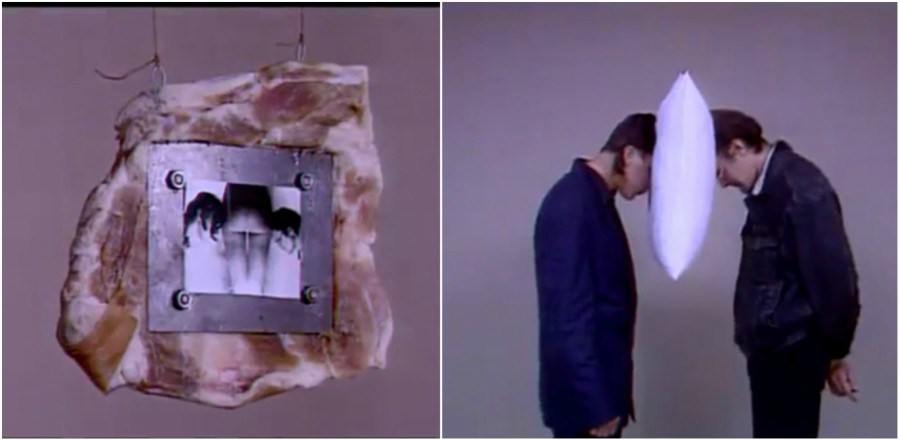
Screenshots from the video “In Search of a Happy Ending” by Olga Sviblova.
“We oppose everything: nature, wind, social reality, the artistic situation before us, the artistic situation after us, the artistic situation inside ourselves — and we derive pleasure from this, elevating the moment of resistance to reality to an artistic level and when reality and resistance to it turn into an artistic object”[5], — commented Reunov on his project.
Unlike previous projects, where ideas of resistance were primarily and mostly embodied in painting, this project under Sviblova’s curatorship included, besides painting, installation and performative components. The exhibition space was divided into several parts, in one of which Reunov and Tistol took turns and together hit their heads against a brick wall on a total installation made of pillows and photographs.
“Act of Artistic Resistance” became one of the first projects conceived within the framework of the joint-stock company “Art of the End of the Century” created by Sviblova. Sviblova described her ideas about the company’s activities and its future projects in the article “In Search of a Happy Ending,” published in the magazine “Rodnik.” Advertisements for the company also appeared in other printed publications. Reunov and Tistol became co-directors of this institution, and the phrase “In Search of a Happy Ending” (the title of Reunov’s series of paintings and Sviblova’s curatorial project) became part of the company’s trademark.

In the program text, Sviblova wrote: “Participants of ‘The Willful Edge’ formed the joint-stock company ‘Art of the End of the Century’ for global development and the fastest implementation of the project ‘In Search of a Happy Ending.’ […] But again, Ukrainians were saved by a sense of humor, southern vitality, and, of course, the special tactility and sensuality characteristic of Ukrainian culture in general and visual arts in particular. Profaning the theme, ‘The Willful Edge’ creates new stereotypes of ‘totalitarian, political, and intellectual erotica.’ The great game of ‘The Willful Edge of National Post-Eclecticism’ is in full swing”[6].
The joint-stock company’s program, designed for ten years, was to function until 2000. Sviblova commented on the project’s idea as follows: “In the era of totalitarian reflexivity, which permeates all spheres of human activity today, including art, double reflexivity, that is, artistic reflexivity of reflexive postmodernist art and the postmodernist cultural situation, may help to break through beyond the dominant postmodernist paradigm”[7]. According to her, the goal of this company and its activities is a “sacrifice” in the name of the birth of new art of the next millennium.

Olga Sviblova and Oleg Tistol. Moscow, 1990. From the private archive of Maryna Skugaryova and Oleg Tistol.
However, after 1991, “The Willful Edge” practically ceased to exist. Political and personal changes in the artists’ lives separated them. In 1991, Maryna Skugaryova and Oleg Tistol became fellows of the Swiss Christian Merian Stiftung program, after which the artists returned to Kyiv. Bystrova moved from Kyiv to Paris. Reunov, together with Avdey Ter-Oganyan, became a curator of a gallery on Tryokhprudny Lane, engaged in activism, and later moved to London, where he lived until 2000. Oleksandr Kharchenko moved to Kyiv, worked independently for some time with digital media — photography, video, etc. He also collaborated with Tistol and Matsenko, and from the mid-1990s — with Arsen Savadov, with whom he realized several photographic projects, including the famous series “Donbas–Chocolate.”

Oleksandr Kharchenko. 1990. In the Shadow of Glory. Canvas, oil. From the catalog “Flash|Вспышка/Спалах.”
The name of the artistic program “The Willful Edge of National Post-Eclecticism” became associated with the two active participants and implementers of the idea of the struggle for the beauty of the stereotype — Tistol and Reunov. The work of Bystrova and Skugaryova fell under this characterization due to their proximity to the “post-eclectics.” Thematically and aesthetically, their works did not quite meet the requirements of “The Willful Edge,” as both artists realized their own mythology and their own searches and experiences. Early work of Oleksandr Kharchenko is closely connected with the ideas of Tistol and Reunov and noticeably resonates with their paintings. However, this period in Kharchenko’s work ended already in the early 1990s, when the artist turned to other themes and worked mainly with the theme of corporeality in art.
A peculiar rebirth of the ideas of “The Willful Edge” took place within the framework of the joint work of Oleg Tistol and Mykola Matsenko and was established in the artistic program “Natzprom,” which declared its task to work with national history and cultural heritage.
Notes:
[1] Akinscha, Kostyantyn. The Poetics of Surzhik, or Chicken Kiev // Decorative Art. — 1989. — No. 3.
[2] https://www.svoboda.org/a/28486230.html
[3] Babylon. [Exhibition Catalog]. — 1990.
[4] Olga Sviblova (b. 1953) — curator of contemporary art, art critic, Doctor of Art History, professor. Initiator of the Moscow House of Photography (now Multimedia Art Museum). In the late 1980s, she worked as a TV reporter, creating programs about contemporary art.
[5] TV program “In Search of a Happy Ending” Author — Olga Sviblova. 1990.
[6] Sviblova, Olga. In Search of a Happy Ending // Rodnik. — 1990. — No. 5 (41). — P. 42.
[7] Sviblova, Olga. Art of the End of the Century // Vernissage. — 1991. — No. 2 (October 25). — No pagination.

Comment type: Research Platform Publications
Author: Katerina Yakovlenko
Sources: Yakovlenko K. “THE WILLFUL EDGE”. ART THAT USES SURZHIK [Electronic resource] / Katerina Yakovlenko // Korydor. – 2017. – Access mode: http://www.korydor.in.ua/ua/stories/mistetstvo-jake-poslugovuyetsya-surzhikom.html.