
In the preface to the Russian-language version of Renata Salecl’s book “(Per)versions of Love and Hate” (“(Из)вращения любви и ненависти”), Viktor Mazin writes about sexual and national identification after the collapse of empires. In particular, he says that “identity is (re)formed within a certain community… The discourse of the community includes ‘its own’ smells, ‘its own’ music, ‘its own’ films, ‘its own’ preferences in architecture and interior design, its own piercing, etc. Outside the discourse, there is no identity” [1]. So what was the Kyiv artistic discourse at the end of perestroika? Which books, music, films shaped it? As before, Moscow magazines about culture, European and Soviet cinema, rock music were relevant, but all this could not fully satisfy the artistic environment, which felt a lack and need for different knowledge. It is precisely this lack that Renata Salecl emphasizes. She writes that a person does not believe in the normative ideals offered by society and therefore becomes the creator of their own identity. Essentially, the subject interacts with the traumatic nature of lack within themselves and in the Other [2].
Artists of the “Paris Commune” circle declare their otherness, in fact — another identity, which, in their opinion, was formed in the community (in opposition to the “Soviet person”) thanks to knowledge — read books, samizdat, Western cinema and music, acquaintances with the Western world, which they were able to join, unlike the philistines.
In this ambivalent situation, where Soviet cultural codes operated simultaneously with the emergence and transformation of Western culture, a peculiar bodily hybrid is formed, capable of adapting to new forms. Therefore, it is quite understandable that, addressing the theme of corporeality, artists use an androgynous form: their heroes have both female and male traits.
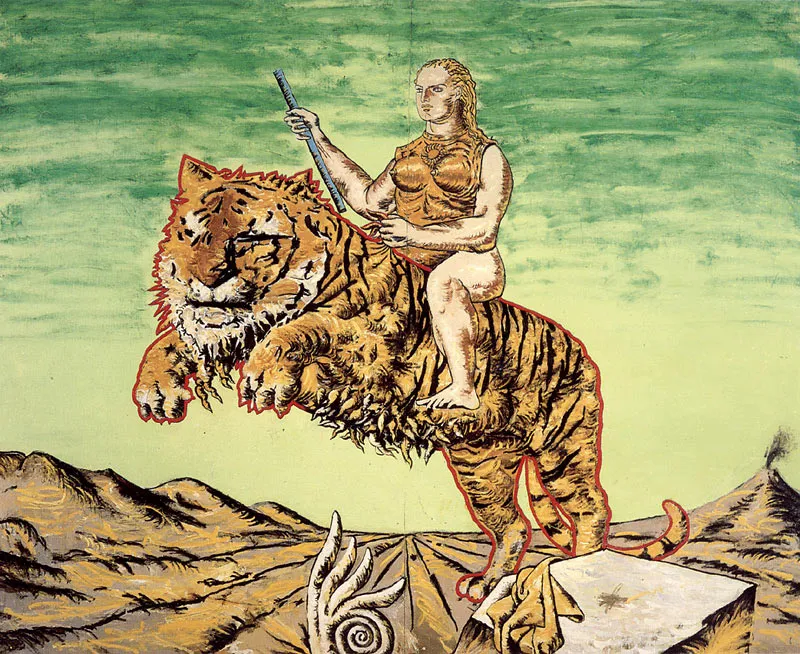
Such, for example, is Savadova-Senchenko’s “Cleopatra,” about whom many texts have been written. Her masculine female body resembles images of Soviet women — heroines of socialist realism, who work at a lathe or in the field (or with children), with a body covered by work clothes, or after work in the bathhouse, with strong “meaty” legs and arms and a steel gaze. In her image, female and male intertwine, creating a peculiar Soviet androgyny — a “new type of person,” to which historians’ books are dedicated, including those by Stephen Kotkin, Sheila Fitzpatrick, Elliot Bornstein, and others.
Cleopatra is a strong, textured woman with a body structure characteristic of Soviet imagery: her legs, like trees, are thick and massive. The heroine’s face is also not “feminine,” distinguished by a straight profile. Her light hair is combed back. The Egyptian queen is belligerent; she is ready to rush forward — in this pose, she froze before the viewer. It seems the tiger she has saddled is ready to attack the viewer and tear them apart at the first command.
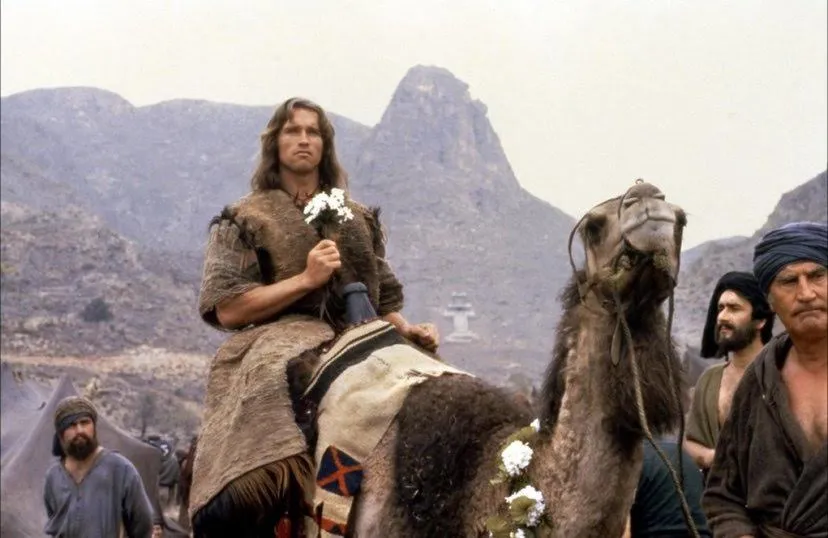
This female image becomes iconic. This Cleopatra is whole and monumental. Her masculine body, like that of Soviet working women, can quite be compared to Arnold Schwarzenegger’s character in the film “Conan the Barbarian” (1982). A similar body structure and even hairstyle create a fully justified analogy.
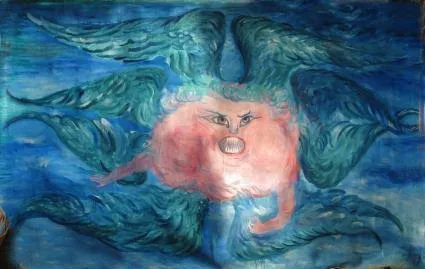
But already at the end of the 1980s, the characters in the paintings begin to lose their integrity. Such a transformation can be analyzed from the perspective of biopolitics theory and Michel Foucault’s theory of sexuality, who spoke about the inseparable connection between the political and social — the person, their behavior, corporeality, and body. During periods of political change and instability, characters acquire the same instability in their depicted bodies. They only seem whole externally; in reality, they are collages that partly create an androgynous, asexual image combining different elements — living and non-living, human and animal. Such a body can be shapeless and amorphous. Such are Valeria Trubina’s “Cherubs” (series “Cherubs,” 1989–1991; various sizes) and Oleksandr Hnylytsky’s “Zephyr” (“Zephyr,” 1990; canvas, oil; 300 × 200 cm). The “Curly bodies” of Trubina’s characters are airy and voluminous. They seem soft and pleasant but absolutely shapeless, often resembling chewing gum.
Unlike these characters, the bees and elephants often depicted on Oleg Holosiy’s canvases seem fully formed and clear. However, looking closely at their images, one can see the faces of real people, including Holosiy himself. Thus, these are not animal characters but people hidden in insect bodies.
Oleksandr Klymenko, on the contrary, deprives his characters of faces or heads, often replacing body parts with inanimate objects (for example, a pole or a lantern) or, say, covering the face from the viewer by immersing them in shadow. According to Freud, if faces emphasize that they are unknown, that their names are forgotten, these are mostly very close people. At the same time, the psychoanalyst interprets the head as a phallic symbol. Thus, depicting characters without a head or hiding it symbolizes castration [3].
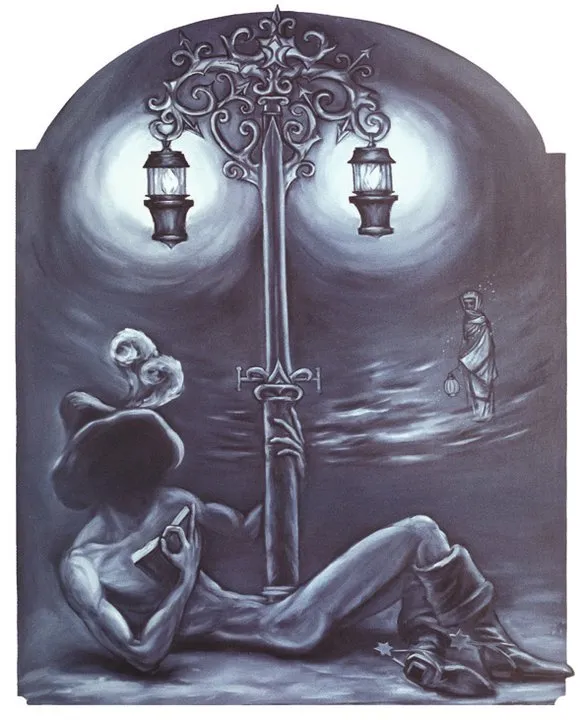
“The Secret Light of Knowledge.” 1991. Canvas, oil
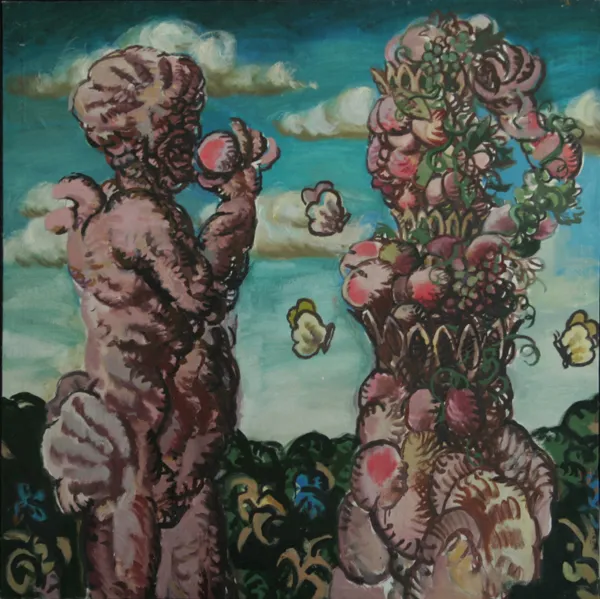
“Discussion about the Secret.” 1988. Canvas, oil
Oleksandr Hnylytsky interprets corporeality especially interestingly. His heroes of the late 1980s can consist of apples or other objects (“Discussion about the Secret,” 1988; “Arrows of Love,” late 1980s — early 1990s) or, say, have stone-wooden features (“Heroic Canon,” 1988).
In “Discussion about the Secret” [4], the bodies of Adam and Eve consist of apples, and by tasting the “forbidden fruit,” they actually traumatize their own flesh. Compared to these “self-destructive” characters, the heroes of the painting “Heroic Canon” look whole and strong, practically rooted in the ground. However, trees also have aging and obsolescence, so no matter how stable these heroes seem today, they can also deteriorate over time.
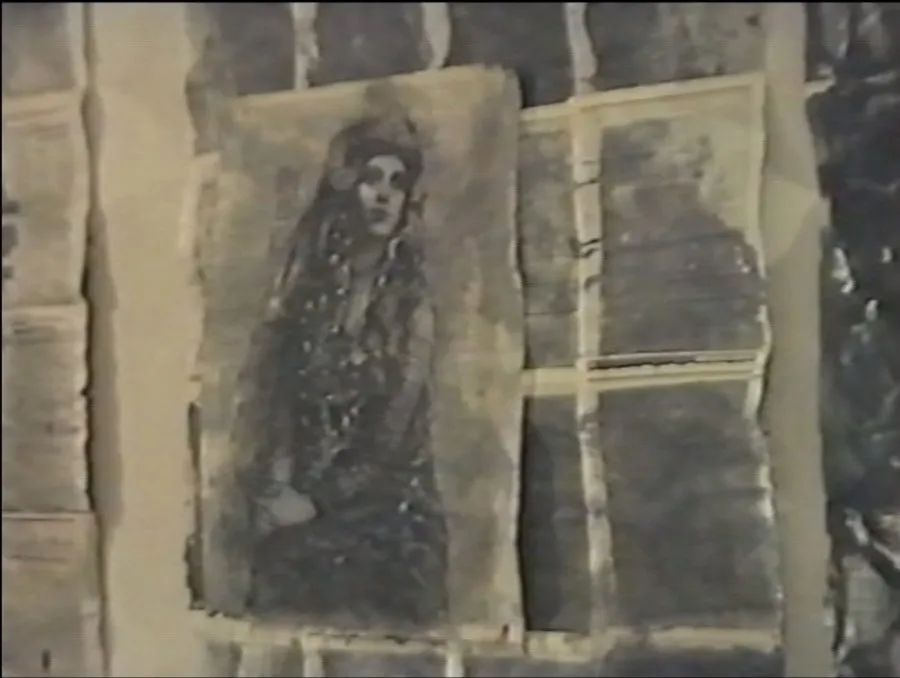
In 1992, at the “Calm” exhibition, Kostyantyn Maslov showed his graphic series, where images were created over newspaper strips. They were exhibited on the wall next to each other or on top of each other, with different images and plots mixing into one large blot.
In fact, this “wear and tear” of form (newspaper) and content can be justified by the equally “worn” state of the art school, which needed change and reflection. It is precisely in this “wear and tear” that social neurosis and fear of the future and present are reflected.
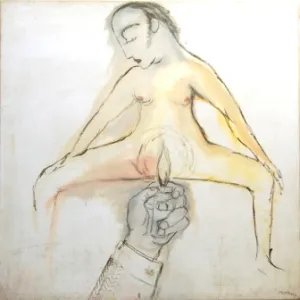
“Lighter.” 1992. Canvas, oil
Formlessness as an important feature of corporeality in the art of the late century was noted by art historian Lesya Smyrna in the article “Ukrainian Art of the 1980s — early 1990s: from retrostylistics to ‘national polystylism.'” According to Smyrna, “the art of the Ukrainian transavant-garde today can be called a new page in the world ‘teratology’ (the science of monsters), with their images of ghosts, monsters, aliens, mutants. Their main feature became a certain amorphousness of form, or, in other words, a form that is in the process of becoming and searching for itself. Later, this formlessness became almost canonical for transavant-garde art and defined a kind of prototype of national consciousness, which is involved in a state of uncertainty that is only forming its national mentality” [5].
However, it is not worth agreeing that these characters are monsters or creatures. They rather resemble freaks, circus artists of the late 19th century. In popular culture, images of freaks were often introduced to emphasize the moral beauty of heroes [6]. In “The History of Disability” [7], Umberto Eco describes the history of the rehabilitation of the “ugly” and its introduction into the field of aesthetics, beauty, and symbolism. Eco writes that the Christian world reached a true “rehabilitation” of monsters in connection with the pancalistic worldview (justification of the Ugly within the framework of the all-encompassing beauty of the world, where disabilities and Evil acquire the same value as chiaroscuro in the image, because the harmony of the whole is revealed in the proportion of light and darkness) [8]. Analyzing the history of disability and beauty, Eco shows that beauty becomes the only value, so life turns into a kind of work of art. Symbolic death, wear, and fragility are important categories of creating and understanding beauty and the world. All this also found its reflection in the themes of artists of the Parkomuna circle.
The character of Valeria Trubina’s “The Cat is Wounded and Walks, the Dog’s Ear is Chewed” can also be androgynous, where female and male are depicted as opposing principles. The heroine of Kyrylo Protsenko’s “Lighter” is also androgynous. At the center of the painting is an image of a naked woman in a provocative pose. It might seem like an erotic image, but the woman evokes the opposite reaction — rejection. Her face is unnaturally blue.
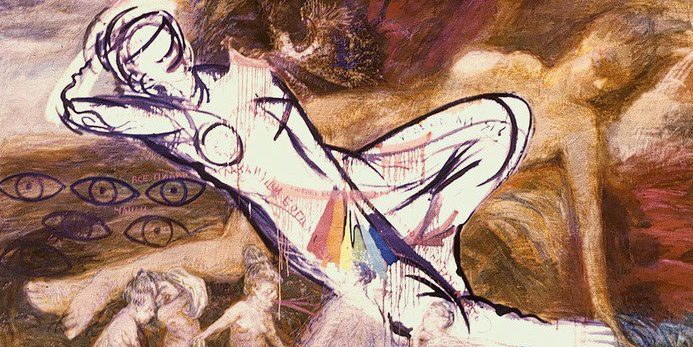
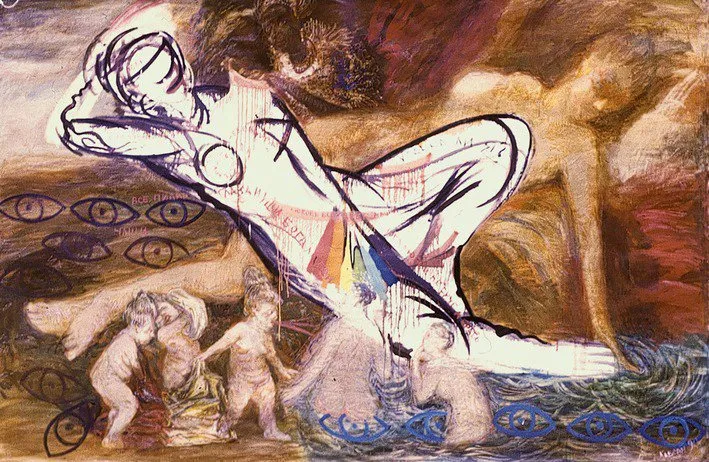
The character of Dmytro Kavsan’s painting “Am I Not Susanna?” is Giorgione’s “Sleeping Venus.” Describing the image of the famous painting by the well-known Italian Renaissance painter, Mykhailo Ivanov notes in it “the ideal harmony of the human body at the center of the universe… ideality and sensuality — equally possible intentions of the ideal female body, which simultaneously demonstrates itself” [9]. The author points to the ambivalence of the heroine: “the hand covering the goddess’s womb refers to the familiar tabooed ‘covering of the body’ from antiquity […] By emphasizing the female womb, the symbolic gesture can be read simultaneously as a taboo sign and as a seductive hint. […] The sensual challenge is complemented by the hand thrown behind the head — a gesture that opens the body to the thirsty male gaze” [10].
If the Renaissance Venus covers her womb with her hand, then Kavsan’s “Venus” is “covered” by a rainbow flag, which appeared on the painting not by chance — a symbol of the LGBT movement fighting for its rights. Kavsan’s heroine’s image is quite schematic: we see a white body, uneven breasts. This schematic body is painted over another naked nature. At the bottom of the canvas are dwarf naked figures with Rubenesque forms.
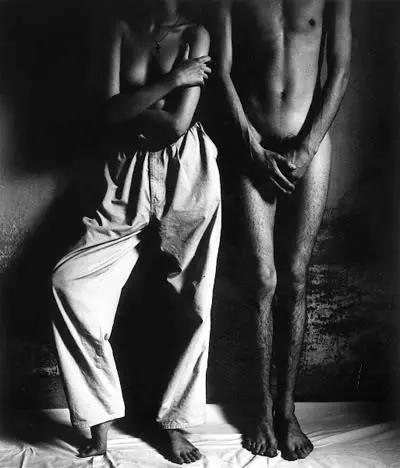
Most often, photographer Mykola Trok worked with the androgynous body. He created his images based on “living collages” — a combination of female and male bodies, for example, the naked slender young body of Viktoriya Parkhomenko and the hairy hands of Kyrylo Chychkan.
With the appearance of video salons and VCRs in the early 1990s, the perception of the body and its image changed. Artists did not just duplicate film images — their paintings became freeze frames from movies. Working with video, Illia Chychkan created “video painting,” where the images of characters seem damaged by glitch (a sound and visual impulse that arises as interference in recorded video).
In the article “Questions of Cultural Identity” (1992), Stuart Hall raises the issue of identity. Referring to Lacan and his “mirror stage” [11], Hall emphasizes that the formation of the child’s “I” through the gaze of the Other is accompanied by their inclusion in other systems — language, culture, and the system of sexual differences. The process of cognition occurs together with experiences and feelings (love, hate, fear, etc.), which are key in the “unconscious formation of the subject.” All these emotions lead to the “splitting” of the “I” and remain with it for life, forming the subject’s identity. Hall argues that identity is gradually formed during unconscious processes and its unity is somehow “imaginary,” phantasmatic. In his opinion, identity always remains unfinished, constantly “in process,” continuously “forming.” Therefore, both male and female traits of the “I” always remain in the subject, finding various unconscious expressions in adult life [12].
The uncertain political and social state of the late 1980s transitions into an even more uncertain and unstable 1990s, when a new political state with a new economic model was being created, which still relied on old rails.
The years 1990–1991 are a corridor between the past social canon and new ideas. In the film “Miss Peregrine’s Home for Peculiar Children” (2016), this corridor separated the magical world and the real world, the past (which can repeat) and the present. Such corridors were caves, a circus, a room in a supermarket. The art of the “Paris Commune” circle is the same transition, containing features of Soviet art, the passing Soviet time, and a new order that has not yet been established. The bodily and sexual identity of these heroes is built on seemingly contradictory things, but it is precisely in this contradiction that its uniqueness was formed: from a stable, resilient heroic figure to amorphous, abstract, formless bodies, the artists of Parkomuna soon begin to turn to the ideal, beautiful, androgynous body and to their own body.
Perhaps this transition is due to the fact that the artist’s body remains the only stable space that, in the event of symbolic, social, cultural, or economic collapse, remains untouched. The body is a stable unit, the artist’s sole property with which they can experiment.
early 1990s
“Saturn Devouring His Own Children.” 1994. Digital print
The closest to Parkomuna, Anatoliy Hankevych and Oleg Mighas worked most vividly with corporeality (performances “Communion” (1992) and “Cleansing” (1991)). For the realization of “Cleansing,” Hankevych brought food from sunny Odessa to Moscow, which the audience consumed throughout the artistic action. At the same time, the artists themselves, naked before the audience, performed a cleansing ritual: using an enema, they removed the insides from a pumpkin. Food is one of the rituals through which one can build up their own corporeality, give it volume and other symbolic meaning.
New optics (first cameras, etc.) allowed artists to look at themselves differently. The first performances, including those directly touching on the theme of corporeality, were recorded on video, which played the role of a symbolic mirror in which artists “found” their identity.
Oleksandr Hnylytsky also worked with the body: together with his wife Natalia Filonenko and Maksym Mamsikov, they considered the body as an object of study (performance, video “Curved Mirrors. Living Pictures”). On the one hand, the artists are fascinated by their own reflection in the curved mirror, bends and distortions — legs, arms, tongue. Such fragmentation cannot but attract attention. This body seems formless, but only seems so. We understand that this is the effect of a curved mirror, a trick by which the body artificially blurs before the viewer. For a knowledgeable viewer, it remains whole. At moments when bodies intertwine, become parts of each other, we understand that the body becomes even bigger: it grows “alien” (read — additional) corporeality, alien (additional) organs, thus it strengthens and develops. In the video work “Curved Mirrors,” there is actually neither desire nor even sexuality. This experiment leaves a feeling of cold calculation: we see the tongue reaching for the mirror and touching it. But this is not sexual attraction or an erotic kiss, but something primal — a gesture of cognition.
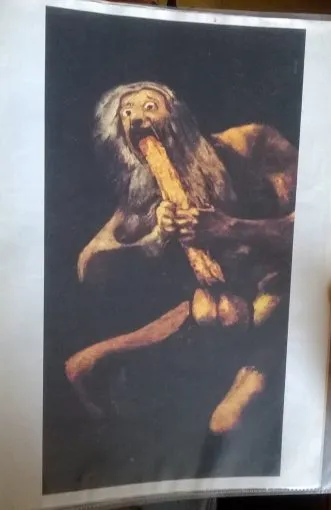
By the way, “building up” in the mid-1990s took on a literal meaning thanks to digital technologies. Thus, for the exhibition “Space of Cultural Revolution,” Anatoliy Hankevych together with Oleksandr Roitburd created the poster “Saturn Devouring His Own Children” — a paraphrase of the famous work by Francisco Goya. Using the first computer technologies, the artists “built up” Saturn’s genital organ. It reaches for its member (in the original painting, this is a child) to deprive itself of pleasure forever and perform an act of castration. The poster can be interpreted from the psychoanalytic perspective, using Lacanian discourse, where, according to Freud, Lacan notes the shift of the concept of castration to a symbolic function. In this work, the artists brutally illustrate this symbolism, forming an image of radical sacrifice: the father not only kills his son, according to the biblical plot, but sacrifices the possibility of procreation altogether.
Androgynous corporeality gradually disappears. Artists continue to experiment with themes, plots, images, and their own bodies, but after brief experiments, many either stop doing art for a short period or switch to other media. These transformations are a topic for further research.