
Serhiy Sviatchenko was born on October 7, 1952, in Kharkiv. In 1975, he graduated from the Faculty of Architecture at the Kharkiv Engineering and Construction Institute (now Kharkiv National University of Civil Engineering and Architecture), and in 1986 he moved to Kyiv, where he studied in the postgraduate program at the Kyiv Engineering and Construction Institute (now Kyiv National University of Construction and Architecture). Throughout his artistic practice, Sviatchenko experimented with various media, but collage brought him the greatest popularity.
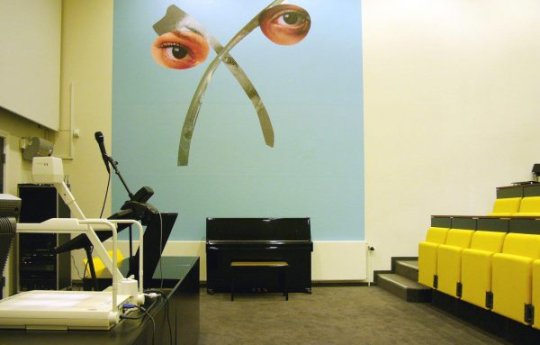
Serhiy Sviatchenko created his first works a year before the announcement of the course towards perestroika. This period is important for many artists of his generation: young authors gained freedom and confidence, felt new opportunities for experiments related to the time and place where they lived, and began to implement their own ideas.
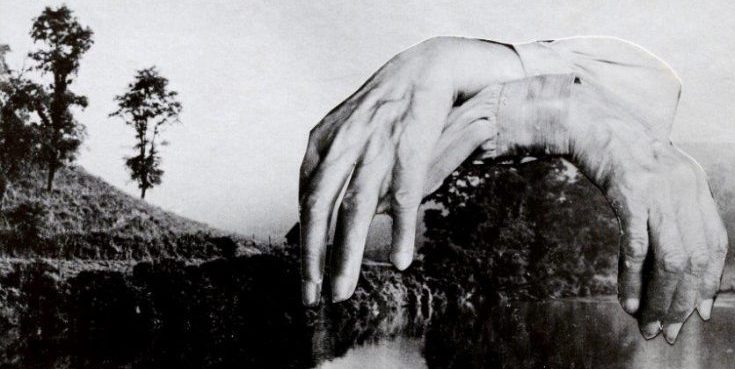
Like many artists who formed in the 1980s, Serhiy Sviatchenko was influenced by the films of Andrei Tarkovsky. The mood created by the director in his films, Sviatchenko tried to convey in his collages. It is felt not only in the plots and artistic rhymes but above all in the space that the artist-architect builds inside the collage. This is especially clearly traced in the first series — “Mysterious World.”
Sviatchenko’s exhibition activity also began in Kharkiv in the 1980s, continued in Kyiv, and developed in Denmark.
“My collage ideology gained strength (I developed and finally formed this direction at the end of the 1990s). And with these ideas, I came to Denmark, where I had the opportunity to prepare a solo painting exhibition at the Thea Fischer-Reinhardt gallery in West Berlin,” Serhiy says.
Collage as a genre gained popularity in the 1920s–1930s, and contemporary collage is not inferior to its predecessors.
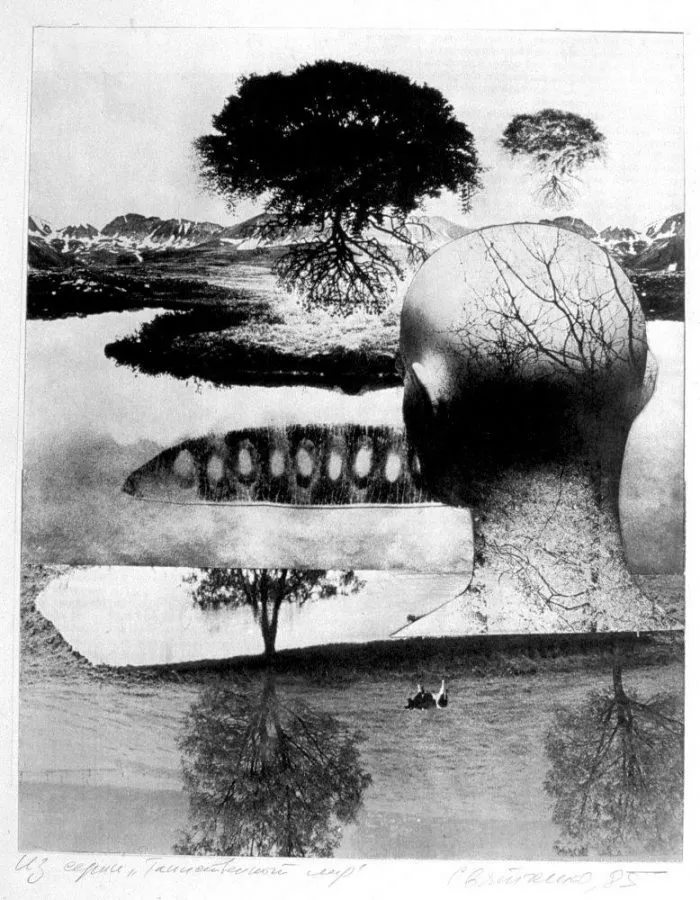
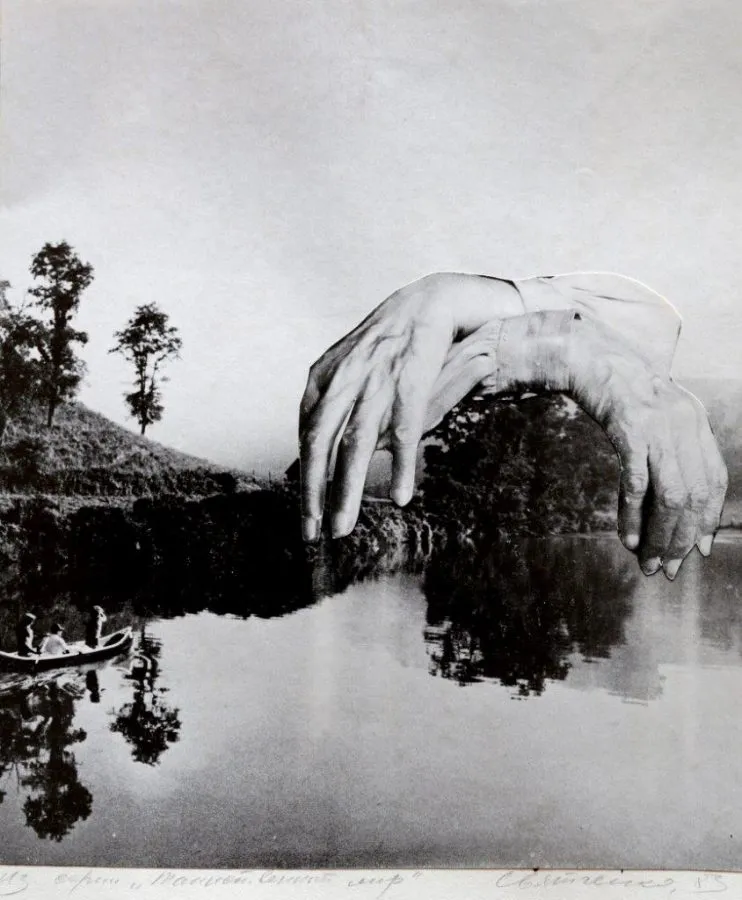
Sviatchenko notes that modernist collage often contains a radical political desire to change society and free it from superstitions. According to him, artists and critics saw in the combination of incompatible images in collages an analogy with existence itself. Collage, like other media, quickly responded to the terrible and radical events that repeatedly occurred in society and changed it.
“Radical subjectivism (this is exactly what I have been doing with my collage for 30 years) gives me the right to assert that one of the theories explaining the huge popularity of collage and its purpose in recent years is this: the high-tech environment allows artists to ‘cut’ the dominant stream of images and try to find or impose a certain meaning on us by creating new visual structures. This shows that collage as media art is becoming relevant again — just as Rodchenko’s revolutionary poster was during the constructivist era,” the author says.
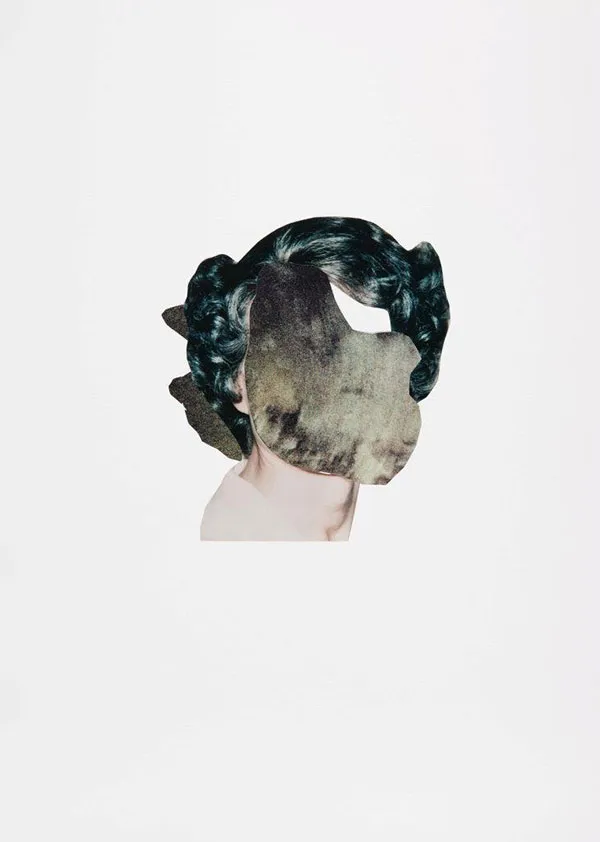
Sviatchenko creates collages manually, using the applique technique. He constructs images by hand, practically building each plot by feel with scissors and glue. This painstaking work resembles how a person paves their own path: cautiously and intuitively moving forward, making important steps, sometimes making mistakes.
Sviatchenko admits that even in the early 1980s, this way of working was natural and the only possible one for him as an artist.
“The cut-out elements for collages are collected and sorted in folders. Each folder has its own name according to the specifics of the selected material. My interest in printed materials and their long-term collection is a conscious-unconscious process that has acquired the character of a special ritual,” the author says.
In his collages, Sviatchenko works both with borrowed images and pictures and with his own materials.
He gained international recognition with the series Less, which he has been working on since 2004. In these works, built from only two or three elements floating on a boldly bright background, the artist turns to color as a plastic, dynamic form. Color creates not only texture but also a surreal plot that refers to the works of Salvador Dalí, René Magritte, and Man Ray. Sviatchenko uses images from books and magazines, acting like a dreamcatcher: filtering images and dreams, he leaves in his own reality only those elements he considers necessary.
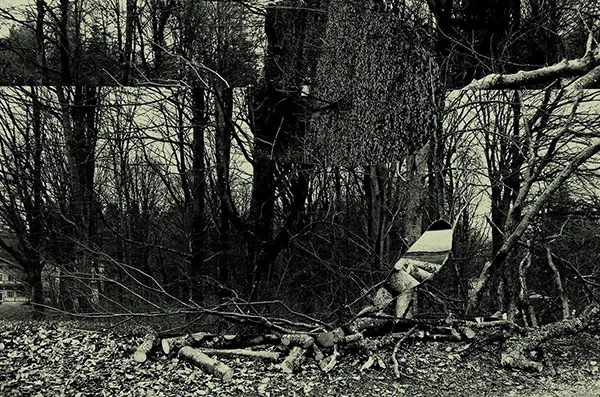
In the series Secretly (2013), photographs of the artist himself became the basis for creating another, alternative mystical reality. Referring to the image of the forest, he tries to intervene in the historical process. On the one hand, each tree is a personal story of a person, their tragedy and happiness. Sviatchenko seeks to personalize history, focusing on individual experience and the uniqueness of each person. On the other hand, these collages return us to the context of the 1980s and Tarkovsky’s work, more precisely — to the musical and verbal accompaniment of his films. The trees, like string instruments, create an internal, invisible music — the rhythm of the work.
By the way, one of the works from this series was displayed in front of the MuseumsQuartier in Vienna until autumn 2017.
“Once, in the early years after my move to Denmark, the director of one of the art museums, Troels Andersen, told me that I had chosen the ‘wrong’ country for work and life,” Sviatchenko recalls. “He said that to establish myself here and gain a name, it would take at least 25 years. And he was right. Denmark is not America or Britain, where diversity of ethnicities and cultures is common. Here, most people have surnames like Petersen, Svensen, or Nielsen, and the surname Sviatchenko sounds very exotic and unusual, especially in artistic circles.”
“Everything started from scratch. At that time, I only knew a little English, but I quickly realized that trying to build a career in this country without knowing Danish was simply pointless, so I learned it. It was not easy, especially with pronunciation. Danish has vowel sounds that do not exist in Slavic languages. Learning to pronounce them does not happen immediately, and because of this, Danes do not understand you even if you have constructed a grammatically and syntactically correct sentence. Of course, I was lucky in many ways. I got the opportunity to collaborate almost immediately with one of the best galleries in the country, which successfully sold my paintings and collages,” the artist recalls.
Today, Sviatchenko collaborates with leading European galleries. In Europe, he also gets acquainted with Ukrainian art.
“For example, in Vienna, when I was installing my installation, I saw works by Mykyta Kadan — a talented artist of the new generation, who, in my opinion, fits well into the European context and is close to me with his ideas,” he says.
Sviatchenko continues to work with collage, painting, and video. He has also created several monumental paintings, including in the Nokia headquarters in Copenhagen, the new office of Jyske Bank in Silkeborg, the Danisco company building in Kunshan, China, and the premises of the new Danish business academy Tradium.
British visual culture expert Rick Poynor, author of several books and publications, professor, curator, and lecturer on contemporary art, characterizes Sviatchenko’s works as follows:
“In Sviatchenko’s collages, the political utopianism of constructivism combines with darker psychological currents and the distortion of surrealism. From the constructivists, he inherited the tendency to use elements of different scales, including significantly larger ones, as well as to leave a lot of free, unfilled space. Another source of inspiration was distorted figures, open backgrounds, and brutal forms in Dadaist photomontages of the late 1920s–1930s.
In terms of content and impact on the viewer, Sviatchenko’s clearly defined images are probably most connected with the world of surrealist dreams. He reconstructs the body with distorted proportions, spare parts, and plastic repetitions. The broken new ‘reality’ he consistently offers defies explanation. Today, he is one of the most influential and provocative innovators of contemporary collage in the world.”