
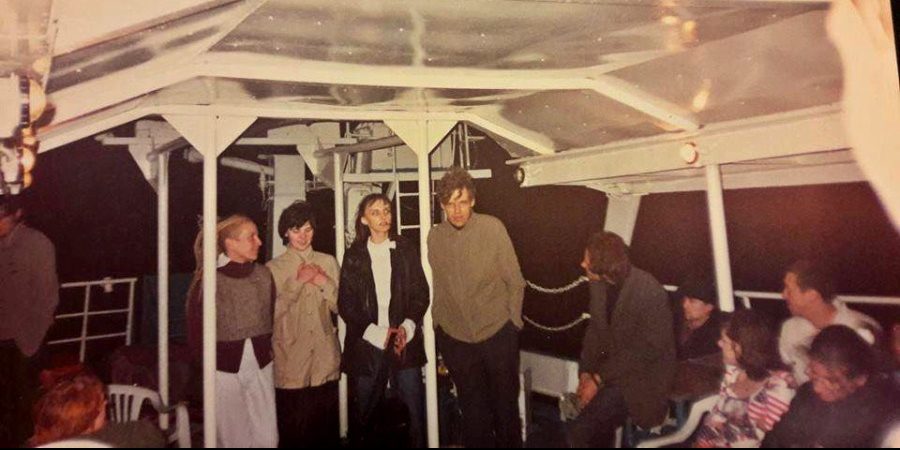
Art historian Nadiya Pryhodych entered the Ukrainian art scene in the 1990s as a student of the art institute. She was one of the first to defend a diploma thesis on contemporary art, in which she described the context and artistic practices of the 1990s. At the end of the decade, Pryhodych organized the video art and short film festival Dreamcatcher, which developed and supported video artists, and over five years of existence turned into an international project.
Currently, Pryhodych is the curator of the project “ALLERGY REWIND,” which takes place within the contemporary art laboratory at the Mystetskyi Arsenal. “Allergy” is a series of video installation exhibitions created by Ukrainian artists during the master classes “Screen Presentations: A New Dimension” within the video art and short film festival Dreamcatcher (2002).
The first exhibition will run until April 15 in the Small Gallery of the Mystetskyi Arsenal.
Kateryna Yakovlenko spoke with Nadiya Pryhodych about contemporary Ukrainian video art, art, and criticism of the late 1990s – early 2000s.
Kateryna Yakovlenko: Please describe the context in which the Dreamcatcher video art festival was created. How did it develop?
Nadiya Pryhodych: In the second half of the 1990s, significant transformations were taking place in the genre hierarchy of contemporary Ukrainian art. Artists’ interest in hybridizing forms of expression contributed to the emergence of a large number of video works. For a long time, Ukrainian artists’ video art remained a passive exhibition form, limited to exhibition halls and viewings within a narrow professional circle.
The history of Dreamcatcher begins in 1997 with the “Open Night” festival, initiated by director Mykhailo Illienko. At that time, Alexander Solovyov and I joined the jury. During the discussion of the works, it became clear that the filmmakers, who made up the majority of the jury, refused to accept video art as a separate genre and considered it part of cinematic culture.
In this context, there was an obvious need for a separate screening of video works. And the following year, in 1998, I founded the Dreamcatcher festival. It was held in the format of a multi-hour night screening outdoors, which was quite logical given the extremely limited budget. All that was needed was a screen, a projector, and several rows of chairs.
The festival’s first partners were the Center for Contemporary Art “Soviart” represented by Viktor Khamatov, as well as the Soros Center for Contemporary Art. By 1999, it became clear that the festival’s audience was growing. In addition to artists and art historians, representatives of other creative communities—cinema, television, advertising—began to attend the screenings, whose interests previously did not include contemporary art.
The growing interest in the event prompted us to expand its format. In the third year, Olya Zhuk and I announced the transition of the festival to an international format. Despite limited communication opportunities at the end of the 1990s, we managed to collect a significant number of applications from foreign artists. The expansion of status contributed to the diversification of the festival program. Exhibitions, symposiums, and master classes gave the festival a distinct educational function.
K. Y.: You mentioned a conflict with filmmakers, but I remember that some video works, for example, by Kyrylo Protsenko, were created together with friends from the cinematic environment. How closely did artists and directors collaborate?
N. P.: There was no systematic collaboration—rather episodic, spontaneous, and not organized on a permanent basis. To a large extent, it was limited to technical support. In my opinion, the reason lay in different conceptual approaches to using moving image media. Of course, there were exceptions. For example, at one of the festivals, the main prize was awarded to the film “Necropolis” by directors, the Alyoshechkin brothers.
K. Y.: In your article in the Moscow “Khudozhestvenny Zhurnal” (“Art Journal”, 1999, No. 30–31), you write that there was no continuity between the new generation of video artists and the previous generation of artists of the 1980s–1990s. You speak of broken connections. Who was this young generation? What interested them, what shaped their worldview, and how did they come to video art?
N. P.: This generation had the opportunity to participate in international educational programs and residencies, which helped its members go beyond the local context and master new technologies. They sought to expand the geography of their creativity and managed to form a fairly coherent phenomenon without uniting into groups based on ideological grounds. Their motto became collaboration. In my opinion, such a break in continuity became a new rhizomatic marker that destroyed the hierarchical structure of the art scene.
K. Y.: How did video art develop in the regions? How widespread was this artistic direction there? Did these processes happen in parallel?
N. P.: Very unevenly and not in parallel. Unfortunately, the technical and organizational features of creating video art at that time required equipment and appropriate skills, and most importantly—independent financial support, which was lacking in the regions.
Nevertheless, we actively collaborated with Lviv artists Anna Kuts and Viktor Dovgalyuk. Odessa artists also intensively mastered video, largely facilitated by the opening of the Center for Contemporary Art in Odessa. Despite the fact that the most opportunities and funding were in the capital, some of the first Ukrainian video works were created by artists not from Kyiv. These are “Lights of the Big City” (1993) by Volodymyr Yershykhin and Vyacheslav Mashnytskyi (Kyiv/Kherson), as well as “Art in Space” by Ihor Dyurych and Ihor Podolchak (Lviv).
K. Y.: How was the preparation for the festival carried out? How much time did you spend organizing and planning?
N. P.: There were only two of us—me and Olya Zhuk. To realize such an event, we had to work all year round, combining many functions: writing grant applications, processing submitted works, communicating with participants, selecting works, and preparing informational materials. Only at the final stage of preparation did we allow ourselves to slightly expand the team.
K. Y.: You mentioned master classes conducted by the Soros Center for Contemporary Art. Were there other organizations at that time that also developed the video art environment? In an interview for the “Research Platform,” artist Heorhiy Senchenko said that in the mid-1990s the organization “Space of Cultural Revolution” held master classes on digital media, one of which took place at the Planetarium. Since the mid-1990s, there was also the Institution of Unstable Thoughts, oriented towards the development of media art.
N. P.: Of course, many artists and institutions were interested in new media, and all supported progress as they could: some invited lecturers, some provided cameras, all together participated in master classes. It was a friendly environment, free of competition.
K. Y.: What factors, phenomena, and people then developed the artistic environment and, in particular, the community of media artists?
N. P.: It seems to me that the main feature of that time was a thirst for information. There was no high-speed internet yet, but there was already a feeling that the world was much more open than it had seemed before.
In the first years of the festival, we tried to establish cooperation with Ukrainian television. Many channels regularly aired programs dedicated to current trends and events in Ukrainian art. We felt strong media support: at festival events, at least five television cameras often worked. Later, a new nomination appeared—”Best Television Story about Contemporary Art.” Unfortunately, the era of TV programs about art has passed, giving way to news reports.
K. Y.: What subgenres or specific genres of video art existed then? How did they develop?
N. P.: I would attribute video documentation to specific genres. For example, video recordings of performances or exhibitions became independent works of art. Music videos can be considered a separate subgenre. Artists often collaborated with musicians, mostly representatives of the alternative scene. The relationship between the musical and artistic environments was equal at that time. Almost every art event was accompanied by musical performances and DJ sets.
Probably the most active figure in this symbiosis was Kyrylo Protsenko, who always acted as an intermediary between visual art and music.
K. Y.: Many artists of the 1980s–1990s generation also worked with video. But later, after experimenting with media, some stopped doing such art and returned to painting. How can you explain this? What is it related to?
N. P.: I do not share the widespread opinion that this process was general. Each case should be considered separately. Some went into advertising or film production, some returned to painting, and some continue to shoot. One of the important and, unfortunately, banal reasons for switching to more traditional media is the lack of commercial interest in video works. Nevertheless, video installations did not disappear from exhibitions.
K. Y.: Artists of the Parkomuna period were often inspired by cinema, transferring plots and images of films onto canvas. What inspired the younger generation working with video art?
N. P.: I do not think the word “inspiration” is part of this generation’s vocabulary. Rather, their creativity was a reaction to events rapidly changing in the lives of artists and society, as well as to the contexts in which these events took place. To a large extent, these were experiments and explorations driven by the possibilities of new media.
K. Y.: How important was irony for the generation of video artists of the 1990s–2000s?
N. P.: It can be said that it was one of the survival tactics in the 1990s.
K. Y.: Was the language they chose a local phenomenon or defined by European and global trends?
N. P.: Artists chose different ways of expression, learned, appropriated, and even copied. But overall, in the process of reviewing Ukrainian video works, local identity is not traced.
It is probably worth noting that over the years, Ukrainian video works have acquired more of a research and existential dimension. Expressions have become more precise and conscious, and artists more professional in working with video.
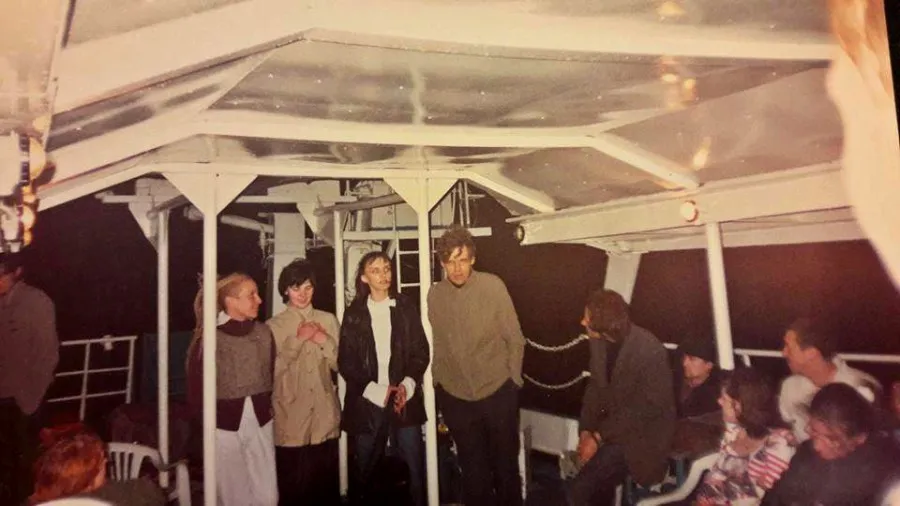
K. Y.: How, in your opinion, did the closure of the festival affect the artistic environment?
N. P.: Undoubtedly, Dreamcatcher played an important role both for artists presenting their works and for the audience that gained access to them. However, the emergence and development of internet resources such as YouTube significantly expanded the possibilities for authors and viewers. This partly became one of the reasons for the festival’s closure. Although it was a landmark event, its educational mission had exhausted itself by that time.
K. Y.: Within the exhibition “Flashback: Ukrainian Media Art of the 1990s” at the Mystetskyi Arsenal, there was a discussion about whether Ukrainian video art is dead. What do you think about this?
N. P.: The discussion was about media art, and video art, judging by what we see at exhibitions, is quite alive.
K. Y.: You said the festival created a platform for young artists who could develop, establish contacts with other authors, create joint projects, and unite. Each year the audience grew, and the circle of viewers expanded. But what happened to criticism, which was supposed to comprehend works and artistic processes? As we see, hour-long cultural programs are no longer available either.
N. P.: Recently, Alexander Solovyov and I discussed this issue and concluded that we did not cope with the task of theoretical comprehension and support of these processes. There were too many tasks on the agenda: we developed educational programs, curated exhibitions, and simultaneously participated in many projects. We managed to launch processes, but we did not have time to describe them promptly.
K. Y.: Returning to your thesis about the lack of continuity between video artists and artists of the 1980s–1990s, I would like to ask: is there continuity between the generation of artists of the 1990s–2000s and those working with video today?
N. P.: I also do not see this continuity and do not feel anxiety because of it. Dialogue, conflict, and criticism seem to me more productive than continuity. Although the emergence of a richer discursive space around the concept of “generation” would benefit everyone—both active participants in the artistic process and future historians.
K. Y.: Today, interest in contemporary art from the perspective of art history is growing. Why do you think it has arisen now?
N. P.: It seems to me this is a timely trend. The time is coming when many things become uncertain: witnesses pass away, originals are lost, tapes demagnetize. Now, together with Olya Zhuk and Solomiya Savchuk, we are preparing a publication about the Dreamcatcher festival. We plan to highlight all the important events of the festival and try to recreate the cultural landscape of the turn of the millennium. This research is taking place within the work of the contemporary art laboratory at the Mystetskyi Arsenal.