
Yana Bystrova is one of the few female artists who entered contemporary Ukrainian art in the early 1990s. The artist was born into a family of Kyiv intellectuals, studied at the Kyiv Art Secondary School, and graduated from the Kyiv State Art Institute. She created her first independent works in 1987–1988, at which time she also began actively participating in exhibitions in Kyiv and Moscow, and in 1990 she became a participant for the first time in the international project “Young Artists from Kyiv” (Helsinki). That same year, the artist moved to Paris, where she lives and works to this day. Currently, Bystrova has her own studio in the French capital.
Kateryna Yakovlenko spoke with Yana Bystrova about her artistic practice, creative searches and experiments, as well as about how life is for a Ukrainian artist in France.
Kateryna Yakovlenko: You graduated from the Kyiv Art Institute, monumental painting department. Your artistic and exhibition practice began in the late 1980s during a period of social, political, and aesthetic changes. At that time, many artists experimented and found their own method of expression. How did you paint? How did your method of working in painting change?
Yana Bystrova: Throughout my practice, I have used various techniques. As it turned out, technique depends only slightly on the artist’s own creative searches, especially at the beginning of a career. In fact, it is a mirror reflection of their environment and material possibilities. Fortunately, I didn’t know this back then — and it was easier to start that way. A person changes the artist living inside them, and accordingly changes the technique used.
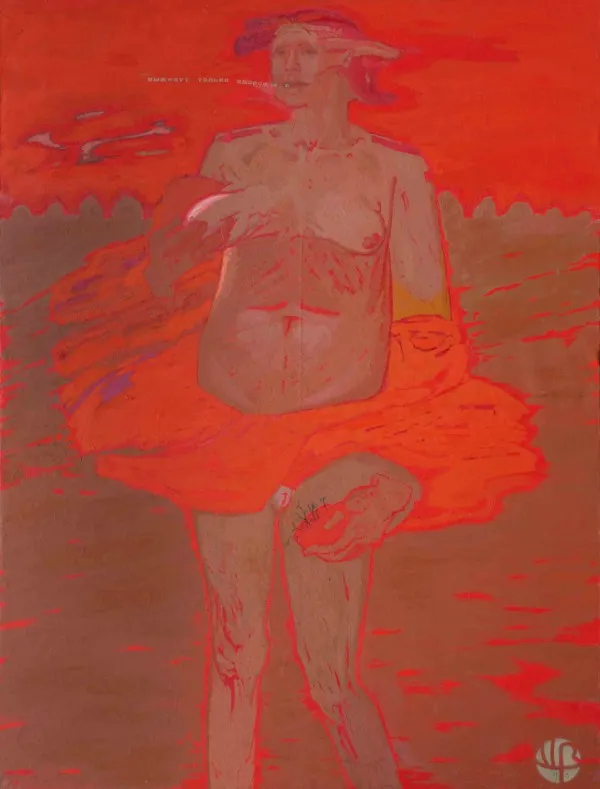
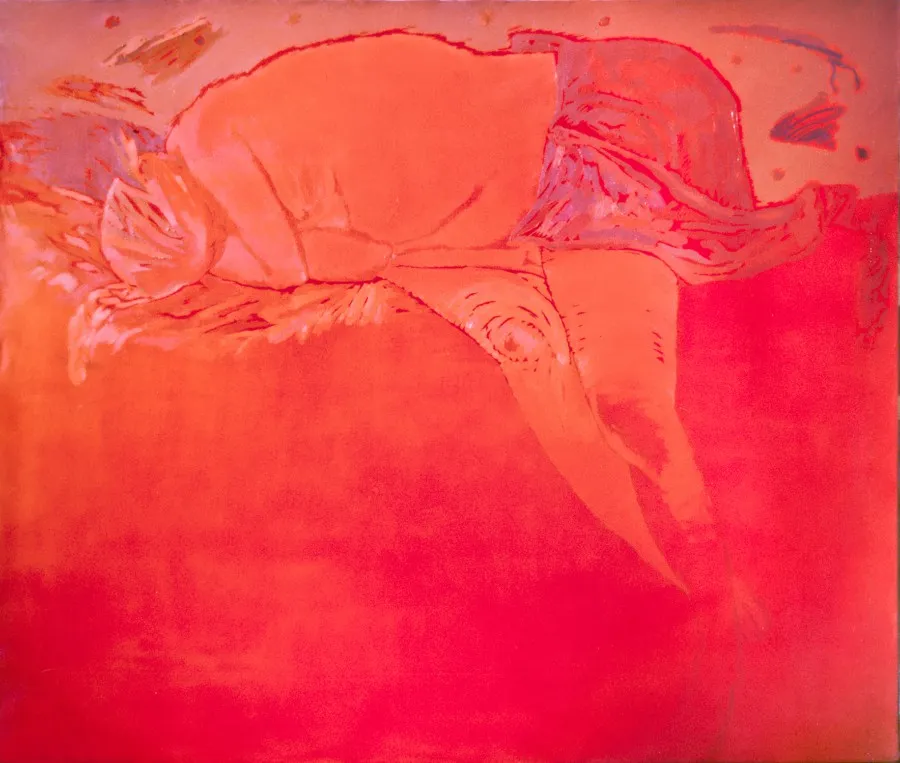
I pay great attention to the touch, the trace left by the brush on the canvas. This was important to me from the very beginning of my work in painting. For example, in my series of early “red” works, I used round brushes that left a kind of “caterpillar effect” — a twisted stroke that could be very long, as well as simply large areas of even color. Now I work differently. For example, I have in my arsenal flat brushes of 15, 20, 35 centimeters. I really love the trace and color they leave. How liquid or thick, dense, transparent the paint is. For some time now, I have switched to acrylic paint — fluorescent, phosphorescent. This allows me to include an additional spectrum of possibilities in the traditional arsenal. But color remains the most interesting and most important thing in all my work. Color is an amazing container of both form and meaning at the same time. Moreover, it is culturally conditioned and has its real meaning only in context. It’s a complex thing and a huge field for play. So accordingly, I invent methods to play.
K. Y.: As you already mentioned, color is very important to you. Red in your work is special; it appears in most of your works.
Y. B.: Yes, red and all its shades — from the coldest to the warmest — is my favorite color to this day, and I exploit it mercilessly.
K. Y.: In the 1990s, Kostyantyn Reunov tried working with oilcloth instead of canvas. Did you have similar experiments?
Y. B.: You know, I haven’t tried oilcloth. As long as I had the opportunity to paint with oil on canvas — I painted with oil on canvas. And when I moved to France, the question simply disappeared for a while due to the lack of a studio.
But I love experiments! I think this is both my strength and my weakness, because the flip side is that I’m not interested in “producing”. When an artist has good works, it is customary to reproduce them, but I’m not interested in that. After all, they pay not for experiments but for recognizability and signature. The works that are not unique and that I do not consider an achievement, my internal “art council” and I simply destroy, so in the end, there isn’t much output.
K. Y.: How did Paris influence your works?
Y. B.: When I went to France, I lost the opportunity to have a studio for a long time, so I had to find new formats of work. At least because there was nowhere to put a canvas and, naturally, nowhere to paint with oil. Photography and silk-screen printing turned out to be a lifeline. In addition, the appearance of new techniques in my work was related to the possibility of making collages on the computer. I have several series of photographs where I experimented with color. The heroine was my favorite model — a fairly well-known French writer whom I photographed a lot. For one of the series, I painted her with bronze paint and immersed her in a bath of black ink (at some point she tried to resist). The color of the shots was corrected on the computer. The photographs themselves were printed in the traditional silver print technique. One of the photographs from this series ended up in an exhibition at the Palais de Tokyo. As a result, the model was so pleased that she wrote a whole article about this experience in the fashionable French magazine Keith.
Moreover, when I got access to a computer, I started doing something like digital appliqué from fragments of photographs. I was interested in manipulating the image. I could do this endlessly: the transition from analog to digital and the freedom of options for the result absolutely enchanted me then. I worked with silk-screen printing, based on appliqué from fragments of photographs of the nude using organic motifs. It was a very erotic series. It was a relief in terms of the possibility to make (print) a work of medium physical size — 150 by 180 cm, which at that time seemed very large. At some point, the opportunity and place to work with canvas and paints returned. And this turned out to be more important to me than I thought.
K. Y.: Continuing the topic of experiments and creative searches, I want to ask you about the series of works depicting heroes without faces, instead of which is the inscription — “Your photo here.” This project was shown at Kostyantyn Reunov’s gallery in London.
Y. B.: Yes, at that time I was already living in Paris but traveled to London. The series is called Your photo here. These works are very small format — 11 by 15 cm. Kostya Reunov was then the organizer of the Attaché gallery project and involved me as one of the participants. The essence is that the work must fit entirely into the Barrow and Hepburn Attaché case. The series was made specifically for this project.
The idea was to recreate famous classical images of couples but with the possibility for the buyer/viewer to insert their own photograph as one of the characters involved, so that he/she could feel like one of the partners of the couple who “entered the classics.” This project was my first attempt at silk-screen printing.
K. Y.: Returning to the 1990s, I want to touch on the topic of “The Willful Edge…” You were part of a group of artists who proclaimed “the struggle for the beauty of the stereotype.” How did you define for yourself the programmatic work for the beauty of the national stereotype? How can you characterize the work in this artistic group?
Y. B.: You know, it’s an interesting program, and it is still relevant, but not for me. I was a member of the group for some time but not an originator. And I belonged to it by family principle (in the late 1980s — early 1990s Yana Bystrova was the wife of Kostyantyn Reunov, one of the ideologists of the program. — K. Y.). Now, apart from anecdotes, mostly related to youthful age, I have little to add to the story.
K. Y.: All your well-known early works were created in Kyiv, but unfortunately, today it is impossible to get a full understanding of your work because many works are lost, there are no reproductions, photographs, their trace is lost. Tell us about your early works, about the themes that concerned you.
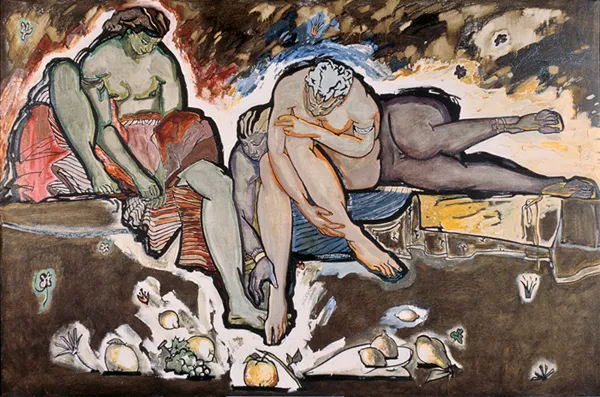
Y. B.: I remember that both at the RKhSSH and at the Academy, when the subject was arbitrary, teachers regularly reproached me for the lack of topical themes. Eroticism, of course, was completely excluded as a theme. Well, there was rest. Or still life. I didn’t like landscapes very much then. One of my first works was the painting “Goddess of Coolness on the Southern Coast of Crimea.” This is probably the earliest of the so-called “large” paintings. This work is a story about my inner and our shared mythology at that time with Kostya. If you look closely, there are elements of still life in the painting, most of which are objects from the studio of Kostya’s father, artist Valentyn Reunov. There is also a character from Gauguin’s paintings. The southern coast of Crimea again.
Still life was also a favorite genre in my artistic practice for many reasons. A compact format that already allowed formal, non-figurative searches. And already in the 1990s, there were attempts at conceptual and formal searches in which I tried to move from figurative to abstraction. This is the first version of the “Lüscher series.” By the way, it was in this series that I first used a marker on canvas. Unfortunately, it has not been preserved entirely. This work is based on a game with eight Lüscher colors. In this version, each color was assigned a corresponding image, which in this case corresponded to a separate part of the body. I completed the full polyptych already in France.
K. Y.: In your early works, you often depicted women; your heroines are often disproportionate, imperfect. What is this connected with?
Y. B.: Every artist has their own aesthetic ideal or, rather, phantasm. I grew up on Velázquez’s Infanta Margarita with her Habsburg lip, Jacques-Louis David’s “Madame Récamier” (count how many times the size of the head fits into the body), Jan van Eyck’s “Arnolfini Portrait” (also not an ideal of proportions). I understood quite early that beauty, proportions, ideal — these are reasons to write my own rules of the game. Moreover, in each of the disproportions you mention, besides the aesthetic, there is also a symbolic meaning — my “red” series shows such disproportionate bodies. For example, in the work “Unsatisfied Needs,” the heroine is depicted leaning, which is a kind of illustration of the difficulties of that period in my life.
K. Y.: Maybe you remember what influenced you then, what shaped you: people, events?
Y. B.: In this part, it is customary to talk about teachers, heroes, and positive examples. I certainly had them. From early childhood, I lived surrounded by artists. Both living and classic. I was influenced by my grandfather, architect Volodymyr Adamovych Kutsevych, who at that time was engaged not only in architecture but also in painting and sculpture. I was influenced by both my parents (sculptor Borys Bystrov and artist Valentyna Kutsevych. — K. Y.) and the parents of my first husband (artist and restorer Valentyn Reunov. — K. Y.). Teachers at RKhSSH and Kyiv Art Institute. Of course, I had a favorite classic of world art since childhood — the list of acknowledgments would be very long if enumerated. But for my formation, negative and traumatic events in my life were no less important, which, by the way, were especially intense in youth. Some part of me survived, some perished, and some of the issues of that time still surface to this day.
My departure to France was triggered both by a personal drama and by a complete rejection of the scale of Soviet values and the place of a person, their personality in it. I was not a political refugee, but rather experienced everything happening around me on a very personal level. By the way, until I was twenty-five, before I came to France, I somehow did not really imagine that there was a world outside the artistic environment. I thought that the way of life I had in the USSR was the whole world. But then it turned out to be quite different. The loss of illusions and the discovery of another world with an exclusively naive moral code as the only compass — this is a rather harsh test. Far beyond the comfort zone. Everything I represent today, professionally and personally, is the result of the above.
K. Y.: You mentioned that your painting changed after moving to France, the technique of working with canvas and paints changed. What concerns you today?
Y. B.: I already mentioned technical difficulties and their solutions. And if we talk about the theme, since Kyiv times, the erotic theme often appeared. Of course, in France, I had to move from the usual and beloved Marina (artist Marina Skugaryova posed repeatedly for Bystrova. — K. Y.) to other models, which took a long time to find. At first, I couldn’t imagine how to create painting completely without nude nature, so the theme of the nude lasted for some time. But this approach exhausted itself at some point. As I said, painting disappeared from my life for a while. And when it returned, the theme, technique, and form were already different. After all, I went through experimentation with the profession — design and later programming. The era of the explosion of virtual communication and digitized reality contributed greatly to this, by the way, I did quite well. And the “professional deformation” brought from this experience awakened an old interest in the question of interaction and interpretation. For example, interpretation of color. Even if major trends cross time and cultures, it turned out that there are a huge number of culturally conditioned details and illusions.
Landscape became a great discovery. For ten years, I organized plein air seasons, usually in the south of France. This was a very fruitful period for me, which brought a lot of benefit and creative joy. And I also get great pleasure from manipulating geometric constructions that describe abstract mathematical concepts. Here, probably, the architectural heritage makes itself felt. So further work in painting is variations of answers to all the above-described problems.
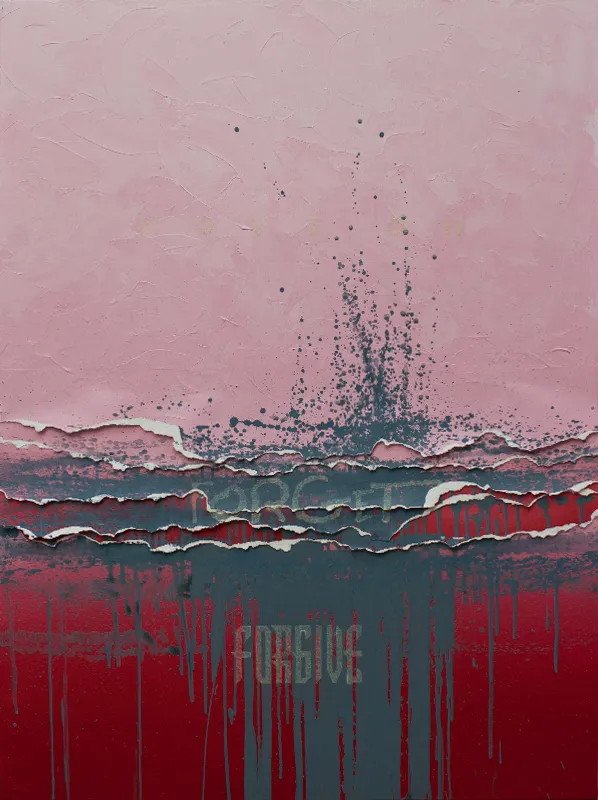
K. Y.: What place does the title of the painting occupy for you in the work?
Y. B.: I rarely leave my paintings untitled. In programming, an element does not exist at all until it is named. In life, by the way, too. And if the principles of naming vary — some literal, some symbolic — the main thing is to understand that they are rarely directly related to what you see. It is always a complex of thoughts, moods, philosophical questions that interested me at that moment. There was a plein air season, for example, when I worked to jazz music. Very often the title of the motif became the title of the work.
K. Y.: Recently, the 1990s are often mentioned in the post-Soviet space, this concerns not only the topic of art but also culture in a broader sense — music, fashion, etc. There is a feeling of a certain nostalgia. Do you feel nostalgic for those times?
Y. B.: Absolutely not. There are people who are nostalgic for youth. For me, that time was insanely difficult. I miss that energy, the physical capabilities of the body at twenty-five, twenty-six years old, but if I were magically offered to return to that time — never, under no circumstances, would I want that. In general, the concept of “nostalgia” has such a depressing meaning exclusively in Soviet and post-Soviet culture. Until recently, the country was dominated by a special post-Soviet format — a person who moved to live in another country carried some kind of stamp of “enemy of the people” and could no longer have any relation to the Motherland. To understand that traveling the world and living in different countries is normal means to squeeze out another drop of Sovietness from yourself. After all, by moving around the world, you do not betray your culture or your country in any way, but, on the contrary, develop, carry, and “promote” it. For many years, I have been a witness to great delicacy (tenderness) in relations between individual countries and their diasporas in the world. Fortunately, I see that the situation is slowly changing in our country as well. People have appeared (and we know who these people are) involved in the cultural life of Ukraine who understand how important it is to restore the prestige of the country abroad and what role culture plays in this process. There is neither time nor place for nostalgia. Sort out the baggage, throw away the unnecessary, carefully preserve the valuable, and move on!