
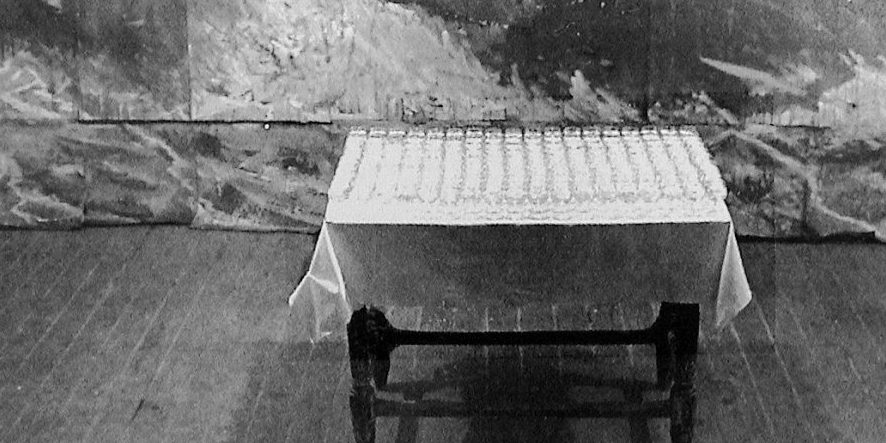
Avdiy Ter-Oganyan is an artist, a representative of Moscow actionism, born in 1961 in Rostov-on-Don. At the end of the 1990s, he left Russia due to charges under Article 282 of the Criminal Code of the Russian Federation “for inciting hatred or enmity, as well as humiliating human dignity” for the destruction of icons as part of the performance “Young Godless” in 1998. In 2002, he received political asylum and has since lived in Prague, Czech Republic.
Avdiy Ter-Oganyan is known to the Ukrainian audience thanks to his collaboration with artist Kostyantyn Reunov, with whom they jointly curated the “Gallery on Tryokhprudny Lane.” During the gallery’s existence from 1990 to 1994, the artists jointly conducted radical social actions, which often involved alcohol consumption (actions “Sea of Vodka” (1991), “Mercy” (1991), “Towards the Object” (1992), and others).
Research Platform employee Valeriya Shiller spoke with the artist about life in the early 1990s, the formation of the artistic environment, the perception of Ukrainian artists by the Moscow circle, as well as about drinking.
Valeriya Shiller: How did you start collaborating with Ukrainian artists? How did the formation of new contemporary art in Russia happen in the early 1990s? How did artists begin to understand what needed to be done and in which direction to move? How did Moscow artists perceive Ukrainian artists?
Avdiy Ter-Oganyan: Back then, everyone hung out together, and there was no snobbery among artists like there is now. Between 1987 and 1990, I gradually moved to Moscow: I traveled there more and more often, and by 1989 I was already in Moscow, having brought all my paints and found a studio. We worked with Valera Koshlyakov [1], with whom we were quite close; we were interested in large-scale paintings. There was a studio on Furmanny [2] at Kostya [Reunov]’s with Oleg [Tistol], which impressed me a lot. Valera and I were offered to rent new studios with three rooms, but we had little money, so we decided to squeeze in and offered Kostya and Oleg to share the rent with us. Our rapprochement happened somewhat by chance; I just met them somewhere and said we needed studios, and it turned out they did too. Sasha Kharchenko and Vitya Kasyanov [3] — a Mykolaiv company — also joined us. Even Oleg Holosiy initially worked with us for a month or a few months until [Volodymyr] Ovcharenko [4] rented an apartment and Holosiy left. So, a Kyiv gang appeared, and it became a Rostov-Kyiv-Moscow squat.
V. Sh.: So this collaboration was more accidental, and you didn’t specifically choose these artists?
A. T.-O.: In a sense, yes, it was accidental, of course, but we wouldn’t have invited artists we didn’t like. We didn’t have a group as such, but we understood it was a serious level.
V. Sh.: Were these studios or still a squat where you lived?
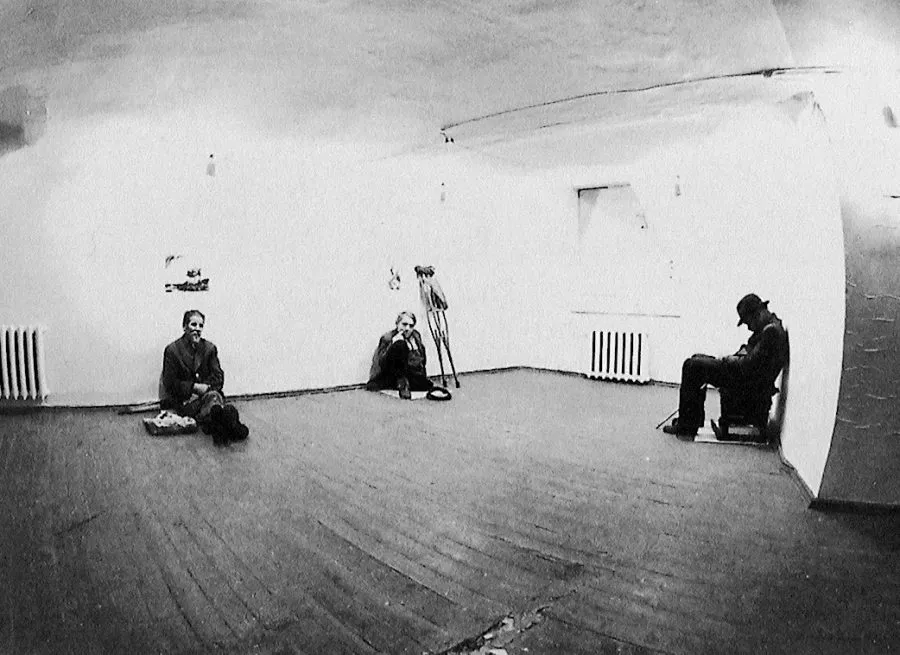
A. T.-O.: We lived and worked there, then another unusual attic space upstairs, a former janitor’s room with a separate entrance, 36 square meters with a low ceiling, a vaulted room, and the maximum height was about two meters, became available. So it was uncomfortable for living. We decided to make a gallery there, and Kostya and I took on curating it, and that’s when we got very close. We decided to hold exhibitions weekly. There were about fifteen of us. If we held exhibitions monthly, we’d have to wait a long time, and everyone wanted to exhibit. We decided to do weekly exhibitions and endured this marathon. Kostya left for London by winter. The whole gang remained except Kostya. By the way, I was in Kyiv once — at the “Shtyl” exhibition, where I brought works directly by train. And I was at Parkomuna only once.
V. Sh.: There are still legends about your conflict with Nataliya Filonenko during your visit to Kyiv. Do you remember anything about it?
A. T.-O.: It was funny, but it can’t be called a conflict. We went as a group to get wine for the vernissage. We had a small minibus with wine and port in three-liter jars like juice. At that time, there was a fight against drunkenness, and everything was in unusual containers. We immediately decided to try whether the wine was good or bad, and it smoothly turned into a terrible drunkenness. Well, probably, I behaved too noisily, so I have no grudges. But Filonenko kicked me out, just threw me out. Honestly, I was drinking heavily then and assume I was somehow wrong. I just don’t remember… I got drunk. I remember being kicked out and being on the street, alone, very drunk, alone in Kyiv, not knowing where to go at all. In a semi-conscious state and absolutely not understanding where I was, I didn’t know the city at all. In general, Kyrylo Protsenko found me and took me in. It can’t be called a conflict. There was drunkenness; maybe I shouted a lot or I don’t know what I did there. The next day was the vernissage; everything was very fun and crazy. And then we left. So I don’t really remember “Paris Commune.” It was all vague, but I know everyone well. Then everyone regularly exhibited in Moscow, and naturally, we got to know everyone again.
V. Sh.: Alcohol is also a recurring theme in your actions with Kostyantyn Reunov.
A. T.-O.: Yes, because the alcohol theme is my theme. You could say it was my contribution to art. Back then, drunkenness was widespread, and I thematized it consciously. It was a riposte to Moscow conceptualism.
V. Sh.: So in this way, you opposed yourself and your group to the more snobbish society of conceptual artists?
A. T.-O.: Yes, precisely the snobbish, intellectual or pseudo-intellectual kind. What distinguishes Moscow conceptualism? They are clever, obscure, everything is murky and vague. We opposed all this with extreme clarity, simplicity, vitality. And in this sense, I saw allies in the Kyiv artists. By the way, Moscow conceptualists perceived Kyiv artists quite snobbishly because “painting is not smart.” By the way, conceptualists did not drink. At least some authors did drink, but drunkenness did not fit into their art; it was just something personal and separate.
V. Sh.: Not as a lifestyle?
A. T.-O.: Yes, of course, and there was some competition in this.
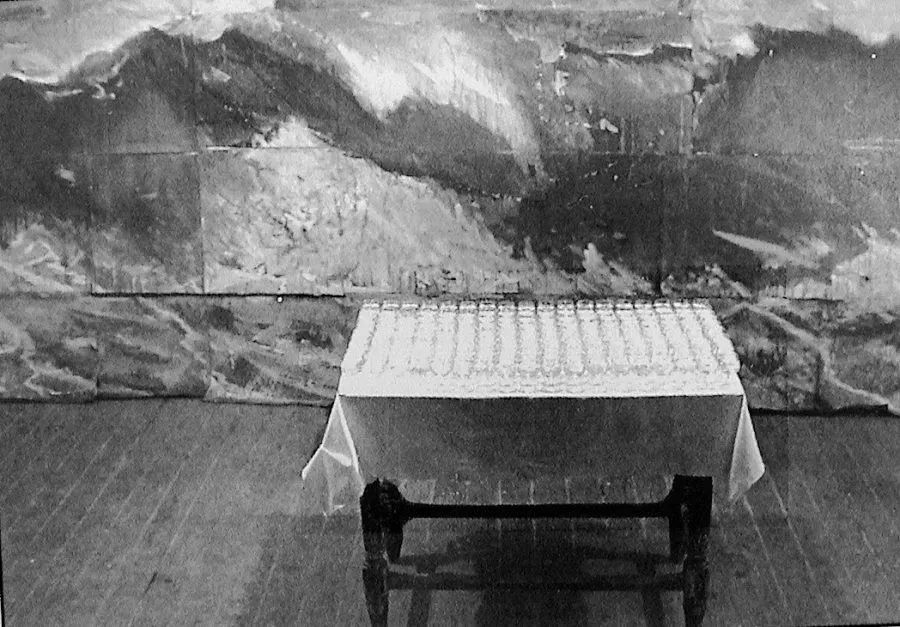
V. Sh.: But you opposed this conceptual circle of artists also with the conceptual language of performance, not painting. Was it an attempt to draw attention or just an attempt to find a new medium?
A. T.-O.: I wouldn’t say we mainly did performance. For me personally, the absence of an artistic environment in Rostov did not allow me to go beyond painting. If there were any actions, they were not documented. They were like art of behavior, art of life, and were not labeled as art because there was no audience.
In Moscow, our space on Tryokhprudny allowed us not only to do actions but also to go beyond painting. It was essentially a whitecube model, where any action or readymade could be art. We covered the gallery with the reverse side of geographical maps, which were very cheap but of good quality at the time.
I hated those pompous references to the East, Zen Buddhism, to something incomprehensible and obscure. And thanks to the fact that I selected works for the gallery, one can talk about some exhibition strategy. The main idea was to show art that was extremely understandable, clear, and entertaining. We had a declarative exhibition “For Cultural Recreation” a year before Tryokhprudny.
V. Sh.: Where was it held?
A. T.-O.: On Kashirka. There was a whole series of exhibitions. First “Waiting for Recreation,” where the circle began to form: there were Dima Gutov, Kostya Bokhorov, Valera Koshlyakov. Then “For Cultural Recreation.” After us, we were invited to Lviv during the “Tryokhprudny” period; we brought an exhibition, part of the works from the “Waiting for Recreation” exhibition — it was called “Saturday Evening” there, curated by Yura Sokolov [5]. There we met Andriy Sagaidakovsky, Ihor Shuliev [6].
V. Sh.: Can we talk about the mutual influence of different artistic circles? After all, Kyiv painters were indirectly influenced by Moscow conceptualism. And communication happened through Odesa artists who traveled both to Moscow and simultaneously collaborated with others. Serhiy Anufriyev wrote the text “Kyiv as a Cultural Model.” Were you familiar with Odesa conceptualists, or was it a separate crowd?
A. T.-O.: It seems to me that Kyiv art is an independent and original phenomenon, which Anufriyev and Moscow conceptualism influenced rather poorly. In my opinion, Kyiv artists took this phenomenon too seriously; it’s a provincial approach. Of course, Anufriyev is a very charming person. Moreover, they were drug addicts, and all this drug addiction brought them very close. I communicated with Odesa artists, but I was not close to what, for example, the “medgermenevts” [7] did. I treated it with sympathy but saw a different path. And I communicated well and drank with Lyonya Voitsehov, simply because I am a sociable person. But Odesa art is, of course, separate.
What I see in Kyiv art is primarily a reinterpretation of classical tradition, an attempt to create something new based on academic education. Obvious examples are the transavantgarde. In St. Petersburg, there was the “New Academy” [8] — very close, and it’s a pity there were no joint projects. It seems to me that communication with Timur [Novikov] would have been more useful for Kyiv artists than with Moscow conceptualists. I observed that during the first half of the 1990s, everyone abandoned painting; everyone had some complexes. I did not approve of this; it was provincial, the West’s intrigues, everyone started going there, although it was clear that such enthusiasm in the West no longer caused and could not cause.
Our art is very original, a living phenomenon; it was never secondary at all. Both Moscow and trips to the West negatively affected it. I saw that guys were complexing, constantly inventing something; everyone started doing some video. It was much more secondary and imitative. If we talk about influence, I can simply testify that Arsen Savadov influenced [Yuriy] Shabelnikov [9]. Shabelnikov is a very talented painter and was simply fascinated by what he was doing. A certain community appeared before our eyes, which could be called neo-academy or neoclassicism in different cities. It’s easy to explain: these are people who had classical education and tried to apply their real arsenal to contemporary art. It was a living unique Soviet art, and it’s very sad that the second generation, which could have been the most powerful, did not happen. Moreover, the main and most talented characters started doing nonsense. I really liked some pornography with crooked mirrors by Hnylytsky [10]. That movie I liked wildly, but, by the way, Hnylytsky remained faithful to painting, right?
V. Sh.: And Holosiy too.
A. T.-O.: And Holosiy too. His Moscow works are his peak. Because in Kyiv, he was in the general line: curly little men, a general tendency. In Moscow, he found himself when he turned to photography. It’s amazing; I’m still delighted with his late works, I highly appreciate them. Of course, I saw all those huge exhibitions of Savadov-Senchenko in Moscow, organized for them by Ovcharenko. And it’s very sad that they left painting, incredibly sad. Here is independence; all Kyiv artists left, contacts stopped immediately. Because they started being invited separately, Kyiv became the capital. This is, of course, bad. They got their own money, opportunities, their own affairs, Ukrainian exhibitions appeared. If you evaluate it this way, it seems to me it became provincial, honestly. This degradation also happened in Moscow exactly the same way until the 2000s.
V. Sh.: How were authorities formed in the artistic environment in the 1990s?
A. T.-O.: For us — artists who formed during Soviet times — the environment was the main thing; we oriented ourselves to each other, there were no curators, no gallerists, we influenced each other; authorities were among us, inside our circle. And in the 2000s, curators appeared who were monopolists; you had to please the curator to go abroad or get into an exhibition, and then you had to please the artists. Then it seemed to me that I was resisting Moscow conceptualism, but in fact, it gave me a lot. Trying to do the opposite, something different, I learned.
Our generation was truly independent, and then other people started coming; everyone began reading “HZh” [11], orienting themselves to Vitya Miziano [12], and it seems to me no one became an interesting artist by orienting to Vitya Miziano. This huge amount of information gave nothing. And in the 2000s, some from our generation became very famous, some less famous, some were accepted by the market, some were not. Then this “Eurostandard” appeared — those people who look to the West, who collected catalogs, who listened to curators, some intellectuals, most of whom understand nothing about art. They simply do not love it, do not understand it, but just read some books; it’s some orientation to philosophy. What does philosophy have to do with it? Philosophy is philosophy, art is art — these are different things. If it were connected, the best artists would be Hegel, Karl Marx, and Nietzsche.
This provincialism, by the way, was everywhere. For example, St. Petersburg at the end of the 1980s — in the first half of the 1990s was the most fashionable place, in some sense cooler than Moscow. In St. Petersburg, there was Timur Petrovich, who spun it all around himself, but it was wildly cool; it was a terribly fashionable place, Kurjokhin [13] was there and Novikov. And what is St. Petersburg now? Some swamp and secondary stuff, and generally nothing interesting there.
V. Sh.: How, in your opinion, is the system of selecting artists formed now?
A. T.-O.: There are talented artists now. But fewer and fewer — the system does not select them. The system does not give a general picture, does not give a trend. During Soviet times, we could earn independently. I worked as a gardener, guard, or janitor part-time. Our generation did not intend to make a career in the Artists’ Union. Why should I paint thematic paintings in a certain correct style? By the late 1980s, the Artists’ Union had greatly degraded but still provided huge opportunities. There were many artists who received studios, did some hack work, and got studios more independently within the Union.
Now they say there was underground and non-underground — this is wrong. In Kyiv, for example, there was essentially no underground; all this “Paris Commune” is the same Soviet artists, and many of them were in youth organizations of the Artists’ Union.
And what is postmodernism? A bazaar where everything is thrown together, a flea market! Second-hand where everything is chaotically mixed. Art of the fair. And there are no criteria: there is conceptualism here, painting there, geometric, etc. Art is intellectual activity, that is, there must be some common tasks, but now there is such a collapse. Art must be some super-task. We need to learn from each other; you cannot pull anything out of yourself; there is nothing inside — art is around us. In the world, not inside. What is inside a person? A little bit there, there is nothing. Everything interesting is outside, around us is interesting, but inside — what is there, well, brains, gray matter. There is nothing good and valuable inside. And this is a general crisis.