
Oleh Kulik is one of the most famous action artists of the 1990s not only in the post-Soviet space but also in the global art community. The author’s loudest action was the work “Mad Dog, or The Last Taboo Guarded by a Lonely Cerberus” (1994) near Marat Gelman’s gallery in Moscow. This marked the beginning of Kulik’s epochal Dogiad, which lasted for decades. The action, which the author conceived as the end of his unsuccessful artistic career, ironically became its loud beginning.
But artistic success was preceded by the “stifling” 1970s in Kyiv, a rebellious youth in a family of a party worker, access to forbidden literature, literary ambitions, and running away from home in 1981 with an ambiguous phrase angrily thrown at his parents: “This country will collapse, and Crimea will go to Russia.”
What Kyiv was like in those years, how the artist tried to stop tanks on Maidan in 1999 with a “Caterpillar” made of people, and what Soviet parades and religious services have in common, Oleh Kulik told in a conversation with Halyna Hleba.
The material is published as part of the cooperation between the PinchukArtCentre Research Platform and KORYDOR.
Tate Modern, Лондон
Halyna Hleba: Oleh, let’s go back to the 1970s–1990s, but let’s not recall the story of Kulik’s dog and the dog Kulik, but talk about the time and environment you were in Kyiv and Moscow. You were born in Kyiv in 1961; tell us a bit about your family.
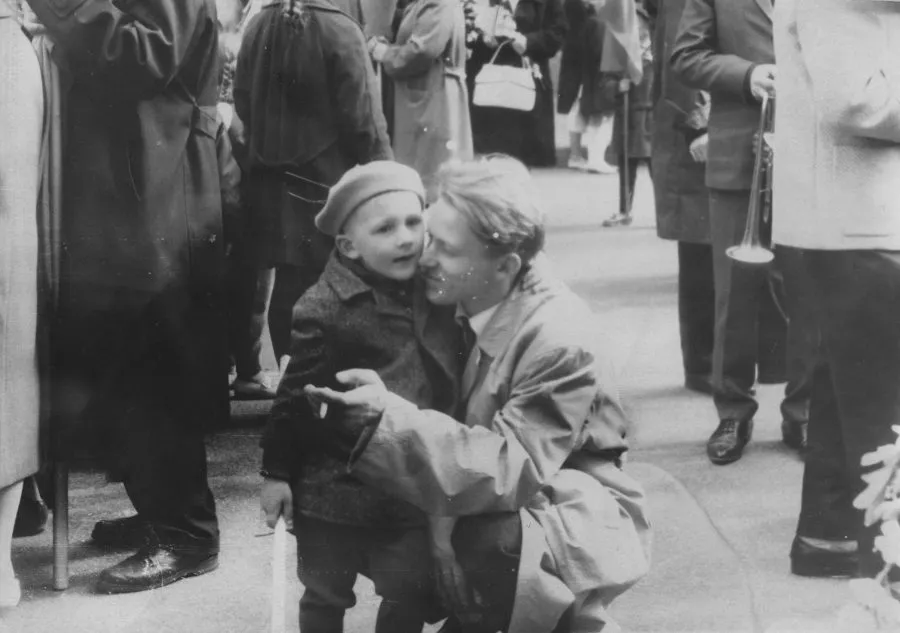
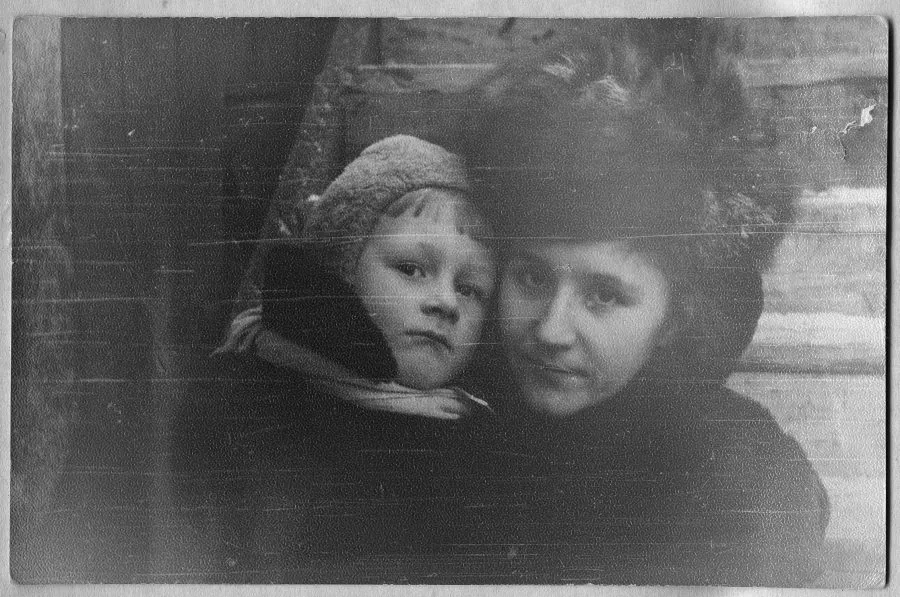
Oleh Kulik: My family comes from peasants (the town of Krasnopillia in Chernihiv region). My father was both a party worker and the director of a carbonated beverage factory in Kyiv during his career. My mother was a teacher of French and English.
H. H.: So it was an intellectual family?
O. K.: Relatively intellectual. My parents had a quite good Soviet career: from peasants to workers, from workers to managers, from managers to party leaders, from party workers to economic managers.
But due to age and environment, in my youth I had a very strong feeling of connections and corruption, as it would be called today. And it was suffocating, in a youthful-romantic sense suffocating. There was a feeling that the people around me didn’t care about ideas, and that the most important thing for them was not to violate generally accepted norms, especially Soviet ones. But not only my parents lived like that, everyone did. At least, that’s how it seemed to me.
H. H.: Who surrounded you in childhood and youth?
O. K.: Sometimes diplomats, theater actors, singers came to us. But it was not communication between intellectuals aimed at mutual interest — it was communication that ensured material status. Because of this, I felt like an eternal seeker: I wanted to find another environment. I didn’t find it in Kyiv. Or I searched poorly.
H. H.: The art school you attended — was it a mandatory part of the cultural upbringing of a young person from a Soviet intellectual family, or did you independently determine this interest?
O. K.: They wanted to raise me as a director of a carbon dioxide factory. My parents pressured me to become, so to speak, a proper person. And I resisted this in every way.
H. H.: When did you realize that despite your family’s efforts to raise you differently, you still wanted to engage in art?
O. K.: There is an important childhood story. I don’t remember the event itself, but the impression on my parents and all relatives was huge. It was before my father’s party work; we lived in a rented house. They brought us a brand new unpainted table — clean planed and sanded boards without protective coating. While my parents were sleeping, I successfully took a jar of brilliant green and created a very beautiful composition on the table. I even urinated a little on it from above. It turned out beautiful.
When my parents saw my work, they reacted with an explosive mixture of surprise, outrage, and confusion. It was a revelation for me that what brings me pleasure causes such a strong emotional reaction in others.
A little later, I created secret wallpaper installations-collages from my mother’s foreign fashion magazines (and try to find them then). Of course, it all came to light when a piece of wallpaper fell off. There was another parental stupor.
So yes, I didn’t really have a choice, but I wanted to be an artist from an early age. Perhaps this was the whole problem of raising me as a “person.”
H. H.: But you didn’t have a role model of artists with a different mindset other than Soviet nomenclature social realists.
O. K.: Who told you that the example of “another artist” convinces you to be an artist? For example, when I look at others, I least want to be like them.
H. H.: Was there opposition regarding your choice of activity with your mother? Did your father not interfere?
O. K.: My father was the voice of the people. My mother loved art and culture very much, constantly visited theaters; for her, cultural leisure was life. But she also understood that this occupation doesn’t feed you.
H. H.: In childhood, interest in drawing is often perceived by parents as a form of play; conflict arises in adolescence. What did the generational and worldview conflict do to you?
O. K.: I had only one thought — to run away. From my parents, from society, from those suffocating conditions, from school, from lectures, just from this place. And I ran away, despite the fact that my father was some kind of boss and was tracking me. So at 19, I left and never returned.
I was a big admirer of Leo Tolstoy and his philosophy. A person who changes himself independently, builds his life, and relies on no one — that’s the image I tried to follow.
H. H.: But before that, you studied at a geological exploration technical school. How did you get there?
O. K.: My parents had to catch me all the time; I didn’t know where to run, and working as a geologist in an expedition was a quite reliable way to officially escape.
I worked in Western Siberia, traveled a bit. There were desperate but warm and cozy people. I felt them free. Not in a political sense, but in a personal and human sense. They didn’t have that sticky Soviet sociality.
H. H.: Your interest in literature was connected to themes of humanism through your admiration of Leo Tolstoy. What about visual arts?
O. K.: I was interested in faces. Through sculpture, I could understand the person in front of me. And since I didn’t have much opportunity to hire good models, I mostly sculpted people battered by life. If you work carefully and long, these people reveal inner aristocracy and subtlety you wouldn’t suspect.
In Soviet times, such “fallen” people preserved the most interesting stories. They couldn’t fit into soulless general rules and prevailed over them with their human quality that doesn’t conform.
That was my “school” until I met the real underground in Moscow. In 1982, I met Vitaly Patsukov and Boris Orlov, a sculptor and art theorist. Orlov is generally considered the father of social art in sculpture. An acquaintance saw my sculptures and pulled me to them, so I entered the world of Moscow underground. And it was wow! What people, what conversations, what relationships, this level of communication — everything shocked, amazed, everything was different, no connection with what was “on the surface.”
H. H.: Was the Moscow underground non-conformist or indifferent to external events?
O. K.: No, by the time I met them, the second or even third wave had already formed.
The first wave — all those who came out of Stalin’s camps; these were elderly people who personally knew Malevich and Rodchenko. A nostalgic avant-garde, they recalled their youth, that Great Art which was forbidden after returning from prisons and secretly painted with cubes-squares on canvases. Then came the middle generation artists — those who no longer repeated this art, did not nostalgize, but lived calmly in their underground, accepting the current situation and doing what they thought was done in the West. Just recall Sidur or Bilyutin. If the first continued Malevich’s traditions, the second generation embodied pure modernism. And it was a very caricatured phenomenon in a touching sense.
They lived in a closed, absolutely isolated and repressive system, deprived of information, but lived as if none of this existed. Their art revealed this. Like unfinished, like avant-garde with elements of naivety. But all this became noticeable when the third generation appeared. It was with them that I met. These were a completely different level of people who reflected on their situation.
H. H.: Were the third generation imbued with dissident spirit, political rebellion?
O. K.: The middle generation had strong rebellion; the third had irony as a tool. Also rebellion, but of a different kind.
It’s not sarcasm but grotesque, a very strong protest. The only thing truly capable of destroying a totalitarian system. They found this powerful weapon — they began to speak the same language as the authorities. This was their discovery, innovation. They didn’t borrow styles or ideas from the past, didn’t pull dead cats from modernism. But they took the language of power, the language of the street and the system, the language of the world that really surrounded them, and exaggerated it a bit, hypertrophied it a bit. They worked with the language of power, ideology, its stereotypes and clichés. Bakhchanyan, Bulatov, Kabakov, Orlov, Prigov, and others received Soviet education. And when conflict with Soviet power arose, they didn’t seek to manifest it demonstratively. Interest in them came from the West. And when their art appeared there, our honest citizens suddenly got agitated: who are these bastards and how come they don’t love our country but publish in the West, and show us nothing.
These artists created an environment full of reflection, intelligent, subtle, and ironic. They built their parallel universe.
H. H.: Is this what you were looking for when you left Kyiv, or something you found by chance that became meaningful for you for a long time?
O. K.: It is definitely what I was looking for. I was looking for a communication environment that would think relevantly, modernly, and without detachment from reality, boldly working with this reality. The underground didn’t run from reality, didn’t torment it. I hadn’t seen this before. Everywhere there were either corrupt cheerful thieves and rapists or dead zombified citizens. And people who had energy and a sense of happiness and formulated their tasks themselves, I hadn’t met before. I thought they didn’t exist at all. That the system crushed such people into the asphalt. So when asked why there was no actionism in Kyiv, I can answer quite easily: actionism is the highest in art, such a complex level that here in Kyiv, there simply isn’t a mass developed. That’s why, for example, it doesn’t exist in Kazakhstan.
H. H.: Besides stuffiness and irritation, did Kyiv inspire you?
O. K.: The brightest impression was still my father, all in ideological work. Whether I liked it or not, I was involved in preparing various celebrations and manifestations. Columns, people, banners. All this fuss and organization of the process pleased me very much. It was the only interesting thing in my father’s activity. I didn’t particularly delve into the meaning of what was happening, I perceived it all as an event-party.
H. H.: Almost actionism.
O. K.: Of course! They made all sorts of products for the October holiday. For example, glassmakers blew iridescent glass balls on sticks. My father gave them to demonstrators, and the column looked very solemn. Like a demonstration of the country’s productive power, but in fact — pure absurdity. But the most interesting thing was later, which I awaited with bated breath: after the parade, all this stuff was brought to one of the courtyards in the city center, they drank solemnly in a narrow circle and began to smash these glass balls on sticks! So easily, having fun and playing. Because no one kept this junk, everything was made for the event, theme, and year. Tomorrow the party would say right, or left, or say to hang oneself, and you had to be ready to creatively approach the change of the party line.
All this buffoonery thrilled me; I gladly participated and admired my father. Because at such moments, I saw something creative, even divine in him.
H. H.: What did you read in the late Soviet period? What access did you have? Did you encounter “confiscated” books?
O. K.: My father had pornography and political “forbidden” books. Obstetric books appeared, probably confiscated as pornography, old ones from the 19th century with illustrations.
But thanks to my father, I got access to Great Literature, even read Solzhenitsyn in the 1970s. I didn’t understand it very well, though. I read many things then. Soviet education was extremely hypocritical. Even Solzhenitsyn’s “The Calf Butted the Oak” is a story about Soviet writers and their relationships, not about politics or camps, but about writers. They all appear vile but alive at the same time. A little later, I came across “One Day in the Life of Ivan Denisovich”, and there the whole story about camps unfolded.
H. H.: Was this story perceived as real or fictional?
O. K.: All these horrors entered young consciousness with difficulty! Later, when I read Shalamov, I believed. Now I understand how stylistically unconvincing Solzhenitsyn was for me in camp stories. He wrote about writers with great inner understanding.
These great writers turned me away from writing. I realized you must write with your heart. Many things came easily to me, as it seemed then. This “easily” always turned out badly. Writing flowed from me at 5,000 words a day. But reading it was impossible.
H. H.: So you experienced an artistic turmoil in Kyiv. You got caught in a time trap between the active cultural 1960s and the new wave of the late 1980s.
O. K.: It is known that the most repressive of all communist parties was the Communist Party of Ukraine; from the Ukrainian people, they pulled up the worst, those who would do anything for the encouragement of power. And I got into these rotten 1970s.
But I was “lucky” twice. I am also the son of a party worker. God forbid they find an icon. My father kept old icons from my grandfather, he hid them, and I took them out and set them up to pray like an iconostasis.
H. H.: Were you interested in religion?
O. K.: I loved my grandfather very much. The most important upbringing I received from him. Grandfather was very religious, a war veteran. We constantly went to services at the St. Volodymyr Cathedral. And the services were very beautiful.
H. H.: The parade with the creation and destruction of attributes, the processuality of religious cults — were you fascinated by this event theatricality?
O. K.: Yes, very much. But everything church-related at that time was broken and in terrible condition. One of the first strong impressions that made me want to act (I even thought about how to find dynamite) was the appearance of the “Woman with a Sword” [1]. Is it still standing?
H. H.: Of course, it is.
O. K.: It’s strange, they fight the Soviet Union, but this is the dumbest and loudest embodiment of the Soviet Union standing over all Kyiv. Such a clumsy, inept thing. The construction inside is such that if you blow up one support, the whole sculpture will fall. I constantly walked next to it and lived with this thought. Of course, I won’t blow anything up, but I experienced a sea of emotions about this “Woman.” They finished it — and I left. This “Woman” displaced everything. She erased the entire shore, destroyed the mountain.
H. H.: Kyiv didn’t hold you with its Lavra spirituality? Despite the Motherland Monument, Lavra still dominates.
O. K.: It’s the most cursed place.
H. H.: Why?
O. K.: I considered this city the hardest place for me. No language, no culture, no traditions. Everything was taken out, everything crumpled. There was no inner nobility here.
H. H.: Did this feeling arise because of the stuffiness of the environment you were in?
O. K.: I think this is generally a bright feature of the Brezhnev era. A feature of early Brezhnev. The late one was ridiculous. In this idiocy, the sprouts of the future were already visible, how the pig rolled down and became a boss, and everything became piggish and swinish around, everyone grunted and had fun. That’s how I felt it.
Yes, maybe this is my personal…
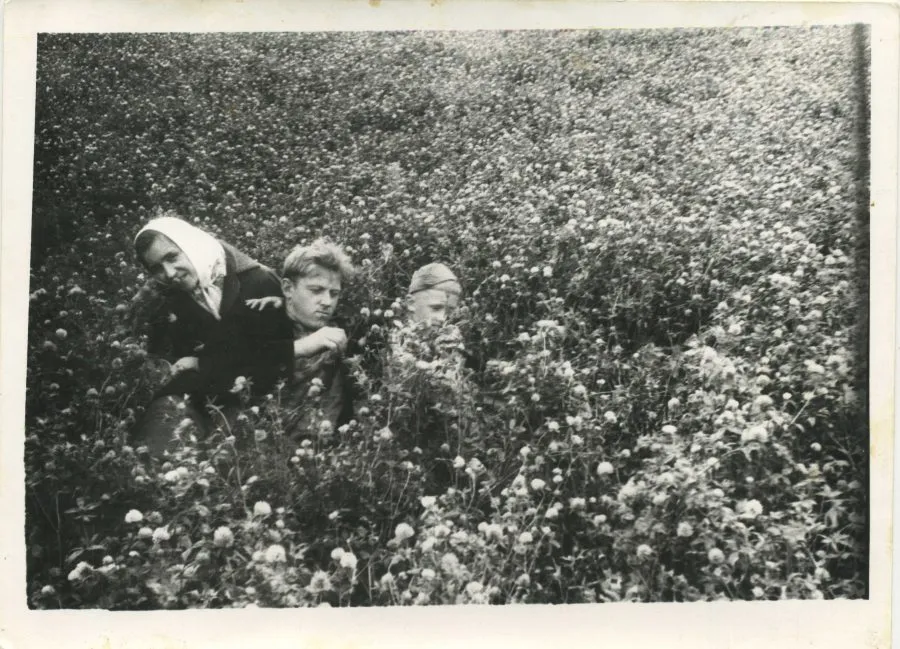
I was taken to school in a white Volga. And we had nannies-governesses at home in Soviet times, covered tables with tablecloths. Well, and in general, we won everyone, no enemies, happiness, joy, movies, food. I didn’t know that people had no food. We had exotic fruits, bananas. And I kept thinking about what a happy country we live in, so happy that there’s nothing to do, nowhere to fight for happiness. Like a prison of happiness. And tears welled up because of this. Strange, isn’t it? A person suffered because he sincerely didn’t understand that this was the real prison, just called differently.
H. H.: Obviously, that’s why Solzhenitsyn and all harsh literature were not perceived as reality that scares; your realities looked completely different and had no place for “harshness.”
O. K.: Yes. A golden prison.
H. H.: In one interview, you mentioned that when leaving Kyiv in 1981, you said, “Ukraine is an incomplete state, it will collapse, and Crimea will go to Russia.” What kind of visionary statement was that?
O. K.: Now I disagree with that, but in 1981 those were my words. I threw this phrase in anger at my father, not the country. But I was against the Soviet system of depersonalization. And in Ukraine, this depersonalization was the strongest. Because I didn’t know about the struggle of this and that, I thought the state was built on heroes, which are not here.
So I left. Everyone thought I was a little fool babbling nonsense, which in principle couldn’t be. The country can’t collapse, and Crimea is ours no matter what…
But 32 years pass, and who ended up fools?
H. H.: After moving to Russia, you visited Kyiv in the 1990s. Did the city change during your ten years of absence?
O. K.: By that time, I had active artistic activity in Moscow. But working at “Regine,” I began to encounter the Ukrainian art scene, which I didn’t know before. Moscow artists had become extremely conceptual, despising any materiality. And in Kyiv, such tasty painting appeared. For me, the brightest were Savadov and Senchenko; they were creating their experimental black canvases. Painted beautifully, but the solution was not picturesque at all. To fill a huge canvas area (3 × 5 meters) with yourself (i.e., paint) requires special bold relations with the format. It surprised me. Everyone was used to small sizes in painting, but here 3 × 5 meters. And there was conceptuality, not only pictorial plasticity but thought.
H. H.: Later, you came here with performances. Artist Tetyana Gershuni has photographs of a figure made of human bodies on Independence Square. What was that?
O. K.: It was the 1999 performance “Tanks Won’t Pass” on Independence Square. Its essence was to block the parade tanks on Ukraine’s Independence Day with bodies.
The performance had two names because I called it “Caterpillar”. It was a protest against militarism deeply rooted in the new independent country’s power. We blocked the road with a “caterpillar tank” made of human bodies because it’s the only “tank” that can and should move through this square.
This is a peaceful country; it even gave up nuclear weapons, a fool. No one intended to fight, and for this, I love Ukraine very much. It’s like a cow and a war horse. You have to feed, water, and pasture the cow, but you shouldn’t attack on it. For that, there is a horse you can’t milk but can attack on. So some comrades decided to fight on this cow. And that’s the war now.
H. H.: Were you personally the initiator of this performance?
O. K.: Yes. I learned about the parade with tanks and went to block it. Independence Day was supposed to be joyful, not a show of force. If you play with tanks, someday this game will become serious.
Ten years passed — Ilovaisk showed how fake the tanks were. Everything was stolen. Only for the square were they kept to scare the public.
Why leave a totalitarian system with its own parades and rattling weapons? These tanks were never used; it was the most peaceful separation from the empire. It just fell off like dried dung.
H. H.: Who were the participants of the performance, and how did the public react?
O. K.: The Soros Center took care of the participants, about 40 people, mostly youth. But the spectators were my age, and they openly showed their dissatisfaction: they harassed the guys, some even walked on the participants and stepped on their heads. They behaved very aggressively, while these were famous and quite well-known artists in Ukraine.
H. H.: Your participation in one of Marta Kuzma’s last exhibitions in Kyiv is also interesting; it was called “Crimean Project 2”. From the description, we know it was a party after the project opening, where your performance “Battleship for Your Show” continued the artistic part. Tell us about it.
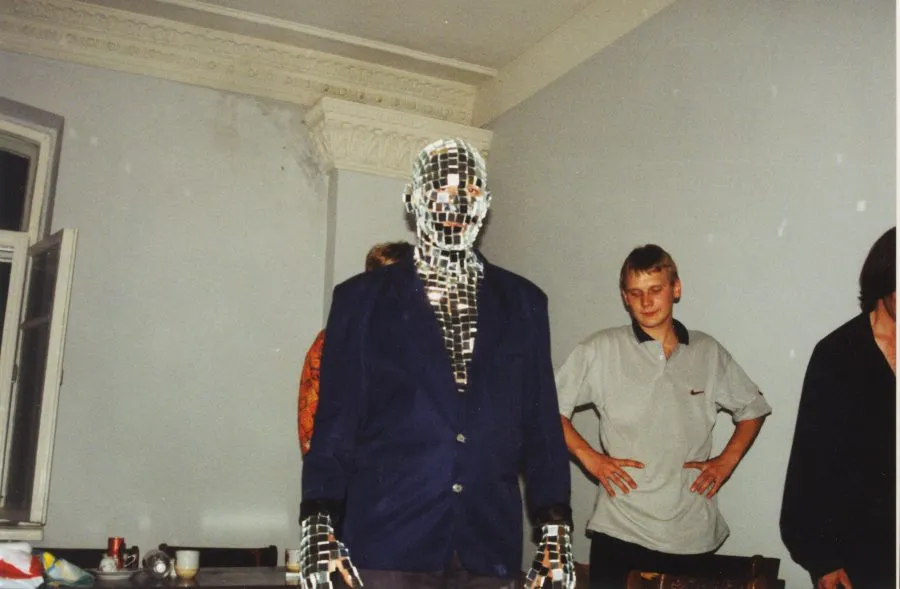
У рамках виставки «Кримський проєкт 2» (куратор Марта Кузьма). Клуб «Факторія», Київ
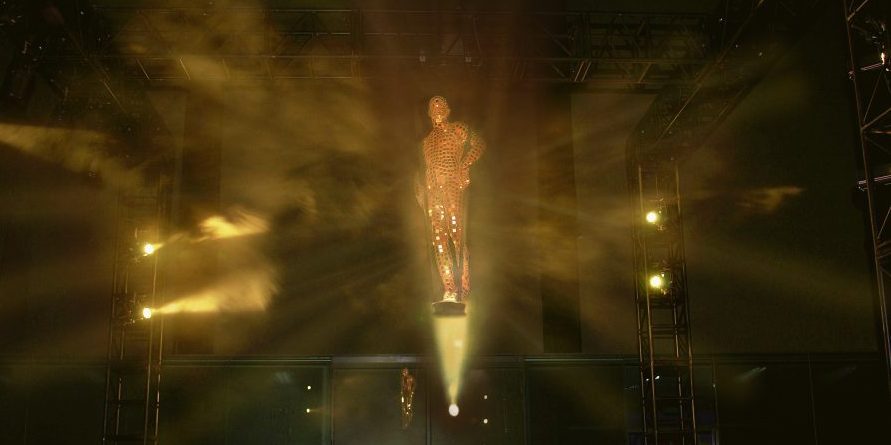
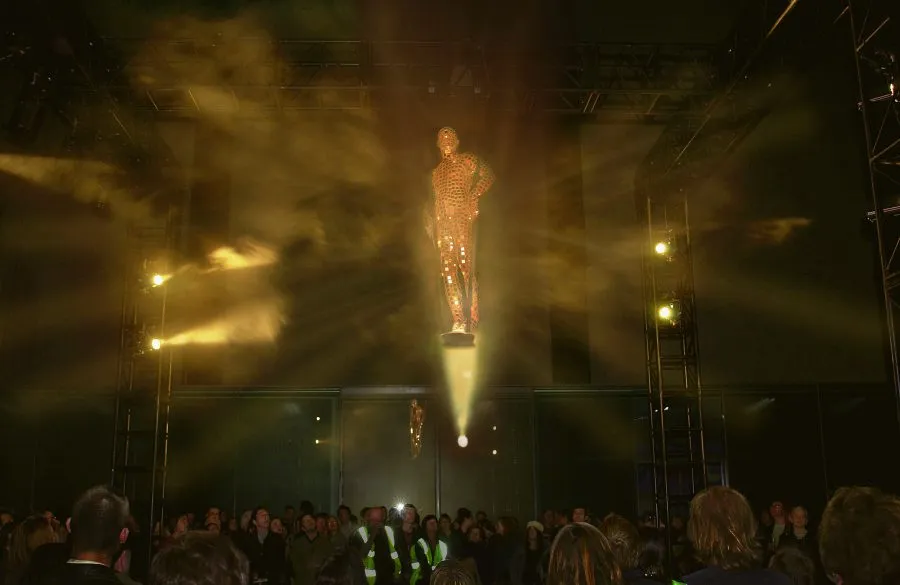
O. K.: Yes, there was a remake in Kyiv. I first performed this performance [2] in Ghent at the Stedelijk Museum voor Actuele Kunst (as part of the exhibition De Rode Poort, November 9, 1996), and with Marta, we decided to recreate the hero as a Ukrainian official. In Ghent, it was a naked person, but here we decided to present him in a black suit, and only the head goes into the mirror.
I stood in the center of the hall on a slowly rotating pedestal. The viewer saw the figure of a person, but instead of a head, there was a disco ball, music played, and light reflected in me. A pure artist’s dream — to be in the spotlight, even reflecting it.
The performance lasted an hour; there were really many people, half danced, and the other half watched me. I think watching a living person portraying a disco ball is a very touching feeling. The music adds its emotional aspect.
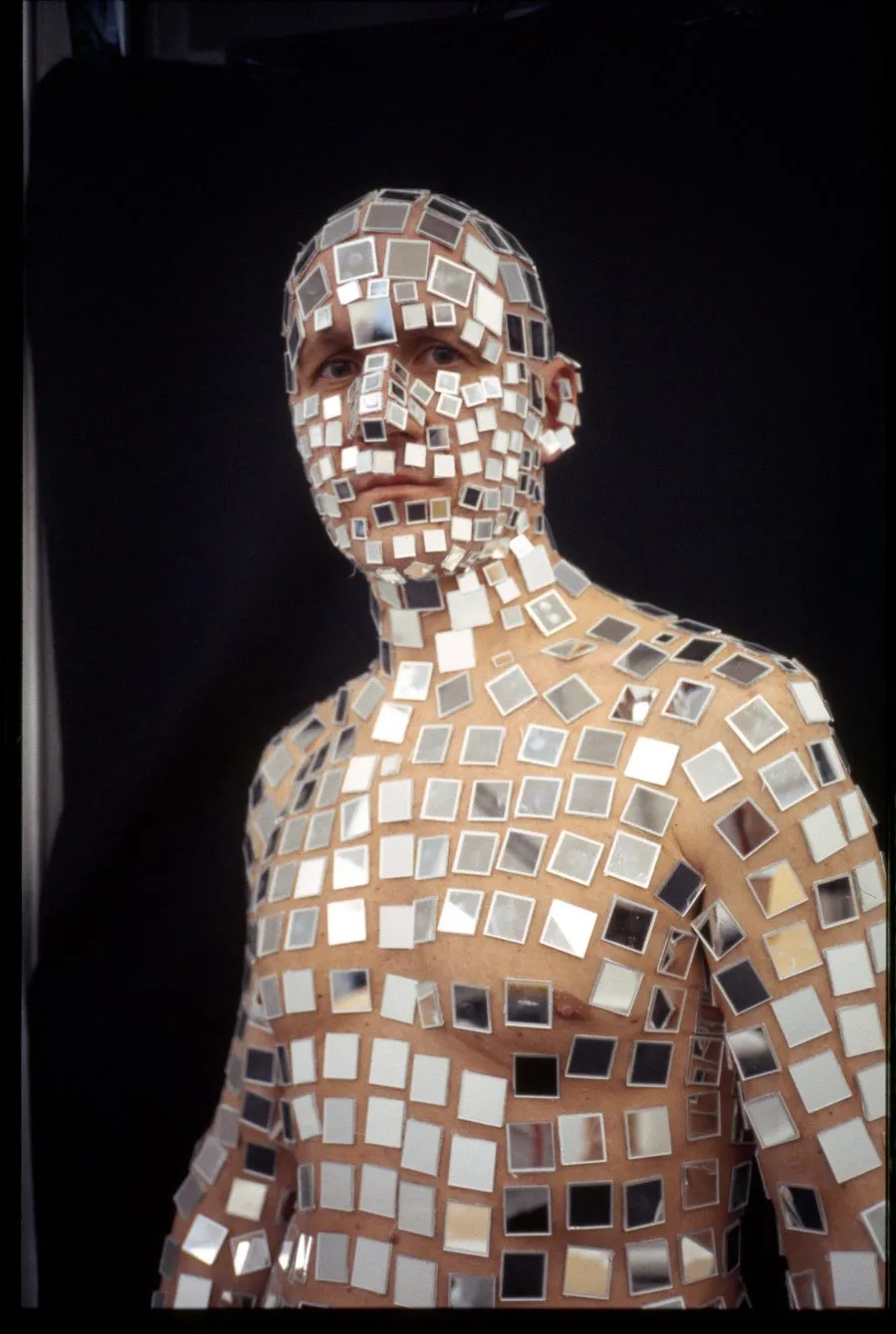
Tate Modern, Лондон
H. H.: What was Kyiv like at that time, what impression did it make on a native Kyivan?
O. K.: It seemed to me then that Kyiv became freer, livelier, more open. I even thought about returning here. In reality, it became open only now. There was an illusion that this was not a beginning but a change that had already happened.
H. H.: In one interview, you also said that artists need to talk to artists because when an artist speaks to society, he involuntarily becomes a designer of social ideas. Then what was the need in the 1990s to go to the people and take to the streets?
O. K.: When there is no audience, the artist has only a crowd. We addressed not the broad public but the street. In the flow of people rushing about their business, someone stops, begins to look and react. In this sense, we formed the territory of art from scratch. Everything that is now in Russian art, both bad and good, was formed by five people in the 1990s.
H. H.: Many artists today reject their early practice of the 1990s. How did you manage to let go of Kulik’s Dog?
O. K.: This is a very important question, and it requires context. Let’s take three characters — Oleh Kulik, Sasha Brener, and, say, a not accidental but very important character — Yuri Leiderman.
Sasha Brener once said that the most interesting artists in the 90s were Kulik and Leiderman. And Leiderman said that the most interesting were Kulik and Brener. Well, in some sense, I can also say that the most interesting for me were Leiderman and Brener. And your question should be considered in the process of personal evolutions, each of us went through it.
Brener, for example, still hasn’t reflected on his individualism. Yuri Leiderman — not only a good artist but also a very attentive person — always wanted to know who a person was before perestroika, underground. Was he not an exiled Cossack? And quite recently, I learned that Leiderman, who once monitored the purity of this circle of artists, like Dzerzhinsky in art, is holding an action at the Pompidou Center where he crosses out portraits of his friends as if renouncing them. That’s so unlike Leiderman!
And in twenty years I create portraits of all my friends. 24 portraits: Osmolovsky, Brener, Marina Perchikhina, Liza Morozova, Petr Pavlensky, PussyRiot and others. I find in each of them a unique manifestation of a true self-sufficient personality in history. These are people who opposed the crowd and won.
Any person makes only one act, and it always puts you in such a position that after it everything is different. That’s what happened to me with the dog. After all, I did not intend to be a dog. I wanted to leave art, but leave as an artist. And I come up with this gesture: a subconscious being that does not possess culture turns into an animal and can live only by its reflexes, instincts. I did not strive to create a portrait of the time, it was my personal tragedy as an artist, I did not succeed. And when I made it, everyone suddenly saw… Whom? Did they really see me?
H. H.: Yourself. Can the power of personality in art manifest not in action, not in an act, but in material carriers?
O. K.: In documentation. There is documentation, there are videos that recently work as the most powerful works of free circulation. No one created works using real surveillance cameras and security services, but Pavlensky did. And that is why Petya, with his activism, renewed the traditions of 1990s art. This is version 2.0.
H. H.: Earlier you claimed that the key theme for an artist was humanism, but the world has changed so much that it is no longer relevant. So what theme is important for the artist now?
O. K.: Individualism. I am not talking about some radical hyper-individualism, the embodiment of which for me today is Petya [Pavlensky]. He is simply such a rare but very important phenomenon that it is unclear how to work with it. We moved away from Soviet collectivism, did we move to individualism? We moved to Ukrainian collectivism. Do you think Ukrainian is better than Soviet? Worse. The smaller the community, the worse and more totalitarian collectivism becomes. In a large totalitarianism you can hide, the Eye of Sauron will not see everyone. But in a small one, in a family, for example, you cannot hide.
Everything comes down to family. We started with family and returned to family. To my beloved elderly mother and father.
This is the main struggle of modernity — for individualism.
H. H.: Thank you for the conversation.