
The exhibition “Red Book: Soviet Art of Lviv in the 1980s–1990s,” currently taking place as part of the PinchukArtCentre Research Platform, should be classified as performative curatorship, since it can be perceived not only as research but also as an artistic practice. The exhibition contains many so-called “curatorial comments” — self-sufficient artworks created by the curators, which serve as clues to understanding the exhibition narrative. For example, a typical Soviet high-rise building is incorporated into the kitschy model of Lviv’s Rynok Square, which represents a stereotypical view of the city as beautiful and hospitable with a long European history. This building reminds us that there was another culture in Lviv, which coexisted in the same space and today is ideologically almost erased. Thanks to the comments, the exhibition is built not on dialogues around individual artworks but is perceived as a cohesively woven fabric that tells about the Lviv artistic context of the late 1980s. As Oleg Aronson wrote about the perception of modernity in Pasolini’s films, “this is not the history of time, but an alphabet of images from which the language of time is composed.” It is precisely from such found, almost lost or deformed artifacts and comments on them that the curators presented the “alphabet” of images of transitional-era Lviv.
Tetiana Kochubinska, curator of the PinchukArtCentre Research Platform, spoke with the curators of the “Red Book,” participants of the scientific-research and curatorial platform “First Proletarian Reserve Named After Jean Jaurès,” Stanislav Silantiev and Halyna Khorunzha, about their research, curatorial association, memory, and interest in understanding the Soviet era.
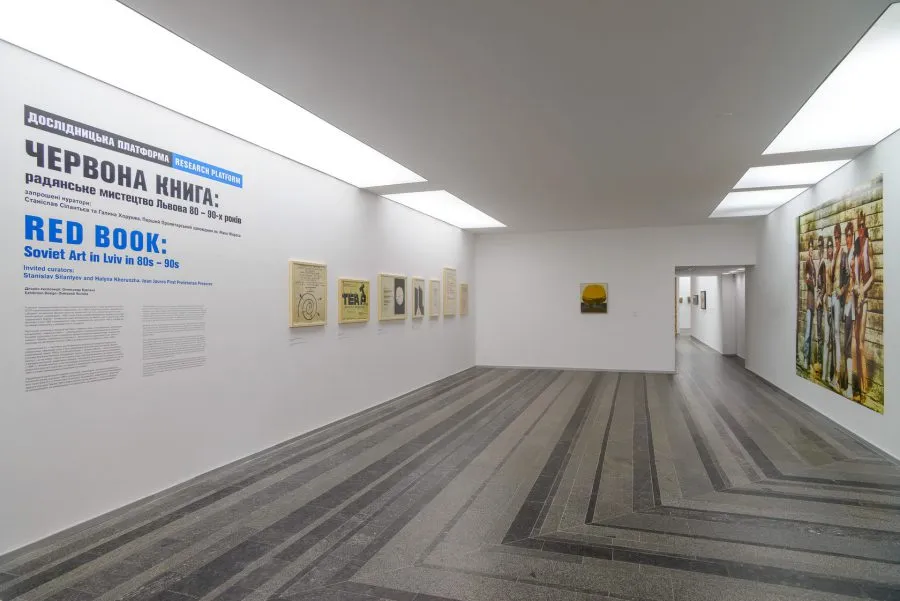
Фото: Максим Білоусов
Tetiana Kochubinska: Please tell us about the work of the curatorial association “First Proletarian Reserve Named After Jean Jaurès.” As I understand it, the conditional date of the association’s formation is Jean Jaurès’s birthday. Why do you appeal to this name, how does interaction occur within the association, and do you distribute roles?
Halyna Khorunzha: The appeal to Jean Jaurès is due to the affinity of socio-cultural circumstances and, accordingly, a consonant type of response to the current situation. The focused area of interest is Ukrainian Soviet art, issues of its preservation and representation in modern conditions, especially in connection with the decommunization process. The distribution of functions is carried out according to the situation, so each case should be commented on separately. In general, the specifics of each participant’s scientific interests necessitate active synergy. Therefore, it would be incorrect to assert that someone is responsible solely for visual and organizational work without conducting research.
T. K.: The “Red Book” somewhat continues the research of “Lviv: Allies” — an exhibition held at the National Art Museum of Ukraine, which, in my opinion, was one of the most original exhibitions last year in Ukraine. Obviously, last year’s exhibition outlined a broader social, economic, and everyday context, while the exhibition at PinchukArtCentre focuses more specifically on the artistic context. The exhibition at NAMU tended toward a comprehensive expression resembling a local history museum, whereas the exhibition at PinchukArtCentre resembles more a total artistic installation, where the production of the artwork is directly equated with the production of the exhibition itself. Yet, many of the same works are shown at both exhibitions: by Mykhailo Frantsuzov, Mykola Kumanovsky, Rostyslav and Platon Silvestrov, and also, notably, the “post-souvenir” “Gas Column.” What makes these exhibition expressions related and different for you?
H. K.: The repeated representation of works occurred with changes in certain intonations and the addition of details that expand the range of acceptance. The main line is undoubtedly related, but nuances have been added.
T. K.: For me, one important aspect of the “Red Book” is the rethinking of the Soviet era, the desire to avoid dividing culture into official and unofficial. It seems to me that one of the most important questions you pose to yourselves, or rather tasks, is to reveal the history and culture of Lviv as part of Soviet reality, which in the modern historical-political discourse is largely neglected and downplayed. What is your interest in this period and even a certain “romanticization” of the Soviet era?
H. K.: The question of “romanticization” did not arise at all, and in no case should this period be discussed from the perspective of idealization. However, many aspects, primarily issues of social interaction and what can be conditionally described as an attempt to build a society with features of “social justice,” prompt a more detailed study of this experience. Likewise, under no circumstances should the scientific and visual components be equated with the thoroughly compromised phenomenon that defines itself as the “left movement.” The interest is an organic need to comprehend the current process, which is an organic consequence of the socio-cultural processes of the previous period.
Stanislav Silantiev: My life is closely connected with Lviv. Since 2007, I became a student of the Lviv Academy of Arts (formerly the Lviv Institute of Decorative and Applied Arts) and lived there until 2012. From the first days, I gained invaluable experience communicating with two wonderful neighbors — a former midwife from Kharkiv, then already retired, Dina Ivanivna, from whom I rented a room on Kotsylovskyi Street, and her neighbor, also retired, once an English philology lecturer at Ivan Franko University, Tamara Slyota. Every Sunday evening, we came with Dina Ivanivna to Tamara Slyota; she would sit in a rocking chair, we beside her, and Tamara would play Russian romances (Okudzhava, Shalyapin), read poetry, and talk about what is now fashionable to call “those times” (by the way, a good title for the next exhibition, don’t you think?
T. K.: A fundamental exhibition!
S. S.: So, Slyota’s apartment was my first living museum of Soviet culture, and today I would say “Soviet culture of memory,” where the shell of a large turtle, a walrus tusk, a stuffed sea urchin, a large library, sculptures and paintings gifted by close friends told about the dynamic life of a Ukrainian Soviet university teacher with many trips abroad to three continents. Later, immersing myself in the city’s history of at least the last half-century, I began to look closely at those urban landscapes that concealed a completely different idea of Lviv, contrasting with today’s artificially recreated bourgeois gloss. Since then, Soviet Lviv and its history have grown into a scientific interest for me.
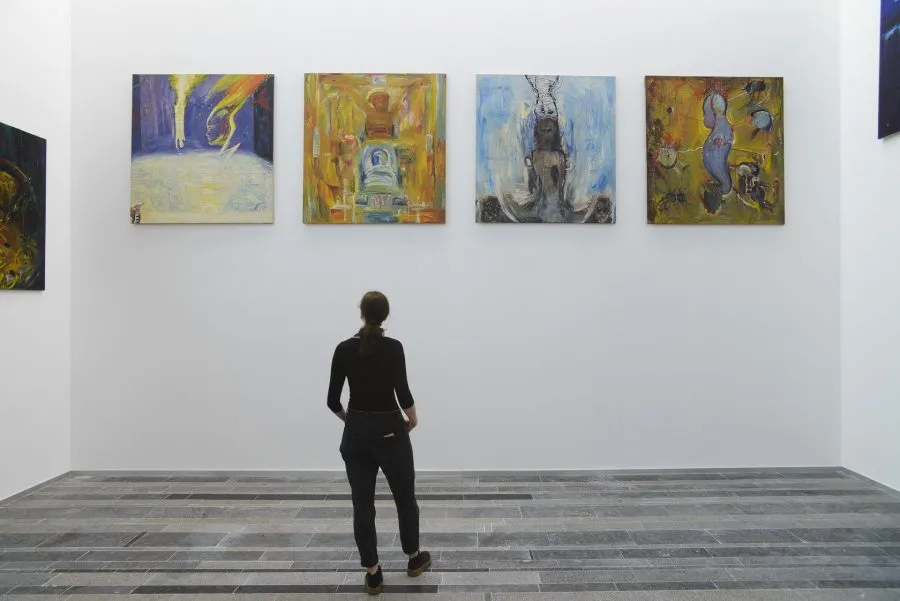
Фото: Максим Білоусов
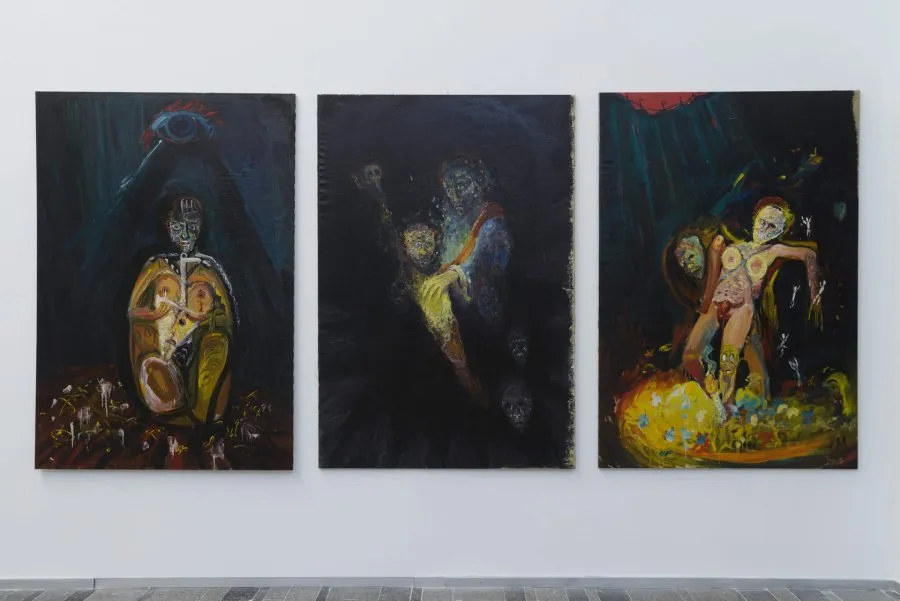
Фото: Максим Білоусов
T. K.: The exhibition’s very title contains a provocation. That is, artists are likened to an endangered species. They experienced the greatest surge and opportunity for self-realization as artists precisely at the turn of the era, and now they are literally forced to die in their own studios or go into “internal emigration.” At the same time, this records such marginalization of the artistic position in the 1990s and the artist’s inability to adapt to new life conditions. In terms of curatorial ethics, do the artists themselves consider themselves such an “endangered” species?
S. S.: I don’t know what curatorial ethics is when it comes to one’s own expression, nor do I know what it means to make an exhibition for someone who might hypothetically visit it. The exhibition is not a personification of negative or positive traits of a particular author. “Red Book” is an atmosphere that can become a source of important information. Regarding the turn of the era, everything happened exactly like that. Adherents of high Soviet culture, who were bearers of healthy human relations, albeit with overly idealistic beliefs, unfortunately could not reincarnate in the chaos of the 1990s. At the turn of the decades, marked by the transition from collective responsibility to individual responsibility, the person is no longer a subject of cultural relations. This is, in fact, the central point of the drama of the lives of the artists we exhibit.
T. K.: One question you often have to answer is about including/excluding certain authors. Your exhibition is primarily dedicated to showing context, not individual artworks, yet in the first hall, you separately present a list of artists: some are represented by works in the exhibition, others appear on posters. Mykola Filatov, for example, is represented by a curatorial gesture that attests to the absence of a legacy. However, at that time, Igor and Svitlana Kopystyanski were working in Lviv, and the Mazokh Foundation appeared in the early 1990s. Some artists are represented quite extensively, like Myroslav Yahoda’s “altar” hall with many of his paintings and a separate hall with his graphics. A large body of Kumanovsky’s collages. Yuri Sokolov is a recurring presence, mainly through comments. What explains such close attention to some authors, whose works are widely seen, and the complete absence of others?
H. K.: The presence of certain authors without representation of works but with the recording of their participation in the process is important because some individuals create environments and form context by their presence, while their works are just another illustration of their time. The history of personalities through whom the events’ flywheel was set in motion is one of the project’s important accents.
S. S.: As you beautifully put it about Sokolov’s art presence in the exhibition — “a recurring line.” We can start from these words to answer your question. We did not aim to create gigantomania from the foam of already familiar retrospective projects. The exhibition concept leans more toward intimacy, autobiographical exclusivity, where both the work and the artist speak not so much about the situation in general but about their own personal experience against the backdrop of specific events. This means that the “Red Book” exhibition does not fit individual personalities into a rather abstract context but contextualizes post factum what remains of that context. As one of the exhibition’s curators, I am not interested in curating an exhibition whose exhibition register tends toward a parade of individual artifacts. I am not interested in biographies of objects and subjects written according to the canons of customary analytical approaches and academic forms of knowledge. Context in my scientific practice appears as a result of reflection on events that are not necessarily consonant with the history of political narratives. Moreover, context in modern conditions cannot have a sharply expressed documentary background. The current era encourages forms of knowledge where the double reading of statements by one author dematerializes the artifact itself, turning it into remnants of those artistic practices that are not related to artifact production.
T. K.: The curatorial text says that Lviv’s culture is “not official, not alternative, not underground, and not oppositional. It is Soviet non-Sovietness.” What does this “Soviet non-Sovietness” mean to you?
H. K.: Soviet non-Sovietness is essentially a construct that could exist exclusively under the USSR conditions, where what was interpreted as opposition was actually a specific heresy, or rather a theological concept within the official ideology.
S. S.: “Soviet non-Sovietness” refers to the term “post-souvenir,” which Halyna and I introduced into scientific circulation at the “Lviv: Allies” exhibition. “Post-souvenir” is a copy of a copy, which in today’s realities weighs more than the original. “Post-souvenir” should not be confused with “simulacrum,” because the original in its physical form is present but only thanks to the copy we reproduced. In practice, it looks something like this. The Lviv Ethnographic Museum’s funds contain two carved medallions with the profile of V. I. Lenin (from 1949 and 1950 respectively) by Vasyl Odrekhivskyi, father of the current rector of the Lviv Academy of Arts, Volodymyr Odrekhivskyi. We learned about their existence not by studying the museum’s funds, access to which is strictly limited by its administration, but by finding information in special departmental catalogs of the Museum from 1956 and 1974. Thus, we verbalize the fact of their physical existence by reproducing their physical copies based on a photo from the catalog. This is precisely “Soviet non-Sovietness,” when reality and fact with the prefix passato (past) become reality despite the modern reality with the prefix futuro (future). At the same time, “Soviet non-Sovietness” has another meaning related to the phenomenon of human individuality, as opposed to any external and internal influences.
H. K.: Regarding the term “post-souvenir,” its introduction is more appropriate in the cultural studies rather than art history discourse. It should be applied to many current phenomena in the domestic socio-cultural process, primarily in the context of deformation and tendentious assessments of the Soviet period heritage.
T. K.: An obvious characteristic of your curatorship is the use of curatorial comments. There are about ten of them in this exhibition. What does “curatorial comment” mean and what does it add? Can you imagine a research exhibition without curatorial comments? And can you tell us, for example, about the comment “LKSF — June 22”: how do you fit it into the overall narrative of the “Red Book”?
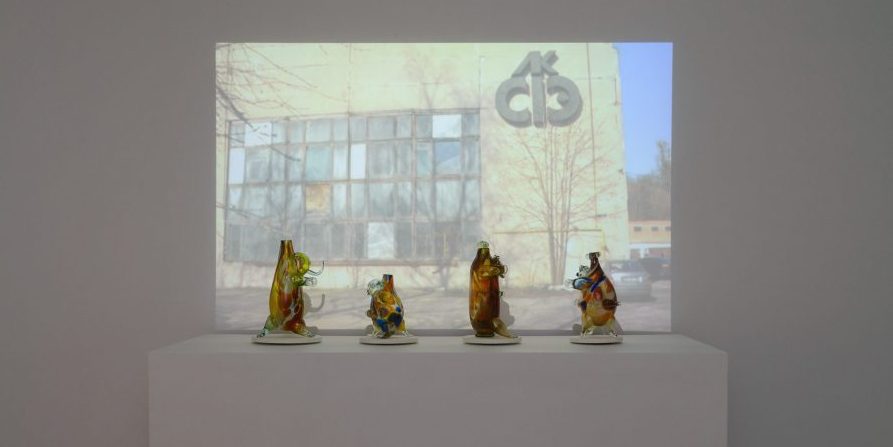
S. S.: Curatorial comments are full-fledged artistic statements that negate the importance of the global context and tell us stories about specific people or objects that could happen to anyone, regardless of location, origin, skin color, or sexual orientation. The global context, as well as discussions about relevance, in my deep conviction, are a byproduct of geopolitical struggles. And forget about Ukrainian art, its inclusion in the global context, when economically we are incapable of being producers of ideas and proclaimers of values. “LKSF — June 22” is a visualized story of the life and death of a successful Soviet Lviv enterprise that declined in the early 1990s. Here, whole “glass bears,” dated to the 1960s–1970s, are the company’s calling card, which gained uniqueness in artistic workshops through individual plastic form and glazes. They “whirl” against the backdrop of photographed modern factory ruins. A war song “June 22 exactly at 4 o’clock” about the beginning of the German-Soviet war plays in the room, and the bears rotate on special mechanisms around their axis, dancing a deadly waltz of a once-existing civilization.
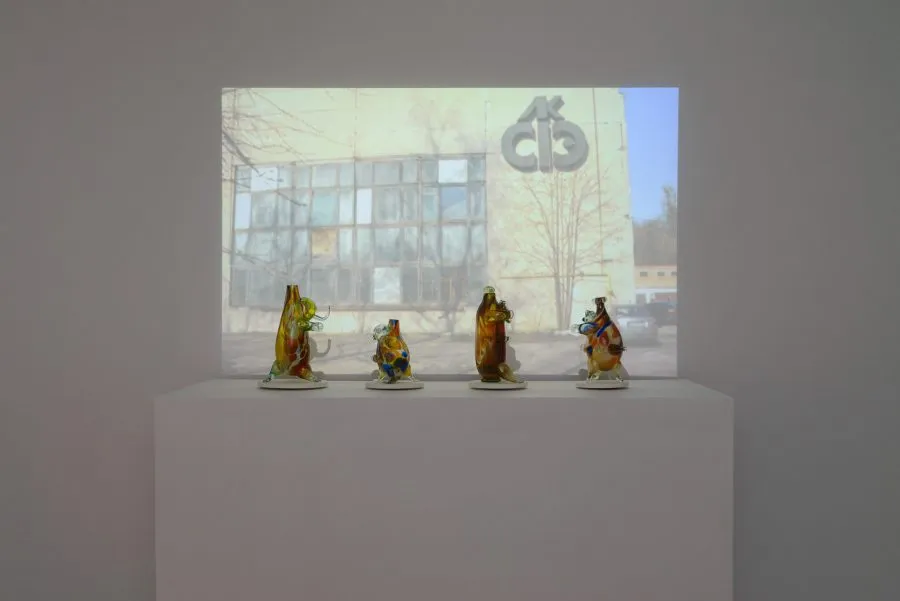
Фото: Максим Білоусов
T. K.: In conversations, you often emphasized that the chosen artists come from families of engineers, military personnel, doctors — that is, the stratum of scientific intelligentsia or Soviet elite, which was allowed a lot. How does this manifest in the exhibition? Do you seek to demystify the notion of the Soviet machine as purely repressive? Why is the biographical, contextual approach always so important in creating an art exhibition?
S. S.: I do not quite agree about the children of the social elite of Soviet Lviv, whose resource elitism in the exhibition context might seem a measure of permissiveness. These were rather children who, due to their parents’ conscientious work, received some economic freedom from them, which over time transformed into symbolic capital. I am an advocate of ideas that point to the individual’s self-determination in questions of being or not being a bearer of culture. I also believe that the need to remain homo sapiens is an inner voice of each person, not a consequence or circumstance arising from certain events. The notion of Soviet repressiveness is valid when we talk about Stalinist terror policies of the 1930s–1940s. At that time, in America, people were being killed because of skin color; xenophobic regimes ruled in Italy, Spain, Germany; the French, Dutch, and English conducted successful colonial policies in Asia, disregarding the opinions and needs of the local population. I say this to you because any state is totalitarian by default, and the level of totalitarianism is justified by the economic balance and the right to distribute material goods. Regarding the demystification of later totalitarianism in the history of the USSR and the Ukrainian SSR, I think it is impossible; the consistent confrontational policy of American presidents like Lyndon Johnson, Dwight Eisenhower, partly Richard Nixon and Ronald Reagan, aimed at distorting concepts and substituting reality concerning the Soviet experience, has its echo even now.
T. K.: In the exhibition, you “enroll” artists in the “Red Book.” How well are you aware of artistic processes that took place outside Western Ukraine? Is such a term possible in a broader context? And if we speak only about Lviv art, would the term “Red Book artists” be possible, and what definition would you give it?
S. S.: Again about context. There is no broader context; this is political speculation. There are many different contexts. I am convinced that the personal experience of our artists was shared and is shared by many others, although their fates and biographies are unknown to us. “Red Book artists” is a good term, in my opinion.
T. K.: According to Boris Groys, “in the context of contemporary art, creating art means showing things as art,” and recently the curator often takes on such a role of the artist. Do you consider your exhibition primarily research, or an artist’s gesture, or is it all curatorship for you?
S. S.: I consider our exhibition research and at the same time do not consider many other exhibitions research. I consider our gesture artistic and at the same time do not consider many other gestures artistic. For me, a curator is someone who knows how to doubt; doubts are a sign of common sense. A curator is someone who sublimates someone else’s artistic radicalism into their fatalistic vision of this sick world.