
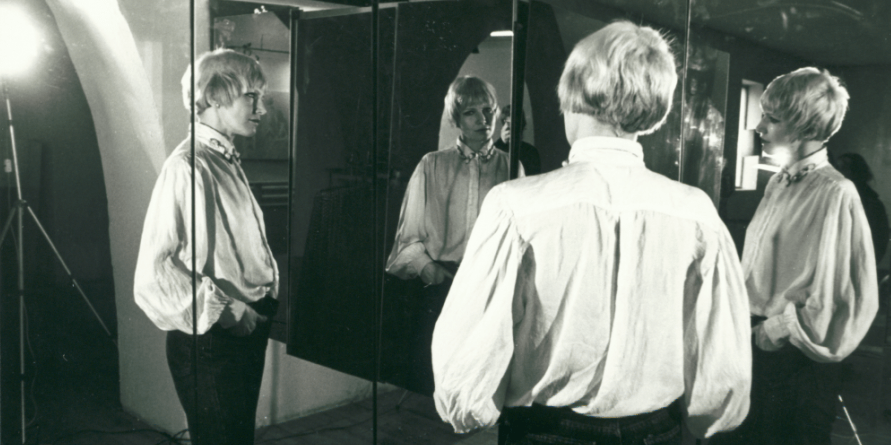
The study of feminist Ukrainian art was primarily undertaken by two researchers — Tamara Zlobina and Oksana Bryukhovetska, who dedicated their texts to this topic. In a lecture on the history of Ukrainian feminist art, Tamara Zlobina formulated its definition: “it is such art that consciously reflects women’s experience, that tries to change the foundations of art production and perception, that makes women more visible in the history and present of art, and also that which calls itself feminist art” [1]. Zlobina considers the first feminist work to be Alevtina Kahidze’s performance “Only for Men, or The Betrothed in Disguise, Appear to Me in the Mirror” (2006), created with the support of the Soros Center for Contemporary Art in Kyiv.
Was there a place for the theme of feminism in earlier Ukrainian art? How were “women’s” issues raised in art, how did female artists work with these themes? Zlobina answers similar questions in her published lecture: she mentions early works by Ukrainian female artists from the early 1990s, which depict female images that can be classified as proto-feminism. The researcher writes that in previous years Ukrainian society was dominated by a patriarchal discourse, which was reinforced by hypocritical attitudes towards the body and sexuality.
“The Female Voice” from the mid-1990s
When discussing the Ukrainian artistic feminist context, the researchers overlook two important exhibitions from 1994 and 1995. The first is Diane Neumayer’s feminist photography exhibition at the “Kosyi Kaponir” [2], the second is Natalia Filonenko’s “Medusa’s Mouth” at the “Brama” gallery. Both exhibitions were made possible thanks to the support of the Center for Contemporary Art in Kyiv, particularly its director Marta Kuzma.
There is almost no evidence of how the exhibition by the New York author went and how the audience reacted to her art. Oleg Sydor-Hibelynda’s review in the publication “Terra Incognita” answers only a few questions. In his poetic review text, the author thanked Neumayer for “another piece of broken ice of prejudice regarding an interesting — and seemingly marginal branch of contemporary art. Prejudice to which the author of these lines also succumbed, but now parts with this feeling”[3]. But judging by the review of the “Medusa’s Mouth” exhibition, which Sydor-Hibelynda wrote a year later, prejudices in his worldview still remained.
“Medusa’s Mouth” (1995) was declared the first feminist exhibition. This is how the project was described in Natalia Filonenko’s grant application to the Soros Center for Contemporary Art in Kyiv. The CCA supported the project despite the modest and hesitant feminist slogans of the curator herself (who, however, did not call herself a feminist), and allocated a budget ranging from 700 to 1000 US dollars.
The exhibition press release begins with the phrase that “Medusa’s Mouth” became a bearer of special, experimental, original, and probably the first attempts at artistic expressions of feminist ideas [4]. The text mentions the different perceptions of feminism in the “Western” world and in the post-Soviet space, where socialism with “declared” women’s rights prevailed. The traditions of feminism, Filonenko writes further, drowned in Ukrainian art; the last feminist action took place in Kyiv in 1916.
Later in an interview, Filonenko recalled the context of her project: it was written in the last months of the existence of the squat on Paris Commune Street, during a period of personal experiences and upheavals. She discussed the project extensively with her colleagues and friends. The feminist line became her main idea, supported by female artists and close friends. Before that, Filonenko had never acted as a curator, only once showing her paintings at the exhibition “Artists of the ‘Paris Commune'”.
Curatorial Approach
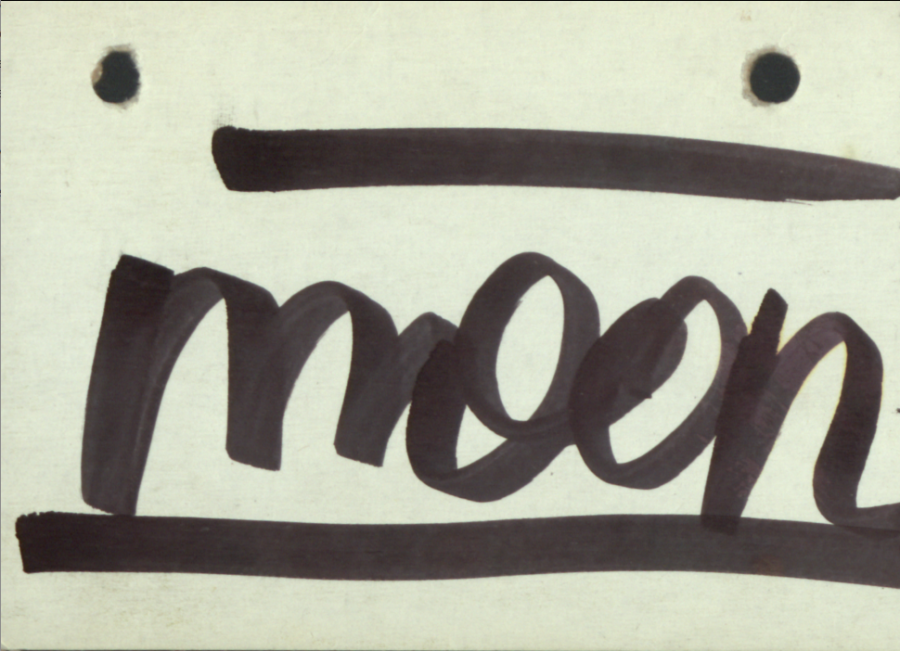
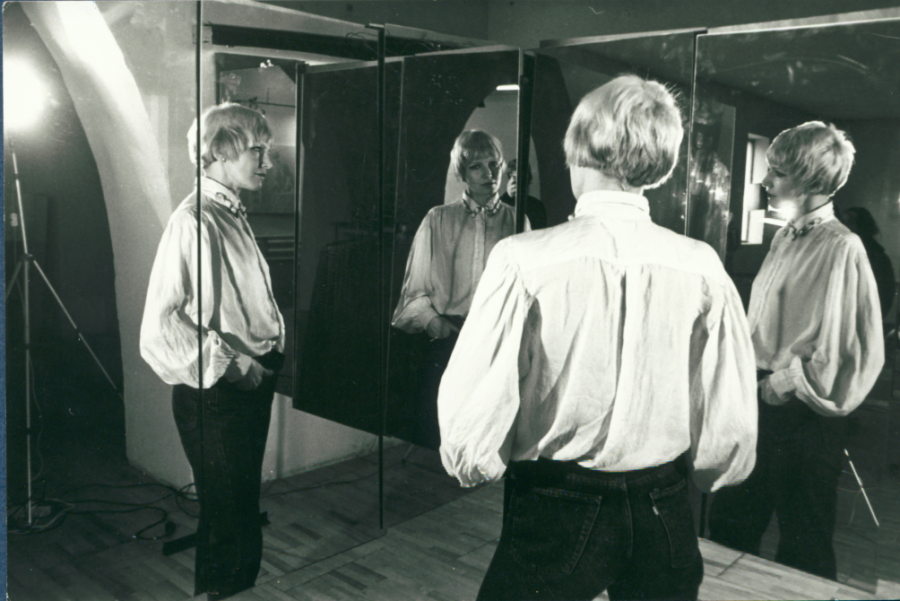
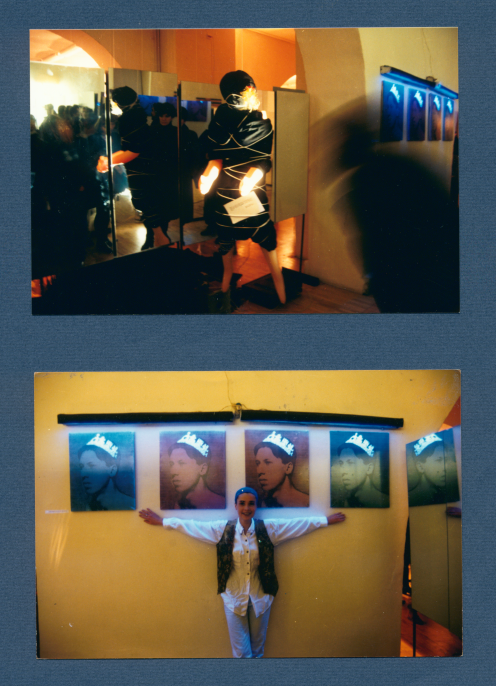
For this exhibition, Filonenko involved almost 20 artists who showed their finished works or created new ones specifically for the exhibition. The works were exhibited in a mirrored labyrinth through which viewers were supposed to walk. Filonenko also created her own work for the exhibition — a cube whose sides corresponded to different phases of the moon.
Filonenko admits that she was not so interested in looking at the process of emancipation, equality of women and men, their rights and duties, and other traditional feminist issues of the West, as in understanding whether this topic is relevant at all for post-Soviet society. For the curator herself, despite its relevance, the topic was not as familiar and close as, in fact, the curatorial work. Filonenko consulted with a writer who had traveled extensively in the West and recommended literature for reading [5]. For Filonenko, a new life began: conversations with artists, planning the exhibition, working on the curatorial text, the exhibition poster, organizing the space.
A kind of “logo” of the exhibition became a woman with the face of Mona Lisa and the hair of the Gorgon Medusa — such a synthesis of two icons, artistic and mythological, a synthesis of beauty, divinity, meanness, and cunning. On this confrontation, Filonenko, on the one hand, supported the “myth of beauty,” asserting that it is a great cultural value, and on the other hand, criticized the “male gaze” on female art and attitudes towards women.
Both Mona Lisa and the Gorgon Medusa are associated with concepts of beauty and sexuality. Especially vivid is the image of the beautiful Medusa, who was punished for seducing gods: her hair turned into a nest of snakes, and people turned to stone at her gaze.
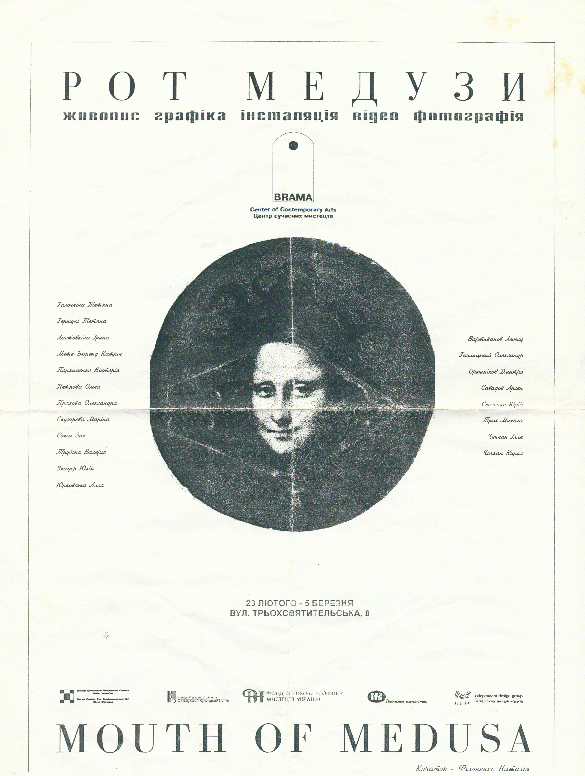
The exhibition title “Medusa’s Mouth” is also an appeal to the sexual, and oral as well. According to Filonenko, the programmatic work at the exhibition was supposed to be Oleksandr Hnylytskyi’s “Childbirth,” made of papier-mâché: the artist molded a woman with spread legs out of paper, and in place of the vagina placed a mirror. However, this work was not exhibited due to moral pressure on the curator from the gallery owners.
Filonenko tried to approach the exhibition by considering the historical (socialist) context in which a woman, besides her family duties, was also an “emancipated” worker, laborer, heroine of labor, etc. To illustrate this heroic female past, the curator used works from the socialist realism era depicting female workers [6]. However, the question of real emancipation of women in the Soviet Union remained unspoken, and she did not raise the issue of opportunities and discrimination.
Works created specifically for the exhibition by artists were supposed to draw parallels and show the state of female emancipation and women’s issues after the collapse of the USSR.
“What is your personal view on feminism?” the journalist asked. “I do not want to refuse any relationships with men. But I want to be free from their influence, I want to be able to be myself, independent of anyone,” Filonenko replied [7].
Works
Surviving materials about the exhibition do not fully describe the presented works, but they at least reveal the context of the mid-1990s, show artistic experiments, and testify to changes in the artistic community that began with the emergence of new opportunities, such as the Soros CCA.
The female body and corporeality are one of the recurring themes of the exhibition. Among contemporary art works and socialist realist paintings, two works by Yulia Ukader stood out — a sculptor who, according to her daughter, artist Tetyana Halochkina, literally defended her works with her body during Soviet times when they were about to be removed from exhibition [8]. Ukader, known for her wooden sculptures, worked all her life with Siberian wood, creating mostly female images; at the exhibition, she showed female and male torsos [9].
The comparison of parts of the male and female body formed the basis of the video “Comparative Anatomy” by Kyrylo Chychkan and Tetyana Halahan (Hershuni). The video, which was broadcast on a TV near the wall, consisted of shots showing breasts, feet, and other body parts that replaced each other.
The theme of corporeality was metaphorically conveyed through clothing and fashion. Such a conditional dialogue was formed by Illia Isupov’s installation (a painted mannequin placed near a mirror) and Irina Lastovkina’s metal sculpture, which stood in the middle of the hall. The metal frame of the dress is almost the first and last work by Lastovkina exhibited at a contemporary art exhibition. The metal, from which military armor was once forged, was delicately reproduced in the elegant form of women’s clothing from the late 16th–17th centuries.
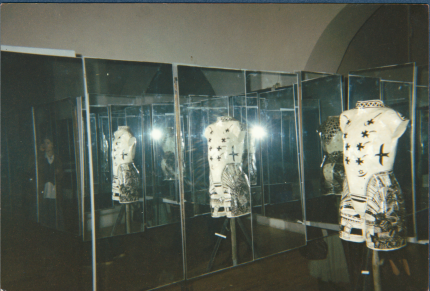
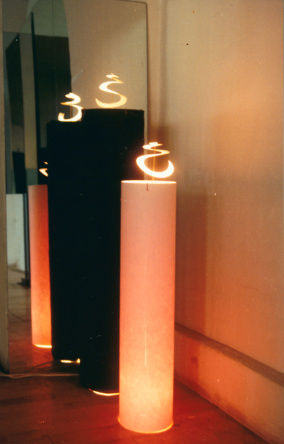
The exhibition featured one work by French artist Catherine Mate-Burend. Elements of the installation, placed in the center of the hall, seemed to tear the gallery floor, disrupting the calm space of the “white cube.”
Homemade installations and lightboxes by Ukrainian male and female artists today are perceived as tender attempts to create art “with their own hands.” At that time, the lack of resources and quality materials was acutely felt; few artists could invest in quality production. In this rule, “female” art is no exception, but in how female artists approached their themes and how they presented them, there was an attempt to assert themselves.
Criticism
In two reviews, then male critics Oleg Sydor-Hibelynda and Oleksandr Lyapin sharply criticized the exhibition. Both authors believed that the exhibition was weakly tied to the theme of feminism, and the percentage of male artists, who, according to the critics, presented much more interesting works than the female artists, was noticeably higher. In particular, they noted the joint work of Arsen Savadov and Heorhiy Senchenko, in which the theme of feminism in general and the role of women in art were sarcastically ridiculed. In the video, Savadov and Senchenko, wearing underwear on their heads, sing “No woman, no cry” and thus question the entire discussion around feminism declared in the exhibition. Although not only feminism — the video undermines the entire contemporary artistic practice of that time.
Neither review contains a critical analysis of the works. Sometimes Savadov-Senchenko’s video, compared to, say, their video performance “Voices of Love” (1994), is frankly a weak and senseless work that falls out of the general picture of their creativity.
An interesting view of two critics on the same work — a photograph by Mykola Trokha depicting a semi-naked young woman [10]. Lyapin calls it “a purely feminist work in spirit and form” [11]. He offers this interpretation: “The woman stands in profile, showing the roundness of her large belly, and confidently, majestically looks at the photographer, and along with him at the entire male community. As if to say, you too can have such bellies, but there, besides intestines and fat, there can never be anything.”
In contrast, Oleg Sydor-Hibelynda has the opposite view: in his opinion, it is the photographer who looks at the woman with inherent male sexual desire, because Trokha, in his opinion, is a “misogynist and anti-feminist” [12]. The author notes: “His (Trokha’s) photographs of women are usually filled with delicate despair for the unfulfilled, absolute nudity rarely appears here, as well as absolute sexuality, seemingly an eternal attribute of the theme of ‘mermaid dreams.’ This time Trokha allowed himself a good drop of pity! — the one thing women never forgive and after which they never take captive (alive)” [13].
According to Lyapin, “no woman who participated in this project was able to perceive this action as an attempt to prove her ability to confidently resist male dominance in art” [14]. But was there a possibility of another scenario?
“There could simply be no ‘other’ scenarios in the 1990s.”
“Medusa’s Mouth” is the first exhibition that raised the issues of feminism and gender equality in Ukrainian post-socialist society, albeit uncertainly and chaotically. This can be explained by the global context, primarily the lack of criticism and understanding of how to approach feminism, especially in the artistic field. It is telling that Western art forgave feminism, but Ukrainian art did not. And although Kyiv reviewers criticized the exhibition, today it can be confidently stated that it was to some extent progressive and became an important part of the history of Ukrainian contemporary art, which is revealed from a new perspective each time.
All photographs provided by Natalia Filonenko.