
Oksana Chepelyk — an artist, one of the few Ukrainian female authors who in the 1990s positioned their practice as socially critical, and she chose feminism ideas as a recurring artistic theme. Working with themes of the objectification of women in the fashion industry, gender stereotypes in a patriarchal world, the artist critically reflected on the image of women in post-Soviet Ukrainian society. The artistic phenomena and themes that prevailed in the art of the 1990s motivated the artist to seek new opportunities for realization and self-expression. These became the professional environment in international residencies, film festivals, and competitions.
Currently, the artist continues to work in the field of social criticism, but the theme of feminism in her practice has been replaced by issues of digital totalitarianism, virtual control, cyberspace.
As an author, she moved from feminism to the ideas of an algorithmic society and what a female project-presentation of the Ukrainian pavilion at the 58th Venice Biennale could be, Oksana Chepelyk told in an interview to Halyna Hleba.
Halyna Hleba: Oksana, reviewing your projects of the 1990s and their transformations, we see that from the beginning of your artistic activity you actively developed the feminist theme. Since 2001, there was an interest in science art. How did it happen that you moved from a very specific socially critical theme to a more abstract one?
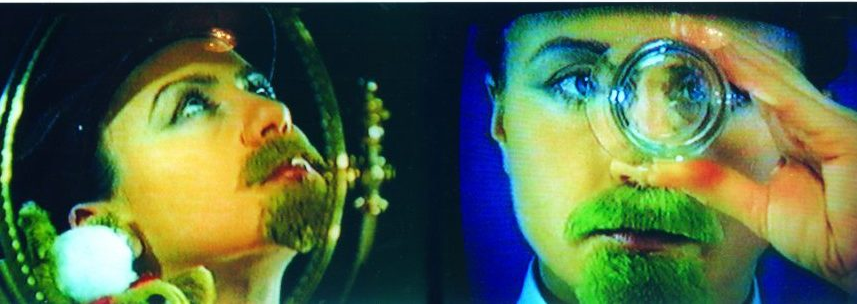
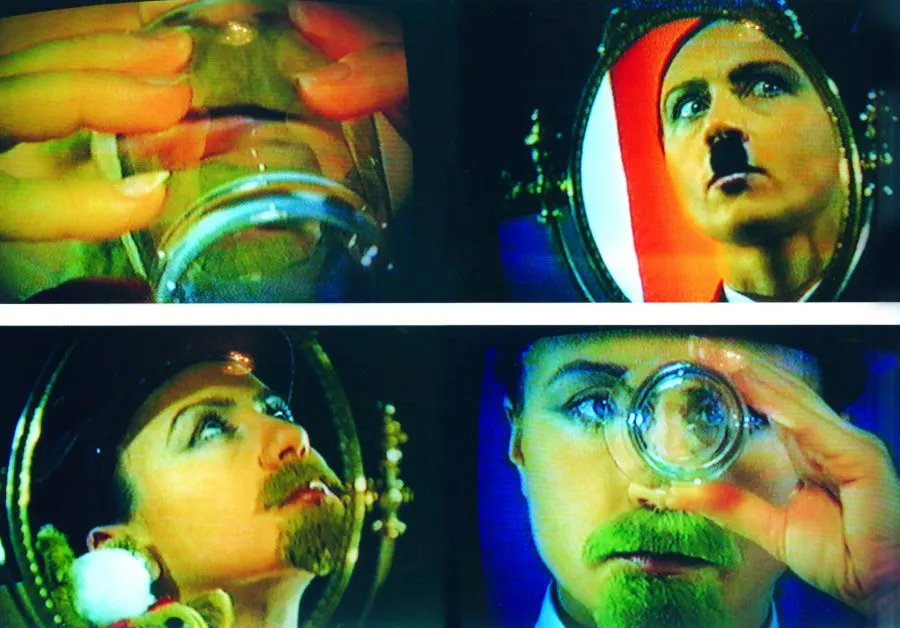
Oksana Chepelyk: I started the feminist or gender theme long before the film “Chronicles from Fortinbras” (2001), the video “Favorite Toys of Leaders” (1998), and even before the installation “Obvious Inevitability” (1997–1998), which was already built on a female confession, although created twenty years before the famous flash mobs #IAmNotAfraidToSay[1] and #Metoo[2]. My works at that time were about the oppression of women by the male world as a bearer of totalitarian essence and the world of politics as a repressive and manipulative mechanism. It was important to draw attention to painful points. And then the mainstream was to have fun, to be ironic, but not to raise critical questions.
H. H.: How did the artistic community react to your works, for which at that time this was not a priority theme of artistic practice?
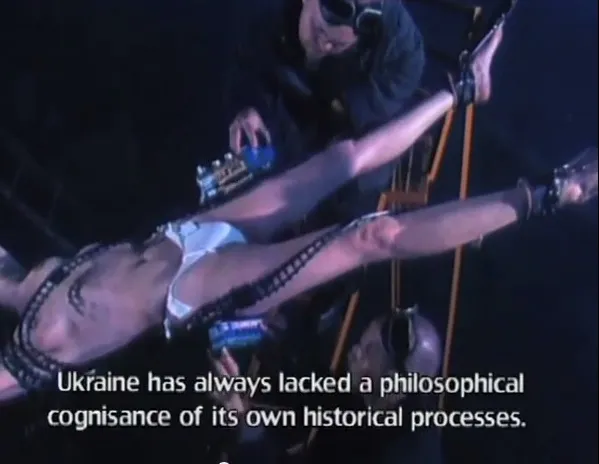
O. C.: The environment reacted with rejection. Firstly, at that moment, a clan situation formed in Ukrainian art, beyond which we still cannot go. This clan system is provoked by the lack of resources, and since resources in the country are very limited, clan behavior is cultivated. It always seemed archaic to me.
These socially critical reflections run through all my work in the form of female and gender themes, the “Genesis” project (2004–2013) about birth, the “Collider” project (2011–2018) about social explosion. “Collider” immediately turned towards quantum physics, towards science. And I used scientific concepts: fragmentation, the idea of particle collision, the idea of the wave (or dual) nature of the structure of the Universe.
H. H.: Your artistic practice is known primarily for films, but among early works there are many installations. What are these projects and how did you move from installation to video?
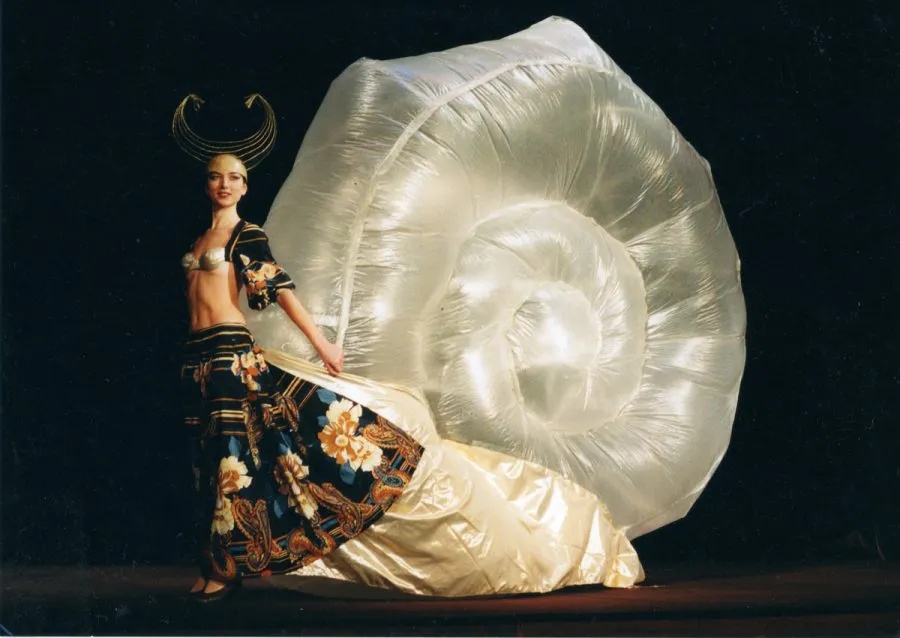
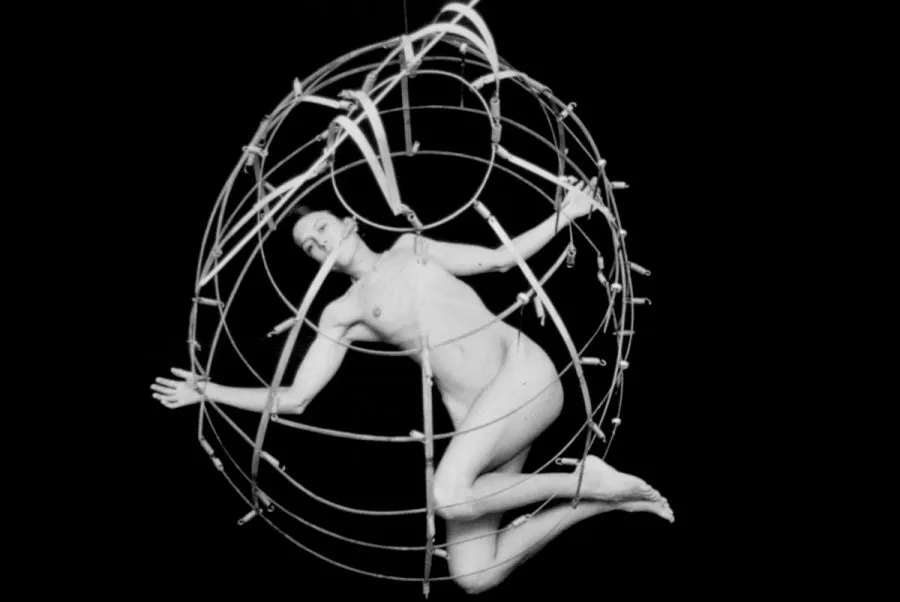
O. C.: It is about a series of performances “Mysteries of Moving Objects,” which were installation-based: “Birth of Venus” (1995), “Wandering Island of Lesbos” (1996), and “Clothing-Hiding Place” (1996) were quite spectacular. We showed them on stage, and they seemed to be “embedded” in the fashion of that time. In contrast, in the gallery space, they revealed the critical messages I embedded. “Birth of Venus,” where heroines with inflatable shells on their backs referred to the plot of the birth of the goddess from sea foam in Sandro Botticelli’s painting. This reflected the trend of those years when a woman had to pretend to be a goddess. And the snail shell on her back was a “home” that the woman “carries on herself.” This is a study of gender issues, the status of women in post-Soviet society, where women became commodities. Clothing especially vividly manifested these changes in social roles. On the one hand, fashion in the post-Soviet space was perceived as a manifestation of freedom; on the other hand, clothing became a tool by which the commodity received a wrapper, reinforcing the woman’s role as an object.
H. H.: I want to return to the “Genesis” cycle. In the history of Ukrainian art, several notable variants of the theme you so vividly showed in this cycle can be traced. For example, “Sleeping Princes of Ukraine” by Illia Chichkan[3]. The work was realized as a shocking, provocative, but very expressive artistic gesture, and it undoubtedly hit the target. Your story is also figuratively expressive and shocking — it is a realistic process of childbirth on a big screen. Working on this theme — the birth of a new person and their mutation under the influence of external circumstances — did you rely on Chichkan’s developments?
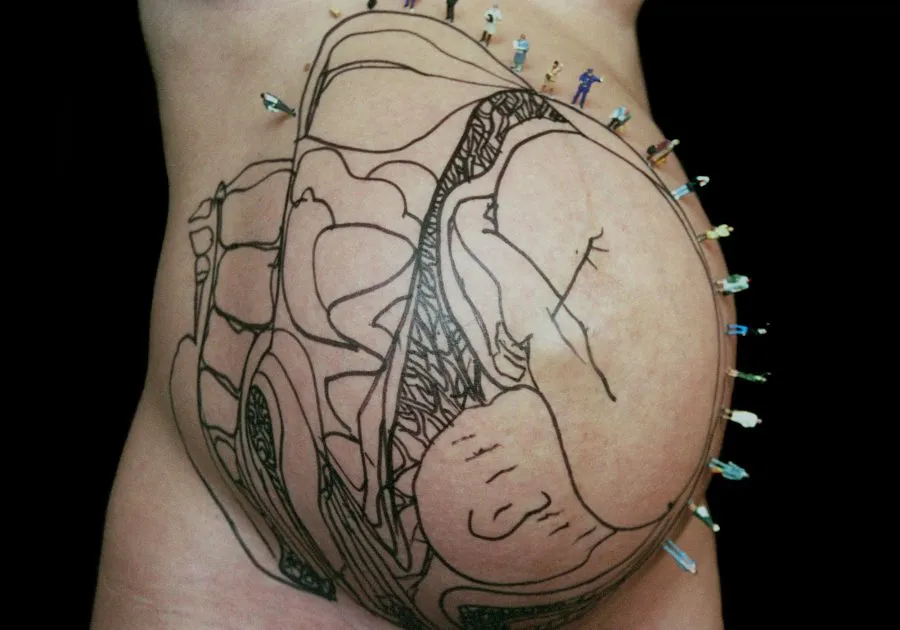
O. C.: Perhaps in “Genesis” the theme of the birth of a “new” person and their mutations appeared only in the painting cycle “NEMOVlyaLKA” from the perspective of manipulating people. “Genesis,” developing the theme of the nation’s gene pool, is structured like DNA: it considers the interconnections between social development and economic, ecological, demographic, bioethical problems, involving historical retrospections, painful present, and future deformations when necessary. “Genesis” was about the population decline in Ukraine. In 1992, we were 52 million; at the time of the project’s creation — 48 million; before the war — 46 million people. Then it was a consequence of both the Chernobyl ecological disaster and economic problems. This was the socio-political reality and circumstances of my life in which I lived after the birth of a child, and they prompted me to develop the “Genesis” project. I then photographed my body, used 2D and 3D materials of ultrasound studies of the fetus for my own artistic practice.
H. H.: So you actually made the material of your private life the subject of artistic expression and thematic research?
O. C.: Both mine and not mine. For example, the macro shot of childbirth in the video work “Birth” (2005) is not my childbirth. And it is not just childbirth but problematic childbirth: the child is very large, and she could not be born without surgical intervention. And for her birth, a surgical incision of the mother’s genital organs was required, which means that the woman will not be able to sit for six months.
After the project’s showing in America, a queue of viewers and students lined up for me. And the gratitude boiled down to confessions like, “We perceived art as ‘fun’ in the sense of intellectual pleasure, through irony, but it can be about real pain and life.”
H. H.: Such a reaction is surprising because social criticism, especially the theme of pain in art, is not new or unexpected for an educated foreigner.
O. C.: Men said that their eyes were opened to what a woman goes through and how much it is connected with real life. Here lies the difference from Chichkan’s work because he has a cynical artistic note, and I no longer have it. I liked honest art; I was in that paradigm that did not fit into the mainstream cultivated in the 1990s.
H. H.: In your opinion, how long did the so-called “mainstream” last in Ukraine?
O. C.: It still continues.
H. H.: And what about artists who appeared in 2004? Their view obviously shifts from “fun” to reaction to reality, the focus changes, feminist themes become more active.
O. C.: I mean that for the cohort of artists of the 1990s, about whom we spoke earlier, this tendency still prevails. They have not changed this vector.
H. H.: How did a socially critical artist exist in the conditions of a patriarchal artistic environment of the 1990s?
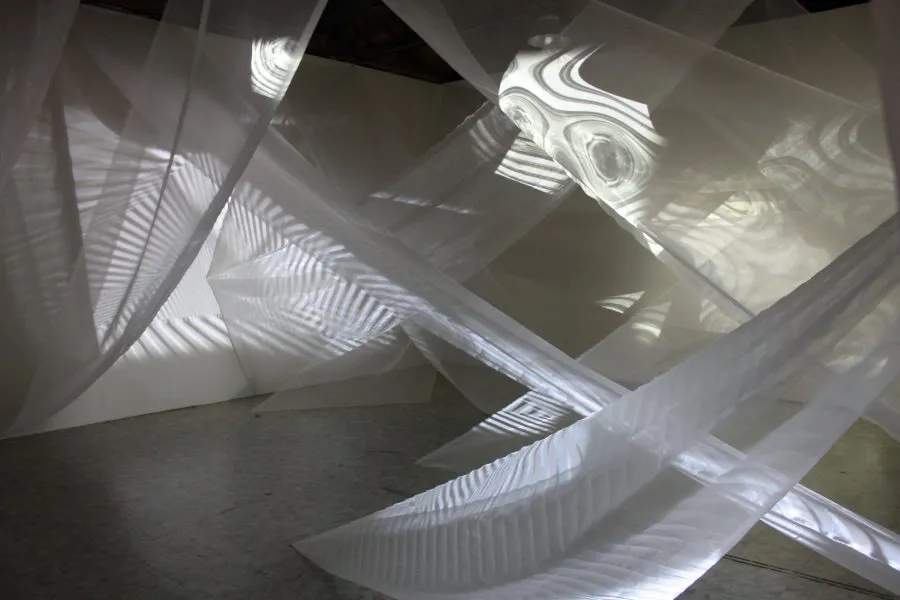
O. C.: The way out could be found in international residencies, participation in international film festivals and new media such as ArsElectronica, Montecatini, EMAF, Oberhausen, Creteil, Backup, during which I ensured Ukraine’s presence on the festival map of the world. I also began actively participating in various foreign programs: twice Bauhaus, twice Fulbright, and continue to do so today. And even my multimedia project Meta-Physical Time-Space, successfully realized in Taiwan[4] this year, I tried in vain to implement in Ukraine for seven whole years! And I am not sure if I will ever be able to show it here.
H. H.: In the 1990s, did you position your practice as feminist art?
O. C.: I always voiced these ideas, but it’s funny that feminist and gender studies in Ukrainian art somehow managed not to notice them.
Unfortunately, there is a practice here to exclude something from oneself. After the exhibition “Ukrainian Body”[5] (2012), for some time it was mistakenly believed that feminist art began with it. However, even “Medusa’s Mouth”[6] (1995) was not the beginning of feminist art. And every time we really start not from the starting point, but from today’s positions.
H. H.: Is it possible to accurately determine when articulated feminist art appeared in Ukraine?
O. C.: The current exhibition “Own Space”[7] at PinchukArtCentre tries to do this — it bridges continuity between themes. Neighboring Poland explores itself this way, builds its artistic and cultural discourses, integrates its country into the global artistic context. For some reason, the goal of our current discourse is quite the opposite. We could look at how neighboring countries do it.
H. H.: What place does gender occupy in art today? Is the formulation about female art legitimate? And is it possible to leave gender aside in art and talk about themes and ideas, not the author’s gender?
O. C.: Gender is not sex but social roles. Let’s get to the essence: why did feminism arise? Because there was oppression. Why would we talk about some male art that does not experience this oppression? We can and will still talk about feminism and gender in art because the oppression of women’s art has not disappeared completely.
H. H.: But if this oppression still exists and we understand that it comes from the older generation of artists, there is no point in fighting the way of life and value system of an entire generation. Another generation has appeared that does not divide art into male and female at all because there is art and the language of artistic expression and no gender divisions. Is it reasonable to fight those who will not change their worldview paradigm by aggressive defense and reclaiming “territory” methods?
O. C.: It seems to me that this is an illusion of equality, openness, and complete freedom, but in reality, it is the prolongation of outdated matrices into our present. We have many female artists who could never call themselves feminists because it is like a stigma for them. God forbid to be called female art because it is a stigma of secondary status. Therefore, they say that “they only use the theme but have nothing to do with female art because they talk about universal values.”
H. H.: In your practice, you use many different media to express ideas. These are photography, spatial installations, documentary and experimental films. Does the medium guide you in your work?
O. C.: I try to subordinate the means to the idea, but I believe that working with moving images and new media is in the spirit of the times, although I often artificially find myself in the “ghetto” of a certain medium. I mean that when you present a video work at PinchukArtCentre, you are assigned a place, a zone to which you belong — video art. Of course, in the 1990s, when video art and new technologies appeared here, it seemed that developing intellectual cinema and video art could continue…
Why did the cohort of 1990s artists after all experiments return to painting? Because it sells. And I never wanted to go with the flow. It turned out that with these honest approaches, it would be quite difficult for me to realize myself in Ukraine if not for foreign residencies. This path “despite” circumstances was dictated, most likely, by responsibility to my own calling.
H. H.: Did residencies give new ideas and knowledge or opportunities to realize already existing ideas? And what was the self-perception of a Ukrainian artist among the world community in the 1990s?
O. C.: Residencies are important to me precisely for opportunities. I brought new ideas, and all works in residencies I created through the prism of Ukrainian experience, projecting Ukraine onto the local context. It was the necessary self-check on an international scale when I am perceived from outside. Probably, I even evaluate myself through the perception the world gives me. These residencies, festivals, exhibitions, projects, and the opportunity to realize them give me inspiration, strength, and understanding of what my art is.
H. H.: How successful do you consider yourself as an artist? And is commercial success identical to professional success?
O. C.: I do not equate commerciality with professional success, although in Ukraine this view is uncommon. Choosing media related to video, moving images, an artist immediately, a priori, goes beyond the zone of commerciality. After all, we still have not learned to sell photographs, and they are material objects, so what can be said about video or installation.
H. H.: Which colleagues resonate with you ideologically?
O. C.: Artists usually name those with whom they exhibit. Therefore, I resonate with figures such as Pawel Althamer, Carsten Nicolai, Viktoria Vesna, Lev Manovich, David Stout, Ricardo Miranda Zuniga, Shirin Neshat, Katarzyna Kozyra, Bogna Burska, Ute Weiss-Leder, Tiare Ribeiro.
H. H.: And among the Ukrainian community?
O. C.: This is a circle of artists — representatives of new media, such as Ivan Svitlychnyi, a circle of filmmakers and artistic communities with whom I communicate closely as the initiator of the International Festival of Social Sculpture, founded in 2007 by the Institute of Contemporary Art Problems. I prefer artists who have their own artistic optics, such as Stas Volyazlovskyi, and who do not belong to the clan cohort. I appreciate personalities not fitting into the canon who create their own worlds.
H. H.: You mentioned a new project realized in Taiwan, the prospects of implementing which in Ukraine you do not see. What is this project?
O. C.: This year in Taiwan, I won two international art residencies: in Taipei at the Kuandu Museum, where I showed my films, and in Taiwan, where my multimedia project “Meta-Physical Time-Space” was realized at Gallery A13 of the Shaolong Cultural Park. This project originates from the long-term “Collider,” in which physics is combined with the theme of global civilizational cataclysms, and it raises the question: are people elementary particles in the system of accelerators of global forces, or is the energy of interaction capable of generating new meanings, new forms of thinking, and new ways of existence in the world?
I already said that in residencies I actively work with the local context but through the prism of Ukrainian. And Taiwan literally reflects the geopolitical state of Ukraine. We have a war and neighbors with imperial ambitions, and Taiwan has China nearby. At least because the world “swallowed” the annexation of Crimea, this is a signal for China to do the same. And today Taiwan lives in a situation of threat, well known to us.
H. H.: Please describe what the project was like in implementation.
O. C.: This project is embodied through the imagery of an algorithmic world: a person enters a multilayered flowing information space, can catch changes that occur imperceptibly, such as the transition to an algorithmic society. If earlier it was about a post-industrial society, now we are already standing with both feet in an algorithmic society, and, in fact, no one understands what to do with this matrix. The Orwellian world we expected to see in the form of totalitarianism turned into another, already digital, control and political mutations, which resonate with our realities of network toxicity.
And this is indicative even in the context of the virality of notorious conferences around the biennale[8]. In fact, both projects are absolutely militaristic: like the plane of the “Open Group,” which visually is perceived as a bomber, and “Voices of Love” by Savadov, where the objectification of women through the image of Monroe is replicated to uplift the spirit of warriors. They use militaristic language, although we are the victims of aggression, and the real aggressor — Russia — will not exploit such an artistic method and theme at the biennale; on the contrary, it is very likely to broadcast humanistic messages. So why does Ukraine use this?
H. H.: Oksana, you also applied to the Ministry of Culture to represent Ukraine at the Venice Biennale. What is the idea of your project?
O. C.: My project concerned consciousness and quantum physics; it is more modern because it balances on the edge of science and art. Quantum physics today can explain the existence of two alternative models of the world that coexist. They depend on a conscious altruistic choice faced by each individual, and this is the key to overcoming the crisis and the survival of humanity. In the context of our conversation about gender, it is worth noting that ideas of concern for the fate of the world, sensitivity to the present — are entirely female ideas. That is why in 2019, the emphasis is on women: the national pavilions of Austria, Great Britain, Ireland, and France at the 58th biennale will be represented by female artists — this is a trend of the 21st century. Because a woman feels the nerve of modernity, and a man, focused primarily on success, does not perceive the vibrations of time.